

The first meal of the day looks different depending on where you wake up. Some countries’ traditional breakfasts would be considered healthy while others lean indulgent. Breakfast can means eggs and bread, a mound of rice, or a fragrant soup, plus coffee or tea. This list of morning meals across the globe is not exhaustive, but hopefully it piques your interest in travel—and your appetite. Here’s what breakfast around the world looks like in 26 different countries.
Türkiye: kahvaltı
No one does a beautiful breakfast spread better than Türkiye. Kahvaltı—literally “before coffee"—is the word for a traditional Turkish breakfast. The incredible spread includes breads like simit, olives, kaymak (similar to clotted cream), olives, tomatoes, cucumbers, sujuk (spicy sausage), and a range of jams, marmalades, and honeys. Don’t miss menemen, delicious skillet-cooked eggs with tomato and green pepper, and, of course, rich tea and coffee.
India: Puri

Puri is most commonly eaten in northern India.
Photo by ManaswiPatil/Shutterstock
India‘s size and diversity means there are dozens of different breakfast dishes. One that’s super popular in northern India is puri. The deep-fried bread is often served with aloo ki sabji (potato curry) or kesari (a sweet made with cream of wheat). Even if you’re a die-hard coffee drinker, having a cup of chai (milky masala-spiced black tea) along with whatever you’re eating is a must.
If you’re passing through Delhi, consider booking a breakfast food tour with Delhi Food Walks, on which you’ll wind your way through the maze of market area Chandni Chowk to eat puri and then some.
Brazil: Pingado with French bread
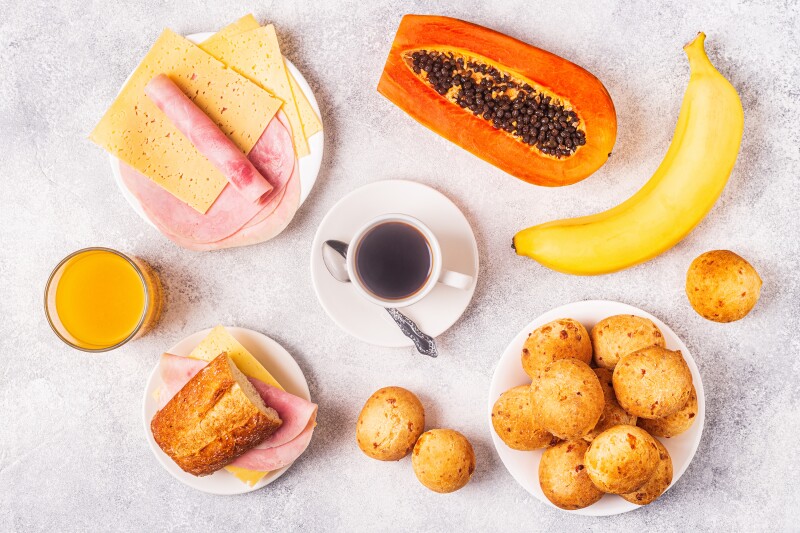
Since much of Brazil is tropical, breakfast in the country usually involves some kind of fruit.
Photo by Tatiana Bralnina/Shutterstock
In Brazil, coffee is an essential part of every breakfast. Pingado is a Brazilian drink made of coffee and a splash of steamed milk. It’s usually drunk sweetened with a touch of sugar. It’s fairly common to see fruit juices or chocolate milk on the breakfast menu, as well. Most breakfasts are also served with pão francês (French bread, like a distant cousin to a baguette) which is often topped with butter and cheese or ham. You may also spot some pão de queijo (cheese bread) or granola on the table.
Morocco: Mint tea, bread, and barley soup

Breakfast in Morocco is typically round, fluffy bread served with honey, olive oil, and farmer’s’cheese.
Photo by Arsenie Krasnevsky/Shutterstock
You’ll always find mint tea on offer in Morocco, no matter what time of day. Breakfast generally includes a round pillowy bread called khobz, olives, olive oil, honey, and jben, a farmer’s cheese. You’ll often also find msemmen, a flaky, square-shaped flatbread, on the table, and a warming barley soup, called hssoua belboula or dchicha.
Germany: Cold cuts, cheese, and dark bread

Naturally, sausages are a big part of German breakfast.
Photo by Vitaliy Netiaga/Shutterstock
A typical German breakfast consists of a few tried and true elements: breads and rolls, usually rye or wholegrain, cold cuts, sliced cheese, and sometimes leberwurst (liver sausage). The breads are often slathered with butter, jams, or honey. Hotels and restaurants tend to offer options like apple pancakes, potato omelettes, bauernfrühstück (a hearty dish of potatoes, eggs, and cheese), and muesli with yogurt or milk plus seasonal fruits.
Mexico: Chilaquiles

Chilaquiles are often served with mole sauce or salsa verde, onions, and cheese.
Photo by Marcos Castillo/Shutterstock
Mexico has a wealth of breakfast options, and depending on where you are, you may see people enjoying gorditas, tamales, pan dulce, tacos, and migas to kick off the day.
The most common breakfast dishes in Mexico are made up of a few simple ingredients: eggs, beans, and tortillas. Chilaquiles, made with tortillas cut into triangles, cheese, eggs, and a side of beans and lots of salsa—is a Mexican staple that appears on most morning menus. Huevos rancheros are another favorite and translates to “rancher’s eggs,” speaking to its origins in 16th-century farmhouses and ranches.
Related: From Tacos to Tlyaudas: 14 Essential Mexican Foods to Try on Your Next Trip
Costa Rica and Nicaragua: Gallo pinto

Neighbors Costa Rica and Nicaragua entice with their signature rice and beans dish, gallo pinto, so-named because it’s believed to resemble a spotted rooster.
Photo by Holly Kathryn/Flickr
The best way to get in the pura vida spirit in Costa Rica and Nicaragua is to start the day with a big plate of gallo pinto. The stir-fried rice and beans dish is cooked with red pepper, cilantro, onion, and a few dashes of the Costa Rican condiment salsa Lizano, similiar in consistency and taste to Worcestershire sauce. Served with eggs, avocado, plantains, or cheese, the rounded mound of gallo pinto looks similar to the spotted rooster for which it is named.
Related: How to Enjoy Costa Rica’s Beaches and Wildlife Without the Crowds
Switzerland: Muesli

In Switzerland, you might take your muesli with milk or yogurt, plus seasonal fruit.
Photo by Alexander Mils/Unsplash
Muesli was invented in Switzerland around 1900 and remains a staple breakfast there. Raw rolled oats are mixed dried fruits, seeds, and nuts, and then eaten with yogurt or milk or soaked overnight to form bircher muesli, which are also called overnight oats. Shredded or diced apple is a common topping, but you’ll also see cherries and other seasonal fruits.
Malaysia: Nasi lemak

No matter where you are in Malaysia, you can start your day with nasi lemak wrapped in a banana leaf.
Photo by Cloud_Yew/Shutterstock
Malaysian cuisine is a reflection of its long, rich, multi-ethnic heritage, with influences from India, Portugal, and the Netherlands (seen mostly in Malacca) Britain, and China, among others.
Malaysia’s national dish, nasi lemak, is the best way to fuel up for the day. Traditionally served with or wrapped in a banana leaf (making it a perfectly portable meal), nasi lemak consists of rich, sweet coconut rice garnished with some combination of anchovies, cucumbers, roasted peanuts, hard-boiled eggs, and sambal, a chili-based paste or sauce. Two popular places in Kuala Lumpur to tuck in to nasi lemak are Village Park and Ho Kow Hainam Kopitiam.
Related: Where to Go in 2026: Malaysia’s Most Overlooked Island Is a Feast for Every Sense
Australia: Coffee and then some

No matter what you eat for breakfast in Australia, pair it with good coffee, like a flat white.
Photo by Daniel Campbell/Unsplash
Australia is incredibly diverse, so breakfast habits vary widely, but there’s one thing most Australians won’t wake up without: coffee. The country takes well-earned pride in its coffee culture, and breakfast isn’t complete without a flat white or a long black (a richer, stronger Americano). This is particularly true in the country’s capital of caffeine, Melbourne, which has roughly 2,000 coffee shops.
To eat, you’re likely to find Vegemite on toast, fruit, smoothies, cereal like Weetabix, and yogurt bowls and, on weekdays, a larger meal that will likely include avocado toast, eggs, halloumi, tomatoes, and grilled mushrooms.
China: Dim sum

Going for dim sum with a large group is ideal, because you can share a multitude of dishes.
Photo by Kia Nakriz/Shutterstock
In Hong Kong and the southern Chinese province of Guangdong, dim sum is a sacred weekend tradition among families and groups of friends. Now a staple in Chinatowns the world over, it’s traditionally served in the late morning and includes a variety of steamed buns, dumplings, rice noodle rolls, congee (a rice porridge), noodle soups, and turnip (radish) cake.
Those living in northern China eat jianbing, a crepe of wheat and millet or mung bean flour, cooked on a griddle, topped with a thin omelette, chopped scallions, hoisin sauce, and usually crispy wonton wrappers.
Sweden, Denmark, and Norway: Open-faced sandwiches

Smørrebrød, literally “butter bread” in Danish, is an open-faced sandwich that usually has a rye bread base.
Photo by Anna Shepulova/Shutterstock
Three of the ƒour Nordic countries are experts in the art of the open-faced sandwiches—smørrebrød in Denmark, smørbrød in Norway, and smörgås in Sweden. Slathered with a range of spreads—butter, soft cheese, jam, mayonnaise—the slices of bread are then loaded with toppings such as cured fish, cold cuts, cheese, vegetables, and/or hard-boiled eggs. The sandwich foundation is usually rye bread.
In Sweden, expect to see filmjölk, a soured dairy product, on the breakfast table as well. You can enjoy eating it with seasonal cloudberries or lingonberries. Residents of all three countries are big coffee drinkers.
France and Italy: Coffee and a pastry

Although it’s most closely associated with France, croissants are believed to have been invented in Austria.
Photo by Shutterstock
In both France and Italy, a common quick breakfast out is coffee (often an espresso or a cappuccino) and a croissant (France) or cornetto (Italy), though at restaurants in France, eggs with a few slices of baguette is common.
A weekday breakfast at home in France might include plain yogurt or a tartine—a slice of bread or half a baguette topped with butter or jam. In Italy, breakfast at home might be toast with jam or Nutella, or some biscotti or even cookies; in general, there isn’t a big breakfast culture (although hotel breakfasts offer more options).
United Kingdom: the full English

While tea used to reign supreme in the U.K., today it’s not uncommon to order a full English breakfast, aka the fry up, with coffee.
Photo by Ajeet Panesar/Unsplash
There is no morning meal as famous or intimidating as the full English breakfast. Real stick-to-your-ribs fare, a classic British breakfast includes eggs, sausage, thick-cut bacon, baked beans, mushrooms, toast, a cooked tomato, and perhaps black pudding, a pork blood sausage. And, of course, a cup (or pot) of tea. We guarantee it’ll keep you full until lunch.
In London, Afar editor Lucy Kehoe suggests going to Regency Cafe, E. Pellicci, or the Wolseley, adding that the Wolseley also serves two other iconic British breakfasts: the underrated kippers with mustard butter and kedgeree, smoked, flaked fish with curried rice and boiled eggs.
Greece: Yogurt with nuts and honey
Breakfast spreads in Greece are a landscape of soft or hard-boiled eggs, strapatsada (scrambled eggs with tomatoes and feta), pastries, breads, several kinds of cheese including feta, tomatoes, cucumbers, olives, and, the star of the show, yogurt. Thick, rich, and creamy Greek yogurt, enjoyed by Greeks and tourists alike, is eaten with nuts and honey, which balance the acidity of the yogurt and make for the perfect start to the day.
Japan: Rice, miso soup, grilled fish

A full Japanese breakfast is high in protein, traditionally including tamagoyaki (rolled omelette) and grilled fish.
Photo by kazoka/Shutterstock
Don’t sleep so late that you miss having a full Japanese breakfast. This healthy and varied spread includes miso soup, steamed white rice, pickled vegetables, grilled fish or tofu, sticky fermented soybeans, tamagoyaki (rolled omelette) and dried seaweed, all accompanied by green tea.
Kehoe says one of the best breakfasts she had in Japan was at Auberge Eaufeu in Ishikawa prefecture, run by chef Shota Itoi. The meal, beautifully presented on traditional lacquerware from nearby Wajima, included rice harvested from paddies visible from the window, flaky, fatty salmon fillet, house-made pickles, and amazake, a sweet fermented rice drink that dates back about 2,000 years.
Uganda: Rolex

A rolex, believed to come from “rolled eggs” is a perfect breakfast: a vegetable omelette rolled up in a slightly pliant chapati.
Photo by stockcreations/Shutterstock
You’d be remiss to leave Uganda without eating a rolex, a vegetable omelette cooked on a griddle, laid gently on a fresh, steaming chapati, and rolled up tightly. Its name is believed to come from “rolled eggs”. A rolex is best eaten warm on the spot from one of the myriad street stalls making them to order, but its snug packaging means it travels well, an ideal car snack to eat on your way to see gorillas.
Pakistan: Eggs, curry, and flatbreads

Chai, flatbreads like roti and paratha, and some curries such as chole (chickpea) are breakfast staples in Pakistan.
Photo by AlexelA/Shutterstock
Breakfast, or nāshtā, in Pakistan varies across the country, but you’ll usually find eggs—fried, scrambled, or omelette—and flatbreads like roti and paratha, as well as curries such as chole (chickpea). To drink, Pakistanis go for chai; if you like to have yogurt in the mornings, you can order a lassi or ask for curd.
On weekends and special occasions, keep an eye out for halwa puri, or unleavened fried bread, served with a sweet semolina dish and a chickpea and potato curry. You’ll know where to find the best halwa puri by the line outside.
Argentina: Café con leche and medialunas

In Argentina, breakfast often means medialunas, such as those at Café Tortoni in Buenos Aires, opened by a French immigrant in 1858,
Photo by NatalieHG/Flickr
Because dinner in Argentina is eaten so late, breakfast is a rather simple affair of café con leche (coffee with milk) and toast or croissant-like medialunas. If you’re looking to switch things up, you can swap your café con leche for maté—a highly caffeinated tea popular in Argentina, Brazil, Uruguay, and Paraguay—or your medialunas for other, sweeter Argentinian pastries known as facturas. Either way, during the morning in Argentina, less is more.
Myanmar: Mohinga
Mohinga is Myanmar’s national dish, a comforting fish-broth soup loaded with rice noodles, lemongrass, ginger, onions, and, in some regions, chickpea flour, and often topped with fried fritters, cilantro, or boiled eggs. To drink, Burmese tend to sip green tea or milk tea, made with evaporated or condensed milk.
Egypt: Ful medames

Some historians believe even ancient Egyptians started their day with ful medames.
Photo by Sergii Koval/Shutterstock
The Egyptian breakfast of ful medames has withstood the test of time. Said to date back to ancient Egypt, the earthy dish is made from fava beans stewed overnight and spiced with olive oil, cumin, parsley, onion, lemon, and chili pepper. It’s served warm or room-temp and is often garnished with hard-boiled, fried, or sunny-side up eggs and paired with pita.
Philippines: Longsilog

Longganisa, a little sausage, is a common sight on the breakfast table in the Philippines.
Photo by Chip Sillesa/Flickr
Breakfast in the Philippines can include fruit, pan de sal (slightly sweet rolls), and a dish called longsilog, which gets its name from its three components: longganisa (the sausage), sinagang (fried rice with garlic) and itlog (eggs). Fruit is abundant in the Philippines, and mangoes, papaya, pineapple, guava, mangosteen, and pomelo are all commonly eaten, depending on the season.
Read more: I Grew Up Eating Filipino Food—These Are the Philippines’ 11 Best Dishes
Poland: Kanapki

The open-faced sandwiches you might eat for breakfast in Poland are with a range of toppings, such as a summery version with farmer’s cheese with tomato, basil, and chives.
Photo by Koefbac
Breakfast in Poland, or śniadanie, features an open-faced sandwich, kanapki. Piled on top of breads and rolls of all shapes and sizes—from traditional rye bread to white rolls—the range of sandwich toppings includes cold cuts, meat spreads, kielbasa sausage, soft and hard cheeses, tomatoes, and eggs scrambled with sausage or soft-boiled.
Note that kanapki is more of a homestyle meal and may not be on the menu at your hotel. You’ll likely come across it if you’re staying at a smaller bed-and-breakfast or guesthouse.
Ukraine, Belarus, and Russia: Syrniki

Syrniki, or hefty pancakes made with farmer’s cheese, are a popular breakfast treat or dessert.
Photo by Max Nayman/Unsplash
Syrniki are thick, slightly sweet pancakes made of farmer’s cheese (think quark), pan-fried in butter until golden on both sides. Some people add fruit within, such as raisins or bits of dried apricot, apples, or pears. Syrniki are typically served with fruit preserves (berries and cherry are common) and sour cream.
Venezuela and Colombia: Arepas

An arepa with black beans, scrambled eggs, and farmer’s cheese is a filling way to start the day.
Photo by Garrett Ziegler/Flickr
Arepas are a key food in both Venezuelan and Colombian cuisine. As versatile as bread is in other countries, arepas accompany most meals, are made in every home, and are available at many street stalls and restaurants. For breakfast, the flat corn cakes are either fried or baked and then split open and filled with cheese, black beans, plantains, sometimes avocado, and stewed chicken or pork.
Vietnam: Pho

It might be an evening favorite in the USA but in Vietnam, pho is a breakfast dish.
Photo by fotobycam/Shutterstock
Hearty enough to fortify you through a morning of sightseeing but not so heavy that it’ll slow you down, pho, a rice noodle and meat soup, is the perfect Vietnamese breakfast. True, you can find the dish served all day, since it is a popular lunch and dinner dish for tourists, but the best pho is available in the morning at street vendors who boil just enough bone broth overnight to satisfy customers through the morning.
If you prefer eggs in the morning, order op-la, a banh mi with fried eggs and (optional) pork sausage. And to drink? Vietnamese iced coffee, of course, sweetened with condensed milk.
This article was originally published in 2017 and most recently updated on February 3, 2026, with current information. Erika Owen and Sophie Friedman contributed to the reporting of this story.


