Paris

A hub for hedonists, a wellspring of inspiration for artists, and a haven for history buffs: Paris is a fantasy destination for millions of travelers each year. The storied bakeries, iconic museums, and corner cafés feel anchored in another time, but the zeitgeist of the city leans forward into a dynamic, multicultural food scene dominated by young French and foreign talents. It is precisely this juxtaposition of old and new that makes Paris the perpetually perfect place to visit. So go exploring, get lost, eat until your belly hurts—and then do it all over again. The City of Light shines on.

Paris-filip-mishevski-eZ2aHgA6Xds-unsplash.jpg

Photo by Filip Mishevski/Unsplash

Overview

When’s the best time to go to Paris?

You’re likely to be disappointed if you arrive expecting the image of springtime in Paris that you see in Hollywood films. In the last several years, the months between April and June have reported below-average temperatures and record-high precipitation—a far cry from the endless days of sunshine in the movies. The weather is wholly unreliable, which foils many travelers’ ambitions for a dry early-season trip. Late summer and early fall typically yield the warmest sojourns (though the summers in general appear to be getting warmer), plus this is when Paris is most culturally active, unveiling new exhibits and welcoming the return of the some of the most anticipated festivals. December and January provide a more festive experience, with Christmas markets lining the well-heeled boulevards and twinkling lights illuminating the city’s boutiques. All weather aside, there is hardly a bad time to visit Paris, rain or shine.

How to get around Paris

From either of the city’s two airports, the RER B, a regional rail line, is the fastest way to reach the city center. Taxis are convenient, but they can be costly.

Getting around: There are few cities as walkable as Paris. For further distances, le métro is the quickest and most reliable means of getting to and from your destinations (sometimes faster than a taxi). Google Maps is a reliable way of figuring out which train to catch. Ubers operate here.

Paris also has excellent bike infrastructure. On nice days, grab a bike share with Vélib, the city’s successful bike-share program, or Lime.

Can’t miss things to do in Paris

– Whether at the peak of summer or in the moodiness of a winter’s night, nothing elicits a chorus of oohs and ahs like a leisurely after-dinner stroll across the city’s iconic bridges and along the banks of the Seine River. Amble across the Pont des Arts toward the Institut de France and continue along the docks of the river, watching the Bâteaux Mouches glide by and illuminate the river with their lights. Keep wandering until you reach a spot to pause for an unobstructed view of a twinkling Eiffel Tower (every hour, on the hour, after sundown). It’s free and absolutely stunning at all times of year.

– If time allows, you really shouldn’t miss visiting the Louvre, the Musée d’Orsay, and Sacré-Cœur, or taking a stroll through the Luxembourg Gardens.

– Following the devastating fire in April 2019, Notre-Dame Cathedral remains closed for restoration work. Officials have said the forecourt in front of the church could open as early as March 2020, but for now, you’ll only be able to snap a picture from afar.

Culture in Paris

Every international city has its iconic landmarks and cultural institutions. In Paris, most travelers would cite the Louvre as the must-visit art stop, but curious visitors should look beyond the usual suspects and explore places like the Musée de la Vie Romantique, the Jewish Art and History Museum, the Cinémathèque Française, and the Fondation Cartier.

Dive a little deeper into a fascinating chapter of 20th-century Parisian history with a historian-led Context walking tour that focuses on the city’s occupation by Nazi Germany, a time marked by unrest, bravery, and heroism. – Given the Parisians’ well-documented penchant for celebrating art, culture, and design in all its forms, you can count on a packed schedule of festivals all year long. Whether for a neighborhood street parade or larger-scale happenings like Paris Plage and Nuit Blanche, it’s worth planning your vacation around the city’s celebratory timetable.

Local travel tips for Paris

  • Always greet shop owners and restaurant staff with “bonjour” when entering and before asking a question or making a request.
  • When metro train cars are crowded, give up your folding seat and stand.
  • A baguette is always better with cheese—the older the cheese, the better.
  • Do not overlook the city’s farmers’ markets as potential lunch spots.
  • Macaron loyalties teeter between Ladurée and Pierre Hermé, so try both and decide for yourself.
  • The Champs-Élysées has few redeeming qualities and is considered the Times Square of Paris by locals. Skip it and opt for a bird’s-eye view from the top of the Arc de Triomphe.

Practical Information

  • U.S. visitors to France do not need a visa for stays of less than 90 days.
  • France uses type E and C plugs, so visitors from the U.S. will need an adapter.
  • France’s official currency is the euro.
  • The official language is French, though you’re likely to hear several languages spoken, as Paris is an international city.

Guide Editor

READ BEFORE YOU GO
HOTELS
These 19 hotels around the world immerse you in their destinations while carving out space for unhurried time together.
These are the 20 best luxury hotels and resorts in France outside of Paris, according to insiders—whether you’re seeking a bucolic Provençal getaway or an immersion in a bygone era of the French Riviera.
These are the top places to stay in the City of Light.
Not all Eiffel Tower views are created equal. These hotels prove why only some are worth the splurge.
This curated list of “maisons,” boutiques, and family-run hotels showcase the kind of style and attitude only Parisian hotels can deliver.
Once home to artists and writers, Paris’s Left Bank still delivers cobblestoned charm and leafy boulevards—and these timeless hotels will put you in the center of it all.
Stylish, central, and surprisingly affordable—Locke’s new Paris hotel brings townhouse elegance to the Latin Quarter.
Palace hotels are the highest distinction a hotel can achieve in France. Here’s what they are—and what makes them so special.
The French capital is filled with stylish hotels that are big on personality—and easy on the bank account.
Airbnb has launched a new category called “Icons” for its most over-the-top stays and experiences (Prince’s “Purple Rain” house, anyone?). It also added a new feature to make booking group trips easier.
RESOURCES TO HELP PLAN YOUR TRIP
For the arrival of Peninsula Hotels in Europe in 2014, many millions of euros were lavished on an Avenue Kléber landmark a cobblestone’s throw from the Arc de Triomphe. Born in the Belle Epoque as the Hotel Majestic, the historic property where George Gershwin wrote “An American in Paris” was transformed by the country’s finest artisans—including the company of tassel-makers who decorated the Paris Opéra.
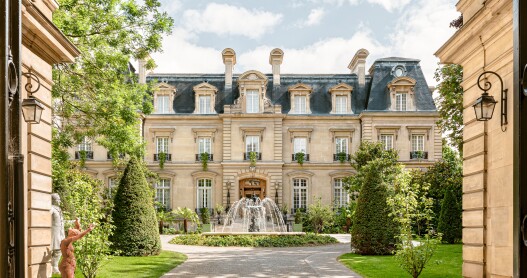
Part of the Dorchester Collection, this Palace-designated hotel is deeply connected to its setting on the avenue Montaigne, the historic home of haute couture in the Triangle d’Or (Golden Triangle). Just across the street, Christian Dior opened his first shop in 1946 then showed his inaugural collection at the hotel. To this day, the subterranean Dior Spa (currently under renovation before a September relaunch) celebrates the link to the designer. The 154 guest rooms and 54 suites are likewise imbued with a chic couture vibe, whether you choose the classical style or newly renovated art deco rooms, punctuated with pops of red to echo the facade’s geranium-filled window boxes.
Privacy and discretion reign supreme behind the iconic red door of this Jacques Garcia-styled hideaway between the Place de la Concorde and the Champs-Elysées. The smallest of the capital’s Palace hotels, La Réserve Paris is set up in a former mansion that belonged to the Duc of Morny (Napoleon III’s half-brother). The hotel maintains the feel of a private home, thanks to a mix of Second Empire decorative touches, including parquet floors, crown moldings, cordovan leather paneling, and velvet drapery. It’s easy to linger in the public areas, including the library packed with 3,000 books reserved for guests during the day, the fumoir that looks out onto a leafy courtyard, and salons with plush banquettes and club chairs.
Opened in 2021, the first urban resort from LVMH—the arbiter and exporter of French luxury—feels sumptuous at every turn. A 100-foot pool, the largest of any French hotel, is covered in hand-laid mosaic tiles, while a series of virtual window panels display illustrated scenes of the Seine in perpetual motion as you swim laps. A penthouse apartment has its own 41-foot pool, projection space, and panoramic terrace. Plénitude, the fine-dining restaurant, earned three Michelin stars within months of opening. The hotel was designed by Peter Marino, an American known for his chromatic and sculptural retail spaces in the LVMH universe, including the recently renovated Tiffany’s flagship in New York.
With the smallest room a sprawling 400 square feet, and suites and public spaces filled with original 18th- and 19th-century art and antiques, the George V, flagship of the Four Seasons chain, lives up to its billing as a palace, an official tourism category introduced in 2010 requiring establishments to “embody French standards of excellence and contribute to enhancing the image of France throughout the world.” Set in a 1928 art deco building, the Four Seasons Hotel George V boasts a regular clientele of bona fide royals, including Saudi princes who rent entire floors for six weeks at a stretch. The staff includes a team of flower designers led by an art director who worked on Chelsea Clinton’s wedding. There’s also a dedicated concierge for children ordering up pint-sized bathrobes and private pastry-making lessons in the Michelin-starred kitchen.
The Pigalle neighborhood’s past comes alive in Hôtel Rochechouart, a 106-room property on the boulevard Marguerite de Rochechouart, itself a late-night destination and a 1920s hot spot for musicians, intellectuals, and artists. The hotel’s design by Charlotte de Tonnac and Hugo Sauzay of Festen Architecture builds off of that legacy; restored details include the blue mosaic floor in the restaurant and the glass elevator. The modern-feeling guest rooms are done up in a moody, autumnal color palette and feature Old World decorative details like burl-wood headboards, curvaceous armchairs, and alabaster suspension lamps.
For years, the easternmost section of the Marais, one of the city’s most beloved districts, was a sleepy, underdeveloped neighborhood. That all changed for L’Arsenal in July 2022 with the arrival of the design-driven SO / Paris, located at La Félicité, a massive urban revitalization site overhauled by British architect David Chipperfield. The hotel occupies one side of the 1960s-era complex (which includes the Terroirs d’Avenir green market and bakery and the Atlas art gallery). The design from Paris-based architects RDAI is retro-futuristic, with rounded couches and soaring ceilings, while decorative touches are nods to the neighborhood (the tiles of the hotel entrance mimic cobblestone streets).
Another new exhibit at the Trocadéro gives visitors an up close view of the 19th-century statues that were removed from the cathedral’s spire for restoration work four days prior to the fire.
Volunteers still have to pay for their flight and accommodation in France but will get a behind-the-scenes look at the 2024 Summer Olympics.
They include new nonstop flights from the U.S. to Auckland, Rio, Paris, London, and Rome.