Bali

Bali is a place people picture when they hear the word “paradise.” You know, white-sand beaches lined with coconut palms and crystalline waters. You might be surprised arriving in Bali how unlike this the tourist areas are, but all the more reason to get out of the madness of Kuta, Seminyak, and Nusa Dua. The highlands, west Bali, and the east coast have so much natural beauty and culture to offer. And the people of Bali are some of the most fcommunity-minded folks you’ll ever meet.

Jatiluwih Rice Field

Photo By Tukang Photo Stock/Shutterstock

Overview

When’s the best time to go to Bali?

Bali has only two seasons, wet and dry. From September to April it rains—not monsoonlike as in India, but rainstorms are common most afternoons. May through August is drier and sometimes called “kite season” because of the cool breezes. Mid-December to mid-January and June to September are popular with tourists, which means higher prices and sometimes heavy traffic.

How to get around Bali

Ngurah Rai International Airport is the only airport in Bali. It’s located in Tuban, next to the tourist hub of Kuta, and about 15 to 20 minutes from the resorts of Nusa Dua and Jimbaran. The town of Ubud is about an hour away depending on traffic and time of day, but a new toll road opened in 2013, and it shaves off about 20 minutes, if your driver uses it.

Bali has become an island packed full of motorbikes and cars. Only recently has the government introduced public buses, but the system isn’t of much use to tourists, as the buses only go up and down the main bypass. The best ways to get around are to rent a motorbike or hire a driver with a car. A motorbike should cost no more than $4 a day, and a car with driver will cost about $45 for a whole day. If you do choose to ride a motorbike, wear a helmet and be aware that many of Bali’s drivers don’t take road laws all that seriously.

Can’t miss things to do in Bali

The rice terraces of Jatihluwih are often missed by tourists but offer one of the most breathtaking sights in Bali. Take a walk along the paths and stop at one of the tiny warungs selling drinks. Breathe in the wonderful, cool, fresh air. This is Bali at its most natural.

Food and drink to try in Bali

With a primarily Hindu population, Bali’s food centers around pork. Ceremonial dishes like lawar (a spicy chopped pork, vegetable, and coconut mixture) and babi guling (spit-roasted suckling pig) are the most traditional of Bali’s dishes, but many elements of Indonesian cuisine are also used. Food cooked in Balinese homes can be oily and spicy, but restaurants and hotels often serve more westernized versions that are easier on the belly. For vegetarians, delicious tofu, tempeh, and vegetable dishes are available everywhere. Street food like satay, martabak (an omelette with vegetables or meat inside), and boiled or grilled corn are cheap and sold everywhere. Arak and tuak are the local tipples, made by tapping palm trees, but quality and taste vary greatly.

Culture in Bali

Offerings are laid daily in the morning and evening to appease the gods and spirits that the Balinese believe exist in every part of nature. In addition to the numerous village temples, each house has its own temple. Dance, music, painting, and carving are important arts, practiced the same way they have been for centuries. Some say the island’s culture is being watered down by tourism, but in every part of Balinese life, community—meaning temples and ceremonial duties—continue to come first before all else.

Bali is an island constantly buzzing with ceremonies and festivals. Not a day goes by when you don’t see people in their temple clothes carrying offerings somewhere. The most important festival is Galungan, held every 210 days. On this day the gods descend to check that everyone is behaving and then ascend 10 days later on Kuningan. Temples are adorned and piled high with offerings, and the streets are lined with penjor (tall bamboo poles decorated outside each house). Balinese New Year, or Nyepi, which usually falls in March, is also a very important day.

Practical Information

- Visa requirements vary depending on your citizenship but Americans traveling to Bali just need a passport--unless they’re staying longer than 30 days.
- The Balinese people usually speak both Balinese and Indonesian.
- The currency is the Indonesian Rupiah.
- As for plugging in your hair dryer or chargers, the voltage is 230V which works on appliances that range from 220V to 240V, but you’ll need a two-pin plug adapter.

Local travel tips for Bali

Bargaining is expected when you shop in Bali, but sometimes visitors think this means getting the price down as low as you possibly can. Yes, sellers see a foreign face and start ridiculously high, but do agree to a price that is mutually beneficial. Mentally set the price you wouldn’t mind paying, then walk away if you don’t get that price.

Guide Editor

READ BEFORE YOU GO
From Indonesia to France, these seven general managers around the globe share how they built their careers—and how they’re shaping the future of hotel leadership.
HOTELS
If you’re looking for serenity in 2024, check out these top destination spas.
Surf, sand, culture, and craftsmanship—these are the 15 most incredible properties in Bali and the Indonesian archipelago.
Three luxury resorts on the Indonesian island of Bali are getting creative with waste reduction and recycling—and are educating travelers in the process.
2020 shows no sign of slowing down when it comes to luxury hotel openings. Here are 6 openings that I am especially excited about, plus a rundown of what other important brands are up to, highlighted at ILTM Cannes this month.
These top-level properties are the places to stay.
RESOURCES TO HELP PLAN YOUR TRIP
Bali’s governor also announced a proposal to revoke visa-on-arrival permits for tourists coming from certain countries.
Journeys: Asia
The second property in the Bulgari Hotels collection is an Italianate stunner perched on the cliffs of Uluwatu, a region at the southern tip of the Bukit peninsula. While the hotel’s vibe stays true to the brand’s roots, hand-hewn volcanic rock, Javanese mahogany, and exclusive fabrics banded and bordered by local artisans reflect the heritage of the archipelago. In fact, Asian-European duality is a prominent theme here: One restaurant focuses on Indonesian fare, while the other is a formal reflection of Italian culture. Watching over the resort at its highest point sits a temple, which employees use to perform daily rituals, as well as a traditional guardian—the Hindu elephant Ganesh. And at Bulgari’s base is a private stretch of sand accessible via an inclined elevator.
This sprawling resort features three luxury properties on one Nusa Dua site: the Mulia, the Mulia Resort, and the top-tier Mulia Villas. Choose a full board or half board package for an all-inclusive experience, complete with butler service (at the Mulia and Mulia Villas) and access to nine different dining venues and bars; there are also beach-level pools—one of them resembling a statue-lined Roman bath—and rows of umbrellas on Bali’s eastern shore. The villas feel like traditional Balinese homes, with indoor-outdoor living rooms that have hydrotherapy pools as well as views of colorful gardens or the Indian Ocean. And the spa is one of the most outrageous wellness temples in Bali, featuring a Finnish wood sauna, aroma steam room, and the region’s only ice fountain.
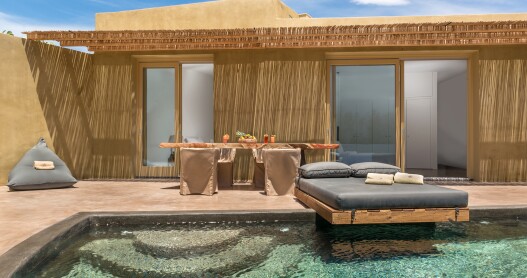
One of the top properties in southern Bali, the Four Seasons at Jimbaran Bay is laid out like a Balinese village that tumbles down to the sea. Villas are separated into clusters of 20 to 25 thatched-roof units enclosed by a courtyard wall, making the 156-accommodation property feel more intimate. Modeled after regional homes, they’re adorned with local artwork, traditional textiles, and hand-crafted furniture. Daybeds, private plunge pools, and ocean views are among the amenities, as are offerings such as lavish spa treatments, hands-on cooking classes, and twilight yoga. The resort is even home to a historic temple and shrine, which guests can tour with high priest Aji Ngurah. After a day of exploration or relaxation, there’s no better way to unwind than by enjoying a cocktail on the deck at modern Asian restaurant Sundara, where fire pits warm the air and waves provide the background music.
Translated as “beautiful bamboo,” Bambu Indah is the regenerative passion project of jewelry designers and husband-wife pair John and Cynthia Hardy. The Canadian and American expats who have lived in Bali for decades bought a collection of teakwood bridal houses in 2005 and moved them 15 minutes west of Ubud Village before restoring and individually decorating them for visiting guests.


Today, the antique residences on Sayan Ridge are surrounded by cutting-edge bamboo houses and tree houses designed by two of the couple’s daughters, including Elora Hardy, as well as organic dining and lounging structures, a permaculture garden, Edenic swimming holes, and green rice paddies. The 11 singular accommodations—filled with vintage furnishings, Indonesian textiles, and local curiosities—are truly one with nature. The resort is filled with whimsical surprises, including a boat-shaped tree house 30 feet in the sky and a rope swing that drops guests into the natural rock pool.


The open-air River Warung is where guests—and day-pass visitors—congregate for three meals a day of organically grown and locally sourced fare. The new-in-2023 Elevator Sunset Bar is another collaboration with the couple’s daughters where arak-spiked cocktails are paired with views across the river valley. On-demand massages are available, as well as early morning walks—more like hikes—throughout the jungle surrounding the resort. From $350
Nestled in the jungle near the center of Ubud, Komaneka at Bisma is a minimalist boutique hotel that celebrates Balinese artistic expression. Local artisans made most of the wooden objects and furnishings in the suites and villas, which emphasize rich woods, cool marbles, and floor-to-ceiling glass walls that look out at emerald rain forests. Daily deliveries of fruit, flowers, and cookies make guests feel like family, but high-tech conveniences such as in-room Apple TVs help them stay connected with loved ones back home. The Komaneka Gallery at the Monkey Forest property showcases one of the world’s largest collections of art from the archipelago; Bisma guests can arrange a tour, which is included in the price of their stay. You can also stay on site and choose from a lineup of activities, including rice paddy cycling tours and wood-carving lessons.
Hailed the world over as one of the best travel destinations, this Indonesian island offers invigorating aquatic outings for the young, the old, and everyone in between.
On Mondays, Wednesdays, Fridays, and Saturdays, catch a performance of Devdan—Treasure of the Archipelago. The 90-minute show, inspired by Indonesia’s cultural diversity, is a kind of Balinese Cirque du Soleil. It features a fusion of traditional Indonesian dance with modern contemporary dance and aerial acrobatics. While highly entertaining, the show also offers an insightful introduction to the history and diversity of the cultures of Sumatra, Java, Borneo, and Papua.
There are two distinct drinking scenes in Bali. Kuta is the hedonistic party town that goes all night every night, and just next door is the more refined and fashionable Seminyak. Whether you’re looking for a cold beer paired with a sunset view or a happy hour deal at a perfect dive bar, Bali has you covered. From high-end cocktails (and a stellar view) at the Rock Bar to the signature cocktail featuring exotic fruit (and, yes, another stellar view) at the Potato Head Bar to wham-bam-get-on-the-dance-floor-again-man shots (no view but loads of international DJs) at Eikon and beyond, there are so many new-to-you places to enjoy.