Sydney

Surrounded by spectacular harbor and beachfront, Sydney is one of the world’s most stunning cities, and one that entices travelers with rare plants and animals and pristine beaches and forests. But this beauty has brains, too, which visitors experience in the form of cracking cultural attractions, events that focus on the locals, and innovative dining and drinking. The city’s temperate climate means that Sydneysiders love spending time outdoors, whether they’re playing in the waves or drinking coldies (cold beer) on a bar patio. In short, Sydney will welcome you in; she might just never let you go.

Sydney Opera House

Sydney Opera House

Photo by Michelle Heimerman

Overview

When’s the best time to go to Sydney?

Featuring a temperate climate, Sydney offers mild weather year-round with warmer, sunnier days in the summer (December through February) and more clouds and wind in winter (June through August). Spring and fall see pleasant weather, thinner crowds, and cheaper hotel rooms. Pack layers and always be prepared for rain, which generally passes quickly and dramatically. Summer is festival season in Sydney, but unique events are held year-round.

How to get around Sydney

Kingsford Smith is Sydney’s only airport, located just four miles from the city center. Direct flights run from Los Angeles, San Francisco, and Dallas—currently the world’s longest flight. The Sydney airport is well-connected to the city’s various neighborhoods by train and bus. And there’s an efficient taxi stand out front for those with a little too much luggage.

Sydney has a good train, bus, and ferry system, but you pay for it. Expect to drop about $2.20 per bus ride (there are currently no transfers) and at least $3.80 for a single train trip. (It’s cheaper if you buy round-trip—“return”—tickets). If you plan to ride public transit often, consider buying a 10-ride bus pass or a weekly Opal pass, which covers unlimited bus, train, and ferry travel within a defined zone.

Can’t miss things to do in Sydney

Australians must be born with more salt water in their bodies. Nearly ninety percent of the nation’s population lives along the coast, and it shows in the way they swim, surf, paddle, row, and barely flinch at oncoming waves. For many Sydneysiders, swimming in the ocean is a daily cleanse. That must be why there’s a seawater pool at just about every beach. From Bondi’s iconic Icebergs club to Australia’s last remaining women-only bathhouse located in Coogee, pick your pool and take the plunge. You’ll never want to go back to chlorine.

If you’re coming all the way Down Under, it only makes sense to explore a little beyond the city limits. AFAR’s partner, Context Tours, offers a private day trip to the Blue Mountains, a UNESCO World Heritage site.

Food and drink to try in Sydney

This is a city that cares about fresh, seasonal, and local food, which is found at hole-in-the-wall cafés as well as white-tablecloth, waterfront establishments. Being so close to Asia, Sydney offers every variety of noodle, roll, bowl, bun, and dumpling, and these are some of the most affordable eats in town. Craft beer, cocktails, and coffee are all in the midst of revolution, so you’re sure to encounter something new to drink here. And indigenous ingredients are becoming more common on menus, linking modern diners with age-old Australian traditions. Tipping is not customary at bars or cafés, but if you receive standout service, leave at least 10 percent.

Culture in Sydney

Home to the world’s most famous opera house as well as volumes of convict lore, it’s no surprise that Sydney is well-loved for its cultural attractions. On top of opera and classical music, Sydney is renowned for dance and theater. And art—you can find touring international exhibitions as well as local stars at the Museum of Contemporary Art. For Aboriginal Australian art, head to the Art Gallery of New South Wales or the Cooee Aboriginal Art Gallery. If you’re more interested in the avant-garde, try Carriageworks. And don’t miss the Hyde Park Barracks Museum or Cockatoo Island for prison history.

Parties might be what Australians do best, and Sydney features a full lineup of festivals, from the huge to the obscure. Start with the famous New Year’s Eve fireworks, and continue summer with the Sydney Festival, Australia Day, and the Big Day Out and St. Jerome’s Laneway music festivals. Early fall sees Gay Pride Mardi Gras, winter comes alive with Vivid Ideas lectures and light shows, and spring features favorites like Sculpture by the Sea, the Festival of Dangerous Ideas, and the Night Noodle Market. Every season has a film festival, or four. Check out Tropfest, Flickerfest, and all the outdoor cinemas that pop up in summer.

Local travel tips for Sydney

Like the weather, buses are unpredictable and often run late, so plan ahead. Or better yet, take the ferry, which offers amazing harbor views, refreshments, and free Wi-Fi. If you have time to kill, ride the long (and cheap) way by bus, or walk. Don’t forget to look up in this city. You might see lorikeets, cockatoos, the occasional owl or kookaburra, and at dusk in certain neighborhoods, giant bats called “flying foxes.” And remember: Sydney faces east, so get up early to catch at least one sunrise on the beach.

Guide Editor

Serena Renner is a journalist and editor whose work focuses on travel, people, culture, and the environment. Her writing has been featured in magazines including VIA, the Intelligent Optimist, San Francisco, Australian Traveller, International Traveller, and AFAR—where Serena worked as an editor for two years. In October of 2013, Serena moved to Sydney’s Bondi Beach neighborhood.

READ BEFORE YOU GO
Public memorials honoring figures from the LGBTQ community say a lot about a city’s culture and serve as a reminder that coming out can be its own heroic milestone.
HOTELS
Hotels can introduce their guests to the creativity that surrounds them—and reveal canvases visitors may not otherwise see.
Whether you’re after a view of Sydney Harbor or a neighborhood hangout with one of the best restaurants in town, these are the 15 best hotels in Sydney.
Rather than constructing new glass boxes, hoteliers in Sydney are converting heritage buildings into boutique stays, helping to preserve a piece of the city’s character.
The city is getting Australia’s first capsule hotel.
Escape the central business district and explore new neighborhoods
RESOURCES TO HELP PLAN YOUR TRIP
A major expansion of the Art Gallery of New South Wales will showcase Aboriginal art while also making use of extraordinary outdoor space.
Since opening in 1819, Australia’s first barracks has housed British convicts, female immigrants, destitute elderly women, courtrooms, and government offices until it was finally declared a museum in 1979. During a twice-daily tour, or with the help of an audio guide, visitors get a glimpse of how high-skill prisoners lived, worked, and slept (on hammocks) during the 19th century—often freely working in the city by day but sleeping alongside more than 1,000 thieves, conspirators, bank robbers, pirates, and bushrangers by night. Offered in the original convict bakehouse and store, a house-made pot pie, burger, or cake with a schooner of beer at Bakehouse is a welcome end to the experience. Outside, freedom has never felt so good.
Sydney’s 158-acre botanic garden, which hugs the harbor between Mrs Macquarie’s Chair and the Sydney Opera House, is home to nearly 9,000 plant species. Depending on the season of your visit, you might seek out spring peaches and wisteria or tropical orchids and summer lotus flowers. On any occasion, don’t miss descendants of the 200-million-year-old Wollemi pine, a dinosaur of a conifer only discovered in 1994. The gardens are also studded with sculptures from historical statues to modern works by Bronwyn Oliver, Paul Selwood, and Keld Moseholm. The quartz-and-sandstone Wurrungwuri depicts an Aboriginal shield once used by the traditional owners of this land. Tours are offered throughout the year, including a 1.5-hour Aboriginal history tour on the food and medicinal properties of native Australian plants.
This two-level Cantonese palace—connected by an escalator—is lined with tanks of live fish, crustaceans, and bivalves, which the staff will stir-fry, steam, salt-and-pepper, and douse in XO sauce to your heart’s delight. There are many reasons the Chinatown establishment is beloved among in-the-know locals and hospitality veterans, and they extend from the warm, welcoming service all the way through the exquisite live abalone sashimi, mud crab hot pot, and private reserve range of wines. For a Chinese food adventure, arrive late (this place is open until 4 a.m.) and order straight from the live tanks. At least, that’s what the rock stars, politicians, and CBD chefs just getting off work do.
The most stunning dining room in celebrity chef Neil Perry’s restaurant empire has got to be Rockpool Bar & Grill in Sydney. Seated amid soaring green marble columns and Art Deco windows in a space designed by Emil Sodersten, diners can choose between the finest steaks, seafood, cocktails, and wines—more than 3,000 of them—that Australia has to offer. Dry-aged beef and sustainable fish are simple yet succulent, cooked over an open flame or in the wood-fired rotisserie. Start with the signature Four Raw Tastes of the Sea before savoring the Wagyu or Cape Grim steak, or opt for classy appetizers and cocktails in the candlelit bar, adorned with 2,682 hanging Riedel riesling glasses.
Set on the western side of Circular Quay, the Museum of Contemporary Art Australia (MCA) is the country’s leading institution for modern art. While access to touring international exhibitions from the likes of Tatsuo Miyajima and Annie Leibovitz incurs an entrance fee, the permanent collection of more than 4,000 contemporary works by Australian and Torres Strait Islanders, from Gary Carsley to Lena Yarinkura—plus a rare collection of artist notebooks, music, letters, and sketches—is always free. Come on Wednesday night when the gallery is open until 9 p.m., or for the adults-only Art Bar on the last Friday of the month. The rooftop café offers occasional live music and DJs plus glittering views of the Sydney Opera House and Harbour Bridge after dark.
A quick bus ride from the city (or a refreshing end to the Bondi to Coogee Coastal Walk), Coogee Pavilion is one of the most happening beach bars in Sydney. The downstairs area is home to a wood-fired pizza oven, oyster bar, juice stall, and kids’ zone with giant Scrabble, pétanque, ping pong, and nautical books, while the breezy rooftop features four different bars, outfitted with love seats and wire-frame stools for taking in the breathtaking bay views. Aussie wines and beers plus fruity cocktails shaken with house-made juice pair with Mediterranean-themed tapas like chargrilled lamb chops and blistered Padrón peppers.
The largest and most storied of the Sydney Harbour islands, Cockatoo was once an Aboriginal fishing ground, a naval shipyard, a girls’ reform school, and a gruesome prison. Today, it offers fascinating walking tours, a casual café, and a number of events such as the Biennale of Sydney. When most visitors line up in the evening to catch the ferry home, those staying on the island are just setting off on a leisurely sunset stroll. They can watch the city light up from what feels like another world and then retreat to their campsite, canvas “glamping” tent, heritage home, or modern apartment until they wake up to birds and boats the next morning.
Formerly the 1888 Hotel.
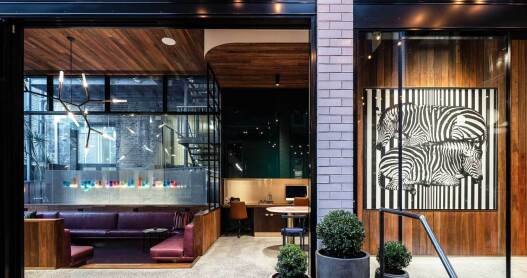
What used to be a wool shed in the middle of a sheep farming area is now a youthful hotel that celebrates the Pyrmont district’s heritage while featuring the full suite of modern amenities. Opened in 2013, the hotel is an extravaganza of wool, which is found in the felted black lampshades attached to old pulleys in the lobby, in the lower wall panels in the hallways, and as carpeting throughout the building. The old Wool Brokers Arms is visible across the street from the heritage rooms on the west side of the hotel. Modern and cheeky touches also abound at this boutique property, known as the world’s first Instagram hotel. There’s an empty “Selfie Frame” hanging amid mismatched furniture in the lobby, and guests with at least 10,000 Instagram followers are offered a free night’s stay. (Mere Instagram mortals have a chance to win, too, by using the hashtag #1888hotel to be entered into a monthly photo contest.) 1888 is also a leader in sustainability; the hotel preserved the building’s original ironbark beams and built desks from recycled floorboards. The minibar is more conscious than usual, too, stocked with Alter Eco chocolates, Charlie’s juices, coconut water, and fresh milk. The best things about 1888 are the little surprises. Even the hotel’s name has a double meaning: 1888 was the year the building was constructed but was also the year that the Kodak camera debuted.
Opened in time for the 2000 Sydney Olympics, the Establishment is a pioneering 31-room boutique hotel housed in an 1890s steel plant near the modern-day stock exchange building downtown. Managed by the hospitality group Merivale—which started as a fashion house specializing in fascinator hats and mini skirts—the hotel is popular among brand executives who book the 328-square-foot Loft Penthouse for product launches and photo shoots. Rooms feature wood furnishings, swinging metal doors, animal hides, and suedelike daybeds as well as such amenities as Apple TV, Bose surround sound, and Lululemon yoga mats. Bathrooms are particularly luxurious here, with marble floors, freestanding tubs, Bulgari products, and tall windows that open up to Sydney’s bustling business district. The best part about the Establishment, though, is the internal access it offers to some of the city’s hottest bars and restaurants, which are housed within the same complex as the hotel. And after enjoying live music and a few stiff cocktails at the speakeasy Palmer & Co, guests are welcomed to bed with Sleep Tight tea and a homemade chocolate chip cookie.