
Egypt

Say “Egypt” and most people think of pharaohs, mummies, and age-old pyramids. The country isn’t just temples and tombs, though. Immerse yourself in the noise and color of urban bedlam, then come up for air on a lonely desert dune or upon the palm-fringed banks of the Nile. Haggle with vendors in a maze-like souk, then sit quietly in a tranquil mosque or Coptic church and observe centuries-old rituals that still resonate in modern life. Go beyond the monumental glory of the pharaohs and you’ll discover a true Egyptian experience.

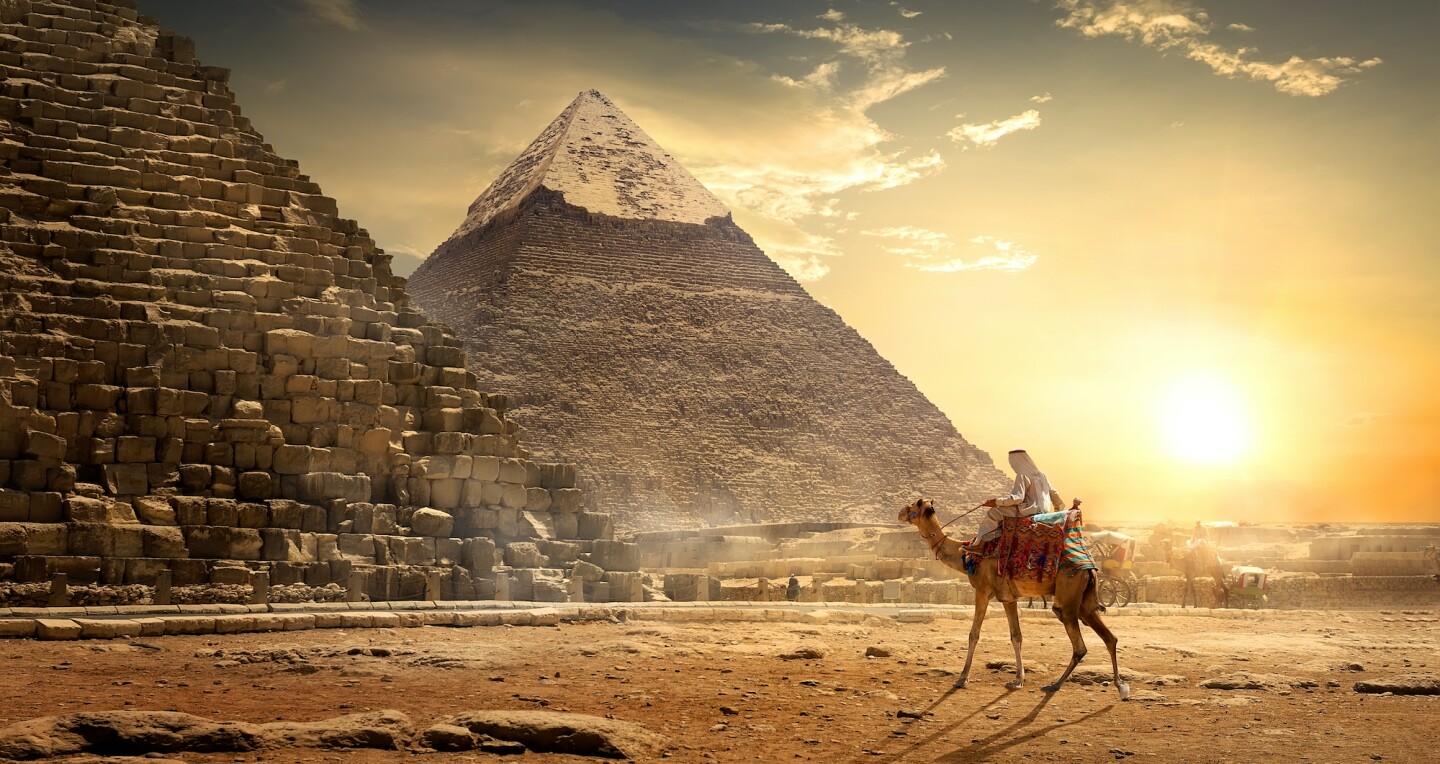
A man on a camel at sunset in front of the pyramids in Alexandria, Egypt

Photo by givaga/Shutterstock

Overview

Can’t miss things to do in Egypt

Egypt’s ancient rulers competed to outdo each other by scattering a cache of lofty temples across the land. The Pyramids of Giza, Luxor’s Karnak and Valley of the Kings, and Ramses II’s grandiose pat-on-the-back at Abu Simbel are the highlights of the pharaohs’ marvelous architectural achievements, but factor time during your visit to explore smaller relics such as the Kom Ombo and Philae temples as well. When temple fatigue sets in, replenish energy levels by discovering Egypt’s natural wonders. More ancient than any pyramid, this nation’s jagged mountain peaks, sinuous Nile, and empty desert expanses are superlative reminders that manmade treasures are only a part of Egypt’s bountiful beauty.

Food and drink to try in Egypt

Egyptian cuisine is infused with fresh and hearty flavors, with influences from the North Africa, the Middle East, and the Mediterranean. This is comfort food at its best: non-fussy, wholesome dishes where seasonal produce plays the starring role. Restaurant menus generally feature kebabs (grilled meat on a skewer) with simple meze-style plates of crispy salads and dips. Heavier specialties include mahshi (stuffed vegetables) and fatteh (chicken or beef with rice and bread, all immersed in a garlic sauce), and the more adventurous hamam (pigeon) and molokhia (a glutinous mallow-leaf stew).

Culture in Egypt

Egyptians are a boisterous, pragmatic people with a sharp sense of humor used to shrug off the hardships of life. Traditional culture and religion still play a prominent role in society, and close-knit family ties are at the heart of daily life. Although conservative in values, you’ll find Egyptians anything but insular. This is a nation that adores having fun and any excuse is used for a celebration. Not known for being stand-offish, and rightly proud of their history, a booming ahlan wa sahlan (“Hello and welcome!”) followed by invitations for tea and a chat are extended to all visitors. Accept those on-the-spot offers and you’ll experience warm and effervescent Egyptian hospitality at its best.

Shopping

Put your haggling hat on and get ready for an adventure. The souk is the quintessential Egyptian shopping experience where you can unearth everything from tawdry plastic pyramids to antiques. The wares at these markets have no fixed prices; the final sum depends upon your haggling skills. But keep in mind: Haggling for your treasure isn’t supposed to be about beating the shopkeeper down to the lowest price possible. It should be light-hearted and fun. For the best souk action in Egypt, head to Cairo’s Khan al-Khalili, whose winding lanes are crammed with textiles, copper workers, perfume, and a bewildering array of kitsch souvenirs. If you’re searching for antiques, look for bargains in Alexandria’s Souk Attareen.

Practical Information

Egypt’s summer (Jun–Aug) is stifling and best avoided unless you enjoy searing temperatures. Spring (Mar–May) and fall (Sep–Nov) are more manageable heat-wise, but winter (Dec–Feb), with its pleasantly warm, sunny weather, is when most choose to visit. Visas are required; most nationalities can buy one upon arrival. Most international flights land at Cairo (CAI) but there are also services direct to Alexandria’s Burg al-Arab (HBE), Luxor (LXR), and Sharm al-Sheikh (SSH). The bus network is extensive. The train is useful for journeys between Cairo and Upper Egypt (Luxor, Aswan), and to Alexandria. The language is Egyptian Arabic; the currency is the Egyptian pound, pronounced “guinea.” Electricity is 220 volts with European 2-pin sockets.

Guide Editor

Jessica Lee is a travel writer who specialises in the Middle East, Turkey, and North Africa. She likes deserts and mountains, and is on a constant quest to find the perfect hummus.

READ BEFORE YOU GO
RESOURCES TO HELP PLAN YOUR TRIP
One of the best things you can do in Madrid is go on a guided tapas crawl. If you don’t know much about Spain and/or don’t speak Spanish it’s best to have someone that knows what’s going on with you. Here are a few high notes from the crawl. My advice is to be bold and try new things. Don’t be scared and always hop into a bar where you see local people. Thank you to my new friend Carlos! Anchoas (Anchovies) at Casa Toni. Calle de la Cruz, 14 28012 Madrid
The churros here supposedly get their crispy exterior from being cooked over an ax-cut beech-wood fire. You can sample the results when the 140-year-old shop is open: only two Saturdays in June, every day during the San Fermín festival in July, and Sundays in October. 34/948-227-627. This appeared in the May/June 2012 issue.
I broke off from my friends in Barcelona to go on a solo excursion to Montserrat, a short one hour train ride from the city. I wasn’t sure what to except but had only heard that it was beautiful with weird rock formations and good trails so knew that I needed to make it before my week in Barcelona was up. This view is proof that I made the right decision. After a fairly strenuous 2 hour hike to Sant Jeroni peak (1,236m), you are rewarded with a 360° view of the green Catalan countryside and the distant Pyrenees. It is absolutely breathtaking and a must-do for the adventure-hearted visiting Barcelona for 3 or more days. One bit of advice would be to get to Montserrat by 9am so that you can descend in time to watch the world renowned boys choir perform in the Basilica of Montserrat at 1pm (something that I wish I had known).
It’s one of the most recognizable facades on Passeig de Gràcia: a modernist fantasy of undulating stone, brightly colored mosaics, and stained glass—one that could only come from the mind of famed Catalan architect Antoni Gaudí. Designed in 1904 as a home for local industrialist Josep Batlló, the building pays homage to the legendary tale of Saint George and the Dragon. The balconies are reminiscent of skulls, and exterior columns look like bones—recalling the dragon’s human victims—while the roof’s arched shape and scale-like tiles mimic the dragon itself. The interior is just as fantastical, all sinuous lines and curving forms. To avoid the crush, try going first thing on a weekday morning, or shell out a bit extra for a Fast Pass timed ticket online (28.5 euros, or about $37—5 euros more than regular admission).
Even now I’m craving their guilt-free collection of tapas-style breakfast miniatures. You can expect to find little croissants stuffed with jamon, light pastries topped with berries, and fresh squeezed orange juice. It’s simple, inexpensive, and quick—nothing fancy but perfect for a snack. I should note it’s a chain but it’s where the locals go, so don’t write it off and pop in when you see one. Tip: Grab a little tile to your right when you walk in, order at the counter and they’ll write on it. If you’re like me, you’ll go back for more so bring it up with you for round two. Then pay when you’ve finished.
Eat dinner like a conquistador at Restaurante Sobrino de Botin. The combination of its central location off Plaza Mayor and its claim to be the “Oldest Restaurant in the World” makes it charming and fun for family and friends. Make sure to put in a reservation in advance and order a traditional dish. I particularly enjoyed the incredibly thin jamon because it was light and not oversalted.
There are plenty of flamenco places in Granada, from the 35 euro tourist cave to the 6 euro wine cellar. My love for flamenco has drawn me to each one. I think the best deal especially if you are only in Granada for a week or a weekend is to splurge and go out for a great meal, the best sangria I’ve tasted in Spain, and some very talented and passionate flamenco. For almost the same price as the tourist filled sacramonte flamenco caves you can have a three-course delicious meal and see top quality flamenco at “Restaurante Jardines de Zoraya, tablao Flamenco.” Located in the Albaycin this restaurant has flamenco shows twice a night and a third matinee show on Saturday and Sunday. Come early so you give yourself time to find it in the hilly small alleys of the Albaycin and also to get a seat and order before the show starts.
Siwa is a desert oasis in the heart of Egypt’s Great Sand Sea, just 30km east of the Libyan border. Traditionally constructed of sand, salt and mud, many of the town’s buildings literally melted away in the torrential rains of 1926, leaving behind eerily beautiful ruins amidst this lush enclave in the middle of nowhere. The buildings were reconstructed with more modern day materials, but some of the original town structures remain, and can be explored with the aid of helpful local guides.
As you enter Barcelona‘s famous Mercat de Sant Josep de La Boqueria from La Rambla, one of the first stalls you encounter is Tocineria Marcos, purveyors of Iberico ham and a stunning array of other cured, cooked, and fresh meats. It’s just one of the dazzling displays of delicacies in this, the most famous of Barcelona‘s 40 or so food markets. (Another favorite, and slightly less touristed, is the beautifully remodeled Mercat de Santa Caterina, short walk away.) La Boqueria dates back to 1217; a pig market was conducted here starting in 1470; and the current metal roof was built in 1914. There’s no better place to shop for a taste of Catalan culture.
One of the best things about Barcelona is its many delicious cafes, offering strong Spanish coffee and rich, flaky pastries. I’ve found the best cafes to be concentrated in the city’s enchanting Gothic Quarter, or “Barri Gotic.” As in a lot of other European cities, you can linger over a cup of coffee, chocolate croissant, and the morning paper for as long as you’d like without risk of being bothered to give up your table. When you’re in Barcelona make sure to enjoy a leisurely breakfast followed by a stroll through the charming Gothic Quarter, where you’ll find everything from entertaining street performers to fun little shops to the obvious highlight, beautiful Gothic architecture.