Austria

Austria was once part of a mighty empire, which the Habsburgs ruled over from Vienna for some seven centuries. Although Austria today is just a fraction of its former glory, it still maintains its rich cultural and artistic heritage. Vienna is one of Europe’s most attractive cities, combining historic sites with a vibrant creative scene. The city is justifiably famous both for its classical music pedigree and for its elegant grand balls. With two-thirds of the country’s landscape shaped by the Alps, Austria is paradise for anyone eager to explore the mountains—or nature in general. Some of the world’s top ski resorts can be found in the western part of the country. The regions around the Danube, as well as south of Vienna, are known for their many family-run wineries. Austria is also a leader in the farm-to-table movement, and has over 20% of its agriculture, and more than 20,000 farmers, committed to organic farming.

Austria castle at sunset

Shutterstock

Overview

When’s the best time to go to Austria?

Temperatures in spring and fall are usually milder, making it a great time to visit. Winter sports are a major draw to the resort towns in the Austrian Alps, and the skiing is consistently ranked as some of the best in the world. The season lasts from December through late March. Vienna and Salzburg tend to be more crowded in July and August, and during major festivals. Temperatures vary by region and elevation, but averages do not climb above a comfortable high 70s in Vienna during summer.

How to get around Austria

Vienna can be reached via direct flights from several North American cities, including New York (JFK and Newark), Washington D.C., Miami, Chicago, and Toronto, though it is often practical to fly through Munich or Zurich—especially for a trip to Austria’s western provinces. Smaller airports in cities like Salzburg, Graz, Klagenfurt, and Innsbruck can be easily reached. High-speed trains connect Vienna and Salzburg with cities like Munich and Zurich. A hydrofoil travels between Bratislava and Vienna on the Danube. U.S. visitors can stay up to three months with just a passport, after which time a visa is required. If you are entering Austria using a rental car, make sure there is a Vignette (toll sticker) affixed to the windshield.

Cities in Austria are linked by a fast and efficient rail system, with Vienna to Salzburg taking as little as two-and-a-half hours. To explore large towns and cities, public transportation (bus and tram), biking, or walking is best. Driving on Austria’s highways requires a toll sticker—available in ten-day, two-month, and twelve-month increments—which can be purchased at gas stations, post offices, auto clubs, and even in neighboring countries. Renting a car is another great way to explore rural regions and high Alpine routes.

Food and drink to try in Austria

Austria’s cuisine reflects heavily on its imperial past, with influences from Hungary, Italy, and the Balkans. Classic dishes like Tafelspitz (beef, root vegetables, and sauerkraut), Wiener Schnitzel (veal cutlet, flattened and fried), and Gulasch (rich meat stew, often with paprika) can be found throughout the country, while every region is proud of their speciality dishes. But, let’s face it, the major food draw is really the delectable cakes and pastries, including the famous apple strudel and Sachertorte. You’d be forgiven for not knowing that Vienna is the only world capital producing significant quantities of wine within its city limits. White wines dominate the vineyards of the Wachau Valley, while reds prevail in Burgenland and Styria.

Culture in Austria

Some consider Vienna the cultural capital of Europe. The city has been synonymous with the music of Mozart, Beethoven, and Strauss, to name a few, as well as painters like Klimpt. Elegant balls, nights at the Vienna State Opera (one of the world’s best), and hours spent in coffeehouses are quintessential Vienna. The 640-year legacy of the Habsburg dynasty, which officially ended in 2011 with the death of Otto von Habsburg, can be found throughout the city. Oh, and let’s not forget the Boys Choir. Austria has nine inscriptions on the UNESCO World Heritage List: Schönbrunn Palace in Vienna, the Historic Center of Vienna, Wachau Cultural Landscape, Prehistoric Pile Dwellings around the Alps, Historic Center of Salzburg, Hallstatt-Dachstein/Salzkammergut Cultural Landscape, Graz Historic Center and Eggenberg Palace, Fertö/Neusiedlersee Cultural Landscape, and the Semmering Railway.

The year waltzes in with Vienna’s Ball Season in January and February, during which time “Fasching,” Austrian Carnival, also begins. The world famous Salzburg Festival takes place July–August, culminating with a performance of Hugo von Hoffmannsthal’s Everyman. Summer sees a variety of music festivals, from classical to rock (Nova Festival) to avant-garde (Styrian Fall), as well as wine festivals extending into the fall. Austria’s Christmas markets round out the year. Vienna alone lights up with 20 official Christmas markets selling seasonal gifts, decorations, and sweets.

Local travel tips for Austria

Austria has nine provinces: Vienna, Burgenland, Lower Austria, Upper Austria, Salzburg, Styria, Carinthia, Salzburg, Tyrol, and Vorarlberg. While German is the official language, there are regional dialects that German speakers from outside may have trouble understanding. In some cases, totally different words are used. The German Krankenhaus, for example, is Spital (hospital), and a Brötchen is a Semmel (roll). But language shouldn’t be an issue; English is widely spoken. Austria is a parliamentary democracy, and its national holiday falls on October 26—a day of free entry to state museums and many government buildings.

Related video

Guide Editor

READ BEFORE YOU GO
HOTELS
Travel like James Bond in these six beautiful destinations, from the beaches of Jamaica to the mountains of Austria.
Rosewood Hotels and Resorts has transformed the historic Schloss Fuschl hotel outside Salzburg into a contemporary lakeside escape.
Whether you’re a food fan or adventurer-—or somewhere in between—there’s something to delight your senses in this centrally located European country.
Afar’s resident hotel expert shares the summer 2024 openings that are worth a special trip.
It’s easy to see why these ski chalets and mountain cabins are among the highest rated on Airbnb.
For the sustainably minded craftspeople in Austria’s most design-forward region, the forest has been a source of inspiration for centuries.
RESOURCES TO HELP PLAN YOUR TRIP
Austrian culture is deeply rooted in skiing and Skicircus is its crowning achievement. Spread over Saalbach-Hinterglemm and Leogang, the winter sports area features nearly 170 miles of piste terrain and is extremely popular with both skiers and snowboarders. Guests can look forward to 70 cableways and lifts, more than 60 cozy ski huts, numerous snow parks, floodlit slopes, and toboggan runs. For those not staying at the resort, the Salzburg Snow Shuttle provides transportation from the city to the slopes.
Towering high above the banks of the Danube in the Wachau Valley, the bright yellow Melk Abbey is one of Austria‘s most beautiful Baroque buildings. It’s been rebuilt several times since its 11th-century origins, with its present form dating to the early 18th century. Inside, the library is one of the most impressive features with roughly 100,000 volumes and a ceiling fresco by Paul Troger. There’s a beautiful church and several important paintings to be found, but the real treasure is the two Melk Crucifixes, one said to contain a piece of Christ’s cross.
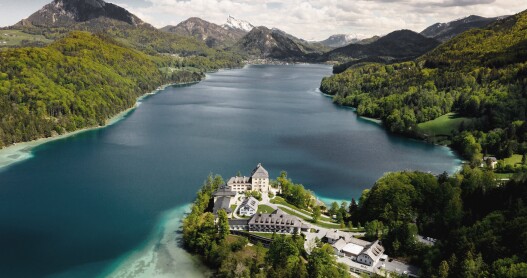
Fuschlsee (Lake Fuschl) is the lake closest to Salzburg and includes four public beaches, all with breathtaking scenery that makes it easy to relax and unwind. Its pristine emerald green waters are considered the cleanest of the Salzkammergut region and suitable for drinking. The Archbishops of Salzburg used the lakeside castle as their hunting lodge - meaning all the fish from the lake ended up on their own tables.
Philippe Starck’s design firm, Yoo, transformed an 1872 dowager hotel into the 63-room Hotel Sans Souci Wien. Expect oversize Starck and Arne Jacobsen furnishings, four-poster beds, parquet floors, pillows made with Fornasetti fabrics, and pieces from the owner’s art collection (Picassos among them) that contrast with a soft color scheme. Downstairs in the spa, you’ll find a true Viennese rarity: a 65-foot indoor pool.
Austrian wines are made all the better by a visit to the many vineyards and wine taverns (Heuriger) on the outskirts of Vienna. Wieninger vineyard is located north of the city on the Nussberg. A light meal and wine outdoors among the vineyards is a great way to cap off an evening in Vienna. Trams run from the city center to Nussdorf. To explore more heuriger, the little Vienna Heurigen Express train runs from Nussdorf to Kahlenberg and Grinzing.
One of Vienna’s most notable structures is its stunning Rathaus, or City Hall. Designed by Friedrich von Schmidt between 1872 and 1883, the imposing Gothic structure is the seat of both the mayor and city council, and is also the backdrop for one of the most popular Christmas markets in the city.
Sacher is synonymous with luxury in Vienna. It’s the name of not just the hotel, but also Austria’s most famous cake, the delectable Sacher-Torte. Eduard, son of Sacher-Torte creator Franz Sacher, opened the hotel in 1876, though it was his young widow Anna who really established the property after he died. In 1934, a few years after her death, the Gürtler family took over the hotel—and continues to maintain it to this day.

Notable personalities like John F. Kennedy and Queen Elizabeth II have walked the halls of this Vienna institution. It was also here that John Lennon and Yoko Ono introduced “Bagism” to the press while inside a giant bag, an event chronicled in the Beatles’ Ballad of John and Yoko. The Belle Epoque–influenced rooms are a symbol of elegance and comfort, while the two restaurants, two bars, and illustrious Café Sacher make it possible to enjoy the hotel’s timeless charm without even being a guest. Be sure to try the famous torte—it’s an essential Vienna treat.
Swarovski, world-famous Austrian crystal maker, has made it its mission to amaze. While the glittering creations do that on their own, the family has also built a whole world of wonder for you to enjoy. The Crystal World is a dream-like place of beauty and art, where visitors can share in the brand’s fascination with glamorous products. Enter through the mouth of a giant, whose grassy face emerges out of the ground, and explore the otherworldly creations of Brian Eno and Alexander McQueen. The Crystal World allows you to let your imagination roam freely and see things through completely different eyes.
Café culture is an essential part of the Austrian experience, and there’s no better place to find it in Salzburg than at the historic Café Tomaselli. Dating back to 1700 and owned by the Tomaselli family since 1852, the great coffees, delicious pastries, and warm ambience mean the marble-topped tables don’t stay empty for long. It’s a place to see and be seen, a traditional institution popular with visitors, intellectuals, and celebrities. Even Mozart was a regular here. His widow, Constanze, later returned to the city with their children and lived upstairs with her second husband, Georg Nikolaus von Nissen, from 1820 to 1826. A Mélange (similar to cappuccino) or Einspänner (mocha with thick whipped cream) are two top picks from the extensive coffee menu. Order pastries separately—from the large selection brought tableside by one of the so-called “cake maids.”
The Habsburgs were, generally speaking, lovers of art and many of the works of the Kunsthistorisches Museum come from their collections. While the grandiose interior alone may be reason enough to visit, the collections here are outstanding. The Egyptian and Near Eastern Collection, Collection of Greek and Roman Antiquities and Coin Library are just a few of the collections to get lost inside. The Picture Gallery includes works by Albrecht Dürer, Jan van Eyck, Pieter Brueghel the Elder and Peter Paul Rubens.