Buenos Aires

Traditionally, it’s the world capital of tango. These days, thanks to a vibrant urban art scene and nightclubs spurring on musical innovation, cool kids from all over the globe look to Buenos Aires as a style capital of Latin America. The Argentine metropolis, by turns moody and frenetic, is just as colorful as you’d expect—and porteños (its inhabitants) themselves are as notoriously proud and effortlessly hip as you’d imagine. While there are sights to be seen, of course, half the joy in visiting Buenos Aires is drinking up the intoxicating blend of the city’s romantic past and trendsetting present.

2_buenos_aires.jpg
Overview

When’s the best time to go to Buenos Aires?

Temperate spring (September to November) and autumn (March to May) are the most desirable times to visit Buenos Aires. Though winter days (June−August) are shorter, and the weather is gray and chilly. The Argentine capital almost never sees snowfall and the cold weather is fine for cultural sightseeing, but winter visitors miss out on the long strolls, park outings, and outdoor café action that make the city so charming. January is oppressively hot: schools are out, some businesses close, and porteños (what the locals call themselves) with enough money to clear out take refuge at beaches outside of the city.

How to get around Buenos Aires

Nearly all international flights arrive at Ezeiza International Airport (EZE), located about 22 miles from the city center. Though public buses serve the airport, they’re notoriously inconvenient; you’re better off paying for a taxi at the official desks inside the arrivals hall. (Prices fluctuate all the time; the current price of 900 pesos is about $15.50.) Some shorter flights arrive at Buenos Aires’ smaller, more central airport, Aeroparque Jorge Newbery (AEP).

Once in the city, public transportation options include the traveler-friendly Subte (subway) and a vast, somewhat overwhelming, but efficient and fast system of colectivos (buses). Purchase Subte tickets in the underground stations before boarding, and if you’re getting on a bus, be prepared with exact change in monedas (coins) to feed into the machine behind the driver. Taxis are abundant and affordably priced; just be aware that many taxistas refuse large bills.

Can’t miss things to do in Buenos Aires

Some cities have food trucks; Buenos Aires has roadside carritos. Look for billowing smoke—or just follow the mouthwatering aroma of sizzling meat—to one of these rickety grill stands. Then ask for a local favorite, the choripán (a chorizo sandwich), and use a plastic spoon to top it off with freshly prepared chimichurri, set out in small bowls near the grill.

Food and drink to try in Buenos Aires

Argentina is world famous for beef; you’ll find it on nearly every table in Buenos Aires, from basic parrillas (steak houses), where grilled steak are served with chorizo, papas fritas (french fries), and green salads, to upmarket restaurants where rare cuts of bife de chorizo are perfectly paired with Malbec from Mendoza. Though vegetarian cuisine and ethnic food trends have been relatively slow to catch on in this meat-eating culture, you’ll find a growing number of international options in the Palermo Soho and Palermo Hollywood districts.

Culture in Buenos Aires

Architecturally speaking, Buenos Aires is fascinating, particularly along the Parisian-style Avenida de Mayo and throughout the historic barrios of San Telmo, Recoleta, San Nicolás, and Monserrat, where the grand Spanish and Italianate buildings stand as testament to the city’s proud immigrant past. On rainy days, see some of the city’s museums—MALBA hosts many of the most significant Latin American art exhibits.

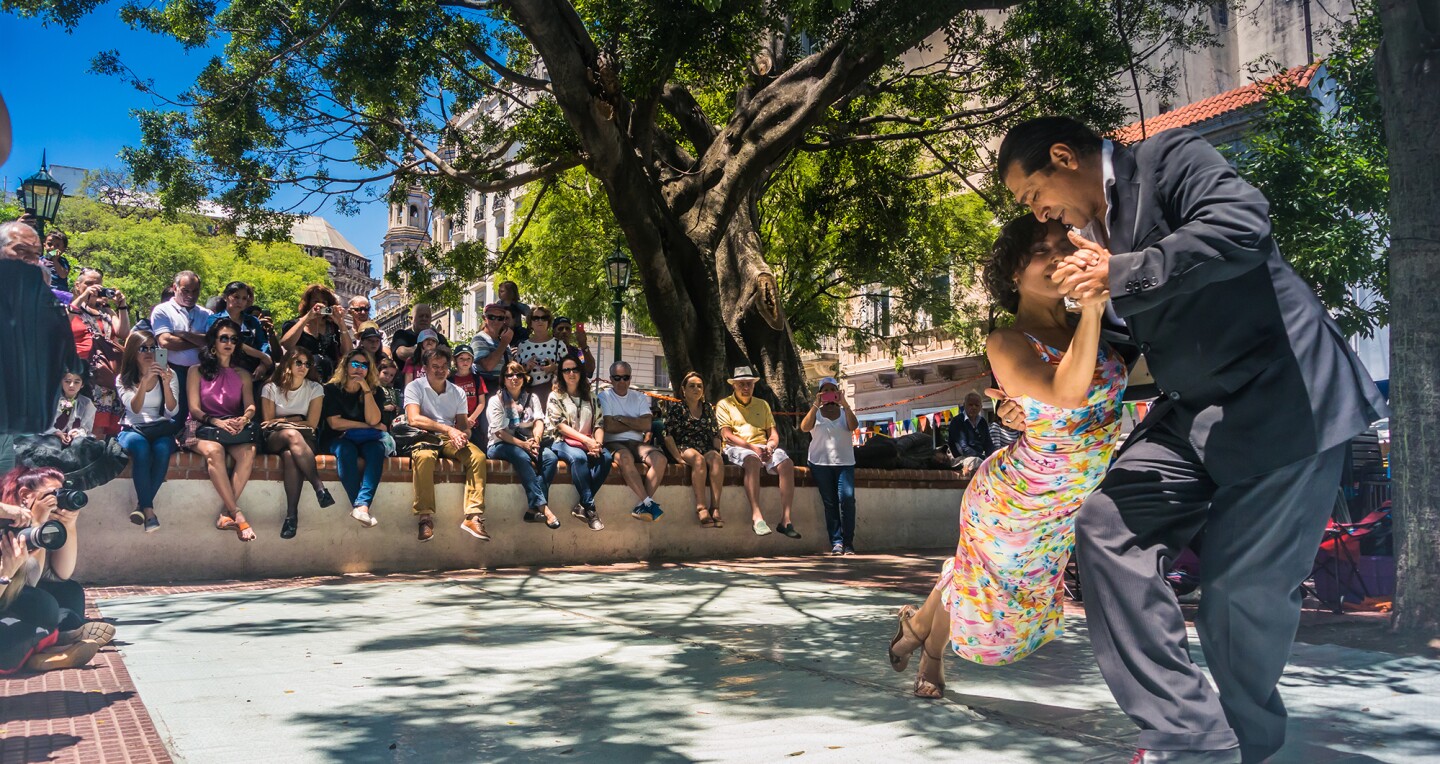
For the most authentic taste of porteño culture, you’ll have to wait until after dark, when local dancers crowd the floors of traditional milongas (tango clubs) and imaginative musicians and DJs mix and mash provincial Argentine music with cumbia, hip-hop, and house music in the city’s nightclubs.

Buenos Aires hosts major events throughout the year. The biggest draws are the ArteBA art exposition, Feria del Libro book fair, Tango Buenos Aires Festival y Mundial, Casa FOA design festival, and La Exposición Rural, a farm show−like agricultural fair.

Local travel tips for Buenos Aires

In Buenos Aires, you can always spot the out-of-towners. They’re usually wandering around the streets in the evening, hungry for dinner at 7 p.m.—and wondering why none of the restaurants have even turned their lights on yet. As a rule, the locals have a light breakfast (often coffee and medialunas—sweet, croissant-like pastries), a late lunch, and merienda (a snack with coffee, mate, or tea) around 5 or 6 p.m. Dinner never happens earlier than 8:30 or 9 p.m., often much later on weekends. Note that the city empties out in January, with many porteños away on their summer vacations.

Guide Editor

READ BEFORE YOU GO
RESOURCES TO HELP PLAN YOUR TRIP
Some of the best memories and connections are forged when we travel as a family. These are our top picks for places to go when we’re traveling with everyone from tiny tots and teens to a multigenerational group that spans many ages and stages.
Some of our favorite destinations are joining the Delta route network.
Author Daniel Loedel on grappling with the past, writing his debut novel “Hades, Argentina,” and making sense of the joy and sadness woven into life in Buenos Aires.
Ranked as one of the World’s 50 Best Restaurants on the 2018 eponymous list, Chef Narda Lepes’s Narda Comedor serves healthy, seasonal meals and adds excitement through an ongoing new-flavor rotation. Vegetables play a key role but this isn’t rabbit food; the kitchen turns out succulent meats from top providers committed to wholesomeness and sustainability. Sharing dishes with your dining companions is a winning strategy.
This small, chic hotel came into being after an Argentine PR director and her English record producer husband couldn’t find the perfect place for their visiting guests to stay during their Buenos Aires wedding. They needed a place with a bar, a spa, a nice pool, good cocktails in a friendly environment—and so in 2005 they opened Home, one of the pioneer boutique properties in Palermo Hollywood. Strategically located within blocks of much of the city’s nightlife, Home has become something of a base for those coming to the city looking to indulge in it.

Generally though, Home’s reputation is quite positive. Few modern design elements have been left out, from Knoll furniture and vintage wallpaper to the Chilean wool rugs and tech-friendly amenities like iPod-ready stereos and LCD TVs. A spacious walled garden area is the focal point of the property, holding the heated swimming pool plus deck chairs and ferns, alongside a bar and restaurant.
The Alvear Palace is a Buenos Aires landmark. Dreamed up by businessman and socialite Dr. Rafael de Miero, who wanted to bring back 1920s Paris grandeur to his hometown, the hotel was erected in 1932 on the corner of Avenida Alvear and Ayacucho after a decade of on-and-off construction. Then after much fanfare, it expanded in 1940, taking over an old mansion next door. For several decades, Alvear Palace was owned by the Duke of Hornes, a cousin of King Juan Carlos I, though Argentina’s economic situation saw the hotel’s reputation steadily decline. Since Anglo-Argentine developer David Sutton Dabbah (also co-owner of Patagonia’s Llao Llao Hotel & Resort) purchased the property in 1984, the Palace has been renovated and renovated again, top-to-bottom in 2011, which lowered the room count and revived the lavish Louis XV furnishings, and most recently in 2016, with the debut of sleek rooftop suites, an indoor pool, solarium, and a rooftop bar. Bathroom amenities are custom-made by Hermès. The lobby bar exudes Belle Epoque elegance, and many of the rooms, while still as picture-perfect as ever, could be mistaken for another century. There are touches of modern luxury in the spa, but over-the-top opulence is still the dominant theme running through the signature French restaurant and afternoon tea, as high society lingers.
With a smart and simple chalkboard menu of cheese plates, salads, sandwiches made with homemade bread, good coffee, and Argentinian wines by the glass, Pain et Vin is a lovely venue for lunch or an afternoon glass of Malbec rosado. The Palermo Soho eatery doubles as a tasting space and shop: look for Friday evening events open to the public, or stop by to choose from the excellent selection of boutique wines to take on a picnic to the park.
New York has Ellis Island; Buenos Aires has the Hotel de Inmigrantes. The huge waterfront building, located near the old port docks in what’s today known as Puerto Madero, served as the temporary home for waves of European immigrants arriving to Argentina between 1911-53. Today, the Hotel de Inmigrantes is an intriguing (and free) museum that few tourists see: come to see photos and memorabilia representing the many immigrant groups who came through the port of Buenos Aires, plus colorful advertisements for trans-Atlantic passages and model boats.
So you didn’t have time on this trip to visit Salta, Jujuy, or other breathtakingly gorgeous destinations in Argentina’s north - put it on your list for next time. At least you can go home with some beautiful handcrafted objects produced in the region’s indigenous communities - and Fundación Silataj, a non-profit fair-trade organization, is the best place to do some responsible shopping. Items at Silataj are divided into four categories: accessories, art, home and textile. Browse through the online catalogue for an overview, or just poke around the store in person. There’s an affiliated shop downtown that’s more convenient for some travelers - Arte de Pueblos (www.artedepueblos.org.ar).
Teatro Colón is considered one of the most beautiful theaters in the world. Though the theater was, to the great disappointment of many travelers, closed for years while undergoing major renovations, the Colón has now reopened and is playing host to a busy schedule of opera, ballet, and symphony. If you can’t get tickets for this legendary theater, try another elegant venue like Teatro Nacional Cervantes or Teatro San Martin. Check out Ciudad Cultural Konex if you’d rather see an edgier contemporary performance of modern dance or theater, or head to La Trastienda to hear live music by some of Argentina’s best young artists.