Zurich

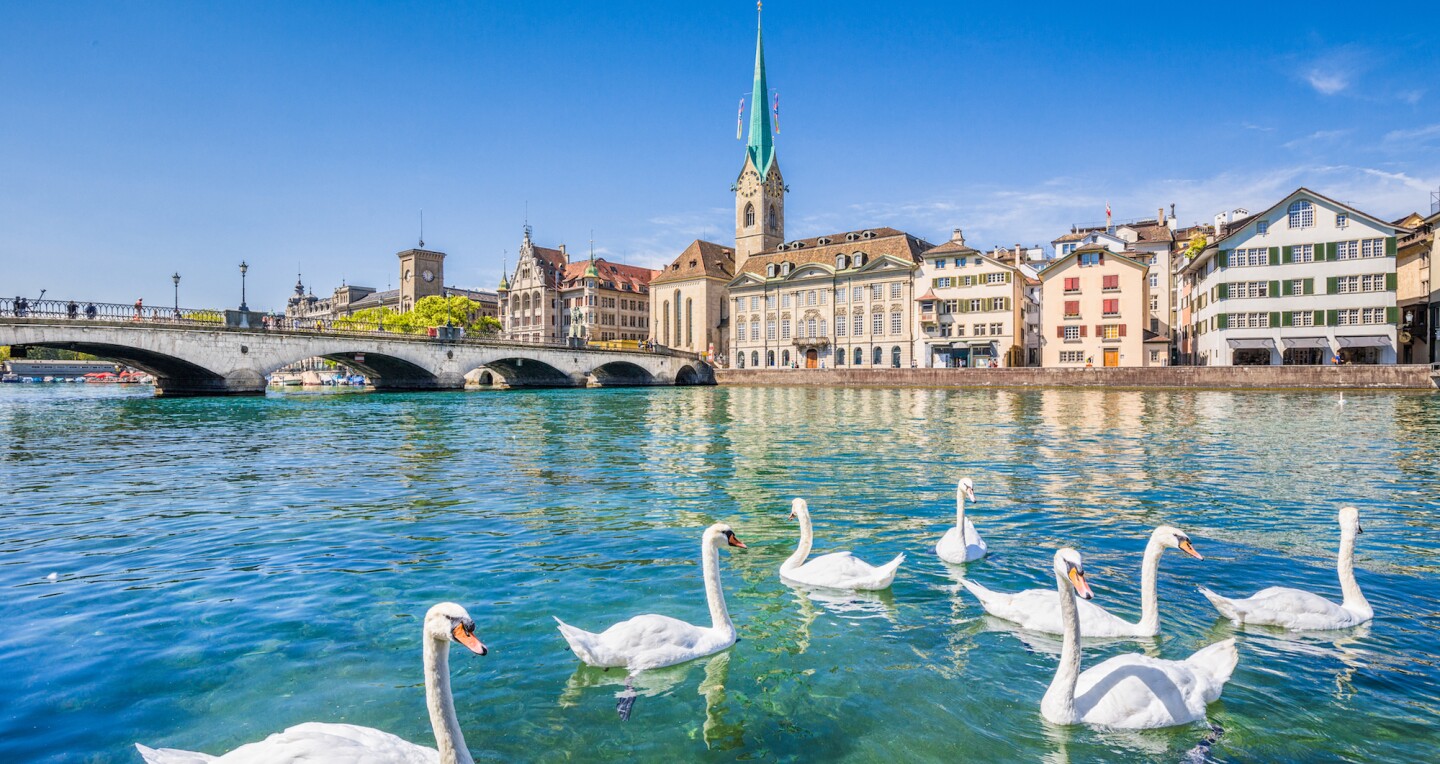
This international finance capital is blessed with one of the highest qualities of life in the world, making for an exceptionally safe and highly enjoyable visit. While the city is smaller than you might think, there’s plenty to keep you busy, whether you’re wandering the gilded cocoon of the Altstadt (Old Town), lined with glittery watch and jewelry boutiques, private banks, and storied chocolate houses, or taking in the dynamic, edgy scene that awaits in Zurich West with its art galleries, design boutiques, and trendy eating and drinking establishments. Capping it all is an unparalleled natural beauty, with the serene Limmat River cutting through the city’s heart before opening into vast, shimmering Lake Zurich.

zurich-switzerland.jpg
Overview

When’s the best time to go to Zurich?

The image of Switzerland might be of snow-capped mountains, but you’ll be hard-pressed to find much snow in Zurich. The country is full of microclimates, and Zurich’s is a moderate one. Winter is a glorious time to visit, thanks to temperatures that barely ever dip below freezing, Europe’s biggest indoor Christmas market, and Bahnhofstrasse shopping—even on Sundays throughout December. Spring weather can be cool and sunny, but it’s often wet, especially in the later months. (One consolation is the numerous pockets of gorgeous cherry blossoms that dot the city.) Surely the best season to visit is summer and early fall, when it’s warm enough to swim in the lake.

How to get around Zurich

The concrete, steel, and glass–clad Flughafen Zürich, also known as Zurich Kloten Airport, offers a microcosm of what to expect in the city you’re about to enter: Everything is pristine, with advertisements for watches everywhere. Zurich’s main train station, Hauptbahnhof, is just eight miles south, and a number of trains will take you there in as little as 12 minutes. The number 10 tram takes 35 minutes but might be more convenient if your destination is on the northern edges of town. Taxis are insanely expensive—about 50 Swiss francs or $55 to the heart of the city—and should be avoided unless you have lots of baggage.

It’s no exaggeration to say Zurich’s public transportation system is the most punctual and reliable in the world. Like practically everything else in this city, it doesn’t come cheap: a one-hour ticket costs 4.20 Swiss francs. But a day pass, at 8.60 Swiss francs, is a relative bargain considering it allows for travel on any of the city’s various modes of public transportation, be it train, bus, tram, funicular, cable car, or boat, during any given 24-hour period. The most popular, and efficient, is the city’s iconic blue tram. A fun alternative is to tour the city on two wheels with Züri rollt, the city’s popular—and free—bike-share program. Also, considering Zurich’s relatively small size and pedestrian-friendly Altstadt, it’s possible to reach many of the city’s most interesting sights entirely on foot.

Can’t miss things to do in Zurich

Even born-and-bred locals can’t get enough of strolling along the lake, with loyalties divided between the right and left bank. The former may seem the obvious stunner, with its gorgeous tree-lined promenade, but the latter certainly has its lures. Keep wandering south until you reach Saffa Island, perhaps the most charming spot on the lake, reachable by an arched pedestrian bridge, and offering a straight-shot view of the Alps.

Food and drink to try in Zurich

Swiss food is hearty—and deliciously indulgent. It is certainly possible to dine on fondue and bratwurst for all your meals here, but it would be wise to seek out some of the lesser-known traditional dishes, like raclette, rösti, and Zürcher Geschnetzeltes, the classic Zurich specialty of pan-fried veal with a creamy white-wine sauce. But the Zurich food scene is much more than just meat, cheese, and potatoes: there’s visionary fine dining, internationally inflected vegetarian, and fresh fish dishes prepared with Lake Zurich catch. There’s also a seemingly limitless choice of chocolate, whether your vice is richly dense cake, Champagne-filled truffles, or single-origin bars. Zurich is a beer-loving city—try a local TurbinenBraü brew—but while you’re here, make sure to sample some of the wines produced from grapes grown in and around the city, many of which you’ll be hard-pressed to find outside of Zurich, much less out of the country.

Culture in Zurich

Where there’s wealth, there’s art. This is a city brimming with cultural institutions. The venerable Kunsthaus, which holds Zurich’s most important collection of modern art, should be on every art lover’s itinerary, as should the lesser-known “Löwenbräu brewery-turned-arts complex, home to Kunsthalle Zürich and Migros Museum für Gegenwartskunst, two of the most important museums for contemporary art in the city. If you never step foot inside a museum, you can still get your fill of great art: Fraumünster church has stained-glass windows by Marc Chagall and Augusto Giacometti, several hotels have sizable art collections (the Widder even commissioned a Rauschenberg), and for high-rolling diners, Kronenhalle serves veal steak and wiener schnitzel amid pieces by Picasso, Matisse, and Mirò.

For a small city, Zurich has a packed celebratory calendar. With time-honored, tradition-bound festivals such as the Sechlauten in the spring, raucous blowouts like Street Parade in the summer, and numerous cultural events like the Zurich Film Festival in the fall, there is no shortage of events around which to plan your vacation.

Local travel tips for Zurich

The Swiss tend to be proud and reserved, but they can be exceedingly polite and helpful if encountered on their terms. Always greet shop owners and restaurant staff with “Greüzi” (hello) when entering, and “entschuldigen” (pardon) before asking a question or making a request. Use polite tram etiquette. On older trams, avoid the second car, which is reserved for strollers and wheelchairs, unless necessary. If you want to cross ahead of an idle tram, make eye contact with the driver and proceed only if he waves you through. The Swiss are very rule abiding: You’ll find them standing at a red light even if there’s no traffic in sight. Follow their lead.

Guide Editor

READ BEFORE YOU GO
RESOURCES TO HELP PLAN YOUR TRIP
The terrace at ETH Zurich—where Einstein was an alum—lords high above the city for catch-your-breath views beyond to the lake and the Alps. A number of trams will take you to the terrace, but the most fun way to get there is on the fire-engine red Polybahn, one of only two funiculars left in the city, and the most conveniently located. It runs every 2.5 minutes from the Central stop.
Locals come to this white heritage-protected 1800s house perched on a hill in the leafy green Wollishofen neighborhood to splurge on the city’s best entrecôte Café de Paris, served in its pan over a warming candle, along with heavenly fries (waiters come around offering more if they see you’re running low). Come summer, the kitchen moves outdoors and the garden terrace, dotted with white umbrellas and shaded by a huge Linden tree, is as lovely a place as any to enjoy the lake view.
Open since 1924, Zurich’s most esteemed classic restaurant exudes wealth—mahogany wood paneling, glittering chandeliers—and patrons would need a lot of it to dine here, too. (The veal steak with morel sauce and spätzli, a favorite, is an eye-watering 68 Swiss francs.) But some say the museum-quality art collection—with works by Picasso, Chagall, Matisse, Mirò and Braque—make dining here well worth the splurge.
Zurich’s original 14 guilds were established in Medieval times to represent different crafts- and tradesmen, and their grand, stately buildings that still dot the city are a testament to their one-time power. Fortunately, most are well-preserved and now serve as fine restaurants. Zunfthaus zur Waag, house of the guild of wool and linen weavers, has a Biedermeier-style dining room with lots of wood-paneling, stained glass windows, and a terrific view of the Münsterhof. The dish to order is the Zürcher Geschnetzeltes, the classic Zurich specialty of pan-fried veal with a creamy white-wine sauce.
Sure, the menu comes in a dozen languages, but Zeughauskeller is no mere tourist trap. Occupying a 15th century building on Paradeplatz, the setting—arched windows, wooden ceiling beams and stone columns—is transportive, while traditional dishes include the Bürgermeister Schwert (veal steaks pounded thin and wrapped around a long sword blade and grilled). The house beer is an exclusive from the local TurbinenBräu brewery.
Strolling down the Limmatquai is an obvious choice for most visitors to Zurich. But just across the Limmat, on its left bank, lies an even more charming path lined with cobblestones and a covered passageway with arches that overlook the river. Artisan workshops and quaint stores can be found, including Lederladen for beautiful, hand-cut and sewn leather bags and Susanna Rüttimann Kiepenheuer for whimsical sculptures.
The most centrally-located mixed badi boasts a prime spot on Lake Zurich, though not too much swimming actually goes on here—it’s more about sunbathing, people-watching, and the occasional dip. There’s also a sauna, massage treatments and outdoor yoga sessions, all surrounded by a beautiful arboretum and fantastic views of the Alps. Photo © Martin Rütschi/Zürich Tourism.
Paris has the Sacré-Coeur, on top of Montmartre, for catch-your-breath views of the city. Zurich’s answer: the terrace at ETH Zurich. Also known as the Swiss Federal Institute of Technology Zurich and where Einstein was an alum, it lords high above the city for prime views beyond to the lake, the Uetliberg, and the Alps. The bQm café and bar lets you pair that stellar view with a drink.
There’s no better way to take in all Lake Zurich has to offer than by meandering this grand tree-lined walkway along its eastern shores. There’s swimming at the historic Seebad Utoquai, pedal boat rentals, and popular outdoor restaurants like the Pumpstation. For a dose of culture, the Center Le Corbusier showcases the Swiss-born architect’s last structure, a striking steel and glass masterpiece accented by multi-colored panels. Photo © Gaetan Bally/Zürich Tourismus.
The striking Im Viadukt opened in 2010 beneath century-old stone arches with Zurich’s first permanent covered market and 50 vendors. At Berg und Tal, owners Simon Rietschin and Daniel Rufli stock their food shop with items sourced mostly from within Switzerland and purchased directly from the producer, from sausages to the more unexpected, like Lindenblüten teas from the Swiss mountainside and absinthe made from angelica and grande wormwood from Val-de-Tavers. The wine shop Südhang sells small production bottlings including those made with grapes grown around Zurich, and Tritt-Käse specializes in local raw milk cheeses. Photo © Ralph Hut/Im Viadukt.