Paris

A hub for hedonists, a wellspring of inspiration for artists, and a haven for history buffs: Paris is a fantasy destination for millions of travelers each year. The storied bakeries, iconic museums, and corner cafés feel anchored in another time, but the zeitgeist of the city leans forward into a dynamic, multicultural food scene dominated by young French and foreign talents. It is precisely this juxtaposition of old and new that makes Paris the perpetually perfect place to visit. So go exploring, get lost, eat until your belly hurts—and then do it all over again. The City of Light shines on.

Paris-filip-mishevski-eZ2aHgA6Xds-unsplash.jpg

Photo by Filip Mishevski/Unsplash

Overview

When’s the best time to go to Paris?

You’re likely to be disappointed if you arrive expecting the image of springtime in Paris that you see in Hollywood films. In the last several years, the months between April and June have reported below-average temperatures and record-high precipitation—a far cry from the endless days of sunshine in the movies. The weather is wholly unreliable, which foils many travelers’ ambitions for a dry early-season trip. Late summer and early fall typically yield the warmest sojourns (though the summers in general appear to be getting warmer), plus this is when Paris is most culturally active, unveiling new exhibits and welcoming the return of the some of the most anticipated festivals. December and January provide a more festive experience, with Christmas markets lining the well-heeled boulevards and twinkling lights illuminating the city’s boutiques. All weather aside, there is hardly a bad time to visit Paris, rain or shine.

How to get around Paris

From either of the city’s two airports, the RER B, a regional rail line, is the fastest way to reach the city center. Taxis are convenient, but they can be costly.

Getting around: There are few cities as walkable as Paris. For further distances, le métro is the quickest and most reliable means of getting to and from your destinations (sometimes faster than a taxi). Google Maps is a reliable way of figuring out which train to catch. Ubers operate here.

Paris also has excellent bike infrastructure. On nice days, grab a bike share with Vélib, the city’s successful bike-share program, or Lime.

Can’t miss things to do in Paris

– Whether at the peak of summer or in the moodiness of a winter’s night, nothing elicits a chorus of oohs and ahs like a leisurely after-dinner stroll across the city’s iconic bridges and along the banks of the Seine River. Amble across the Pont des Arts toward the Institut de France and continue along the docks of the river, watching the Bâteaux Mouches glide by and illuminate the river with their lights. Keep wandering until you reach a spot to pause for an unobstructed view of a twinkling Eiffel Tower (every hour, on the hour, after sundown). It’s free and absolutely stunning at all times of year.

– If time allows, you really shouldn’t miss visiting the Louvre, the Musée d’Orsay, and Sacré-Cœur, or taking a stroll through the Luxembourg Gardens.

– Following the devastating fire in April 2019, Notre-Dame Cathedral remains closed for restoration work. Officials have said the forecourt in front of the church could open as early as March 2020, but for now, you’ll only be able to snap a picture from afar.

Culture in Paris

Every international city has its iconic landmarks and cultural institutions. In Paris, most travelers would cite the Louvre as the must-visit art stop, but curious visitors should look beyond the usual suspects and explore places like the Musée de la Vie Romantique, the Jewish Art and History Museum, the Cinémathèque Française, and the Fondation Cartier.

Dive a little deeper into a fascinating chapter of 20th-century Parisian history with a historian-led Context walking tour that focuses on the city’s occupation by Nazi Germany, a time marked by unrest, bravery, and heroism. – Given the Parisians’ well-documented penchant for celebrating art, culture, and design in all its forms, you can count on a packed schedule of festivals all year long. Whether for a neighborhood street parade or larger-scale happenings like Paris Plage and Nuit Blanche, it’s worth planning your vacation around the city’s celebratory timetable.

Local travel tips for Paris

  • Always greet shop owners and restaurant staff with “bonjour” when entering and before asking a question or making a request.
  • When metro train cars are crowded, give up your folding seat and stand.
  • A baguette is always better with cheese—the older the cheese, the better.
  • Do not overlook the city’s farmers’ markets as potential lunch spots.
  • Macaron loyalties teeter between Ladurée and Pierre Hermé, so try both and decide for yourself.
  • The Champs-Élysées has few redeeming qualities and is considered the Times Square of Paris by locals. Skip it and opt for a bird’s-eye view from the top of the Arc de Triomphe.

Practical Information

  • U.S. visitors to France do not need a visa for stays of less than 90 days.
  • France uses type E and C plugs, so visitors from the U.S. will need an adapter.
  • France’s official currency is the euro.
  • The official language is French, though you’re likely to hear several languages spoken, as Paris is an international city.

Guide Editor

READ BEFORE YOU GO
HOTELS
These 19 hotels around the world immerse you in their destinations while carving out space for unhurried time together.
These are the 20 best luxury hotels and resorts in France outside of Paris, according to insiders—whether you’re seeking a bucolic Provençal getaway or an immersion in a bygone era of the French Riviera.
These are the top places to stay in the City of Light.
Not all Eiffel Tower views are created equal. These hotels prove why only some are worth the splurge.
This curated list of “maisons,” boutiques, and family-run hotels showcase the kind of style and attitude only Parisian hotels can deliver.
Once home to artists and writers, Paris’s Left Bank still delivers cobblestoned charm and leafy boulevards—and these timeless hotels will put you in the center of it all.
Stylish, central, and surprisingly affordable—Locke’s new Paris hotel brings townhouse elegance to the Latin Quarter.
Palace hotels are the highest distinction a hotel can achieve in France. Here’s what they are—and what makes them so special.
The French capital is filled with stylish hotels that are big on personality—and easy on the bank account.
Airbnb has launched a new category called “Icons” for its most over-the-top stays and experiences (Prince’s “Purple Rain” house, anyone?). It also added a new feature to make booking group trips easier.
RESOURCES TO HELP PLAN YOUR TRIP
At the summit of Montmartre, the highest point in the city, you’ll find the Basilica de Sacré-Cœur. Contrasting with the Gothic churches like Notre-Dame, the Romano-Byzantine architecture is both beautiful inside and out. While outside, take in the panorama of Paris and while inside, marvel at the Apse Mosaic—one of the largest mosaics in the world. The Sacré-Cœur website has instructions on how to download the free audio guide on your phone before your visit which is recommended. Also, research the well-known (and apparently tried-and-true) scams before traveling to Paris. Overall, the city seems pretty free of tourist scams, but around Sacré-Cœur especially, visitors should be on alert.
Though the Pigalle neighborhood has mostly shaken off its red-light reputation, the bon vivant spirit of the area’s past has been elegantly revived at Maison Souquet. The owners gave carte blanche to Jacques Garcia, the venerated French designer with a passion for Belle Époque interiors, who masterfully reworked the early 1900s design codes to bring to life the space, itself a former pleasure house. As during the heyday of these maison closes, which brought together artists and socialites, Garcia created an intimate, multi-room layout, meant to take guests from one stage of the experience to the next. It begins in the entrance lounge bedecked in Moorish tiles and Cordovan leather, leads into the Salon des Petits Bonheurs (Little Delights), where you’ll find the bar, and ends under the glass canopy of the Jardin d’Hiver (Winter Garden), which also doubles as the breakfast lounge.
Husband-wife duo Yves and Claudine Camdeborde got their start as industry pioneers with their restaurant La Régalade, the city’s first “neo-bistro” (a trend marked by high-quality cooking at an accessible price point), which they ran for 12 years. Since 2005, their acclaim has come from their Relais Saint-Germain hotel-restaurant combo located in the beating heart of Saint-Germain. The hotel blends quaint Parisian style with a just-like-home atmosphere.

The design goal was to preserve the 17th-century soul of the building, keeping its original, exposed beams and stones and blending antique furnishings and old parquet floors with avant-garde decorative elements and rococo textiles hand-picked by Mme. Camdeborde. The result is an urban inn that guests would want to return to year after year. Each of the 22 rooms bears the name of a celebrated writer inspired by Paris—from Madame de Sévigné to Marcel Proust—and a unique aesthetic theme (Asian, African, Louis III) in a nod to the neighborhood’s literary past. What unites them is an intimate vibe that instantly makes guests feel at home.
Hotel Crayon Rouge, the little sister of Hotel Crayon just around the corner, drives the homey atmosphere with a number of clever features: an honesty bar and cheerful open-plan kitchen with a readily stocked fridge accessible for late-night cravings, an intimate lounge in the entry, used books on bedside tables, and reading lights in bathrooms. Colorful guestrooms are like fantasy bedrooms, with retro-chic style, graphic illustrated wallpaper, antique furnishings, and vintage decorative touches. Though rooms are compact, smart use of mirrors make them feel more spacious. The design of the property was masterminded by artist Julie Gauthron and is framed subtly around wine, the owners’ passion. You’ll find playful wine-themed wallpaper in the lounge, lamps in cork oak above the reception desk, and wine and whiskey carafes above the Rouge Bar dining table.
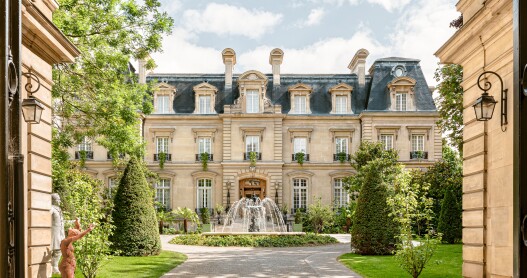
Hilton’s reentry into the heart of Paris is nothing short of majestic. After a $50 million design overhaul, the 125-year-old hotel, made for the 1889 World’s Fair, has been revived to its 19th-century splendor with a contemporary twist. Formerly the Grand Hotel Terminus and the Concorde Opéra Paris, the property’s landmark status—with its Haussmannian facade and elegant public spaces—demanded it be painstakingly preserved. Among the restored, original elements, the most awe-inspiring are the Corinthian columns, chandeliers, balustrades, hand-painted frescoes, and marble and mosaic tiling. Fortunately, the bar takes pride of place among them, making it the ideal spot to start your stay with a cocktail or glass of wine.

The style in each of the rooms breaks with the traditional stark-white modern codes of most business hotels. Here it incorporates warm accent colors and textiles. With few heritage elements left to preserve, the sense of place is woven in with custom etchings of iconic Paris scenes hung behind each bed. But you won’t be spending much time here, as the action happens in the grand salon.
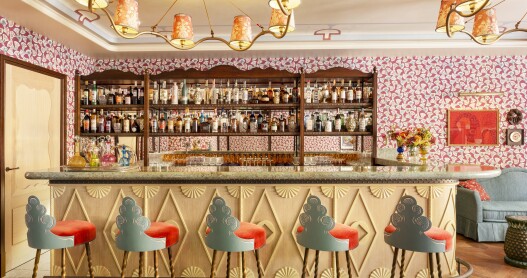
After achieving tremendous success in Paris, London, New York, and Ibiza with the Experimental Cocktail Club and a handful of other nightlife hangouts, the three bons vivants behind the Experimental Group have expanded the concept into hospitality. Their first hotel is located in Paris’s most coveted neighborhood, South Pigalle, overlooking the Villa Frochot (Toulouse-Lautrec’s former abode). Unsurprisingly, these pioneers of the Paris cocktail movement have integrated their savoir-faire in top-shelf drinks. In fact, they go so far as to bill it a “bed and beverage” boutique hotel, which translates to custom cocktails offered in the ground-floor lounge, delivered straight to rooms, and available in guestroom minibars. To further drive their vision, the trio enlisted the talents of Dorothée Meilichzon, the city’s most in-demand interior designer, who has already directed the look and feel of each of the group’s establishments. Here, she applies her flair for mixing unique patterns and design styles to the cocktail lounge and rooms, kitted out with sumptuous velour sofas, black leather armchairs, and brass light fixtures. The result is a style that feels like understated Hollywood regency meets 1920s Parisian glam. While rooms afford less quiet and privacy than most design hotels, the (tolerable) din feels like a necessary component to the stay-up-late Pigalle experience.
From the luxury Oetker Collection, Le Bristol is one of the first hotels in France to obtain Palace distinction. Occupying nearly an entire block on Rue du Faubourg Saint-Honoré near the Élysée presidential palace, this soulful property has been a gathering place for Parisians since 1925. The 190 guest rooms, which feel like private apartments, are decorated with precious fabrics, paintings, and 18th-century antiques. The on-site attractions include a spa by Le Prairie, a teak-lined pool resembling a yacht, and a courtyard garden fragrant with jasmine. For more than a decade, chef Eric Frechon has held three Michelin stars at Epicure, where menu fixtures include the macaroni stuffed with black truffle and foie gras. Frechon’s culinary dominions are a portal into French gastronomy itself: The hotel has its own chocolate factory, cheese cellar, flour mill, and boulangerie.
The Park Hyatt Paris-Vendôme opened in 2002 at the heyday of Asian minimalism, with American architect Ed Tuttle employing dark woods, taupe silks, and clean-lined furniture to transform the grand, 19th-century former headquarters of the Paquin fashion house into one of the city’s most luxurious business hotels. It’s accented with modern French touches such as bespoke sculpted bronze door and cabinet fittings, underfloor heating, French limestone soaking tubs, and rain showers with Blaise Mautin toiletries. Amid other services, airport pick-ups in a Bentley Continental or Rolls Royce Phantom helped win over tourism officials who granted the hotel its current palace status, a grade above a mere five-star rating. Still steadily occupied, but often as hushed as a bank vault, the Park Hyatt Paris-Vendôme is a calm, elegant counterpoint to the nearby Palais Garnier Opera House and blingy Place Vendôme, epicenter of the city’s jewelry district. It’s been a home away from home for many celebrities and it’s a haven for regular business travelers of all industries.
The former residence of Napoleon Bonaparte’s grandnephew, on a hill leading down to the Seine next to the Trocadéro, has been converted into this striking palace hotel whose airy, light-filled spaces by Pierre-Yves Rochon showcase European Empire and minimalist Asian decorative influences in a manner some French traditionalists find refreshing, others eccentric. The location is a bit of a desert when it comes to shopping and dining. However, culture-minded guests love the cluster of less touristy beacons within a two-block radius.

Many rooms in the Shangri-La Paris have unimpeded views of the river, and some have Eiffel Tower views from the bathtub. The second-floor historic rooms, with alabaster columns, stained-glass windows, and coats of arms bearing bees and “B” for Bonaparte, have become a popular venue for society baptisms.
This designer budget hotel, set in a former brothel, is the brainchild of Andre Saraiva, a graffiti artist and nightlife entrepreneur who worked with Parisian artists and designers to pull off an edgy balance of style and substance. Rooms, which are on the small side, are painted in unconventional palettes and decorated with graffiti, and curated flea market and auction finds, vary in their level of provocation, though each could double as a contemporary art gallery installation or soft-porn concept store. While traditional services are nonexistent, the hotel is perfectly located for exploring SoPi, the more upper-crust residential part of the 9th arrondissement just south of the transvestite cabarets and tourist zones of Montmartre, where classical mansions and 19th-century buildings are being colonized by young Parisians and expats opening bars, restaurants, vintage shops, and fashion boutiques. The restaurant that occupies most of the lobby and garden is a perennial favorite among Parisians of all ages for dinner and Sunday brunch.