
Egypt

Say “Egypt” and most people think of pharaohs, mummies, and age-old pyramids. The country isn’t just temples and tombs, though. Immerse yourself in the noise and color of urban bedlam, then come up for air on a lonely desert dune or upon the palm-fringed banks of the Nile. Haggle with vendors in a maze-like souk, then sit quietly in a tranquil mosque or Coptic church and observe centuries-old rituals that still resonate in modern life. Go beyond the monumental glory of the pharaohs and you’ll discover a true Egyptian experience.

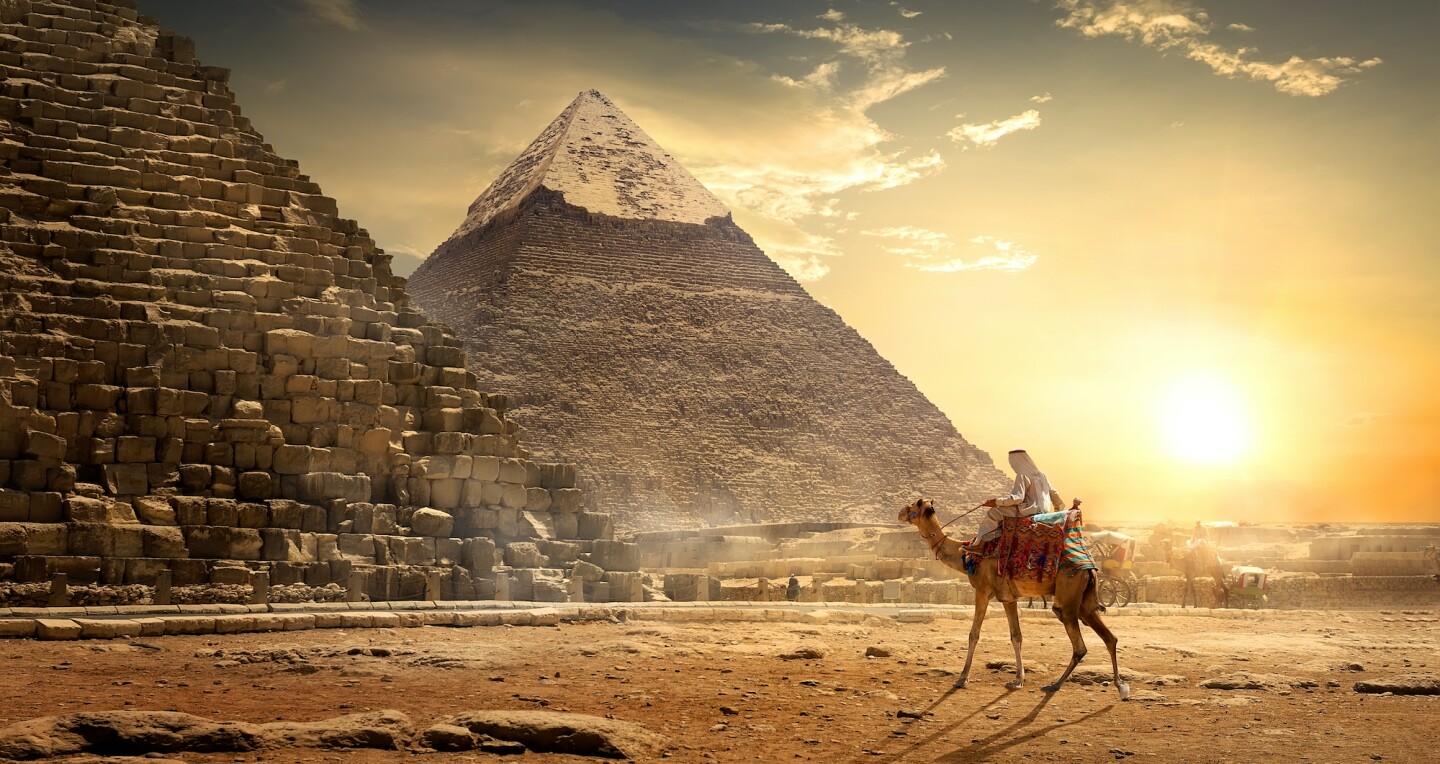
A man on a camel at sunset in front of the pyramids in Alexandria, Egypt

Photo by givaga/Shutterstock

Overview

Can’t miss things to do in Egypt

Egypt’s ancient rulers competed to outdo each other by scattering a cache of lofty temples across the land. The Pyramids of Giza, Luxor’s Karnak and Valley of the Kings, and Ramses II’s grandiose pat-on-the-back at Abu Simbel are the highlights of the pharaohs’ marvelous architectural achievements, but factor time during your visit to explore smaller relics such as the Kom Ombo and Philae temples as well. When temple fatigue sets in, replenish energy levels by discovering Egypt’s natural wonders. More ancient than any pyramid, this nation’s jagged mountain peaks, sinuous Nile, and empty desert expanses are superlative reminders that manmade treasures are only a part of Egypt’s bountiful beauty.

Food and drink to try in Egypt

Egyptian cuisine is infused with fresh and hearty flavors, with influences from the North Africa, the Middle East, and the Mediterranean. This is comfort food at its best: non-fussy, wholesome dishes where seasonal produce plays the starring role. Restaurant menus generally feature kebabs (grilled meat on a skewer) with simple meze-style plates of crispy salads and dips. Heavier specialties include mahshi (stuffed vegetables) and fatteh (chicken or beef with rice and bread, all immersed in a garlic sauce), and the more adventurous hamam (pigeon) and molokhia (a glutinous mallow-leaf stew).

Culture in Egypt

Egyptians are a boisterous, pragmatic people with a sharp sense of humor used to shrug off the hardships of life. Traditional culture and religion still play a prominent role in society, and close-knit family ties are at the heart of daily life. Although conservative in values, you’ll find Egyptians anything but insular. This is a nation that adores having fun and any excuse is used for a celebration. Not known for being stand-offish, and rightly proud of their history, a booming ahlan wa sahlan (“Hello and welcome!”) followed by invitations for tea and a chat are extended to all visitors. Accept those on-the-spot offers and you’ll experience warm and effervescent Egyptian hospitality at its best.

Shopping

Put your haggling hat on and get ready for an adventure. The souk is the quintessential Egyptian shopping experience where you can unearth everything from tawdry plastic pyramids to antiques. The wares at these markets have no fixed prices; the final sum depends upon your haggling skills. But keep in mind: Haggling for your treasure isn’t supposed to be about beating the shopkeeper down to the lowest price possible. It should be light-hearted and fun. For the best souk action in Egypt, head to Cairo’s Khan al-Khalili, whose winding lanes are crammed with textiles, copper workers, perfume, and a bewildering array of kitsch souvenirs. If you’re searching for antiques, look for bargains in Alexandria’s Souk Attareen.

Practical Information

Egypt’s summer (Jun–Aug) is stifling and best avoided unless you enjoy searing temperatures. Spring (Mar–May) and fall (Sep–Nov) are more manageable heat-wise, but winter (Dec–Feb), with its pleasantly warm, sunny weather, is when most choose to visit. Visas are required; most nationalities can buy one upon arrival. Most international flights land at Cairo (CAI) but there are also services direct to Alexandria’s Burg al-Arab (HBE), Luxor (LXR), and Sharm al-Sheikh (SSH). The bus network is extensive. The train is useful for journeys between Cairo and Upper Egypt (Luxor, Aswan), and to Alexandria. The language is Egyptian Arabic; the currency is the Egyptian pound, pronounced “guinea.” Electricity is 220 volts with European 2-pin sockets.

Guide Editor

Jessica Lee is a travel writer who specialises in the Middle East, Turkey, and North Africa. She likes deserts and mountains, and is on a constant quest to find the perfect hummus.

READ BEFORE YOU GO
HOTELS
These 19 hotels around the world immerse you in their destinations while carving out space for unhurried time together.
RESOURCES TO HELP PLAN YOUR TRIP
From family-friendly Nile sailings and ultra-luxurious Danube cruises to a Black history-focused journey on the Rhone and an exploration of Northern California’s Napa Valley, these are the new river cruise experiences to book in 2023.
How to see a new side of the oldest and most visited tourist attraction in the world? Travel with an archaeologist.
Sometimes, the most enchanting experiences can be found outdoors.
Canada opened to vaccinated Americans in August, and numerous European countries changed their entry requirements in September. Here’s the complete list.
A belle epoque grande dame presiding over San Sebastián’s iconic La Concha Beach, the Hotel de Londres y de Inglaterra has been a palace, casino, hospital, and of course hotel since its construction in 1865. Before and after World War I, it was the kind of place where well-to-do Europeans went on seaside holidays for months at a time, enjoying direct beach access, the city’s renowned seafood, and the hotel’s elegant design. Nowadays, the society consists of a somewhat less star-studded lineup—once Toulouse-Lautrec, Archduchess Elizabeth of Austria, and Mata Hari were all guests—but the unobstructed Bahía de la Concha views, lovely rooms (all with private balconies), and pride of place at the heart of the city remain. The window-lined brasserie takes its cue from classic French bistros—it’s not hard to imagine that the well-dressed gentlemen at the next table are French aristocrats-in-exile—and its tables along the beachfront promenade are the perfect place to while away a few hours over pintxos, txakoli (a sparkling white wine from Basque Country), and people watching. If you were to spend a few months in a seaside town, this would be the way to do it.
One of the most famous landmarks, the pyramids that grace the Giza Plateau certainly don’t disappoint. Nearly 4,000 years old, these mystical tombs have captivated the attention of people around the world since they were first built.


Tourism is down in Egypt, making this a great time to visit and have these monuments almost to yourself. With your admission ticket you can wander around the massive structures and even descend into the incredible Pyramid of Khafre.

Touring the pyramids with a trained Egyptologist, like those found with Insight Vacations tours, makes the experience even more enriching. It’s hard not to feel like an archaeologist of old as you “discover” the inner chambers for yourself.
It’s not hard to find souvenirs in Cairo. In fact, most of them will find you at every site you visit. While street vendors are a cheap and easy solution for affordable gifts, if you’re looking for a quality souvenir of your time in Egypt, head to Karnak Jewellery. This huge store specializes in handcrafted items from around the country. You’ll find delicately inlaid boxes, statues carved from bronze, silver, and semiprecious stones, hand-made carpets, and even larger furniture items. But handmade jewelry is the specialty and you can have a piece made to any specification. One of the most original and affordable ideas is a hand-carved pendant featuring the name (or word) of your choice in hieroglyphics. I was given a silver pendant as a gift and it remains a treasured reminder of my brief time in Egypt. Alison Cornford-Matheson traveled to Egypt courtesy of the Egypt Tourism Authority and Abercrombie & Kent. Her highlights are part of AFAR’s partnership with The United States Tour Operator Association (USTOA), whose members provide travelers with unparalleled access, insider knowledge, peace-of-mind, value, and freedom to enjoy destinations across the entire globe. See more about Alison’s trip at the USTOA blog.
Cairo is more than camels and desert, although they have that too. The areas around the Nile are green and lush with trees. Sometimes when I’m walking in Dokki or Zamalek I feel like I’m walking in my hometown in downtown Chico. Unlike the posh island of Zamalek, that’s filled with expats, Dokki is quite authentic. This bustling very local area is full of interesting and unusual restaurants such as my favorite, the Yemeni restaurant. You can also find delicious Sudanese food nearby.
Take a stroll down one of the cobbled streets of Valladolid and you might come across a cart peddling “volcanos.” The busy vender sells one item: a thick masa bun stuffed with chili marinated pulled pork and topped with red onion. For an extra kick, pour on a spoonful of homemade habenero sauce, but be careful! These small pockets pack heat.
One of the best things you can do in Madrid is go on a guided tapas crawl. If you don’t know much about Spain and/or don’t speak Spanish it’s best to have someone that knows what’s going on with you. Here are a few high notes from the crawl. My advice is to be bold and try new things. Don’t be scared and always hop into a bar where you see local people. Thank you to my new friend Carlos! Anchoas (Anchovies) at Casa Toni. Calle de la Cruz, 14 28012 Madrid