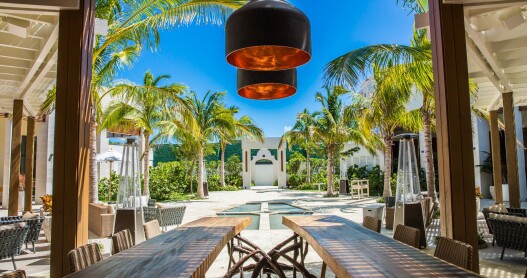
Turks and Caicos Islands

Exploring Turks and Caicos Islands feels like tripping down Alice’s rabbit hole: It’s under British rule, but the currency is the American dollar. Traffic moves on the left, but most rental-car steering wheels are on the right. And you won’t find a single McDonalds or KFC. What you will find is one of the world’s most stunning shorelines, Grace Bay Beach. The 12-mile porcelain-white crescent of sand is fronted by turquoise and beryl-hued waters. The color and clarity come partially from the crushed pink coral sea bottom, found only in this part of the South Atlantic. A protective barrier reef enables safe lagoon swimming for kids, easy snorkeling, and excellent diving and bonefishing. But should you wish simply to relax, the vibe is all about tranquility—more beach chic exclusive than overdeveloped. Although numerous resorts have opened on Providenciales (really the only island developed for tourism), the hotels here blend into their natural environs.

Sail boat on the ocean in Turks and Caicos

Photo By jpbarcelos/Shutterstock

Overview

When’s the best time to go to Turks and Caicos Islands?

Technically in the Atlantic hurricane belt, Turks and Caicos’ location often spares it direct hits from major storms—though Hurricane Ike did pummel the outer islands of Grand Turk and South Caicos in 2008. If you travel during the off-season (June–October), you can score serious lodging deals and likely have great weather on Providenciales. Expect prices to skyrocket during the high season, December to April. The average temperature is between 85 and 95 degrees in summer, falling to 80 in winter. With abundant sunshine throughout the year, the islands are a year-round destination.

How to get around Turks and Caicos Islands

The Turks and Caicos have three international airports, but most foreigners go through Providenciales International Airport on Providenciales (Provo) the main developed island. Most flights go via Miami, and there are limited flights within the Caribbean from Turks and Caicos—so if you plan to island hop, you will likely find yourself backtracking through Florida. The airport in Provo has a tourism booth for arriving passengers, and a restaurant, but little else. The Grand Turk International Airport and South Caicos International Airport are local airstrips used mostly by private charter flights.

It’s easy to get around Provo either by taxi or rental car. If you plan to explore beyond Provo, however, it’s best to rent a car, even if just for a few days, as taxi fares add up quickly. And a car is necessary if you’re staying in one of the villa rentals on the island. Most rental companies offer free drop-off and pickup from your hotel. You can also rent scooters. Note that driving is on the left-hand side.

Food and drink to try in Turks and Caicos Islands

Fresh fish and shellfish are staples in Turks and Caicos. The islands’ geography doesn’t lend itself to growing much in the way of fresh fruit and vegetables, so a traditional local dinner would involve fresh seafood accompanied by peas and hominy. Conch is on nearly every menu and served dozens of ways, with fritters probably the most common. Rum and local beer are the popular alcoholic beverages, although one can find just about any mixed drink at a restaurant.

Culture in Turks and Caicos Islands

Turks and Caicos have a mixed population. They are still governed by Great Britain, and this fact has caused contention in recent decades. Many residents are descendents of African slaves and have been living on the islands all their lives. These residents are known as “Belongers.” The island nation is also known as one of the world’s best tax havens, and as such it attracts a sizable wealthy population of expats hailing from across the world.

Junkanoo has been celebrated in Turks and Caicos since the 16th century, when slaves were given one day off around Christmas to spend with their families. Today the event is celebrated at midnight on January 1, when revelers take to the streets with homemade costumes and instruments and party until dawn. Cinco de Mayo is also celebrated with gusto in Provo.

Local travel tips for Turks and Caicos Islands

Turks and Caicos is not a nightlife destination. You won’t find much open past 10 p.m., making it perfect for honeymooners, couples, or families looking for a quiet getaway. Food and drink here can be pricey, so if you plan to consume a lot of both, look into renting either a villa or a residence-style hotel room with a full kitchen to cut down on costs. One of the world’s most beautiful beaches, Grace Bay is also a great place to learn your chops with a mask and snorkel, as you can literally walk out to snorkeling spots. The coral and fish here are abundant and colorful.

Guide Editor

Becca Blond is an award-winning freelance travel writer based in Denver, Colorado.

READ BEFORE YOU GO
HOTELS
Sure, the beaches and views are great. But these islands excel with sustainable innovation, rich local traditions, and unique accommodations.
At these 14 luxury resorts, it’s possible to have that dream vacation on a private island—without having to own one.
Whether you’re traveling with toddlers, teens, grandparents, or in-laws, these Caribbean retreats offer a balance of ocean and cultural adventures, plus endless opportunities for play.
At these properties, the children’s programming goes far beyond basic caregiving services with immersive experiences that offer younger guests a deeper look into culture, nature, sustainability, and even themselves.
Sometimes the most challenging thing you can do on vacation is absolutely nothing. Our intrepid editor reports from the beaches of Turks and Caicos.
RESOURCES TO HELP PLAN YOUR TRIP
At Mopa Mopa in Oranjestad, local handicrafts aren’t just souvenirs—they’re decorative art. The gallery specializes in carved wooden figures, crafted lovingly in the traditional mopa mopa, or barniz de Pasto, style. To finish each piece, artisans paint them with vegetable dyes and resin-based lacquer, making for one-of-a-kind keepsakes. Visit the gallery to shop and speak with the artisans themselves, who will gladly answer questions and demonstrate their intricate techniques.
History buffs and expert divers score big at this site just 10 minutes off the coast of Aruba. A German freighter during World War II, the 400-foot-long ship is one of the largest wrecks in the Caribbean. Today, its starboard side is blanketed in coral, serving as a home for sponges, anemones, lobsters, and a kaleidoscope of fish. Visibility at the ghost ship is generally 30 to 50 feet, and thanks to virtually zero currents, viewing is easy for both snorkelers and scuba divers. Still, it’s best to explore with a guide, who can lead you through the labyrinth to the most worthy points of interest.
I found Kroměříž when it was almost too late. I had been living in another small city in the Czech Republic for 15 months and, as soon as I realized I really would be leaving, panic set in and I started looking for a new place to settle. That’s how I found myself in love with the small town of Kroměříž. I went alone, walking its streets and parks, photographing Art Nouveau residences, stealing a listen as monks sang in the cathedral, testing out cafes, and taking in the views of the gardens from the palace tower. In the end, I couldn’t stay more than a couple of days, but the unspoiled beauty and quiet of this town stayed with me, like an unrequited love. The Kroměříž palace and gardens are a UNESCO World Heritage Site. They reflect the style of a perfect Baroque garden and played an important role in the establishment of this formal garden style in central Europe. Opening hours vary by month (link to the palace and garden’s official website is below).
Even in a city like Prague is filled with unusual and world-class art, The Memorial to the Victims of Communism at Petrin hill in Mala Strana will command your total attention. Dedicated to those who were arrested, shot, exiled, and otherwise brutalized during the Communist era of 1948 to 1989, this masterpiece made by sculptor Olbram Zoubek and architects Jan Kerel and Zdenek Holzel is especially disturbing at dawn and twilight. Seven bronze men are stood on a set of concrete stairs, and only the first figure is intact, the statues decaying with each step up, symbolizing the effects of communism on the Czech people.
Prague is absolutely one of the most beautiful cities in the world. Its abundant beauty is not only related to the variety of architecture styles (Gothic; Art- Nouveau and Baroque) but also to natural elements such as wild swans that gracefully float along the Vltava River at sunset. Wherever you step in; a restaurant, a bar, a pizzeria... no matter, you will feel embraced. Czech citizens speak Czech, German and English (especially the young crowd). Even though Prague‘s touristic appeal brings thousands of tourists every year, it is a very affordable city and doesn’t give off any feelings of greediness at its core. Food and fun are affordable here. One of the simplest and most exuberant things to do in Prague is walking along the Vltava River. Cross Charles Bridge, enjoy old town, check out the Astronomical clock and do not skip the “Dancing Building”! It’s a masterpiece and a must see. If you love architecture, design, art, photography or even if you are just a visual person, you will have a great time when you see this building because it’s just so cool! It’s also easy to spot as it’s located in Old Town and it’s also a hotel. The building was designed by Croatian-Czech architect Vlado Milunić in cooperation with Canadian-American architect Frank Gehry (the same architect that designed Disney Opera Hall in Downtown Los Angeles). The Dancing House was designed in 1992 and completed in 1996. The building design was controversial at the time because the house stands out among the Baroque, Gothic and Art Nouveau buildings for which Prague is famous. However, then-Czech president Václav Havel (who also lives nearby) gave all of his support hoping that the building would become a center of cultural activity. It turned out to be a great decision to support the project since designers, architects, artists, and enthusiasts from all around the world are drawn in flocks to see “Fred and Ginger”, a nickname given by Gehry as the building resembles a pair of dancers. The nickname is not commonly used but refers to famous dancers Fred Astaire and Ginger Rogers.
On most days in Prague, it feels like every tourist in town has gathered on the Charles Bridge. And for good reason — this 14th-century cobblestone span crosses the Vltava River, connecting the Old Town with the Lesser Town (Mala Strana) and providing picturesque views of both sides of the river, medieval churches, towers, and Prague Castle on the hill. King Charles IV commissioned the bridge in 1357. The bridge has 16 arches and protected by towers on either end: the Old Town Bridge Tower in Old Town and the Judith Tower and Lesser Town Bridge Tower on the Mala Strana side. The bridge is lined with 30 large statues of religious figures and luminaries, dating from the Baroque era to the present day The best time to go is at dawn, sunset or after dark after the crowds have thinned and romance is in the air.
Vaulted ceilings and arched hallways retain the medieval character of the 14th-century monastery that originally stood here in the Malá Strana district. The hotel also houses Essensia restaurant. Doubles from $350, Nebovidská 459/1, Malá Strana, 420/2-33-088- 888.

This appeared in the October 2012 issue.
The Prague Castle complex, which sits on the top of the hill above the city, dominates the skyline, and houses multiple palaces, churches, halls, and museums. The crown jewel of the complex is St. Vitus Cathedral. Construction of this Gothic and neo-Gothic masterpiece began in 1344 and took nearly six centuries to complete. The largest and most important church in Prague, which is surrounded by smaller chapels, is also the spiritual heart of the city. Bohemian and Czech kings and queens have been coronated here and are also laid to rest here underneath the cathedral. The exterior with its heavy bronze doors and carved stone is massive and imposing, but once you enter, the soaring Gothic ceiling overwhelms you with a feeling of lightness. The interior is filled with golden sunlight and glowing colors from the stained glass windows, designed by prominent 20th-century Czech artists, including art nouveau master Alphonse Mucha.
Prague’s Astronomical Clock is the world’s oldest working one of its kind. Installed in 1410, it is located on the Old Town City Hall in Prague‘s Old Town Square. The medieval clock features an astronomical dial; “The Walk of the Apostles”, an hourly show of moving sculptures; and a monthly calendar dial with the 12 signs of the zodiac. The clock is the center of Prague and the city’s most popular sight. On the top of every hour, huge crowds gather to watch the movement of the Twelve Apostles. Two doors on either side of the clock open and the statues become animated with twelve moving disciples. Animated statues representing greed, vanity and death also add to the performance, which during the Middle Ages was one of the man-made marvels of the world. For centuries it has been displaying the time and date, the position of the sun, the phase of the moon and astronomical cycles. Even in the age of smart phones, that is pretty impressive! It’s easy to spend a whole afternoon, if not a whole day, here. You can visit the Town Hall, climb to the top of the tower for one of the best views in Prague, watch an Astronomical Clock performance, then enjoy a Czech meal in one of the local restaurants.
Old Town Square, founded in the 12th century, is the center of Prague. In the middle of it all, the Old Town Hall (which also houses the famous Astronomical Clock), built in 1338, still provides the best 360-degree views of the city. For a fee, visitors can climb or take an elevator to the observation deck of the nearly 230-foot tower for views of the Adam and Eve towers of Tyn Cathedral across the square, the Jan Hus monument, Prague Castle, Strahov Monastery, the National Gallery, and the winding cobblestone streets and red-roofed buildings below.