France

Few countries in the world can rival France for the diversity of its riches, from culture, wine, and gastronomy to exquisite landscapes, charming villages, and sophisticated cities. Throw in a history dating back to prehistoric times, plus the world’s most seductive city, and you have an endlessly fascinating destination. Skiers flock to France’s luxurious resorts, while cyclists and hikers have miles of gorgeous coastline and wooded reserves to explore. Still, cosmopolitans will always feel they’re getting the best deal. Between the countless splendors of Paris and France’s many cultivated cities—Strasbourg, Lyon, Nice, Marseille, Toulouse, and Bordeaux among them—there’s enough to keep visitors busy for a lifetime.

France-Bordeaux-guillaume-flandre-unsplash.jpg

Photo by Guillaume Flandre/Unsplash

Overview

When’s the best time to go to France?

France is definitely a country for all seasons. There’s no question, however, that April and May are loveliest, especially in the villages of Provence and the Mediterranean, which can be scorching in high season. In summer, the French vacate Paris en masse and festivals abound, from theater in Avignon to opera in Aix. Come fall, everyone heads back to the cities and savvy visitors have the tiny villages and tourist hot spots all to themselves. With the exception of airfare, prices do not fluctuate much from town to town, season to season, but the crowds do—another good reason to go in the off-months.

How to get around France

Paris has two major commercial airports, Charles de Gaulle (where most flights arrive) and Orly. The country’s other international airports are located in Marseille, Lille, Bordeaux, and Lyon. From the international airports, you can easily fly to most places in France via budget airlines like EasyJet, Ryanair, and Transavia.

You could also travel by train. Right from the airport in Paris, you can hop on a TGV (fast train) to dozens of major cities, including Aix-en-Provence, Avignon, Bordeaux, Marseille, Strasbourg, and Toulouse. In the city of Paris, six major train stations serve the entire country with fast, easy, and economical connections to pretty much anywhere you want to go, including points throughout Europe. Prices are cheaper the further in advance you book.

In Paris, Lyon, and Marseille, visitors will find clean, safe, and cheap metro and bus systems. Several of France’s other big cities, like Lille and Toulouse, also offer metros, and most have fast, efficient tramways. For touring smaller towns and villages, a rental car is the way to go—arrange for one before you travel and pick it up at the airport or train station in any major city or town. France has very well-marked roads and accepts both U.S. and international driver’s licenses.

Food and drink to try in France

France is the ultimate destination for food lovers, but you don’t have to be a gastronome to appreciate the country’s diverse culinary scene. In Paris, you’ll find pretty much everything the country has to offer, from haute cuisine to traditional brasseries and tiny bars touting natural wines. Smaller cities are more regional—Provence is known for sunny Mediterranean dishes like bouillabaisse, ratatouille, and tapenade; Brittany and Normandy are famous for lamb, cider, crêpes, and oysters; and Perigord and Dordogne are the places to go for foie gras, wild mushrooms, and every kind of cheese imaginable. The croissant—while most plentiful and so very good in Paris—can be found countrywide.

Paris is ground zero for the country’s drinks scene, though wine and cocktail bars are all the rage and you’ll find them just about everywhere in France. The capital city is also the center of the coffee renaissance, but good cafés have quickly spread to other major cities.

When traveling in France, be mindful that restaurants keep strict hours, almost uniformly from noon to 2 p.m. for lunch and 7 p.m. to 11 p.m. for dinner. Brasseries are the exception—they stay open all day, making them perfect for families. Bars keep slightly longer hours, though for true late-night revelry, you’ll need to find a nightclub.

Culture in France

It’s hard to find a city in France that doesn’t have a museum, historic site, or other cultural attraction; even the smallest towns have something enriching. You could spend years exploring Paris’s legendary arts scene—the city has nearly 100 museums, plus countless theaters, cinemas, opera houses, and monuments—or traveling to places like Honfleur, Rouen, and Provence, which inspired artists such as Monet, Picasso, Cézanne, and Van Gogh. Cities like Nîmes, Marseille, and Lyon offer fascinating vestiges of Roman France, while the extraordinary caves of Lascaux and Chauvet take visitors back 40,000 years.

Festivals abound in France, so it’s a good idea to check what’s on before you go. Some of the more famous events, besides the Cannes Film Festival in May, include the Aix Opera Festival and the Avignon Theater Festival (which, together with its alternative Off Festival, offers more than 500 performances each day). In Paris, visitors can plan around the FIAC and Art Paris fairs for contemporary art, as well as the wonderful Festival d’Automne for the performing arts every October through December. Smaller festivals, including the Menton Lemon Festival and Carnival in Nice, provide an excellent introduction to local life.

Can’t miss things to do in France

There’s no better place to start your visit than Paris. From there, France is your oyster, since the superb rail system makes it simple to reach the rest of the country. Foodies will appreciate France’s historic culinary capital, Lyon, as well as the scenic wine trails through Bordeaux, Champagne, Burgundy, and Provence, while hikers and bikers will love château-hopping in the Loire, sightseeing along the wild Brittany coastline, and exploring the wildflower-strewn trails of the Alps. Snow bunnies can soar down Mont Blanc, summer-ski in Megève, or experience the luxurious après-ski scene in Courchevel, and culture vultures will find sustenance everywhere, from Paris to Provence and beyond.

Practical Information

Travelers from the U.S. do not need a visa to enter France. They will, however, need a passport that is valid at least three months beyond the return date on their airline ticket. The currency in France, like the rest of the E.U., is the euro. Though you can order euros from your bank in advance, there really is no need, as ATM machines abound and typically offer the best exchange rates. While the language is French, many people—especially in Paris—speak at least some English. The voltage is 220 and the plug type is C (two round pins), so if you’re traveling from the U.S., be sure to bring an adapter for electronics and a converter for heated appliances.
Guide Editor

Related Guides
READ BEFORE YOU GO
HOTELS
The hotels on this list are as thoughtful about accessibility as they are about design, going beyond compliance to make travel more comfortable and intuitive for disabled guests.
From Indonesia to France, these seven general managers around the globe share how they built their careers—and how they’re shaping the future of hotel leadership.
The newest members include a forest retreat in Georgia, a reef-side resort in Belize, and a Michelin-starred restaurant in Alsace.
These 19 hotels around the world immerse you in their destinations while carving out space for unhurried time together.
From longevity-focused retreats to urban resorts with serious spa programs, France’s top hotels for wellness prioritize results-driven wellness shaped by tradition.
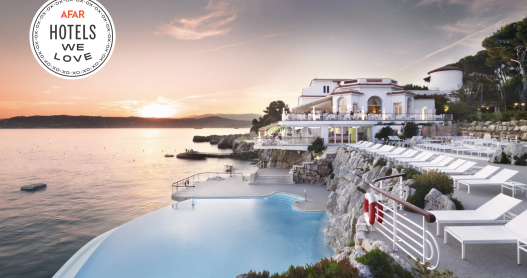
These are the 20 best luxury hotels and resorts in France outside of Paris, according to insiders—whether you’re seeking a bucolic Provençal getaway or an immersion in a bygone era of the French Riviera.
Afar editors share the 2025 hotel stays they didn’t want to leave—and would happily return to.
The historic Riviera hideaway of Bendor Island—once home to artist studios, two small hotels, and France’s first diving center—returns in May 2026 with restored architecture, new landscaping, and the 93-room Zannier Île de Bendor.
From a cliffside aerie to a hideout on the sand, France’s Mediterranean coastline is filled with outstanding luxury hotels—and these are the 14 best places to stay.
These are the top places to stay in the City of Light.
RESOURCES TO HELP PLAN YOUR TRIP
Dedicated to saving threatened marine wildlife, particularly the marine mammals of the Mediterranean, SOS Grand Bleu invites visitors to St. Jean Cap Ferrat to set sail for an afternoon on the historic Santo Sospir sailboat. Catch up with endangered dolphins and whales and follow their pods as guides educate guests on the various species that populate the local ecosystem and the importance of marine conservation across the globe.
Cruising down the Garonne river onboard the AmaDolce, the first port we called on was Cadillac, located about 19 miles from the city of Bordeaux. Cadillac, founded in 1280, is a small fortified town, and I bet their charming Sunday market is probably just as old. The market occupies a number of streets in the town center–you won’t miss it. It’s a great place to try all sorts of local specialties (seafood, breads, cheese, sausages), and of course to people watch. The locals not only do their weekly grocery shopping here, markets are also a real social event in France. Friends catch up, stories are exchanged, laughter rings through the streets. Stock up on your picnic needs, as you’ll have no challenge finding a picturesque spot to sit down and snack along the Garonne.

No worries about the little goose pictured here, it already had a name by the time the buyer walked away from the stand. Definitely pet, not food.
A maze of narrow medieval streets wind up and down this village perched along the Grande Corniche. The ruins of a château are now an exotic garden, and the 18th-century neoclassical Notre Dame of the Assumption church is a national monument. Spectacular views inspire artists and artisans, and their galleries fill the village. Exceptional restaurants like the Château Eza are happy to welcome guests for a drink or a Michelin-starred meal as they relax and savor the scenery.
It’s not just Restaurant le 3842’s elevation that will make you lose your breath. Known as one of Europe’s highest restaurants (3,842 meters above sea level), this remarkable spot provides panoramic views of snow-dipped Alpine peaks that you can almost reach out and touch. Somehow built onto the side of Aiguille du Midi and only accessible via the cable car, this remarkable feat of engineering seems more like the dining place of Gandalf the Grey than a quality French restaurant. Once you’ve dragged yourself from the viewing platform, head inside to dine on locally sourced fare including cured meats, cheese, and Savoie rump steak.
Sometimes overshadowed by more glamorous southern French cities, Montpellier comes as a surprise to many visitors when they stroll its lovely medieval old town, filled with boutiques and bistros, and with the vibrancy of university life in the air. In an enormous renovated mansion, the Musée Fabre has vaulted to major-art-museum status with a collection of French masters like Poussin and painters from the Fauvist movement, as well as a notable decorative arts collection.
Forget food trucks and crepe stands. When Parisians want a quick, easy meal, they head to the local boulangerie and order a jambon-beurre—"un mixte, s’il vous plaît!” The best sandwiches are the simplest: a thick slice of country ham nestled between butter-spread halves of a freshly baked baguette. Ensconced in an old chevaline (horse butcher shop) replete with 1950s decor, Chez Aline is a fast-food deli with a reputation for the best jambon-beurre in the city. Chef Delphine Zampetti offers a selection of other sandwiches, salads, and desserts to curb your hunger.
Surrounded by nature, La Vigie has water on one side and a small pine forest on the other. Perhaps all this exposure to nature inspired Chef Paolo Sari to create his organic menu of pastas and seafood cooked in a regional Italian style, the first organic restaurant to earn a Michelin star. Since this is practically (but not technically) Monaco, there is caviar on the menu, but the overall ambience is casual-chic, not glamorous. In addition to reservations, sunglasses and hats are necessary to combat the intense light playing off the waves.
A Saint-Tropez institution since the 1950s, La Ponche has served all comers, from luminaries like Picasso and Sartre to fishermen and tourists. The restaurant feels a bit secluded, hidden around a corner in a small square overlooking a tranquil bay. Seafood takes precedence on the Mediterranean-influenced menu. Take your pick among tagliatelle with lobster, grilled prawns, mussels, and the catch of the day, be it sole or sea bass. Outdoor tables with a view encourage sticking around for another bottle of rosé—and should you really get comfortable, there are 18 luxury hotel rooms at your service.
While Chamonix boasts a plethora of exquisite fine-dining restaurants, the area has a rugged, often wild side too. Step forward, Micro Brasserie de Chamonix or MBC as it’s known: Towers of nachos covered in glowing cheese, jugs of beer dripping with froth, and a clientele more chug than chic make this fun spot ideal for après-ski. Run by Canadians, this microbrewery offers a wide selection of real ales and lagers brewed in the onsite fermenting tanks and vessels. Classic Canadian poutine, slow-cooked ribs, and a wide selection of burgers satisfy the appetite after a long day on the slopes.
A quintessential Alpine winter break wouldn’t be complete without scooping dripping molten cheese from a fondue pot after a day on the slopes. Few places offer this traditionally Savoyard experience quite like the warmly elegant La Calèche Restaurant. It’s not just the variety of fondues, raclettes, and tartiflettes which sets this place apart: The Savoyard dishes merge perfectly with the array of black-and-white photos of Mont Blanc hanging on the walls and the wooden sledges and skis hanging from the ceiling. The cozy terrace is ideal for watching skiers heading back home, while on a Tuesday evening a lively costumed folklore group induces singing, dancing, and mountain merriment.