Costa Rica

Costa Rica is a small Central American nation that shelters nearly six percent of the world’s biodiversity. Expect to see gorgeous orchids, colorful birds and butterflies, howler monkeys, and maybe even the elusive margay, a spotted nocturnal cat that lives in the rain forest. In addition to natural beauty, there’s a lot to love about a place that hasn’t had an army since 1949. Costa Rica’s Ticos (as locals are called) have managed to avoid the conflicts that have devastated neighboring nations.

Costa-rica-KatieOrlinsky.jpg

Photo by Katie Orlinsky

Overview

Can’t miss things to do in Costa Rica

Most visitors come to Costa Rica for nature. Twenty-five percent of the country is protected, and most natural areas are easily accessible, though some require going off the beaten path. There are 186 areas protected by the National Conservation Areas System, including 32 national parks and 51 wildlife refuges. More than 10 conservation areas are within reach of San José, the country’s capital, alone, and each offers a different nature experience. From the last remaining tropical wet forests in the Mesoamerican Pacific, located in Corcovado National Park, to the stalagmite- and stalactite-filled caves of Tempisque Conservation Area, travelers can see a variety of habitats in one trip. As for accommodations, there are plenty of options for roughing it, but Costa Rica also features upscale resorts where you can retreat and recharge after a day outside.

Food and drink to try in Costa Rica

Local food is a way of life in Costa Rica. Corn, beans, and root vegetables are grown here and find their place on most Tico tables. Start the day with locally produced coffee, served alongside such Costa Rican fruits as pineapple, cashew fruit, and sapote. Don’t be surprised by the heaping portions of gallo pinto, a rice and bean dish served any time of day. At breakfast, it’s usually accompanied by an egg, tortilla, and thick slice of farmers’ cheese. Plantains and meat often join gallo pinto at lunch and dinner. Costa Rican food is not spicy; if you need an extra pop of flavor, splash a dash of the local favorite Lizano Sauce (akin to HP Sauce) on your meal.

Culture in Costa Rica

Costa Rica is an anomaly in Central America. Like its neighbors, the country traces its cultural heritage back to indigenous groups that occupied the land before the Spanish colonial period, but its modern history is quite distinct. Political choices to embrace democracy, abolish the national army, and protect rather than develop its natural assets have put the country in an economic and social position in which the quality of life here generally exceeds that of most Central American countries. Costa Rica has repeatedly been designated among the happiest countries in the world by international development researchers. Visitors come from around the world to discover the secret of pura vida, or pure life.

Shopping

Unlike most of its Central American neighbors—most notably Guatemala, which offers one of the region’s largest markets, Chichicastenango—Costa Rica does not have a thriving handicraft culture. However, there are a few Costa Rican goods worth taking home—such as hammocks, jewelry made of fruit and tree seeds, and non-perishable food products like homegrown coffee and the popular Lizano Sauce. In Costa Rica, your money is best spent on epic experiences, from hiking and zip-lining to exploring caves and active volcanoes. Those memories will last longer than any souvenir.

Practical Information

  • Costa Rica has several international airports. Most visitors fly into San José, the capital, or Liberia.
  • Costa Rica’s official language is Spanish, and the currency is the colón. Credit cards are widely accepted.
  • When you leave the country, you will be required to pay a U.S. $29 departure or exit tax; many airlines include the fee in their ticket prices.
  • Voltage and plugs are the same as in the United States.

Guide Editor

Julie Schwietert Collazo has been a bilingual freelance writer, editor, and translator for the past 10 years and loves (almost) every minute of it, but tells people if she could have any other job, it would be a gig as a Mexico City evangelist. The Mexican capital is her former home and the first place she always wants to go when she gets on a plane. Read more at collazoprojects.com and Cuaderno Inedito.

READ BEFORE YOU GO
HOTELS
Waldorf Astoria opens in Costa Rica with rainforest views, spa rituals centered on Indigenous healing practices, and ambitious sustainability goals—while navigating the scale of a nearly 200-room property.
Occupying a peaceful corner of Costa Rica’s biodiverse Peninsula Papagayo, the new Nekajui, a Ritz-Carlton Reserve, lets travelers commune deeply with nature and local culture.
If health is the new wealth, then Blue Zones travel offers one of the most immersive get-rich-quick schemes on Earth. Afar takes a closer look at a program at Andaz Costa Rica at Peninsula Papagayo.
At these rental properties around the world, you can commune with wildlife and farm animals.
The best way to embrace the country’s pura vida is by staying in one of these nature-surrounded rental properties.
From the Swiss Alps to the Brazilian rain forest, these Airbnbs are worth booking just for the views.
The world’s best beach resorts put cultural and environmental preservation front and center.
Located on the green Osa Peninsula, this resort offers a comfortable base for nature-filled adventures.
RESOURCES TO HELP PLAN YOUR TRIP
Especially after its recent $35 milllion refurbishment, Four Seasons Costa Rica sets the standard for service and luxury in Costa Rica’s burgeoning luxury resort market. Its location is unmatched: perched atop a narrow isthmus, overlooking beaches on both sides, at the very tip of the Papagayo Peninsula. Three swimming pools form the hub of action, spanning the width of the peninsula; on one side of the enormous main pool is an adult pool leading to serene Playa Virador on the Pacific, while the busier family pool leads down to Playa Blanca, where most of the water activities happen—snorkeling, stand-up paddling, kayaking. There’s also an 18-hole Arnold Palmer–designed golf course that’s been tamed from the surrounding jungle. Guest rooms have marble baths, and outdoor terraces or verandas, while the larger suites (one- and three-bedroom) include their own pools. For light dining options, try the ceviche offerings poolside at Bahia or Italian seafood at Pesce. For a splurge, head to Caracol at the golf course for steaks and lobster tail.
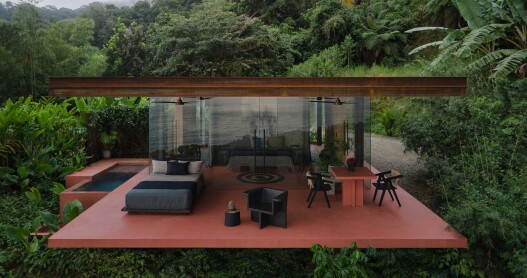
The first thing guests notice as they approach the 600-acre Rio Perdido ecolodge is a large wood-and-steel rotunda that, from a distance, resembles a flying saucer, an award-winning design that houses the resort’s open-air restaurant, bar, and spa. The bungalows are just as stylish: 30 prefabricated cubes are suspended on seven pylons (no trees were cleared during the building process) and feature an airy, modern aesthetic, with twin rolling beds, brass fixtures, and terraces with hammocks sited for gentle breezes. Larger suites are moodier and more romantic, with walls of singed wood and volcanic-stone floor tiles. Soak in the property’s natural springs, which are heated by the activity of nearby Miravalles Volcano, then choose your own adventure. If you’ve worked up an appetite hiking, tubing, or canyoneering, the restaurant serves satisfying Costa Rican casados (rice dishes) and ceviches, which guests can arrange to enjoy from a platform that sits 160 feet above the river that gives the property its name.
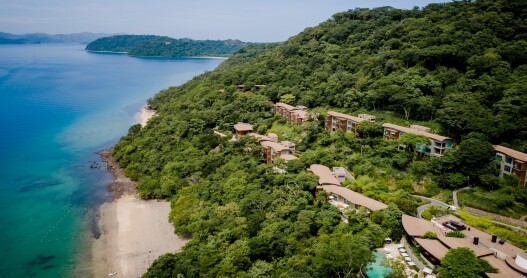
Occupying 28 ocean-front acres on the northwest coast of the Bay of Culebra, Andaz Peninsual Papagayo evokes its natural surroundings at every turn. Costa Rican architect Ronald Zürcher took an organic approach to the design of the buildings, modeling rooflines on shapes found in the shells and cocoons that appear on local shores and in the jungle canopy.

Even standard rooms—which are sprinkled over a hillside that’s bookended with beaches—elicit a strong sense of place with hand-carved artifacts, forest views, and walk-in rain showers that open to large balconies, blurring the line between indoors and outside. (Luxury seekers can upgrade to a suite to take advantage of soaking tubs and private plunge pools.)

For the actively inclined, there’s a golf course, tennis course, and access to nearby zip-lining, though no one would blame you for kicking your feet up by a pool overlooking the bay; there’s an adults-only infinity pool as well. Ostra serves fresh seafood caught in local waters, while Chao Pescao offers the ultimate expression of pura vida with tapas and small plates, a first-rate mixologist, and live music and dancing on Saturday nights.
Even if you don’t have anything specific in mind to buy, go to browse Tamarindo’s main avenue for well-priced souvenirs. Here you’ll find traditional coffee and chocolate next to art and wood crafts. There are also supermarkets, drugstores, and jewelry and boutique stores. Whether it’s a valuable artwork or lovable trinket, it will remind you of your visit to this beautiful country.
Among Playa Avellana’s numerous pleasures, the small-town, almost-no-cars vibe sets the scene for true relaxation—as well as fun. Look for Lola’s—perhaps the hippest spot in town—in the tiny business district and try out fresh, locally sourced pizzas, mahi-mahi tacos, and veggie burgers; smoothie lovers will go nuts. Locals and visitors pack in under the almond trees late mornings after surf excursions and other adventures. Be on the lookout for Lolita, the piglet daughter of the original Lola (sadly no longer with us) as she frolics in the sand or ranges across the property.
On the white-sand beach of Playa Flamingo, Coco Loco has everything you need to set your afternoon or evening on the right note. Enjoy fresh food and delicious cocktails in a fun, laid-back environment. Make sure to try their signature drink, the Coco Loco: a sweet and flamboyantly colored concoction.
Guaitil Pottery Studio in Tamarindo is a truly unique experience. Here, owner Arbin Espinosa Guevara displays and sells his Guaitil pottery, and gives lessons to visitors interested in learning the craft themselves. One of the few remaining indigenous crafts still practiced in Costa Rica, this organic coil-built pottery is beautiful and intricate. Browse the studio, watch artists at work, or take lessons in this ancient tradition yourself.
Palo Verde National Park is the perfect escape for avid wildlife and bird watchers. The park is one of the world’s most important wetland sanctuaries and a vacation destination for many species of migratory birds. It is also home to crocodiles, monkeys, deer, coati, and jaguarondi. The best way to glimpse the wildlife is on board a boat ride through the fast-flowing Tempisque River.
Part dive bar under the palms, part reggae dance hall, and part DJ club. This is the place to come for a great night out with friends. All Pura Vida!
Nestled under an old tree, Lazy Wave offers fresh Asian, Latin, and European fusion cuisine. The setting is wonderful, with fluffy cushioned couches and candle-lit tables in an exotic garden.