Panama

The first thing you’ll get when visiting Panama is a warm, sloppy, atmospheric kiss; relative humidity never falls below 80% and temperatures never dip beneath 77˚F. The nation’s capital city rises at the northern limits of the Gran Chocó, the planet’s rainiest geographic region. Though it’s small compared to other Latin American capitals, Panama City’s location and historical role as a port and a canal that brought together people, commodities, and customs from every corner of the planet, have endowed it with a strikingly cosmopolitan air that’s hard to find in other cities its size. In Panama, everything—shopping, watersports, mountain hiking, getting out into nature, and visiting historic sites—is close by and can be done in a single day.

Aerial view of Boquete in the Chiriqui province of western Panama.

Photo By Curioso.Photography/Shutterstock

Overview

When’s the best time to go to Panama?

Panama isn’t subject to the standard four seasons, just a rainy period from May to November—characterized by merciless sun and sudden downpours—plus a dry season from December to April. The best time to visit is in December and January, when the weather transitions through both periods and cold fronts from further north sweep across the Caribbean Basin, meaning cool breezes caress the Central American isthmus.

How to get around Panama

By air, Panama City is one of the Western Hemisphere’s best-connected spots. There are “tourist taxis” that connect Tocumen International Airport with downtown Panama City. Cars are available for rental, as are Uber and Cabify rides. Good public transport from Tocumen is lacking but the Metro’s Línea 2 (part of the first subway in Central America) seeks to solve that problem starting in 2019. Buses—both in town and heading toward the suburbs and the countryside—are reliable if not perfectly comfortable. Domestic flights connect Panama City to other tourism destinations in the country like Bocas del Toro, David, Chitré, San Blas, and Darién.

Can’t miss things to do in Panama

Without a doubt, the Panama Canal is an absolute must-do on any trip to the country. This engineering feat was, is, and will continue to be a key factor in the role Panama plays on the world stage, as well as in the profile of its people and culture. The rain forest is also a mandatory stop, especially because you can get there so easily from the capital. As its geography might suggest, the Isthmus of Panama is a bottleneck where a great deal of all tropical biodiversity comes together, lives together, and fuses.

Food and drink to try in Panama

Cultural diversity is Panamanian cooking’s forte. From earliest childhood, for example, the people of Panama lap up Chinese culinary traditions alongside Africa-derived cuisines. That said, if you’re looking try something from the country’s traditional menu—something simple, tasty, and hearty—ask for the chicken soup called sancocho, arroz con pollo, or a tamale (they come in the style you’ll recognize and also in casserole form)…and that’s just a handful of essential favorites. As for drinks, the spirit known as aguardiente seco (no relation to the anise-flavored liquor enjoyed in Colombia) as well as rum, are the typical choices. A 10% tip is customary in restaurants. Any sort of obligatory service or set-up fees, as may be the practice in other countries, are against the law in Panama and you should refuse to pay them.

Culture in Panama

The people of Panama take pride in their traditions and history and, above all, their struggles for full territorial sovereignty, a goal finally achieved in 1999. The nation prides itself on its raucous nightlife, and pub crawls called arranques (not unlike the Spaniards’ marchas) are an institution for locals, especially between Thursday and Sunday nights. Soccer is winning over fans, but baseball still reigns supreme; provincial-town matches make for a colorful study in popular customs and quirks. Not least of all, you can’t understand the culture of Panama without considering Carnaval: though its pageantry and opulence are lesser than what you see in Rio or Barranquilla, its explosion of street-level flirtation and revelry is unknown in other regional countries.

For Families

Panama is an ideal family destination, above all for those who like spending time in the great outdoors. Activities include visiting a plethora of natural areas a short hop from the capital. The Museo de la Biodiversidad as well as the Punta Culebra nature center—operated by the Smithsonian Tropical Research Institute in the Amador region—support interactive activities for explorers of all ages.

Local travel tips for Panama

Panamanians are cordial, but deal with life on their own schedule, so don’t always expect lightning-fast responses to your requests; try to take things easy. Although posted rates exist for taxis, these are disregarded as a matter of course; you’ll need to negotiate fares before getting underway. Your status as a foreigner may tempt a price hike; be ready to say no at first to reach a more reasonable charge. While the weather in Panama is hot, running around too scantily clad is not seen as very good form; in fact, men who ply city streets shirtless may be in for a police hassle. Also expect a vast contrast between outside heat and the gelid temperatures to which most AC systems are adjusted.

Guide Editor

Roberto Quintero is a storyteller and dramatist who has lived in Madrid, Buenos Aires, and now calls Panama City home. Under the stage name Winnie Sitton, he has enjoyed an outrageous stand-up comedy career in Panama that he supplements by writing travel journalism for publications at home and abroad.

READ BEFORE YOU GO
HOTELS
At these 14 luxury resorts, it’s possible to have that dream vacation on a private island—without having to own one.
AFAR’s picks for the 31 best new hotels in the world.
Panama City is best known to travelers for its famous canal, but a new hotel from Sofitel Legend is elevating the city’s profile.
Nayara Bocas del Toro offers a new—and luxurious—way to experience Panama’s wildlife-rich islands in the Caribbean Sea.
RESOURCES TO HELP PLAN YOUR TRIP
Panama’s principal Baha’i temple exudes peace and serenity 770 feet above sea level. The religion’s houses of worship are prayer and meditation spaces open to all, regardless of individual belief, social group, or ethnicity. The faithful follow the teachings of the prophet Baha’u’lláh, who preached—among other tenets—human unity, the individual pursuit of truth, harmony between religion and science, as well as equality between men and women. Panama’s temple, opened in 1972 at the summit of Cerro Sonsonate, is one of just eight like it in the world; Baha’i sacred scripture considers Panama a “crossroads.” Since its opening, the stately white dome crowning the temple, drawing the eye toward heaven, has become one of the urban landscape’s most striking architectural elements.
The Cinta Costera is a seaside walk that follows the shores of Panama Bay and features recreational areas and green spaces, sports facilities, and bike paths. A very popular spot, especially on weekends, the promenade brings together all of Panama: a mash-up of athletes, canoodling couples, and families out for a stroll, slurping on ice cream or cucurucho de raspados (sweet, syrupy shaved ice). You’ll also enjoy a view of the city skyline, from the modern districts and their look-at-me skyscrapers to the old colonial quarter. There’s another great vantage point at the Mirador del Pacífico, a 15-acre landfill breakwater that’s become one of the city’s most visited attractions. Other standout “la Cinta” sites include the food stalls at the Mercado del Marisco and Sabores del Chorrillo, as well as the Maracaná soccer stadium.
To see the Panama Canal in person is to dive deeply into that nation’s history. Coming from the capital, the closest entry point is the Miraflores Visitor Center. Dedicate enough time to check out exhibitions that reveal why the waterway was built here and how the route shaped Panama’s international profile. Head outside to see how the canal works. The structure has several levels, and the third level is always crowded with visitors seeking photo ops. (There’s a restaurant on level four.) If you have time, the Agua Clara observation center on the canal’s Caribbean side offers views of newer, wider locks that opened in 2016.
The canal’s descent back to sea level begins at the Pedro Miguel Lock, whose single step is almost quaint in comparison what’s happening in the canal’s other two sets of locks. Yet, so vitally important is it that Presidents Theodore Roosevelt and William H. Taft both stopped to inspect excavations and address workers here. The lock is so narrow that you could almost reach out and touch the “mules,” the toylike silver locomotives that guide the ships.

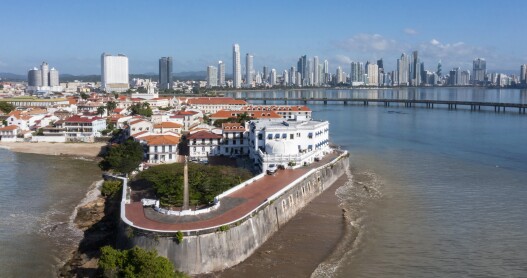
Conquistadors built Panamá Viejo, the first European settlement on the Pacific Coast of the New World, in 1519. The original site was abandoned in 1671 after Henry Morgan’s pirates attacked and the residents relocated down the coast. This second settlement, now called Casco Viejo (old town), is the historic district of Panama City. Together, both locations make up a UNESCO World Heritage Site. At Panamá Viejo, visitors can explore an archaeological site with famous ruins, while Casco Viejo is abuzz with the markets, cafés and nightlife found along its narrow streets and in its classic waterfront buildings.
The Mercado de Artesanías 5 de Mayo is best known for crafts such as painted ceramic bowls, woven baskets, textiles and dolls in traditional outfits, though you can also pick up touristy souvenirs. It’s the place to shop for a panama hat in Panama City (even if they are actually imported from Ecuador) or that hammock you’ve always wanted.

Reservations at Donde José, with room for only 16 diners, have been coveted ever since the restaurant opened in 2014. Chef José Olmedo Carles uses traditional Panamanian ingredients from local farmers, such as ñampí, a variety of taro root, in tasting menus that change every few months. After their meal, diners can stroll along the Cinta Costera waterfront.

This is dinner (or lunch) theater like you’ve never experienced before. You’re guaranteed a show at the Miraflores Restaurant, atop the Miraflores Visitor Center, when your table has views of the ships passing through the locks. It may be a touristy spot, but the restaurant gets high marks for its lunch buffet and dinner menu, with the ceviche and fresh grilled fish especially good options.

From 1903 to 1979, the Panama Canal and an area extending eight kilometers (five miles) beyond it on each side were an unincorporated territory of the United States. The Canal Zone was not only politically but culturally part of America, with towns that could have been plucked out of the Midwest except for the humidity and tropical foliage. Balboa was the administrative capital of the Canal Zone, with American schools, several Protestant churches with services in English and both an Elks Club and a Masonic Lodge. Many of the buildings, like the YMCA and the Panama Canal Administration Building, still stand. After 1979, the Canal was jointly administered by Panama and the United States for 20 years before being returned completely to Panama in 1999.

In reality, the 1,620-hectare (4,000-acre) Barro Colorado Island is a hilltop. Or, at least it was until the creation of Gatún Lake turned it into the largest island in the Canal Zone, one where the Smithsonian Institute operates a research center and gives morning tours. Ships sail tightly past the island, offering the chance to glimpse toucans, iguanas and bats that live among the 1,300 plant species and 381 bird species of this vital tropical woodland.