
I’m standing beside the Yarra River as it carves through Melbourne beneath skyscrapers shimmering in the January sun. Except it’s not the Yarra. My guide, Rob Hyatt, explains that in the Wurundjeri language, yarra simply means “flowing river,” which colonial surveyor John Helder Wedge mistook for its place name. This waterway is properly called Birrarung—river of mists and shadows.
“Until colonization, this was all wetlands and lagoons,” says Hyatt, a Wotjobaluk man who runs experiences at Koorie Heritage Trust, a First Peoples cultural center in downtown Melbourne. Waterfalls offered fresh water separate from the salt water of Port Phillip Bay, “and it was crystal blue—you could see to the bottom.” I peer at the surface and see only my reflection.

Near the town of Daylesford, Hepburn Regional Park is home to walking trails that pass waterfalls, including the popular Sailors Falls; Rob Hyatt guides public walking tours for the Koorie Heritage Trust, a Melbourne–based arts and culture organization that dates to 1985 and invites visitors to discover Aboriginal Victoria.
Photos by Charlie Hawks
In Australia, a continent that’s 70 percent arid, water has always been a vital resource, both for the people indigenous to the land and the settlers who appropriated it for their flocks and herds. Since the 1960s, when the country began promoting its coastline to international tourists, its surf and wide white beaches have been obvious draws for travelers. But the water experiences I’m here for are less about surfing and suntans: I’ve come to follow the Great Victorian Bathing Trail, which opened in 2024 to connect natural springs, spas, and sea pools.

Victoria has Australia’s highest concentration of mineral springs.
Photo by Charlie Hawks
Victoria, the second-smallest state in Australia (after Tasmania), is home to most of the country’s mineral springs, and their waters have long been believed to have beneficial effects, whether you swig them or soak in them. Several springs along the trail were once sacred sites to their traditional custodians. “We know the Aboriginal people here would have known about them, but we don’t know how they would have used them,” Hyatt says. Other stops include bathing sites that date back to more than a century ago, when immigrants first established European-style bathhouses here. Some are even more recent, with contemporary facilities for soaks, salt floats, and contrast therapy, which alternates between cold and hot water immersion.
The Bathing Trail stretches almost 560 miles between Portland in the west and Mount Hotham in the east. I’ll follow a portion of it as it curves around Port Phillip Bay, heading southeast from Melbourne to the Mornington Peninsula, then crossing the bay and circling back up to the Daylesford area northwest of the city, the fountainhead for 80 percent of Australia’s natural mineral water.

Cliffy’s Emporium maintains signage from when it opened in the 1950s.
Photos by Charlie Hawks
For some people, the idea of a spa break that involves 250 miles of driving may be less than appealing. But holing up for a week at a wellness retreat has never been my thing. I love to be in water, but all that herbal tea and tinkly background music makes me feel as if I’m pretending, playing the part of someone on vacation. To truly relax, I need to be on the go. Perhaps this bathing trail, which presents the opportunity to try a wide variety of water-based activities, might help me appreciate an approach to wellness I’ve long overlooked.
Heading out of Melbourne, I’d planned to stop for a swim. But in the seaside town of Dromana, on the Mornington Peninsula, the wind thwarts my plans, conjuring a dangerous swell; even a walk along the sand is a battle with invisible forces. A long row of colorful beach huts fronting the dunes suggests this is a popular spot, but I see only a couple of determined dog walkers, hoods up. “Normally, this is the calmest beach,” one of them assures me. He even shows me pictures on his phone to prove it.
As I begin my drive inland, the peninsula’s charms become more obvious. After a steep ascent up Arthurs Seat, a landmark 1,000-foot granite hill with views over Port Phillip Bay, I strike out along the main ridge toward the southern coast. Much of Mornington is a national park; wending through Cape Schanck, with its red-capped lighthouse and low cliffs furred with vegetation, I can see why.

At Alba Thermal Springs & Spa, robes are the de facto uniform—including at dinner.
Photo by Charlie Hawks
By early afternoon, I’ve arrived at Alba Thermal Springs & Spa, where everything seems purposefully designed to slow you down. I’m told, in peaceful, elongated tones, that there are 25 pools here of different sizes and shapes, and the water is naturally heated in underground aquifers to temperatures ranging from 98.6 to 109.4 degrees Fahrenheit.
Geothermal activity was first recorded on the peninsula in 1979, although the Bunurong people, the land’s traditional owners, have long had a cultural connection to the waters of this region. About 40,000 years ago, during the last Ice Age, the hot springs must have been welcome to the migrant humans walking the land bridge between here and Tasmania. Alba, which opened in 2022, is a mile away from Peninsula Hot Springs, created 20 years ago when a pair of brothers drilled a 2,000-foot bore into the earth to channel the underground flow into artificial pools; Alba’s water today is sourced from a geothermal aquifer that same distance underground.

Beyond outdoor soaking pools, Alba Thermal Springs & Spa includes 22 treatment rooms, steam rooms, and relaxation lounges.
Photos by Charlie Hawks
For someone not accustomed to a spa break, Alba is an advanced place to start. The low-lit interior presents like a futuristic space station. What appear to be walls are actually automatic doors; sculpted stone benches might be teleportation platforms. I manage to get lost in the short distance between the changing rooms and the exit to the pools, which are arranged along a terraced hillside.
I find that most of the pools at Alba are occupied by people in pairs, and I’m too shy to slide in next to them. Eventually I spot an empty one: a shallow circular basin that looks like a birdbath for humans. I wriggle down until I’m covered to my neck in pleasantly warm water. The naturally occurring minerals—sulfur, magnesium, calcium, and potassium—are believed to have relaxing and restorative benefits when absorbed through the skin, loosening tight muscles, boosting skin health, and improving lymphatic flow. But the first thing I notice as I close my eyes is my thoughts: Is this what other people call calm? If not, what is? How do I relax more quickly?
Over the course of the afternoon, I hustle from bath to bath, dunking myself like an overused teabag. I spot a group of young women who are clearly regulars and ask them how to achieve a more zen-like state; they tell me to “go with the flow.” It’s helpful advice when I’m in Alba’s elegant restaurant that evening, given that I’ve never dined in public in a robe before.

Colorful beach huts feature prominently along the Great Victorian Bathing Trail.
Photo by Charlie Hawks
The next morning, my limbs are tired to the marrow. Is this the work of the nutrients? In my discombobulated state, the small seaside town of Sorrento, where I’ve headed to catch the ferry, seems like a hallucination. Its architecture is a mix of European styles, including Swiss chalet and French château. At Amalfi-style cafés, residents and travelers sit under lemon-colored parasols.
After I drive onto the ferry and park my car on the ship deck for the 40-minute journey to the Bellarine Peninsula, I stand at the passenger rail, watching beachgoers race each other into the surf. As the ferry hugs the coast, the clear turquoise water rolls gently toward a row of fantastical houses, each with a private jetty and a motorboat (and the occasional helicopter). Then a shuffle of passengers indicates a new sight on the other side. I follow and see a pod of a half-dozen dolphins surfing and spinning in our foamy waves, embellishing the performance with occasional arcing leaps.

The Mornington Peninsula offers the opportunity to swim with dolphins who live there year-round.
Photo by Charlie Hawks
We disembark in the town of Queenscliff, population 1,516, and I cross its narrow spit of land to the hamlet of Point Lonsdale, only slightly larger, with 3,788 residents. Near the point itself, at the end of a driveway fringed with alliums, stands a farmhouse repurposed as Lon Retreat & Spa, where guests like me can bathe in the mineral waters that run through the limestone beneath our feet.
With seven rooms, the Lon is a boutique affair. For an entire afternoon I have the place to myself. I spend my time under a Swedish “soak bucket”—filled with freezing-cold water you tip over your head with the pull of a cord—dousing myself with its short, sharp shock before I set out, invigorated, on the nature trails that wind around the grounds. Seven generations of the same family have worked the surrounding farm, and there are still handsome black cattle grazing on the land, vegetables in the kitchen garden, and olives ripening in the groves.
But I turn away from all of that to a location on the map marked “Moonah Forest.” For 20 minutes, I work my way around a field, encountering only flies, snakes, and errant balls from the neighboring golf course. A peculiar smell turns out to be the sweet, briny aroma of a vast salt marsh, where a black swan swims back and forth.
The forest itself is a narrow strip of woodland, and yet its Moonah trees are as enchanting as their name. Twisting, twining limbs that might have been drawn by a Disney illustrator lean in as if in welcoming embrace. Trunks creak like swings in an empty playground, while wind whistles through foliage. The flies have been replaced with butterflies the size of my fingernail, and a long-tailed lizard crosses my path for a few panicked steps before seizing up in the vain hope of camouflage. Here comes an epiphany: I want my water treatments with a real-earth experience like this one—not something so separate, sanitized, and perfumed.

Geelong’s Bollard Trail Walk along the Eastern Beach waterfront is lined with more than 100 painted wooden posts that represent the town’s history.
Photo by Charlie Hawks
The next morning, I drive a half hour west to Geelong. With 189,239 people, Victoria’s second-largest city may have only a fraction of Melbourne’s population, but it has been a destination for sea bathing since the mid-19th century, when men and women were expected to take to the water in separate enclosures. Enriched by the Victorian gold rush of the 1850s, Geelong’s Eastern Beach waterfront was gradually developed into a public leisure destination; the art deco bathing complex that stands here today, complete with a 1927 brick pavilion, was the last of many such spots created around Port Phillip Bay, and it’s the only one to have survived.
I need no sign to find it. The vast, semicircular boardwalk that delineates the ocean pool—painted in red and blue strips—is visible from the road at the top of the cliff. Within its shark netting, you could happily accommodate several battalions of swimmers, although at the moment, only a few kids cannonball from diving platforms while their parents use the structures to sunbathe. I run across the sand into the water without noticing if it’s warm or cold. Teenage boys gather at the top of the 32-foot board, their talk fluttering across the water as they promise backflips their bodies will never attempt.

The Mornington Peninsula attracts visitors for its indoor–outdoor dining at restaurants such as Pizza Luna in McCrae, pictured.
Photos by Charlie Hawks
Salty and satisfied, I dry myself off and point my car north. Hepburn Springs, some 60 miles from Geelong, lies in the country of the Dja Dja Wurrung people, who were the first to draw on its healing waters. The tiny town became the epicenter of the state’s spa culture in Victorian times, when Swiss-Italian immigrants recognized the therapeutic qualities of the natural mineral waters and, in 1865, established Australia’s first reserve to protect them from mining activity. Today, they are still free to drink, hand-cranked straight from underground aquifers via pumps dotted across the town’s park.
Each pump comes with a board listing its mineral content and properties. I start by filling a cup at the Soda Spring; it tastes like seltzer that’s gone flat, but the sodium bicarbonate will supposedly help to balance the pH of my bloodstream. The water from the Locarno Spring, just a short walk away, is fizzier, and contains higher levels of calcium (good for bone density) and magnesium (key for muscles and kidneys). At the Sulphur Spring, the water’s rotten-egg stench nearly makes me gag, but I hold my nose and swallow anyway, mindful of its detoxification benefits.
It’s a short stroll to the Hepburn Bathhouse & Spa, whose receptionist promises me that it’s not only gullible tourists who sip from the park fountains. “We’ve got regulars here who swear by them,” she tells me. “They won’t drink anything else—they’re here every week to fill up their bottles and their drums.” I’ve already passed the spa’s original 1895 bathhouse, a pretty pavilion with an octagonal roof and stained-glass windows that now operates as a café and event space. Another historic bath, built in the art deco style in the 1920s, is a relaxation area.
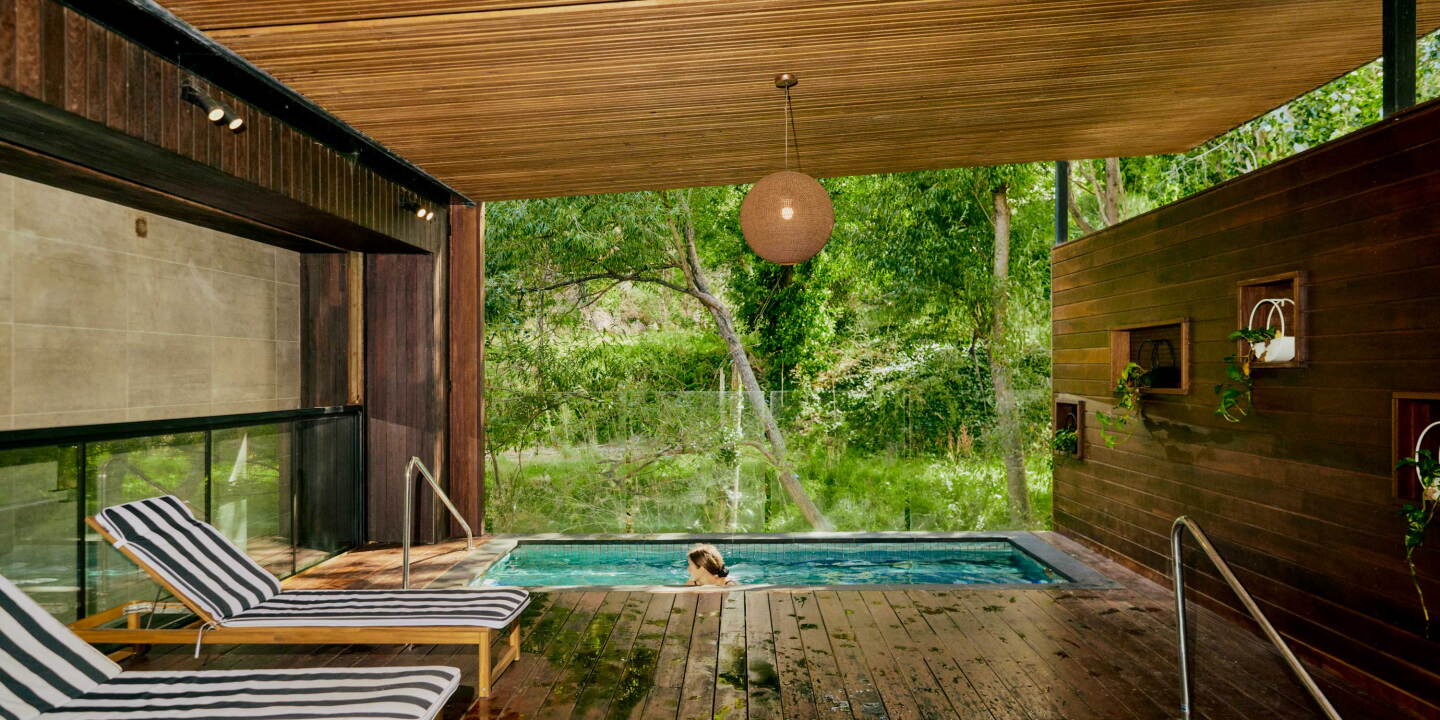
A $1.2 million renovation in 2025 included updates to the existing magnesium salt pool and steam room and the installation of a salt-wall sauna. I’m booked for a 90-minute pass and am delighted to discover that the glass-walled baths look out onto a creek lined with eucalyptus trees. With heavy discounts for locals, families bathe en masse in the communal spaces; parents tell their kids to keep one eye on the window and shout when they spot a wallaby.
A couple of regulars see me struggling with the submerged couches in the jet pool and show me how to hook my legs, so I don’t keep floating away. Before I know it, we’re in the hammam scrubbing each other’s backs with peppermint-scented salts, and Helen—whom I’ve just met— is sharing her life story. The venting of the steam muffles all but the occasional word—“husband . . . Oslo . . . education . . . Lombok . . . chef . . . Beijing”—so I discover very little. But I learn that Helen is an adventurous woman, and that spas don’t have to be a lonely experience just because you arrive at them alone.
Hepburn Springs has 368 residents, the neighboring country town of Daylesford almost eight times that, but even there everyone seems to know each other. In the early evening, I pass by an ornate piece of aquatic architecture, the three-tiered Wills Square Fountain, on my way to dinner. Kadota, the Japanese fine dining restaurant, is a local’s recommendation. Chef-owner Aaron Schembri grew up here, and when he was young, Daylesford still had a hippie vibe, with lots of communal parties where his jazz singer mother would perform. He spent a decade traveling as he learned his craft—including a year working in a Michelin-starred kitchen in Japan—and returned with his wife Risa Kadota (now the restaurant manager) to a “far more polished” place.

Daylesford (pictured) and Hepburn Springs have 80 percent of Australia’s springs; Aaron Schembri and Risa Kadota run their restaurant Kadota out of an 1860s building.
Photos by Charlie Hawks
As I sip on house-made tea at Kadota, the couple stops by my table to ask how I’m doing. I tell them I’m well—before realizing, in a spasm of self-reflection, that I truly am. It’s not just that I’m full of exquisite kingfish sashimi or sunchoke custard. I also feel calm, rested, content. Aaron recognizes these symptoms; he’s a frequent visitor at the Hepburn Bathhouse, where he likes to sit and think. He also tells me he gets the water he uses for brining fish and simmering vegetables from Daylesford.
My final stop before heading back to Melbourne is Lake Daylesford, created in 1929 to add to the burgeoning spa town’s appeal. Two of the area’s most accessible mineral springs are located near the lake, to the south of town; miners uncovered them as they searched for gold. It is indeed a beautiful place, but not without blemish. Often, engineering work blocked or polluted the springs—you can still find remnants of their mine shafts and machinery in several of the creeks—and the land’s traditional owners, the Dja Dja Wurrung, had already been dispossessed by settlers.
Around the lakeshore, educational boards reveal the stories of Daylesford’s different communities. One shows an Indigenous artwork that demonstrates the fishing and weaving that previously took place here; another quotes a Dja Dja Wurrung elder speaking of the fields of edible daisies that once made this land so resource rich. Elsewhere, black-and-white photographs show well-to-do tourists in fur coats and feathered hats.

Beyond its bathing culture, Geelong is also a gateway to the nearby Great Ocean Road, a 151-mile scenic coastal route that winds past attractions including the Twelve Apostles limestone stack formations.
Photos by Charlie Hawks
I lower myself into the lake from the grassy bank and push off. There’s a thrilling sensation as my arms break the warm surface, while my legs plumb the water’s cooler depths. The voice of a child paddling in the sandy shallows reaches me like a mantra, a well-earned message of the new ways I have seen and felt wellness on this trail: “The more we do it, the more fun it is!” Moving slowly through the water, I say a zen amen.
How to take this trip
Australia’s Great Victorian Bathing Trail stretches more than 550 miles along Victoria’s southern coast, linking hot springs, spas, and more. Unless you have more than a week, it’s best to focus on a single part of the route, which is divided into three sections: West, North, and East. Or, as contributing writer Emma John demonstrates, you can loop around it from Melbourne. Here’s how.
Begin in Melbourne, Victoria’s capital. The 257-room Ritz-Carlton is located in the central business district and has panoramic views of the surrounding city and Port Phillip Bay. In the Southbank neighborhood, Hannah St. Hotel opened in late 2025 with a 66-foot pool and 188 boutique rooms and suites.
A 60-mile drive south brings you to Alba Thermal Springs & Spa on the Mornington Peninsula. Raise your pulse on a section of the peninsula’s 62-mile walk, or lower it at Alba, where 25 geothermal pools and a full menu of hydrotherapy treatments make a convincing argument for staying on the property.
Continue eight miles west to Sorrento, a port town with a distinctly European feel. From its waterfront, board the Searoad Ferry to the small town of Queenscliff on the Bellarine Peninsula; the 40-minute crossing runs hourly, year-round.
Located five miles southwest of the ferry port in Queenscliff, Lon Retreat & Spa occupies a sleek sandstone farmhouse where guests can enjoy a sauna, cold plunges, holistic spa treatments, and private mineral baths. The boutique seven-room hotel is a member of Small Luxury Hotels of the World.
Continue to Victoria’s second-largest city, Geelong, roughly 19 miles northwest. It offers many ways to enjoy the waterfront, from strolling the Bollard Trail Walk, lined with more than 100 painted sculptures, to swimming at Eastern Beach, home to a 1927 brick bathing pavilion that now houses a restaurant.
Travel 60 miles north to Hepburn Springs, long the heart of Victoria’s spa country. Its free-flowing waters rise from underground aquifers, and signs throughout the town detail the mineral content and purported benefits. The Hepburn Bathhouse & Spa—Australia’s first, opened in 1895—is still in operation, while the original bathing space is now a café.
Daylesford, a mile south, is known for its eponymous lake. In between swims, stroll to the 100-foot Sailors Falls, hike 6-million-year-old Hanging Rock, and fuel up at Cliffy’s Emporium, a historic general store and diner opened in the 1950s. From here, it’s just 70 miles back to Melbourne. —Katherine LaGrave


