

Europe’s quintessential summertime locales (Greece! Croatia! Southern Italy!) are undeniably gorgeous, but they can also be overcrowded, increasingly sweltering, and expensive in June, July, and August. For much cooler temps and no crowds, consider off-season visits to these popular destinations. You probably won’t be wearing a bathing suit, but in nearly all of these destinations you’ll enjoy tranquil town squares, markets where you have elbow room to browse, and well-priced hotel rooms. Here are seven summer destinations in Europe to visit during winter.
Dubrovnik, Croatia
Where to stay: The Pucić Palace
There’s a good reason Dubrovnik is billed as the pearl of the Adriatic. Its coastal location, well-preserved medieval architecture, and numerous cultural attractions gave it UNESCO World Heritage status. Daytime temps in the low 50s (Fahrenheit for all temperatures) from December through February and lovely holiday festivities make the city an ideal candidate for off-season travelers. In December, the Old Town feels magical and intimate with Christmas markets and outdoor concerts. Be sure to sample orahnjaca, a traditional walnut roll cake.
There are plenty of year-round activities for visitors to check out. Stop into the baroque Assumption Cathedral, walk the old city walls (and stop for the jaw-dropping view from Minčeta Fortress), and visit Rector’s Palace, which now houses the Cultural History Museum. Winter is also peak truffle season; from Dubrovnik (and many places in Croatia), you can join a truffle hunting excursion and tasting.
Related: Pick Olives, Crush Grapes, and Dig for Truffles at These Hotels in Europe, Asia, and the U.S.

As the summer crowds finally thin, Provence, like many of its South of France neighbors, takes on a refreshingly slower pace.
Photo by FiledIMAGE/Shutterstock
Provence, France
Where to stay: Hôtel de Cambis in Avignon; Villa Saint-Ange in Aix-en-Provence; Maisons du Monde Hôtel & Suites or Les Bords de Mer in Marseille
While Provence’s famed grapevines, olive groves, and lavender fields go dormant in the colder months, the countryside goes into peak truffle season during the late fall and winter. Hunt for the delicacy on a foraging tour with Les Pastras and visit busy markets overflowing with all manner of local goodies, including seasonal fruit, nougat, honey, and olive oil. For antiques and other secondhand home goods and souvenirs, peruse the stalls at the Sunday market in L’Isle-sur-la-Sorgue.
There’s plenty of history to take in, too—the Romans saw the region’s trading and wine production potential long ago, and many ancient Roman ruins still stand today. Avignon’s Gothic Pope’s Palace, Arles’s UNESCO-designated arena, and Nimes’s Pont du Gard are all easy day trips from the university town of Aix or buzzing, coastal Marseille, from where you can hike in the Calanques National Park. Expect daytime temperatures between 50 and 60 degrees and mostly sunny days.
Related: Why Cruisers and Travelers Should Linger a Day or Two in France’s Second-Largest City

Sa Sartiglia is the traditional Carnival of Oristano.
Photo by Marco Cuccu/Shutterstock
Sardinia, Italy
Where to stay: Palazzo Tirso Cagliari Mgallery
This 9,305-square-mile island in the middle of the Mediterranean Sea exemplifies la dolce vita, island style. In summer, visitors come for the powdery beaches, clear turquoise waters, and natural wonders (including several sea caves like Neptune’s Grotto). With daytime temps in the low 50s, you probably won’t be swimming in winter, but you can take beach walks, wander around empty villages, visit ancient ruins, and taste delicious cheeses like Fiore Sardo, a pecorino, and Axridda, a semi-hard and crumbly cheese made from raw sheep’s or goat’s milk only from January to May. Several towns across the island, including Nuoro, Oristano, Mamoiada, and Ottana, celebrate Carnival in February, with their own colorful iteration of masqueraded parades.

The colder months are a fine time to explore Madeira’s natural wonders.
Photo by Robert Harding Video/Shutterstock
Madeira, Portugal
Where to stay: Quinta Jardins do Lago
Many travelers come to the four islands that make up the autonomous Portuguese archipelago of Madeira just to walk. On the main island, also called Madeira, a network of centuries-old levadas, or irrigation channels, have created some 1,800 miles of walking trails, much of them through verdant forests and along rugged, dramatic cliffs. Walking about the capital, Funchal, is also a worthy pursuit with beloved cookie factories (Fábrica Santo António) and wine shops (legend goes that the signing of the Declaration of Independence was toasted with Madeira wine) lining the streets. The Madeira Photography Museum is also a must-visit, as is Bordal, one of a few remaining embroidery houses where you can see artisans at work.
February, when the daytime high is in the low- to mid-60s, marks a time of events and festivities, including Carnaval parades and concerts and the annual rum festival. Finish with dinner at Kampo, helmed by inventive chef Júlio Pereira.
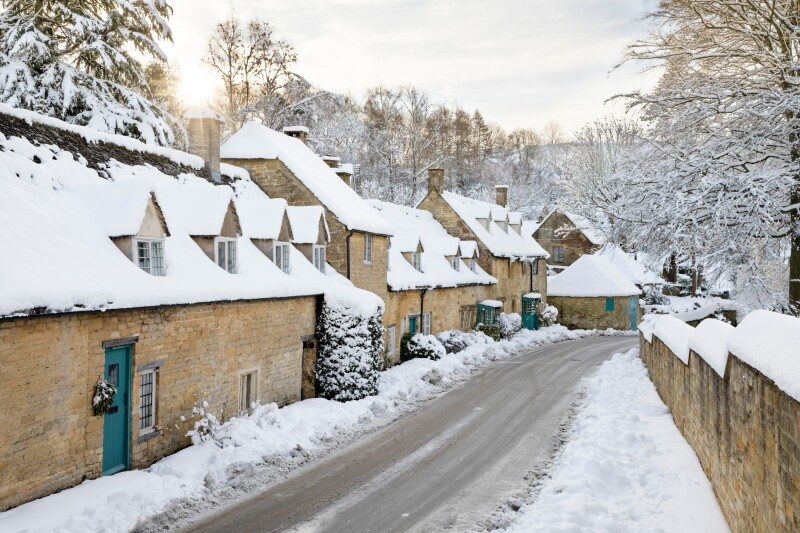
Live out your winter wonderland dreams in the Cotswolds.
Photo by Robert Harding Video/Shutterstock
Cotswolds, United Kingdom
Where to stay: The Painswick
Coming to the Cotswolds in winter means leaning in to cold weather and gray skies. Enjoy a pot of tea, biscuits, and a good book or two while cozying up in this region 90 minutes west of London. Its rolling hills are briefly interrupted every now and then by a pint-size village with stone-clad and thatched roof cottage. During the winter, travelers can wrap up warmly and stroll in snow-covered landscapes in small towns like the idyllic Bourton-on-the-Water.
In Winchcombe between November 21 and December 30, 2025, Sudeley, a Tudor jewel of a castle dating back to 1442, hosts its annual Spectacle of Light after-dark event. Visitors are invited to walk an illuminated trail that follows the story of Sleeping Beauty. The castle then reopens for daytime visits on Saturday, March 14, 2026.
Related: This Pub-to-Pub Hike Is 102 Miles of English Countryside, Cottages, and Castles

Explore Timanfaya National Park in Lanzarote for incredible landscapes.
Photo by Robert Harding Video/Shutterstock
Lanzarote, Spain
Where to stay: Palacio Ico
The easternmost of the Canary Islands, Lanzarote has a volcanic landscape—lava flows, ash fields, hidden caves, and craters—that visitors can still explore during winter. While daytime temperatures remain in the range of 60° to 70°, check out Timanfaya National Park, which showcases many of these features with unique rock formations and swaths of burnt orange–colored earth at every turn. The volcanic eruptions responsible for forming the island eventually created secluded sandy stretches and blue-green coves such as Papagayo beach. If you tend to run hot, the island is also a fine place for scuba diving even during the colder months, giving you the chance to see angel sharks, octopus, and rays without the crowds.

Cities like Heraklion remain lively in the winter.
Photo by hybbGO/Shutterstock
Crete, Greece
Where to stay: Phāea Cretan Malia
The largest of the Greek islands is well-known for pink-sand beaches, agrotourism, and ancient Minoan ruins. Although numerous ferries operate year-round from Athens, the 50-minute flight from the capital to Heraklion is both easy and cheap. Once there, the major port towns of Chania, Rethmyno, and Heraklion—all along the northern coast—are where much of the action is concentrated.
Unlike in some of the smaller cities on Greece’s other islands, most restaurants, bars, and hotels on Crete don’t close in the off season. The island isn’t warm in the winter—expect daytime temps to hover around 45 degrees—but the true off season means no crowds and low prices for upscale hotels.
Tour sites such as the Knossos Palace, near Heraklion, among the most visited archaeological sites in Greece after the Acropolis. Stop by olive oil farms like Spiridi Olive Oil Farm (harvest season is from mid-November to January), where you can also make cheese or pottery. Or stroll Elafonisi Beach, on the island’s southwestern coast, and explore the cobblestone lanes of the harbor towns.
Related: Where to Go Every Month of the Year for Better Weather, Fewer Crowds, and the Most Value
This article was originally published in 2024 and most recently updated on December 29, 2025, with current information.


