

“There’s a chance we’ll flip on this section,” says Cade Hertz, our captain. “If anyone would like to switch to the safety raft, now’s your chance.”
No one says anything. I’m a strong swimmer, but the rapids ahead look terrifying: Gallons of white water unfurl violently, wrapping around boulders the size of cars and opening up enormous swirling black holes. Still, we jam our feet into our rubber footholds, straighten our backs, and paddle forward, ice-cold water already pooling at our feet.
On Chile’s Futaleufú River, you’re never quite sure how long you’ll stay dry. Translating to “big water” in the Indigenous Mapuche language, the Futaleufú is fed by glacial meltwater in the Argentine Andes, flowing more than 62 miles (100 kilometers) into southern Chile through temperate rainforest and snow-capped peaks—a river so ecologically significant it was recently protected by law.
I’m in Patagonia—a vast, sparsely populated region at the southern end of South America. Unlike the dry, windswept plains of the region’s southern half, much of northern Patagonia is covered in lush Valdivian forest, home to 3,000-year-old trees and animals found nowhere else on earth. I’ve come to experience this landscape through its rivers, traveling the Futaleufú Valley on a multiday rafting trip with Earth River Expeditions, staying in lodges along the way.
Getting to Patagonia
In addition to Earth River, other bespoke travel companies such as Plan South America and Pura Aventura can also help tailor itineraries and coordinate logistics across the region, including arranging accommodation and rafting with local outfitters.
But first, I needed to get to the river. From Santiago, it’s a two-hour flight to Puerto Montt, then a small propeller plane or ferry to Chaitén, before continuing along the Carretera Austral highway, which stretches more than 1,200 kilometers and often dissolves into gravel as it cuts through dense forest. While on the road, I wonder at what point I’ve entered Patagonia.
“It depends who you ask,” Nicolás “Nico” Luna, one of our guides, explains later. “Some people will tell you it starts as far north as Puerto Montt. But for us who live here, that’s not really Patagonia.”
Nico grew up in Santiago but moved to Futaleufú 17 years ago to become a rafting guide. “When the roads get rough, the forest thickens, and you don’t see buildings for miles,” he adds. “That’s when you know you’re in Patagonia.”

The road narrows and bends through tiny settlements—La Junta, Santa Lucía—where wood smoke rises from tin-roofed cabins, and sheepdogs, matted and soaked to the bone, linger in the rain.
We stop at a small roadside café, run from a family home. Inside, a man named Patricio cooks potato bread on a wood-fired stove, serving it hot with cheese and rosehip jam. He’s the grandson of one of the area’s early settlers, who arrived here in the 1940s to raise cattle. Before the Carretera Austral was built in the 1970s, he tells me, travel was by horse, and even basic supplies meant days-long journeys, sometimes crossing into Argentina just to buy flour. “We had to bushwhack our way through the forest,” he says, jam spilling on his round belly.
Farther along the road, two gauchos ride on horseback, herding cattle with three dogs at their heels, dressed in white sheepskin chaps and wide-brimmed hats. Behind them, cerulean-blue glaciers hang between black granite peaks, and waterfalls spill from the forested hills on either side. Rivers—some an electric turquoise, others a milky jade—cut through the woods like roads on a map. When I finally arrive in Futaleufú valley, I pass a hand-painted sign nailed to a wooden post: un paisaje pintado por Dios (a landscape painted by God). It’s hard to disagree.
What to know about rafting Class V rapids
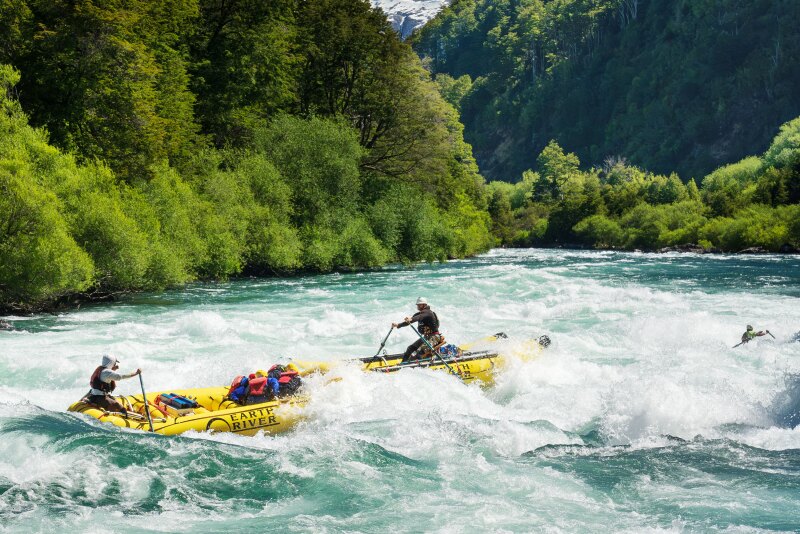
The powerful rapids are named after threatened animals found only in Patagonia.
Photo by Teal Hertz/Earth River Expeditions
Now, I’m on the Upper Futaleufú, my hands trembling as we prepare to raft Terminator: an extremely challenging Class V rapid that for years was thought to be unnavigable. In the mid-1980s, during one of the first attempts to descend the Futaleufú, a team was caught here in what rafters call a “hole”—a powerful recirculating current that can trap and spin a raft in place—and held there for nearly 20 minutes.
“They made it out,” Cade tells me. “But their boats and gear didn’t.”
It was Cade’s father, Eric Hertz—an American river guide, conservationist, and founder of the rafting company Earth River Expeditions—who returned to the Futaleufú in the 1990s. With lighter rafts and less gear, he was able to navigate more challenging sections of the river, later developing safety catarafts that made commercial rafting here possible for the first time. Now, Futaleufú is considered one of the world’s best rafting rivers, with dozens of operators offering day trips.
“The river encapsulates so many different emotions at once,” says Teal Hertz, Eric’s youngest son, who’s also guiding our trip. “The scenery, the colors, the big water . . . . It’s hard to comprehend the first time you see it.”
The last thing I see before I shut my eyes is a wall of water cresting over the bow and the boat pitched at a sharp angle.
The raft edges into the current and, within seconds, we’re in it. The river crashes over the bow as we drop into the first wave, the boat bucking beneath us before being pulled sideways. We paddle hard, digging into the current as Cade calls commands from the stern, his voice steady over the deafening roar of the river.
Ahead, the Futaleufú rises again into a chain of steep, cresting swells known as the Himalayas—the kind that swallow rafts whole. We hit them head-on, climbing and dropping like an inflatable seesaw. At one point, my feet dislodge from the footholds completely, and I’m thrown into the raft; the only thing keeping me from being pulled overboard is the rope clenched in my right hand. The last thing I see before I shut my eyes is a wall of water cresting over the bow and the boat pitched at a sharp angle.
Then, just as suddenly as it began, it’s all over. The river eases, the boat steadies, and the noise falls away. When I open my eyes, Nico and Momo, our two safety guides, are there smiling and clapping. We’re through.
That night we stay at Peuma Lodge, which has nine rooms in four elegant wood cabins set on an 800-acre riverside farm, where horses and sheep roam free beneath towering snowcapped peaks. I spend the afternoon soaking in a wood-fired hot tub to the sound of Arroyo Guapito, a tributary of the Futaleufú.
Over dinner—chupe de centolla (king crab casserole) and bottles of Chilean Carmenere—we relive the day’s biggest waves with the guides. With so much rainfall recently, the rapids are running higher and faster than they’ve seen in a while. Outside, the air smells of sodden earth and woodsmoke.
Why the rivers in Patagonia need protecting

Local businesses—like Peuma Lodge—are fighting against overdevelopment in Patagonia.
Photo by Teal Hertz/Earth River Expeditions
The next day, we’re back on the river, rafting a stretch known as Bridge to Bridge. The rapids come in quick succession, each one named after an animal found in Patagonia: puma, cóndor, and pudú, the world’s smallest deer.
“They’re all species that are threatened, either in Patagonia or elsewhere,” says Teal. “It’s a way of reminding people what’s at stake.”
For a long time, Teal explains, the Futaleufú was under threat. In the 1990s, Chile’s largest electricity company, Endesa, proposed a series of hydroelectric dams along the river, a plan that would have flooded large sections of the valley. A similar fate had already destroyed the Biobío River farther north—once considered one of the best rafting rivers in the world, before it was dammed in 1993.
“Futa was protected because of rafting,” says Teal. “If you make people fall in love with a place, it’s very easy for them to want to help protect it.”
Local communities, environmental groups, and rafting companies (including Earth River) spent decades resisting development along the Futaleufú, helping preserve the river and the surrounding forest. In late 2025, the Chilean government passed a law requiring that much of the Futaleufú’s water remain in its natural course, limiting future dams and large-scale development. A similar protection was granted to the nearby Puelo River, making them the first rivers in Chile to be safeguarded in this way.
If you make people fall in love with a place, it’s very easy for them to want to help protect it.
By the time I reach Yelcho Lake, the end of the Futaleufú’s 62-mile journey, a log fire is already burning at Yelcho en la Patagonia, my lodge for the night. After days of white water, the calm is almost unsettling: Rain dimples the lake’s glassy surface, while a kingfisher perches on a low branch, a small trout twitching in its beak. Horses graze along a granite-colored shoreline, and snow-dusted peaks drift in and out of misty clouds.
Sitting here, watching the river meet the lake, it’s hard to imagine the Futaleufú as anything other than it is now: wild, free, alive. And yet, as my guides remind me, protection here is ongoing. Along the banks, new development is beginning to creep in, and the glaciers that feed the river are slowly retreating, threatening the flow that gives the Futaleufú its power.
“The tributaries are losing their season, and we don’t know how many years the glaciers will be here,” Cade told me. The kingfisher swallows the trout whole and lifts from its branch, disappearing into the trees as the sky darkens into a metallic gray-blue.
“Growing up, I didn’t think the river would still exist today,” were Teal’s parting words. “But it’s still here. As long as you let the Futa speak for itself, people will want to save it.”


