
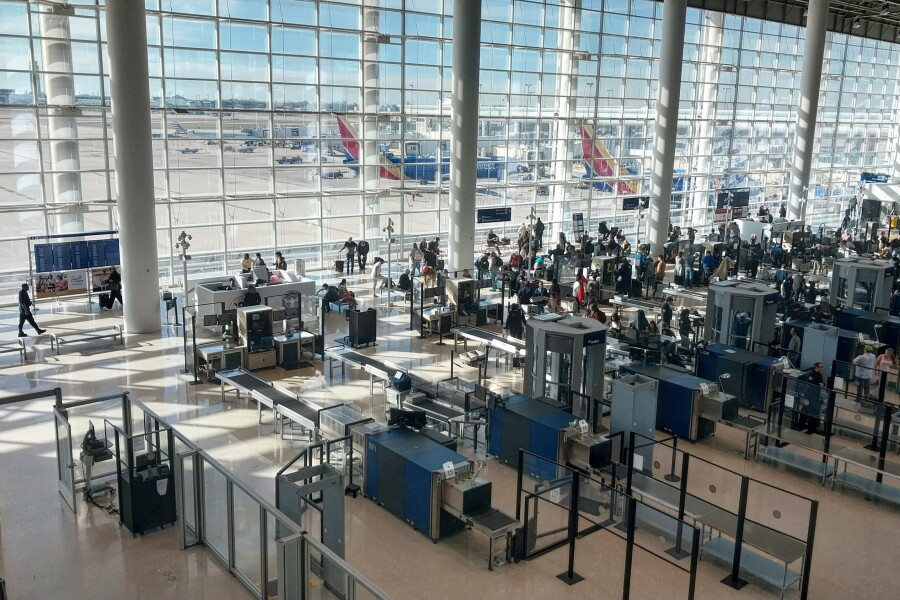
Fly on a random weekday and you can breeze through airport security in the USA in a matter of minutes. Travel during a government shutdown, and you could be staring down an hour-long line. Short of flying private, there is no secret way to get through a TSA checkpoint faster, but there are things you can do to ensure passing airport security is as smooth as possible. Read on for seven tips from a TSA staffer and an airline industry consultant on how to clear airport security faster and with lower stress.
Enroll in TSA PreCheck or Clear
TSA PreCheck is a trusted traveler program ($80 for five years) that allows those who are enrolled to go through an airport security line that is usually shorter and faster than the regular line. Those in TSA PreCheck do not have to take out anything when going through security—your laptop, liquids, belts, and even light jackets can all stay in your bag or on your person.
TSA PreCheck is not to be confused with Global Entry, which speeds up clearing immigration upon arrival into the United States—although signing up for Global Entry will automatically enroll you in TSA PreCheck. “If you’re doing international travel, Global Entry is entirely the way to go,” says Lisa Farbstein, formerly a spokesperson for TSA. A five-year Global Entry membership costs $120, reimbursed by many travel credit cards, and includes TSA PreCheck.
Travelers can also enroll in Clear, which costs $209 per year and includes TSA PreCheck. After signing up online and completing a short in-person scan to verify your identity, you’ll be able to walk up to a staffed Clear kiosk or a biometric eGate at 60 airport across the U.S. and scan your boarding pass; it uses facial recognition to verify your identity. You’ll then head straight to the security checkpoint, bypassing the regular line where TSA agents check IDs.
Airline industry consultant Mike Arnot told Afar, “I have Clear, and I signed up on the spot at Dulles Airport one travel day when I was really, really late to get to the airport—where I needed to spring to the gate. I shot through security. I don’t use Clear that often, but it has saved the day at least once, and so for frequent fliers, it can be a win.”
Opt into TSA PreCheck Touchless ID
Want to get through security even quicker? At 65 airports across the country, including busy international hubs like Atlanta and regional airfields like Long Beach Airport, travelers with TSA PreCheck can glide through security using TSA’s newer PreCheck Touchless ID program, which uses facial identification technology to verify travelers’ identities at security checkpoints.
It is available to anyone who is already enrolled in TSA PreCheck and is flying with a participating airline—Alaska, American, Delta, Hawaiian, Southwest, and United Airlines (sadly, JetBlue is not a participating airline yet)— but you must opt into Touchless ID in order to be able to access the often much shorter Touchless ID security lines. To opt in, you will need to go to your frequent flier account with a participating airline and adjust your personal settings.
Each airline has slightly different instructions on how to do so (the airlines links above will direct you to the process for each), but for instance with United, you go to the app, go to the Help Center, then MileagePlus account, then Adding a KTN (Known Traveler Number) to your profile, and in this section you can make sure you have opted in.
Once you have opted in, access to Touchless ID will appear on your boarding pass, same as it does when you have TSA PreCheck. Then, rather than handing a TSA officer your physical ID, such as a passport or Real ID, you simply stand in front of a kiosk that captures your image from the neck up. One Afar staffer has found TSA PreCheck Touchless ID to be faster than regular PreCheck and even the pricier Clear membership.
Check security wait times before you leave for the airport
Airline apps and MyTSA, as well as most airport websites, are updated regularly to show TSA checkpoint wait times. CNN and the the New York Times have also introduced TSA wait time trackers. Sure, having this knowledge won’t make security lines go any faster, but simply knowing how long you’ll be stuck at security can help keep travel anxiety at bay. If you know that in, say, 30 minutes, you’ll be on the other side of security, maybe breezing into an airport lounge, it’s easier to deal with a potentially frustrating situation.

Packing cubes help your carry-on bag stay organized and make it easier to pull out only what you need.
Courtesy of Eagle Creek
Pack your carry-on (relatively) neatly
You don’t need to be immaculate when it comes to folding shirts and pants, but cramming things into a carry-on will lead to unnecessary headaches at airport security. For anything you might have to take out during security checks, like a laptop, tablet, phone, e-reader, or toiletries, be sure it’s not buried in the middle of your bag, says Farbstein. Plus, TSA sometimes randomly checks luggage, and having things organized will make it easy to repack and get to your gate. (We recommend using packing cubes to help corral everything.)
Make sure you’re following TSA’s 3-1-1 liquid rule
Any liquids, gel, or aerosols in your carry-on luggage must be in containers that are 3.4 ounces (100 milliliters) or smaller. These must all be placed into a quart-sized clear plastic bag, limited to one bag per passenger.
Less clear is what TSA considers a liquid in the first place. “A good rule of thumb,” Farbstein says, “is that if you can spill it, spray it, spread it, pump it, or pour it, then it’s a liquid, gel, or aerosol.” And that includes peanut butter and other foods. “If [peanut butter] is already spread on a sandwich, you’re OK. But packing a jar of it will be a no-no at airport security.”
If you’re ever unsure, you can consult TSA’s helpful What Can I Bring? tool or text TSA your question.
Related: Yes, You Can Bring Food Through TSA—With Some Exceptions
Empty your water bottle
A reusable water bottle is an important travel accessory, but make sure it’s completely empty before you go through security. Full water bottles are a common reason TSA stops passengers for further screening. Once you’re smoothly through security, fill your bottle up at a drinking fountain; airplanes are dry and staying hydrated is important.
Plan extra time during busy travel seasons
“Summer travel is like peak travel on a highway,” says Farbstein. “Oftentimes, on holidays, people are traveling with children and that can help slow down a line.” She suggests taking extra time if you know your flight is scheduled for an especially busy period. Some early morning flights might also mean PreCheck lanes are not yet open—so don’t attempt making a flight simply on the assumption you’ll sail through an expedited security line.
This article was originally published in 2018 and most recently updated on April 27, 2026, to include current information. Sophie Friedman contributed to the reporting of this story.


