
Philippines

With more than 7,000 islands sprawled along the Pacific Ring of Fire, it’s virtually impossible to visit all of the Philippines. Fortunately, the country’s finest qualities—including stunning landscapes and hospitable locals—can be found all across the archipelago. Those seeking white sand beaches should visit Boracay (which is, admittedly, also a serious party island) or Palawan (which is less developed).” Culture-lovers are better off on the largest island, Luzon, home to the UNESCO-recognized town of Vigan, the Ifugao rice terraces, and baroque churches.

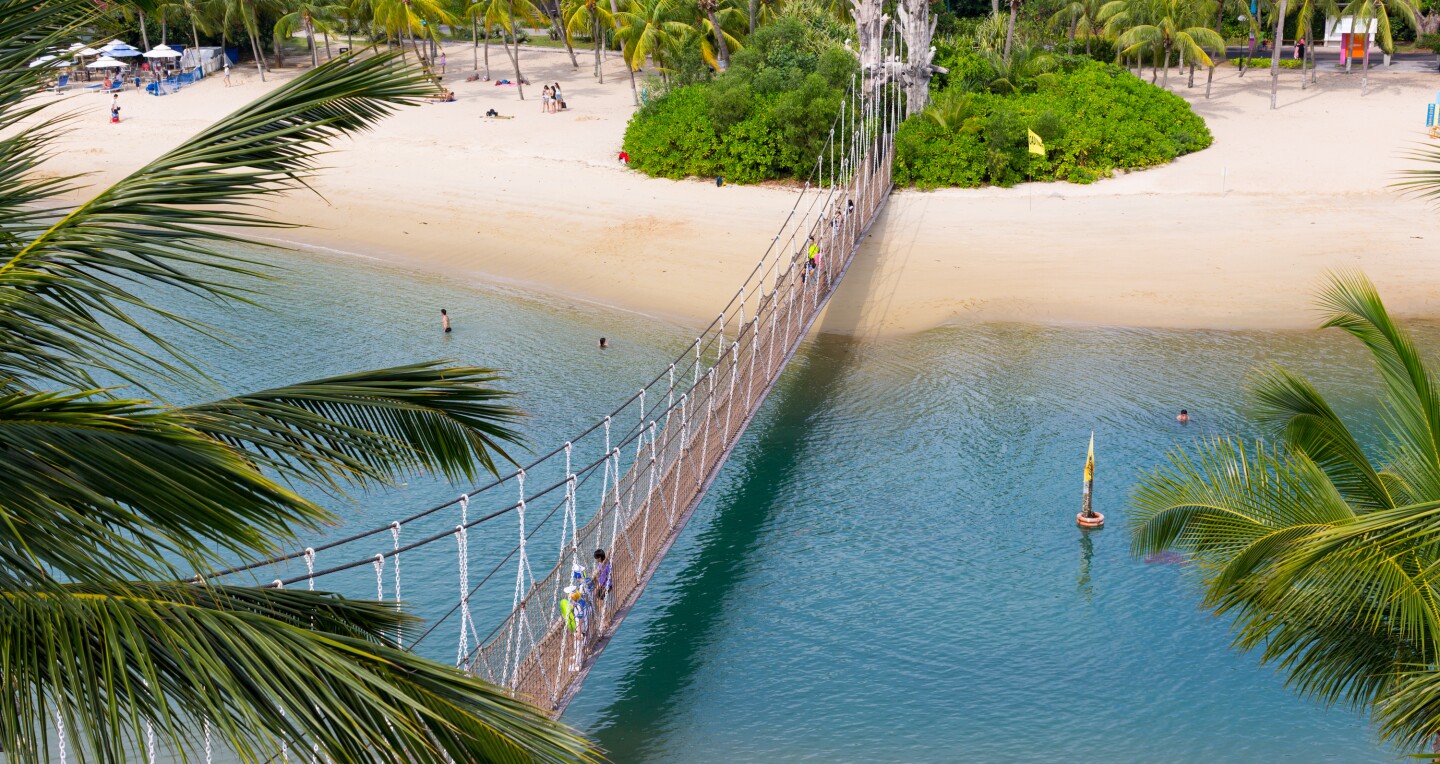
Hanging bridge to Palawan island, Sentosa, Singapore

Photo By Roman Rudiak/Shutterstock

Overview

Can’t miss things to do in Philippines

The Philippines’ charm stems largely from three characteristics: ancient cultures, natural beauty, and overwhelmingly friendly people. A visit to the beach is a must. Swimming with whale sharks is highly recommended (and completely safe). Island-hopping trips among the thousands of uninhabited islands are surprisingly affordable. A visit to a village where life has remained essentially the same for millennia—such as to Batad, set among rice terraces inscribed on the UNESCO World Heritage List—is a unique and humbling experience. Hospitality is an important part of Filipino culture, and if you socialize with locals you’re likely to be invited to a home-cooked family dinner.

Food and drink to try in Philippines

Filipino cuisine—like the culture—varies from island to island. It consists of a hodgepodge of Austronesian dishes influenced by neighbors (such as Malaysia) and former rulers (Spain and the United States). The result is a variety of paellas, pork, noodle-based dishes (known as pancit), and liberal use of soy sauce, vinegar, and fish sauce. Outside of large cities, few Filipinos frequent restaurants, and the best food is most often found on dinner tables in local homes. Fortunately, locals are wonderfully outgoing and quick to invite a new friend to dine with the family. Where possible and appropriate, accepting such invitations is recommended.

Culture in Philippines

The Philippines lacks many of the characteristics shared by other Southeast Asian countries. While others in the region have strong Buddhist and East Asian traits, Filipinos are a primarily Austronesian people (the same who later migrated to Tahiti and Hawaii), strongly influenced by three centuries of Spanish rule and a long American military presence. The culture is best described as Asian–Latin American. American fashion and rock-and-roll culture are popular, Catholicism is widespread, and colorful Filipino Jeepneys are practically identical to Latin American “chicken buses.” Music completely ingrained in the culture and ancing is an unofficial national pastime.

Shopping

Low prices and affordable alterations make shopping any place in Asia a treat. This is especially true in the Philippines, said by some to be Asia’s shopping capital. Western styles are common, and malls are so popular that many of the world’s largest reside in the country. For high-end shopping in Manila, Greenbelt in the Makati district is the obvious choice. The SM Megamall in the Ortigas district is the biggest shopping center in the country and is an impressive sight. Bargain hunters should head for Greenhills in the San Juan district, where pearls are plentiful, designer goods suspect, and shopkeepers ready to bargain. The best times to shop are after Christmas and Valentine’s Day, when sales are ubiquitous.

Practical Information

March through May are the hottest months in the Philippines, followed by a rainy season that lasts until October. November to February are the most temperate months to visit. Most nationalities don’t need a visa for trips of up to 30 days, though an ongoing ticket and a passport that’s valid for at least six months are required. Air conditioning on buses can be frigid, so be sure to take warm clothing. The currency is the peso; English is widely spoken. Electricity is 220 volts.

How to get around Philippines

The majority of international flights land in Manila, though there are other options if you want to avoid the chaotic capital. For a nonstop flight from the United States, book on Philippine Airlines. As of October 30, 2018, the airline launches nonstop service from JFK to Manila five times per week. Domestic travel in the Philippines is affordable. Islands are easily reached on airlines including Cebu Pacific Air, Philippine Airlines, PAL Express, and AirAsia Philippines. You can also island hop by ferry. Book through 2Go Travel.

Guide Editor

READ BEFORE YOU GO
HOTELS
These hotels know how to make an entrance.
RESOURCES TO HELP PLAN YOUR TRIP
You don’t need rose-colored glasses at these pink sand beaches.
Jollibee offers a comforting stop—and destination—for Filipinos who travel.
Fully vaccinated arrivals can finally skip the mandatory quarantine in government-designated facilities.
Mau‘i-based chef Sheldon Simeon thought his grandmother’s pork adobo recipe was lost to history. Then he traveled to the Philippines to film an episode of “Family Recipes” and discovered that the recipe was right where his grandmother left it.
Shangri-La’s Boracay Resort & Spa is located in one of the Philippines’ most popular vacation spots. And while it has all the musts—the turquoise waters, the powdered-sugar shores, the lush hills—what it doesn’t have is the crowds. And therein lies the resort’s beauty, or at least some of it. Tucked into an eco-reserve with its own shimmering beach, the Shangri-La is also home to a canopy-cloaked dining aerie, sunset-surveying clifftop cabanas, and a peninsular spa on a private bay. Accommodations are impeccably appointed with local touches (think woven abaca rugs and lamps bedecked with capiz shells), and several of the lodgings feel more like private vacation homes. Take the aptly named treehouse villa, for example, where the canopy-level second story commands stunning sea views (best enjoyed from the hot tub on the balcony), or the pool villas, where the lure of en suite swimming almost overpowers the sea just outside.
A city within a city, Makati is Manila’s poshest shopping, business, and nightlife district. At the Makati Shangri-La, guests have amazing access to—and respite from—all of the above, including the malls that have made the neighborhood a retail pilgrimage site. After settling in, walk over to Glorietta, where you’ll find everything from high-end beauty boutiques to a family-run pawn shop and multiple Starbucks for good measure. Some of Manila’s best restaurants are also located in Makati, but the Shangri-La’s own Shang Palace is so beautiful and beloved, you won’t want to miss the experience if you have even the slightest interest in Cantonese food. As for the aforementioned breathing space on the guest floors, it starts with the waterfall you’ll pass en route to your room and ends with the custom-appointed bed in your plush, spacious surroundings. Go for one of the Deluxe Suites and you’ll also enjoy panoramic views of the bustle you’ve just left behind.
The problem with Pangulasian—dubbed the Island of the Sun, thanks to its surreal sunrise and sunset views—is its excess of good choices. Do you book a beach villa with direct access to the powdery sand and turquoise waters that likely lured you to the remote northern reaches of Palawan in the first place, or a pool villa with almost 240 square feet of private plunging space and gorgeous vistas of Bacuit Bay? What about a canopy villa that soars 50 to 60 feet above the ground and offers treetop-skimming panoramas of the El Nido islands, or a Kalaw Villa with its own private cove? Once you’ve decided on your accommodations, the choices only get harder. While heading off on an adventure is tempting—think snorkeling, diving, stand-up paddle boarding, windsurfing, kayaking, sailing, touring lagoons, and picnicking on private islands—so is the prospect of simply taking in the view from your gracefully netted, organically appointed bed.
The undisputed grande dame of Filipino hospitality, the Manila Hotel has so many tales to tell that even Hemingway was impressed. “If the story’s any good,” he’s reported to have said, “it’s like Manila Hotel.” The Nobel laureate was but one in a series of visiting dignitaries, from military brass (General MacArthur took up residence in 1935 and left shortly before Japanese troops occupied the property in the ’40s) to Hollywood A-listers (including Douglas Fairbanks, Jr. and Sammy Davis, Jr.) to rock stars (when the Beatles notoriously snubbed Imelda Marcos by accident in 1966, they stayed here). The hotel has had plenty of cosmetic work done as well, including a dramatic renovation for the 2012 centennial festivities. So while you can still stay in, say, MacArthur’s quarters (known as the MacArthur Suite), the bathrooms now come with Bulgari toiletries and the bedrooms with HDTV. There was little the hotel could do to improve upon the already amazing bay views, as you’ll see from the suite’s dining room windows.
Puerto Princesa Underground River is set in a protected area of the St. Paul Mountain Range in Palawan. It’s a five-mile stretch of the Cabayugan River that runs through a huge limestone cave and directly into the West Philippine Sea near Sabang village (the bottom half of the river is tidal). Announced as one of the New7Wonders of Nature in 2012, it’s hard to fully envision unless you experience it for yourself. Reservations are required for the tours, which enter the underground river on a small boat. The boatman manually paddles you in as the light fades, the water becomes pitch-black, and you almost lose sight of the person beside you. The boatman will then start flashing his tiny light on the stalactites, stalagmites, and other rock formations you pass. The tour takes about 45 minutes and covers only a mile or so of the river (the inner portion is closed to the public).
Makati’s Salcedo Village is abuzz with the energy of Manila’s creative circle. The coffee at Commune, undoubtedly, fuels this buzz. The community-minded café is a hub of activity at all times: Mornings see neighbors schlepping in for their sleepy breakfast fix, lunch hour is packed with multi-taskers having a meeting while tucking into the local Filipino menu. By mid-afternoon, the space fills with freelancers typing away, rewarding themselves with custom cupcakes while in the background, fashionistas pose for selfies with Commune’s popular 3D latte art. The post-dinner crowd saunters in for a second caffeinated wind paired with warm, homemade apple pie and conversation. The vibe here is casual and friendly. But most importantly, the coffee is potent. Commune salutes its community by using locally sourced and roasted coffee beans. Meanwhile, their drinks are served up in beautifully handcrafted pottery mugs. (I wanted to smuggle one home. In every color!) When in Manila, get to know Salcedo Village, starting at Commune. Because when you’re here, though you may just be a visitor, you’ll feel right at home.