
Cambodia

Cambodia is smaller than Oklahoma, with a landmass of less than 70,000 square miles, yet it contains some big lures for visitors. At Angkor, one of the world’s most significant archeological sites, 12th-century temples stretch for 150 miles. The Tonlé Sap, a lake within the Mekong River basin, represents one of the most varied freshwater ecosystems on the planet.

More than two million people a year visit Cambodia, heading to the central and northern regions, as well as to the heartlands for temple tours and river experiences. The charming coast also wows, from the colonial architecture of Kampot to the lively seafood markets in Kep, and the natural splendor of Ream National Park.

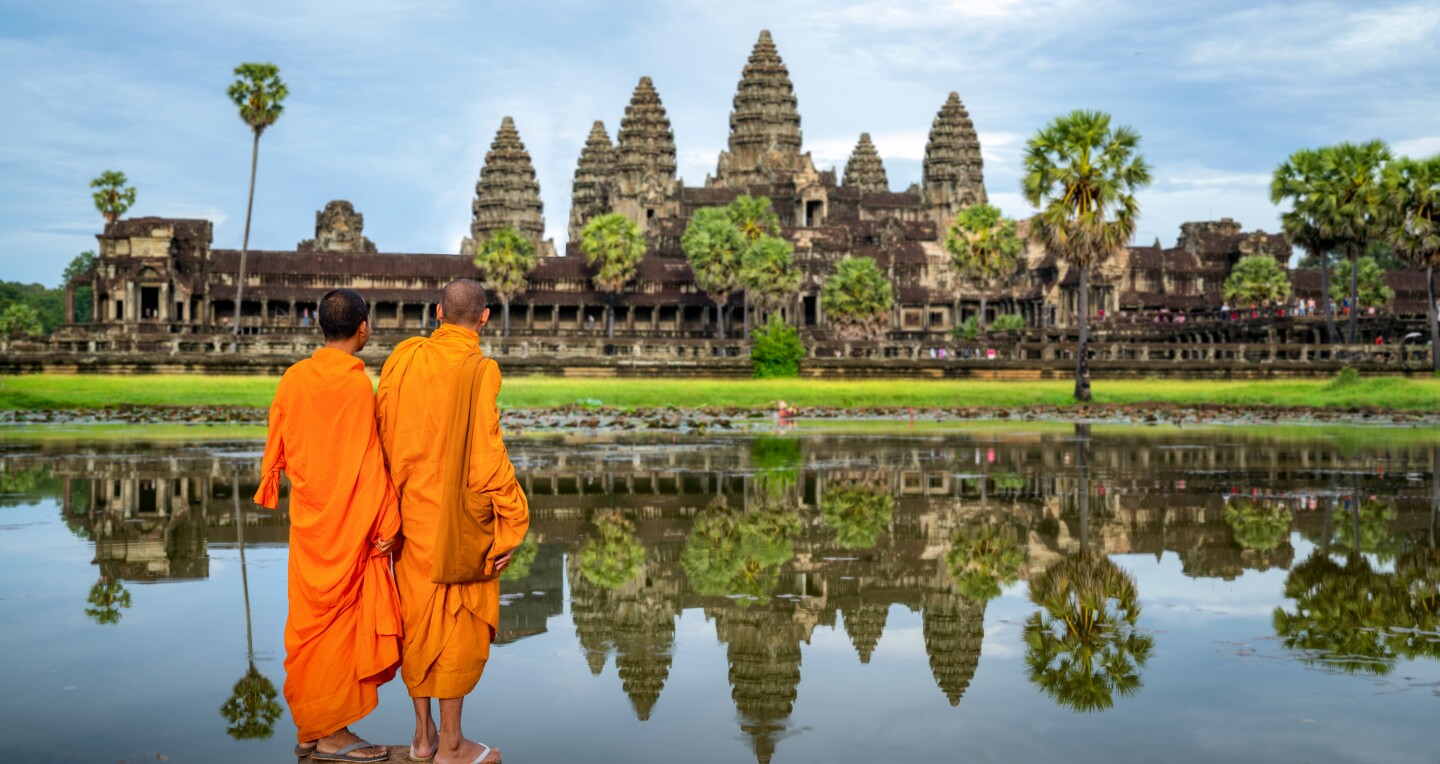
Asian monks stand and look to Angkor wat in siem reap, Cambodia, this image can use for travel and landmark in Asia

Phot By anek.soowannaphoom/Shutterstock

Overview

When’s the best time to go to Cambodia?

Cambodia has two seasons—wet (May to October) and dry (November to April)—and both hold charms abundant.

In November, temperatures at night dip to the low 70s, and while you won’t need a raincoat, you may want an umbrella to shield you from the sun and to put some distance between you and the seasonal crowds at Angkor Wat.

April usually means 100 degrees during the day, but that month’s New Year’s festivities are beautiful, with games and dancing and celebratory dishes like the kralan, a delicious roasted coconut rice cake. It’s easy to fall in love with the romance of the monsoon months, when jungles are at their most vibrant, wildlife is abundant, and crowds are blissfully absent.

How to get around Cambodia

A flexible itinerary and easy-going attitude are optimal, as the few existing highways only began seeing extensive asphalt in 2008.

Flights land daily at Phnom Penh International Airport from major Asian cities, via several carriers. Cambodia Angkor Air flies Phnom Penh to Siem Reap and down to the beaches of Sihanoukville for a few hundred dollars, but charter buses are the cheapest and most common option. Private car with drivers are also popular and can shave an hour off of bus time. A private car from the capital to the coast costs around $60 each way.

Cambodia’s Royal Railway––defunct for decades––is running again, and is a romantic-yet-thrifty option ($7+) for travel to Phnom Penh, Sihanoukville, Takeo, and Kampot. The restored cars offer air-conditioning and bathrooms.

In cities or villages or beach towns, tuk tuks can take you where you want to go. And in Battambang, ride the famous Norry trains, bamboo platforms that ramble along tracks to nowhere and back again, reaffirming that “it’s about the journey, not the destination.”

Can’t miss things to do in Cambodia

Millions of people tour Cambodia’s UNESCO-recognized temples, spending the night in lovely boutique hotels in neighboring Siem Reap. Battambang’s mesmerizing local circus gets press for good reason, and a plate of pepper crab in Kampot is an unforgettable indulgence. The sunsets over the emerald waters and white sand of Koh Rong Islands are Instagram gold, and Phnom Penh’s culinary scene is the latest talk of Southeast Asia.

Food and drink to try in Cambodia

Expect ingredients familiar from Thai food, like lemongrass, lime, coconut, soy, sugar, ginger, and vinegar, but without the intense spice. The most common pepper you’ll find is a peppercorn variety native to Kampot. Amok is the national dish: a slightly sweet coconut fish curry, with turmeric, lime, palm sugar, and fish sauce. Bai Sach Chrouk is breakfast—sliced pork over rice with pickled cucumbers—and never skip dessert. In this former French colony, skilled bakers are plentiful.

Culture in Cambodia

This was a powerful kingdom from the 4th to the 14th century, comprising vast sections of Thailand, Laos, and Vietnam. Cambodia has worked its influence on many Asian arts, from carving to dance, ceremonies to architecture. Family is extremely important to the fabric of life, and traditional marriage remains sacred. In rural areas, unmarried women and men avoid physical contact, as sex before marriage is strongly held social taboo. Children begin school around the age of seven and while the father figure in the family usually holds the authority, Cambodians show great respect to the matriarch as well. In the late 1970s and early ‘80s, the Khmer Rouge regime enslaved and murdered millions. A visit to the Killing Fields of Choeung Ek and the Tuol Sleng Genocide Museum in the capital is an important step to understanding the culture’s troubled past and fervent desire for a bright future. The Phnom Penh City Center project––a real estate venture bringing new housing, entertainment, retail, and restaurants––can provide a happy counterpoint in focus. The project is predicted to draw 200,000 people per day by 2025.

Events

One of the most popular annual events is November’s Water Festival, with colorful boat races and fireworks stretching over three days.

In summer, monsoons flood the Mekong River, temporarily forcing its waters back upstream into the lake of Tonlé Sap and bringing rich nutrients to the lake as well as thousands of fish. This is a bountiful time for eating, drinking, and celebrating.

Most events follow the Cambodian Lunar Calendar—the Chhankitek—but that’s not to say all are religious or agricultural. The Johnnie Walker Golf Tournament at the Phokeethra Country Club in Siem Reap is held in autumn. Marathons are popular, too, including the International Half Marathon in December and the Ultra Trail d’Angkor in January.

For Families

At the Battambang Phare Ponleu Selpak Circus, performers of all ages mix comedy and satire with breathtaking acts under a ‘big top’ tent. This city’s Norry trains are also popular families. Passengers whizz through the jungle on bamboo platforms propelled by small motors. (The rigs were originally used to transport agriculture between villages.) The Russian Market and weekend night market in Phnom Penh offer a million entertaining sights, sounds, and toys for sale, and the koi fish pond at the National Museum is a kid favorite.

Local travel tips for Cambodia

Theft is common in the capital. Avoid wearing jewelry or using your cell phone on the street. Cambodians traditionally cover their knees and shoulders, and this practice is enforced at holy sites and temples. Unmarried women and men avoid touching. Putting your arm around a stranger for a photo or touching a child may be misunderstood.

Guide Editor

Jenny Adams is a full-time freelance writer and photographer, who over the last decade has spent six months a year living in Southeast Asia. She formerly worked for an NGO in Sihanoukville, Cambodia. Jenny catalogs her triumphs and mishaps on her blog, www.BuddhaDrinksFanta.com. She covers food, cocktails, and off-the-beaten-track travel stories for a number of publications.

READ BEFORE YOU GO
RESOURCES TO HELP PLAN YOUR TRIP
While cute souvenir shops and even haute couture boutiques exemplify the changing face of the retail scene in Siem Reap, the city’s famous Old Market remains a heady hub of traditional trade and commerce. Located right in the heart of town, Psar Chas is amply stocked with lots of things that you might want to buy—as well as plenty of things you probably do not. That said, perusing the labyrinthine aisles full of silverware, silks, handicrafts, spices, stone carvings, and other assorted ephemera is worth a couple hours of anyone’s time. Stay calm and haggle politely with a smile on your face, and you’re sure to find a bargain or two.
Better known as the Tomb Raider Temple since its starring role in the Hollywood movie of the same name, Ta Prohm has at least as much star quality as Angelina Jolie. Cloaked in dappled shadow and locked in the embrace of the vast root systems that are still reclaiming it for the jungle, the temple is arguably the most atmospheric ruin at Angkor Archaeological Park. Construction on Ta Prohm began in 1186 C.E.; it was built in honor of the mother of King Jayavarman VII. Modern-day visitors are not permitted to climb onto the crumbling galleries of its 39 towers due to safety concerns. Nevertheless, picking a route around the various structures, close courtyards, and narrow corridors sprouting with lichen, moss, and creeping plants is one of the most enthralling experiences at Angkor.
I hadn’t been awake for longer than a minute. I peeled back the tarp door to my room, walked out onto my deck, and leapt. It was an abrupt but purifying way to start the day. The cool, brackish water instantly defogged my mind, and my eyes opened to see the surrounding Tatai River and dense Cambodian rain forest. A lone sampan, anchored along an islet, was the only man-made object to interrupt the natural scenery. My chic bungalow lightly swayed on the calm water behind me, an incongruous encampment against the wild jungle backdrop.

Located on the southern tip of the Cardamom Mountains, near the Gulf of Thailand, the 4 Rivers Floating Lodge lives up to its name. The retreat’s 12 landless suites all float on their own buoyant platforms, moored to the riverbank. Outfitted with a ceiling fan, armoire, and wood-paneled shower, each of the towering, safari-style tented rooms also provides a nearly 360-degree view of the tropical landscape. A boardwalk connects the rooms to a central lounge and dining area decorated in a muted variety of Miami Beach sleek.

At first blush, getting to this secluded outpost might seem daunting. Guests can arrive by boat, drive, come by cab or take a bus from Phnom Penh: I took a five-hour bus trip from Phnom Penh, followed by a half-hour longboat ride from the village of Tatai. But the journey is well worth the peaceful reward. The Cardamom Mountains contain the largest and most intact evergreen rain forest in mainland Southeast Asia. For decades, the region was largely off-limits to developers because of land mines and fighting between government forces and the Khmer Rouge militia. This very isolation protected the area’s natural habitat, which is now home to scores of endangered species, including Asian elephants, hairy-nosed otters, and Siamese crocodiles.

Mine-clearance efforts and the end of hostilities have made travel here safe for more than 10 years, but it remains a sparsely populated frontier. The area’s remoteness is remarkable in and of itself. In the afternoon, I took a boat ride to the Tatai waterfall with several other guests. Even our skipper, a young Cambodian man who leads visitors on these trips every day, was still in awe of the lush surroundings. “So quiet and beautiful,” he said, looking at the palm trees along the river’s edge. After we arrived at our destination, I spent the rest of the day sitting beneath the waterfall’s forceful but soothing cascades, letting nature’s masseuse relax my muscles.

I returned to the lodge for dinner beneath an orange and purple sunset. On the restaurant’s uncovered patio, the only sound accompanying the clang of my utensils was the soft splash of kingfishers swooping to pluck fish from the river. I was less delicate, digging into skewers of mozzarella, watermelon, and fresh shrimp and a plate of steamed river fish topped with a basil cream sauce. In the lingering twilight, I sipped a gin and tonic on my private terrace before easing under my bedsheets. As the gently undulating waters rocked me to sleep, any illusions I had about roughing it in the wilderness drifted away. —Brendan Brady
Shopping in Siem Reap can be a delight—from watching artisans at work in ateliers before you purchase their crafts, to getting fitted for affordable couture fashion, to buying handcrafted gifts at the Made in Cambodia market. We even enjoy the guilty pleasure of bargaining for tacky tourist trinkets at the markets. Start in the morning at the Old Market for the people-watching as much as the shopping, spend the day browsing boutiques and galleries, then finish at the lively night markets.
Three days will give you a taste of Siem Reap and its archaeological sites with time for a handful of other engaging experiences. Spend the first day focused on the star sights at Angkor Archaeological Park, like Angkor Wat and Angkor Thom, home to Bayon and Ta Prohm. On day two venture out to lesser visited temple ruins such as Koh Ker and Beng Mealea. On day three, do a cooking class and walking tour or floating village cruise. Spend your evenings seeing cultural shows, shopping and dining.
Where Southeast Asian beaches are concerned, the longer the journey, the more worthy the destination. It’s true. It may take a bit more effort to reach Cambodia’s beaches than many of those in Thailand or Malaysia, but choose wisely and all the buses, taxis, and tuktuks will soon be forgotten. Adventurers eager to get off the grid entirely will love Koh Ta Kiev. If lounging by your own personal infinity pool is more your speed, then you should invest your vacation budget in a villa at Song Saa’s private island resort.
The gateway to the ruins of Angkor, Siem Reap draws temple tourists from around the globe. From Ta Prohm, Angkor Wat, and Banteay Srei, the temples of Angkor date back to the 12th century, if not farther back.
From sunrise over Angkor Wat and scrambling the Khmer Empire temples of Bayon and Ta Prohm to cruising the floating villages and learning to cook Cambodian cuisine, Siem Reap offers some must-do experiences that are essential no matter how touristy they may be. The star archaeological attractions shouldn’t only occupy you. Also allow some time to eat and drink—in Cuisine Wat Damnak and Miss Wong respectively—and kick back in atmospheric spots like Cafe Central.
Siem Reap is home to Cambodia’s finest restaurants, including the outstanding Cuisine Wat Damnak, named Cambodia’s Best Restaurant when it crept onto the San Pellegrino Asia’s 50 Best Restaurants list at #50 in March 2015. The town’s Khmer restaurants should be your priority, including Sugar Palm and Chanrey Tree for outstanding traditional food, served in beautiful spaces. However, Siem Reap also boasts an abundance of restaurants offering international cuisines, from Italian to Indian.