

If you’re looking to venture beyond bustling Spanish metropolises such as Barcelona and Madrid—especially as the 2026 solar eclipse sweeps over the countryside between those two cities—consider exploring Spain’s charming small towns.
There are nearly 20,000 historic villages. A dedicated list compiled annually by the Association of the Most Beautiful Villages in Spain has grown since 2011 to include 126 of the country’s most picture-perfect settlements. Many of these spots are accessible from Spain’s urban hubs by public transportation, but renting a car is the way to go when it comes to comfort and flexibility. (Remember to get an international driver’s license before you hit the road.)
Here are some of the dreamiest hidden villages in Spain; some are recognized on the association’s list and others are lesser known.
Morella

Morella, a medieval fortress in eastern Spain, is situated on a rocky hilltop and features significant Gothic-style architecture.
Photo by tokar/Shutterstock
Travel time: Two hours driving from Valencia and three hours driving from Barcelona
Where to stay: Las Moradas del Temple is about 16 miles away in a neighboring town but is highly rated for its preserved medieval feel.
This ancient fortress in eastern Spain comprises a rocky outcrop topped with a towering castle and crumbling medieval walls. On an overcast day, the walled town is evocative of a villain’s lair that might be used as a filming location for Game of Thrones. This is the perfect position from which to watch the 2026 solar eclipse, since Morella sits in the middle of the path of totality.
Beyond its impressive hilltop position and significant Romanesque and Gothic-style architecture, Morella is noted for its artisan baked goods, such as flaons, palm-size pastries stuffed with fresh cheese and ground almonds soaked in aguardiente (Spanish moonshine made from distilled grape liquor), and mistela, a fortified wine.
The medieval town is also known for traditional textiles, namely wool blankets that have been made locally since the 13th century and today are sold at shops around town. In addition, Morella has a dinosaur museum with prehistoric fossils and other archaeological artifacts excavated in the area.
Ronda
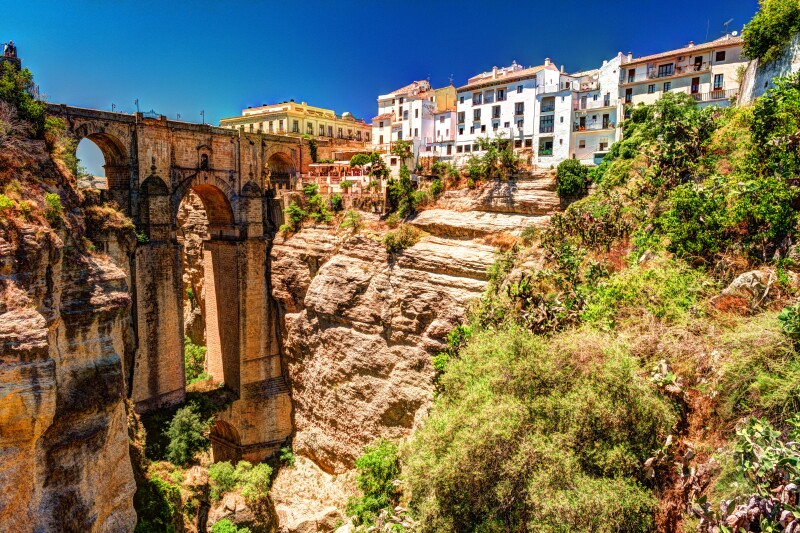
Ronda is most famous for its picturesque gorge, but it’s also the birthplace of bullfighting.
Photo by Romas_Photo/Shutterstock
Travel time: Less than 90 minutes driving from Málaga
Where to stay: Catalonia Reina Victoria is a plaid and preppy estate offering scenic views of the surrounding mountains.
Ronda has some of the most dramatic sights of any Spanish town thanks to the Tajo Gorge—clocking in at 394 feet deep—which runs straight through the middle of town. Each of side of the gorge is connected by the Puente Nuevo, or “New Bridge,” completed in 1793.
Considered the birthplace of bullfighting, Ronda is where matador Francisco Romero first faced off against a bull with a muleta, a red cape hiding a sword, around 1726. Visitors can check out the local bullfighting ring, Bullring of the Royal Cavalry of Ronda, designed in 1785 by Martín de Aldehuela, the same architect who built the New Bridge.
These days, the ring is a riding school. Visitors can still learn about the history of bullfighting with an on-property Bullfighting Museum—antique saddlery and ancient firearms are also on display.
Chinchón

Only 28 miles from Madrid, Chinchón has one of the most attractive squares in Spain.
Photo by Avillfoto/Shutterstock
Travel time: One hour driving from Madrid or Toledo
Where to stay: Founded by the first lords of the area, Parador de Chinchón is an old monastery in the medieval part of town, equipped with a monastic garden and grand rooms with four-poster beds.
Walking through Chinchón will make you want to own a balcony, so that you too can gaze down upon the happenings in the central plaza. The main square has 234 such balconies, made of wood and painted green, stacked like a multi-tiered cake. The effect is even more layered thanks to overhead corridors and staggered roofs.
The Plaza Mayor hosts medieval festivals, bullfighting, and plays, so even enjoying tapas and local anise liqueur at one of the surrounding restaurants will make you feel like you’re participating in a Middle Ages scene. Chinchón is also perfectly positioned between Madrid and Toledo; you can easily make a day trip from major destinations. Don’t miss the chance to try a whole suckling pig roasted in a wood-fired oven, such as that served at Restaurante El Convento Parador de Chinchón.
San Esteban de Gormaz

San Esteban de Gormaz is home to a well-preserved Romanesque bridge and the 11th-century San Miguel Church.
Photo by Juan Enrique del Barrio/Shutterstock
Travel time: Approximately two hours by car from Madrid
Where to stay: El Rincón de Elena is a hotel that operates out of a traditional Catalan home; guests can rent individual rooms or the entire home.
August is a big month for this medieval village in northwestern Spain. On the 12th of August 2026, the town will witness the maximum totality of the solar eclipse. Then, on the third weekend in August, locals dress up in period costumes to sell artisan wares—including candles, dried herbs, chocolate, and cheese.
No matter the time of year, travelers can walk across the Duero River on the well-preserved Romanesque bridge and visit the 11th-century San Miguel Church, both highlights of San Esteban de Gormaz. As you explore, look for mysterious chimneys jutting straight out of the ground—they’re “breathing” vents for the town’s underground wine cellars.
Nearby, the Bodegas Gormaz vineyard is worth a trip to sample area wines. While not as well-known as Spain’s Rioja wine region, Ribera del Duero is famous throughout Spain for its hearty tempranillos.
Frigiliana

The white village of Frigiliana is on Spain’s southern Costa del Sol near the Sierras of Tejeda, Almijara, and Alhama Nature Park.
Photo by bryan mancin/Unsplash (L); photo by Liene Grenevica/Unsplash (R)
Travel time: Roughly one hour driving from Málaga or Granada
Where to stay: Miller’s of Frigiliana is a family-run, boutique property with white walls overflowing with plants, in the heart of the town’s Moorish quarters.
With its winding labyrinth of whitewashed houses and steep cobblestone alleys decorated with hand-painted ceramic mosaics, this Mediterranean mountain village is reminiscent of a seaside town in the Greek Islands—but Frigiliana is purely Andalucían. Situated on the southern Costa del Sol, this town offers sweeping vistas of blue skies and blue waters in equal parts.
At the top of El Fuerte hill, which overlooks the white village, the 9th-century Moorish Castillo de Lizar is a prime spot to take in the surrounding scenery, and the Moorish old quarter known as Barribarto offers plenty of shops for local handicrafts.
Every year during the last weekend in August, the tiny town celebrates its confluence of Christian, Muslim, and Jewish traditions with the Festival of Three Cultures. During three days, restaurants here create special tasting menus for the event and food stalls serve delicacies like traditional Arabic pastries.
Albarracín

The Moorish village of Albarracín is home to approximately 1,000 people.
Photo by AntonioAlcon/Shutterstock
Travel time: Less than four hours driving from Madrid
Where to stay: Parador de Teruel is a half-hour drive from Albarracín and operates out of a Mudejar-style mansion.
This picturesque village is named for the Berber dynasty—the Banu Razin—that settled in this part of Spain sometime around the 9th century. Built within a rocky canyon on the hills above the Guadalquivir River, it is home to some 1,000 people. This area also falls directly under the shadow of the eclipse and is a transportive homebase.
Much of the isolated mountain town was destroyed during the Spanish Civil War, but the country’s government later restored many of the village’s 11th- and 12th-century homes. Albarracín has both Moorish and Catholic influences and features narrow, cobbled streets, a Gothic cathedral, the ruins of a Moorish alcázar, and pieces of a 10th-century curtain wall. Spaniards love this ancient village so much that they voted it the most beautiful in Spain a few years ago.
Castellar de la Frontera

Visit the castle fortress of Castellar de la Frontera.
Photo by Antonio Ciero Reina/Shutterstock
Travel time: 20 minutes driving from Algeciras
Where to stay: Book a room at the Hotel Tugasa Castillo de Castellar, which is built into the town’s castle walls.
Castellar de la Frontera is a walled castle town atop a hill at the southern tip of Spain. If you drive, you’ll want to park your car outside the walls and walk up to the gate, not only to pretend you live in medieval times but also because parking is tricky in the ancient town. Visiting in the summer means you might be greeted by a market at the village entrance. Otherwise, there are numerous cafés and shops within the white, red-tile-roofed buildings lining the hilltop.
Visit the 13th-century Arab fortress or climb the Torre de la Almoraima watchtower, built during Moorish times, to imagine spotting approaching armies. Or make your way to nearby Morocco; the ferry to the southern neighbor is only a 30-minute drive from town. You can also hike in the surrounding Los Alcornocales Natural Park, which has white rock cliffs, waterfalls, caves with Neolithic rock art, and oaks used to make corks.
Rupit

It’s believed that people have been living in Rupit for more than 1,000 years.
Photo by ABB Photo/Shutterstock
Travel time: Less than two hours driving from Barcelona
Where to stay: La Rectoria de Sant Miquel de Pineda is a bed-and-breakfast in a former priest’s home that dates to the 12th century.
This village in Catalonia may make you wonder if you’ve inadvertently wandered onto the set of a live-action Disney film, with its cobblestone streets and stone houses adorned with wooden balconies and flowerpots. A stream splits the village in half, so you have to cross a wooden hanging bridge on foot to reach the town center. But don’t be fooled by Rupit’s near perfection: This town has survived everything from plagues to earthquakes during its centuries of existence.
For a special outing, pack a lunch of local charcuterie on bread and pick up an apple dessert known as coques de l’avia (grandmother’s cakes) from any bakery in town, then take a leisurely hike (approximately two hours) to the Sallent Waterfall.
Cudillero

In a 2018 survey from the national El País newspaper, Spaniards voted Cudillero the second-most-beautiful village in Spain.
Photo by Ricardo Algar/Shutterstock
Travel time: Approximately three hours driving from Bilbao
Where to stay: Casona De La Paca is a former country manor house in a meadow just a 20-minute walk from the sea.
If you want to see the solar eclipse and the ocean at the same time, Cudillero is your spot. The coastal fishing village is known for its colorful houses and hillside location on northern Spain’s Asturian coast. This small town by the sea is where Spaniards come when they’re seeking beach time but want to escape the crowds. (In 2018, El País’s readers ranked Cudillero as the second-most-beautiful town in Spain, just behind Albarracín.)
Head to Playa del Silencio (Silence Beach) for a day of lounging, then stroll the promenade around Puerto Pesquero and duck into a tavern for some fresh fish and caña (small glass of beer). Don’t miss the dramatic coastline and cliffs at Cabo Vidio, a short drive from town.
Sóller

Sóller’s orange tram makes it easy for travelers to get from the town’s mountains to the sea.
Photo by proslgn/Shutterstock
Travel time: Half an hour driving from Palma
Where to stay: The adults-only Hotel Finca Ca N’aí looks like a boutique farmhouse; the Mallorcan Morell family has owned it since 1723.
Sóller sits on the northeast coast of Mallorca in the “Valley of Oranges” (drinking freshly squeezed orange juice while you’re in town is practically mandatory). And the entire island of Mallorca will be swathed in the eclipse’s path of totality, so you’re sure to get a good view from here. Although you could drive from Palma, one of the most popular ways to travel to Sóller is by a historic train line that whisks passengers by citrus orchards; some of them have been in production since the 13th century.
The town’s square is also not to be missed, with its fairy-tale-like buildings from the 14th century. The nearly 300-year-old Sant Bartomeu church is the jewel of the town square with its elaborate Gothic and baroque architectural influences. After exploring, set aside time to relax on Sóller’s white-sand beach.
This article originally appeared online in 2017; it was most recently updated on April 3, 2026, to include current information. Danielle Hallock and Mae Hamilton contributed to the reporting of this story.


