

New Yorkers and visitors alike are blessed with convenient air access to and from numerous destinations, thanks to three airports that share nonstop flights with countless major cities and smaller hubs throughout the world. And if you haven’t been to New York City in the past few years, you might be surprised to find entirely new terminals, concourses, and modernization projects that have and are continuing to completely transform the three major hubs that serve the New York City area.
Which airports serve the New York City area?
Three major airports serve the New York City area:
- LaGuardia Airport (LGA)
- John F. Kennedy International Airport (JFK)
- Newark Liberty International Airport (EWR)
There are benefits and drawbacks to flying into and out of each of these airports, including the distance from Manhattan and the relative ease—or lack thereof—of getting to each.
All three airports have been undergoing massive updates: Newark’s $3.5 billion AirTrain currently under construction, increasingly swanky lounges opening at LaGuardia (after a six-year renovation), and JFK’s ongoing $19 billion overhaul, which will completely transform the airport in the coming years.
Here’s what travelers should know about each of the three main New York City area airports.
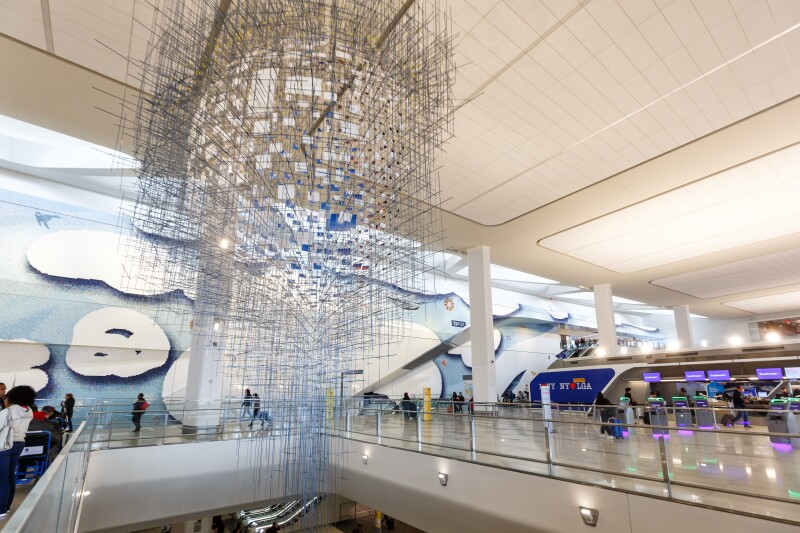
Anyone who hasn’t flown through LaGuardia in a few years might not recognize this completely transformed New York airport.
Photo by Shutterstock
LaGuardia Airport: Once considered the worst airport in NYC, now the local favorite
If you’re flying domestically to or from New York, LaGuardia Airport could be your best bet. Thanks to its complete recent transformation and its proximity to Manhattan, LaGuardia has definitely risen in the ranks among New Yorkers as a preferred travel hub.
Located in the New York borough of Queens (not far from the culinary and cultural melting pot of the Jackson Heights neighborhood), LaGuardia Airport (LGA) is not only the closest airport to Manhattan (particularly convenient from Midtown East and the Upper East Side, as well as from northwestern Brooklyn) but it also underwent a full $8 billion rebuild between 2016 and 2022 and now features brand-new terminals and passenger gates. They have turned this former underdog (once likened to a “third-world country” facility) into an award-winning hub.
Because of its “perimeter rule,” which caps most nonstop flights to and from the airport at a distance of 1,500 miles, LaGuardia can’t be a world-class international airport on par with JFK or Newark. But for domestic flights, especially with Delta Air Lines (which has made huge investments in its LaGuardia terminal), you should definitely consider LGA.
How to get to LaGuardia Airport from Manhattan
How to get to LaGuardia by public transportation
Public transportation access isn’t LaGuardia’s strong suit. There is direct bus service on the free Q70-SBS (aka the LaGuardia Link) from the E, F, M, and R subway trains at Jackson Heights–Roosevelt Avenue or from the 7 (or Long Island Rail Road) at the 61st St.–Woodside subway station. Those riding Metro–North can transfer to the M60-SBS bus at the Harlem 125th Metro–North Station to get to LaGuardia Airport. But many tourists and locals opt for a rideshare, taxi, or paid van service.
How to get to LaGuardia by taxi or rideshare service
The most common option is a taxi or rideshare service. It’s about a $34 to $57 taxi ride from Manhattan to the airport (and vice versa), not including tolls, new congestion pricing fees, or tip, and it takes from around 40 minutes to Terminal B with no traffic, to up to one hour during peak hours. Thankfully, the rideshare experience has become more convenient at LaGuardia; there’s a dedicated, close-by pickup area for each terminal. Fares range from an average of $53 to Central Harlem to an average of $91 to Battery Park.
Budget-conscious travelers can also opt to take the Uber shuttle service that offers rides to and from LGA between 5 a.m. and 11 p.m. for around $20. The 14-person vans go from LGA to 33 St., Times Square, 42nd St., the West Village, and the World Trade Center with several stops on each route. Rides can be booked up to three days in advance, but make sure to allow extra time for getting to the airport.
The best food and services at each terminal in LaGuardia
Here are some of the best ways to spend your time before your flight or during a layover at LGA.
Terminal A
The historic Marine Air Terminal dates back to the 1930s and is often a source of confusion for passengers. It’s a beautiful art deco–style terminal on the other side of the airport from Terminal B and Terminal C, but is not linked to those terminals in any way. Before Spirit Airlines shut down in 2026, it operated out of all six of the quiet terminal’s gates, but now the terminal no longer hosts traditional commercial airlines. Private airline company Modern Aviation is now the only tenant.
Terminal B
The airport’s main terminal, home to American, Southwest, JetBlue, and United, among other airlines, completed a $4 billion renovation that was so successful that it was dubbed 2023’s best new airport terminal in the world by aviation rankings organization Skytrax. The 1.3-million-square-foot Terminal B has also received a prestigious five-star Skytrax rating for two years running. The bright and airy hall is unrecognizable from its former cramped and dingy digs. There’s now a floor-to-ceiling dancing fountain at the center of the terminal, along with a selection of premium airport lounges, including a Centurion Lounge, Air Canada, American Airlines, and United Airlines. The Chase Sapphire lounge debuted its flagship location here in 2024 (check out the shuffleboard table in the hidden back room and the tree-house-like second floor), and Capital One opened an exciting culinary-focused lounge earlier this year with tapas from José Andrés. All travelers can take advantage of the terminal’s two kids play areas, a meditation room, and a Be Relax Spa.
The terminal is packed with food and snack options, too, including New York staples like Bar Veloce, the East Village wine bar; Brooklyn’s Junior’s Cheesecake; Talde Noodle Bar from celebrity chef Dale Talde; scrumptious sandwiches at Melt Shop; classic pies at Tony and Benny’s Pizza Parlor; Zaro’s Family Bakery for bagels; 5 Boroughs Food Emporium; and Brooklyn Diner, serving American classics. Other fast-casual options range from Hill Country for Texas-style barbecue and fried chicken, to the always reliable Shake Shack and 2025 newcomer Mezze for Mediterranean fare. If you’re looking for a leisurely meal to fill up a long layover, you can head to other sit-down options like Mulberry Street, IL Viaggio, and Hunt and Fish Grill, or pull up a bar stool at Orpheus + Apollo, Panorama Bar, Bar 212, Pour Authority, or Spirit & Bell.
Terminal C
In 2025, Delta’s LaGuardia hub completed a $4 billion redesign that includes a vast and airy arrivals hall and a 35,000-square-foot Delta Sky Club, the largest in the Delta system, with capacity for 700 guests. The terminal operates over 220 daily flights from 37 gates across four concourses. (Terminal D no longer exists as a separate terminal.) There is ample artwork throughout the terminal, including giant murals, sculptures, and digital art installations. And the culinary scene has received a welcome boost, notably from several New York City outposts, including Artichoke, known for its signature artichoke spinach pizza; Bubby’s for comfort food; Eggy Weggy for breakfast sandwiches; Chuko for ramen from Morimoto veterans; Essex Burger, of Lower East Side fame; H&H Bagels; and Magnolia Bakery to satisfy your sweet tooth.
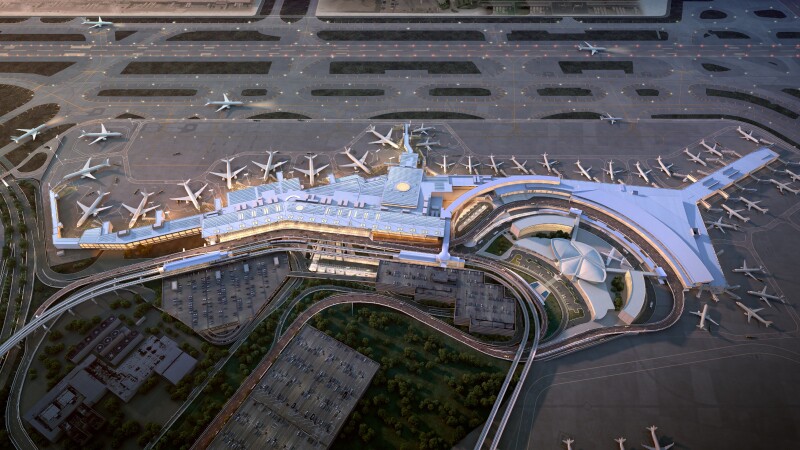
A new JFK is on the way, as this rendering of the forthcoming Terminal 6 shows.
Courtesy of the Port Authority of New York and New Jersey
John F. Kennedy International Airport: New York City’s main international hub
John F. Kennedy International Airport, also known by its airport code, JFK, is definitely the easiest way to get from the New York City area to destinations around the world due to the sheer number of nonstop flights available on major carriers, such as British Airways, Turkish Airlines, Lufthansa, Delta, and American. The one major airline that doesn’t fly out of JFK is United (the airline briefly returned to JFK in 2021 following a five-year hiatus, only to then pull out again in 2022); it uses Newark as its main hub. More about that below.
JFK, located in Jamaica, Queens, is in the middle of a massive $19 billion revamp slated to be completed in 2030. Over the course of the ambitious project, six separate terminals are shrinking to four, anchored by two new complexes at either end of the airport, in what’s being billed as “one unified Kennedy Airport.” Unfortunately, the transformation means that there will continue to be construction-related detours and road delays in and around the airport in the coming years. But it also means that a new JFK is on the way.
Modernization efforts aside, JFK is an international hub on par with other major global airports, such as London’s Heathrow Airport, Frankfurt Airport, or Dubai International Airport. And it is one of the busiest airports in the United States. Simply walking through the terminals presents a who’s who of international airlines and a potpourri of people from around the world. It makes for fascinating people-watching.
How to get to JFK from Manhattan
How to get to JFK by public transportation
The easiest way to get to JFK is by taking the Long Island Rail Road (LIRR) to the AirTrain, which then stops at all terminals. It used to be that you could only take the LIRR from Penn Station on the West Side of Manhattan—an inconvenience for those who lived or stayed on the East Side. But in early 2023, a new LIRR annex, named Grand Central Madison, opened at New York City’s Grand Central Terminal, finally making it possible to get from the East Side Manhattan train station to JFK via train. An LIRR train ticket between Grand Central or Penn Station and Jamaica (where you pick up the AirTrain) costs $5.25 or $7.25, depending on peak or off-peak times. JFK’s AirTrain fee is $8.75.
Alternatively, travelers can also take the A subway line out to the Howard Beach–JFK Airport stop and transfer to the AirTrain (make sure you board one with a sign that says its bound for Far Rockaway; those that say Lefferts Blvd do not stop at the AirTrain). Or you can take the E, J, Z to Sutphin Blvd-Archer Av-JFK Airport and then connect to the AirTrain. Both subway lines will take longer and makes at least a dozen stops between JFK and Manhattan, but depending on where you’re starting from, they may be easier than having to first get to one of the LIRR stations. Subway fare is $3; the AirTrain is a separate $8.75 fee.
How to get to JFK by taxi or rideshare service
Traveling by car highlights the biggest drawback of JFK; it is 15–20 miles outside Manhattan, which wouldn’t be so bad if it weren’t for the all-too-common traffic along the way, which has gotten even worse amid the current construction. And you can definitely expect to hit some unless you’re going to or from the airport after 10 p.m. or before 7 a.m. When there is no traffic, the drive is about 45 minutes, but during most of the day and evening, passengers should figure on a 75- to 90-minute car ride to or from Manhattan. The flat rate taxi fare from JFK to Manhattan via a classic Yellow cab is $70, not including tolls and tips. (Note that rides from JFK have a flat fare, but rides from LGA and EWR do not.) Additional surcharges based on time of day and route range from $2.75 to $8.50. From Manhattan to JFK, however, you’re paying whatever the meter indicates for a 90-minute trip plus tolls and tip, which could set you back considerably more. Be sure to use the official taxi stands for Yellow cabs (outside baggage claim areas); these are regulated by the flat fare rule and by the NYC Taxi and Limousine Commission.
Those flying JetBlue out of Terminal 5 should also note that due to the construction at Terminal 6 next door, the taxi stand has been moved farther from the main facility to the ground level of the yellow parking garage, which is near the AirTrain station. (Note: Both the taxi stand and the AirTrain station are a very long walk from Terminal 5’s arrival gates; contact JFK accessibility services for assistance.)
Rideshares via Uber and Lyft can be a bit less pricey in off-hours but also are subject to peak pricing surcharges, which can push the tab to over $100. Due to construction, the rideshare pickup locations from Terminals 5 and 7 have been moved to a parking lot at the Howard Beach AirTrain Station. Passengers can take the AirTrain to the pickup lot at no cost. The most affordable rideshare option is the Uber Shuttle. The shuttle runs from three Manhattan locations to JFK—Times Square, Greenwich Village, and 42nd Street—with several stops along each route. Exact costs vary based on time and pickup location, but riders can expect to pay around $25. Uber shuttles from JFK to Manhattan leave from Terminals 4 and 5.
How to get to JFK by car
If you’re driving your own car, there are plenty of spots in long-term parking lots with a maximum fee of $49 a day versus up to $80 a day to park in short-term lots closer to the terminals. You can check how full the lots are before leaving home, or plan ahead and prebook parking online. All on-airport parking lots, including long-term, are connected to terminals via the free JFK AirTrain. If you’re going by road, try to time your departure to avoid the worst of the rush hour traffic—typically from 6 a.m. to 9 a.m. and from 4 p.m. to 7 p.m. on weekdays. Be aware that construction has been causing heavy traffic and limited availability in the parking lots.
How to get to JFK by paid van service
Apart from Uber Shuttle, there is a smattering of van services between JFK and Manhattan, a great way to save money but not time. Airlink NYC and ETS Airport Shuttle are two of the main van services authorized to operate on site at JFK. Fares start at $35 one-way between JFK and the Grand Central train station in midtown Manhattan, which is a good deal, particularly if you have a lot of luggage and don’t mind sharing a ride and experiencing multiple stops at various hotel drop-offs or pickups along the route. Keep in mind that because of construction, traveling on the road may take longer than expected.
How to get to JFK by helicopter
The absolute fastest way is via the Blade helicopter service, which spends about 10 minutes in the air flying between helicopter pads in Manhattan and a private terminal at JFK. Most flights take off from West 30th Street, but service is available from East 34th Street between 2:45 p.m. and 6 p.m. on weekdays. It starts at about $200 for an Instagram-ready seat. When you factor in surge pricing for rideshare service, this actually isn’t that bad of a deal.
The food and services at each terminal in JFK
Depending on which terminal you’re in, you’ll either have ample options or pretty slim pickings for things to do before your flight or during a layover. JFK consists of a (sometimes confusing) set of five terminals, numbered 1 through 8, but terminals 2, 3 and 6, were demolished over a decade ago. Here is a breakdown of what to expect in every terminal; each has its own distinct features and design.
Terminal 1
The main airline tenants in Terminal 1 are Air France, Japan Airlines, Korean, Lufthansa, and Turkish. So, it’s not surprising the duty-free shopping is first rate, with brands like Bulgari and Hermès on offer. If you can gain access, the T1 airline lounges provide a posh place to escape for business- or first-class passengers. Otherwise, there’s also a Primeclass lounge for Priority Pass members. The dining is mostly fast food, but some reliable options include the Local, which serves American standards like burgers and pizza; Soho Bites for a preflight cocktail; Eat & Go Istanbul for Turkish fare; and Wok & Roll with a Chinese and Japanese menu.
Terminal 4
The vast and airy newer Terminal 4 space boasts dozens of high-end shops and restaurants, lounges, and even a valuable private art collection. International airlines ranging from Air India to Emirates and Virgin Atlantic operate from this terminal alongside Delta (with Delta Sky and Delta One clubs), which flies both domestic and foreign flights from here. Capitol One unveiled its 13,500-square-foot flagship lounge just past security in 2025. The AmEx Centurion Lounge here is loved for its specialty coffee bar and a hidden speakeasy, and the Sapphire Reserve Lounge that opened next door counters with more light and open spaces. Any passengers can purchase use of Minute Suites and the HelloSky Lounge. In Terminal 4, travelers will find cult fast-casual burger joint Shake Shack, the Palm Bar & Grille serving hearty steakhouse fare, and cocktail spot Gotham Speakeasy. There’s a Lego store, sports souvenirs at the Scoreboard, and two candy shops—Chocolate & More and So Chocolate. Victoria’s Secret, Hugo Boss, and Kiehl’s are also on hand for last-minute packing needs.
Related: These Are the Most Exciting New Airport Lounges in the U.S.
Terminal 5
This terminal is currently undergoing a major refresh scheduled to be completed later this year. It is JetBlue’s home, complete with the airline’s very first lounge, BlueHouse. Several other upgrades have already rolled out, including vastly improved dining options, new art installations, and an outdoor terrace with a dog run. Local favorites like Jacob’s Pickles, Leon’s Bagels, and Melt Shop have all opened outposts in the terminal. Other grab-and-go spots such as Caribbean Kitchen and Custom Burgers offer plenty of choices for a preflight meal. Shopping spots aren’t as abundant as they are in some of the other terminals, but you can browse at Herschel, Where Traveler Books, and a retail space modeled after Bryant Park that includes a Build-a-Bear station. Terminal 5 also has the advantage of being connected to the TWA Hotel; located in the original Eero Saarinen–designed 1962 airport terminal, it’s JFK’s only on-site hotel.
Terminal 7
When JFK’s redesign is complete, the new Terminal 6 will occupy the space currently taken up by Terminal 7. For now, Terminal 7 is home to Air Canada, Condor, Icelandair, Norse Atlantic Airways, and Frontier Airlines, among several others. It has two lounges, Aer Lingus and Horizons.The terminal’s food choices are decidedly less inspiring, with a Dunkin’, Le Grand Comptoir wine bar, and True Burger. Shopping is also scarce and mostly consists of a few duty-free shops and several Hudson News stores.
Terminal 8
Terminal 8’s makeover was unveiled in April 2026. American Airlines, British Airways, and other Oneworld partners like Finnair are the main tenants here. The project expanded the terminal by 130,000 square feet, making room for five new gates, dozens of new shopping and dining venues, and an enhanced baggage system. American Airlines’ Flagship Lounge and Admirals Club are available for club members and premium passengers. New food highlights include Eataly’s first airport location, the Blinded Tiger speakeasy, the upcoming Peach Palace by Momofuku, and much more in a spacious food hall. Shop ‘till you drop—or boarding begins—at Marc Jacobs, Alchemy, Longchamp, and Lacoste.

The TWA Hotel’s 1958 Lockheed Constellation “Connie” airplane has been transformed into a cocktail lounge.
Courtesy of TWA Hotel/David Mitchell
JFK’s TWA Hotel
One of the buzziest features of JFK is the throwback glamour of the TWA Hotel, which opened in 2019 in the airport’s original 1962 Eero Saarinen–designed terminal, back when the airport was known as Idlewild. The midcentury building had been abandoned since 2001 (Jet Blue’s Terminal 5 opened adjacent to it in 2008), but now it’s a hotel that sports a rooftop pool with runway view, a cocktail lounge inside a restored Lockheed Constellation L-1649A airplane (aka “Connie”), a sprawling red-carpeted sunken lounge restored to its original 1962 glory, and the Paris Café, a restaurant by Jean-Georges Vongerichten (who has Michelin cred and is behind Jean-Georges and ABC Kitchen in Manhattan). Visiting the TWA Hotel is like stepping back in time and is worth popping into for a meal or a drink or to stay overnight in the midcentury-modern-meets-space-age rooms if you need a place to sleep before or after your flight.
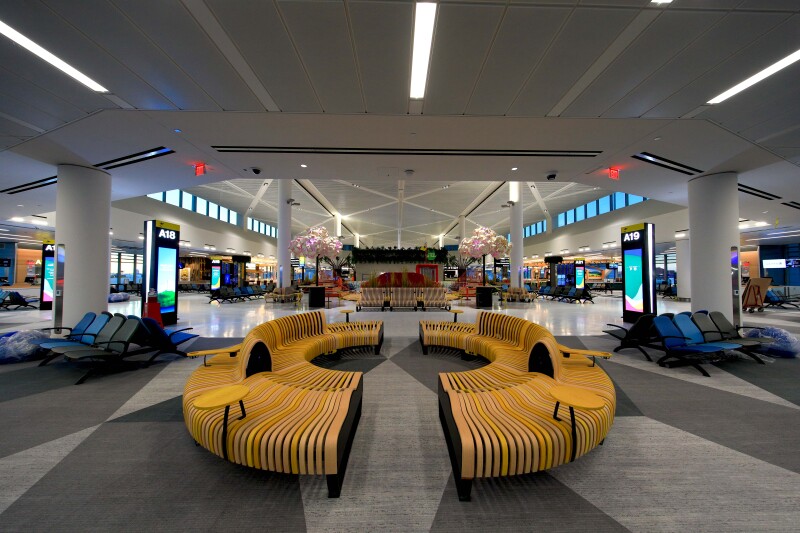
A brand-new, sparkling Terminal A is now open at Newark.
Courtesy of the Port Authority of New York and New Jersey
Newark Liberty International Airport: United’s New York City hub
If you’re flying with United or a United partner airline, you’ll be flying out of Newark, the main hub for United Airlines in the New York area, although it’s in New Jersey. But there are other reasons to consider this airport. It’s not that difficult to reach with public transportation, as detailed below, and it offers a fair amount of international service, minus some of the chaos of the more popular international hub JFK.
Newark Liberty International Airport has also benefited from some major renovations in recent years, namely a completely reborn Terminal A, which opened in early 2023. The much-needed new terminal, with its high ceilings and light-filled concourses, is a welcome departure from its dowdy predecessor. The spacious gate areas now feature colorful artworks, 60 percent more seating capacity, and charging stations at each gate, among numerous other upgrades. Newark has also begun a $3.5 billion plan to upgrade its entire AirTrain system for getting around the airport and connecting with New Jersey Transit trains.
How to get to the Newark airport from Manhattan
How to get to Newark by public transportation
Travel to Newark by train is quite good by New York standards. From New York’s Penn Station, you can get to Newark Liberty International Airport Station with a New Jersey Transit train. The 30-minute trip costs about $17 per person and includes your free transfer to the AirTrain, which stops at each airport terminal. The entire trip from Manhattan can take about one hour. However, the Port Authority warns of delays on weekdays through June 9, 2026, while shuttle buses replace AirTrains due to current construction. (AirTrains will operate normally on weekends.)
How to get to Newark by shuttle service
Airlink NYC and ETS Airport Shuttle are among the companies that operate shuttles between Manhattan and Newark, with rates starting at around $40 per person.
How to get to Newark by taxi or rideshare
Over the past few years, United Airlines has been trumpeting that it is actually much faster to get from certain parts of Manhattan to EWR than to JFK. That said, taxi rides and rideshare services to Newark are expensive. Your fare from Manhattan can run upwards of $100, plus a surcharge and a charge for the return tolls paid by the taxi.
The food and services at each terminal in Newark
Terminal A
This $2.7 billion facility is able to handle nearly 14 million passengers annually (the previous terminal was designed to handle 9 million), with 33 gates spread out over 1 million square feet. Airlines operating here include Air Canada, American, Delta, JetBlue, and United. A central rotunda features a food court and a cluster of digital towers that honor important figures in New Jersey’s history. Concessions include Jersey & Co. Gelato, Jersey Mike’s Subs; Playa Bowls, which serves açai and poke bowls, smoothies, and juices; Shake Shack; and Starbucks. The retail stores feature major brands like Boss, MAC, Kiehl’s, and Tumi. There are also several play areas for children, and three airline lounges: an American Airlines Admirals Club, a Delta Sky Club, and a United Club. An American Express Centurion Lounge is slated to open later in 2026.
Terminal B
This is the main international terminal—except for United flights. It has lounges for British Airways and other international carriers. Head to Malone’s Fish Market for healthy food options, such as fish and a selection of salads, or Unusual Times for a full English breakfast.
Terminal C
This is the home of United Airlines and offers some of the best food options at Newark. For example, the sushi restaurant Tsukiji Fishroom serves fish that comes directly from Japan a few times per week. There’s a wood-burning grill at the terminal’s Daily restaurant (that’s its name), which has a menu that changes—you guessed it—daily. The Eggy Weggy for breakfast standards transitions into a Custom Burger at night. Garden State Diner is styled after a retro Jersey diner experience. A Melange Café Bakery Chocolatier features cookies and other sweets from the universe of chocolatier Jacques Torres. Terminal C also has a United Club and a United Polaris Lounge.
This story was originally published in January 2020 and has been updated to include current information. Barbara Peterson, Chris Dong, and Michelle Baran contributed reporting.


