

“You have died of dysentery.”
“Dang it!” said my son, Wells, tossing the Nintendo Switch controller on the couch. Those five words had earned the same grimace from him that they had from me three decades earlier. For many millennials, a blocky pixelated computer game called The Oregon Trail taught a young generation about westward expansion through an alarming amount of gut rot, making the historical route seem like an obstacle course of old-timey misfortunes.
Now celebrating its 55th anniversary (and even a mobile app version of the game), the game has a new generation of fans, including my 11-year-old. When he became hooked last spring, my husband and I came up with an idea to get him off the screen and on the trail.
We created a road trip through the Wyoming section—the Oregon Trail’s crucial midpoint—where landmarks like Independence Rock, the Mormon Ferry, and Devil’s Gate bring the pioneer experience to life. It turns out we’re not the only ones embarking on game-cations.
Which section of the Oregon Trail to re-create? Press start to head west
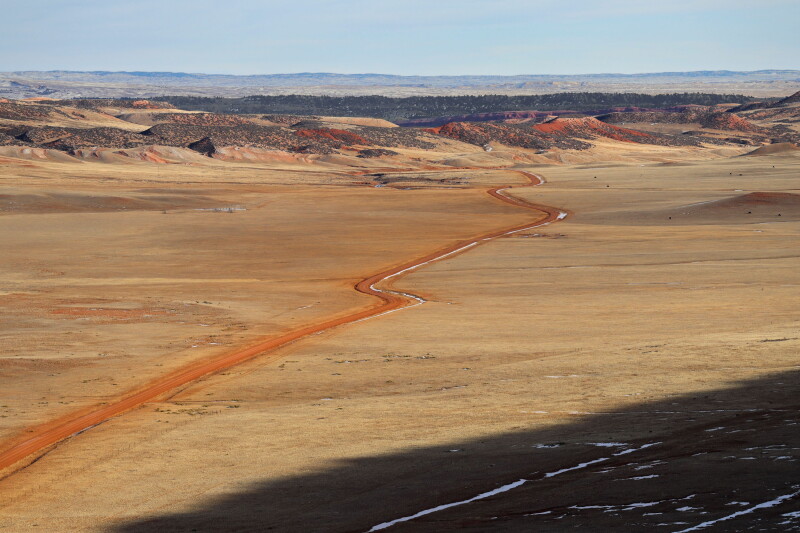
The Oregon Trail video game makes westward migration seem like one well-worn track; in reality, it was a web of overlapping routes.
Photo by Wirestock Creators/Shutterstock
Unlike the roughly 400,000 migrants who made the more than 2,000-mile journey west beginning in the 1840s, we had at least one notable advantage when crafting our route: freedom of choice. No blinking cursor demanded we start at Independence, Missouri. So we cherry-picked what we considered to be one of the most significant points in the path’s history: the wild crossroads of Casper, Wyoming.
This city, we felt, was where the Oregon Trail decided to get serious. The overlanders who reached this point would have just completed two months of crossing the relatively forgiving Great Plains, and they faced the Rocky Mountains, which rose ahead of them like a warning. What could be a better place to start?
We landed in Casper, picked up our rental car, and promptly departed the central Wyoming city. We had pioneers to catch.
Why game tourism is increasing
Our first stop was Independence Rock, now a state historic site, about an hour southwest of town.
“That’s it!” Wells said as the massive dome of granite came into view.
That flash of recognition—seeing a landmark he knew from a screen—is exactly what game-cationers are after, says Akua Harris, a travel agent and founder of Geekdom Travel, a travel agency specializing in gaming fandom.
“Gaming tourism is definitely growing,” Harris says. “It’s about immersing yourself in your geekdom, as I call it, and experiencing that lore in a new way.”
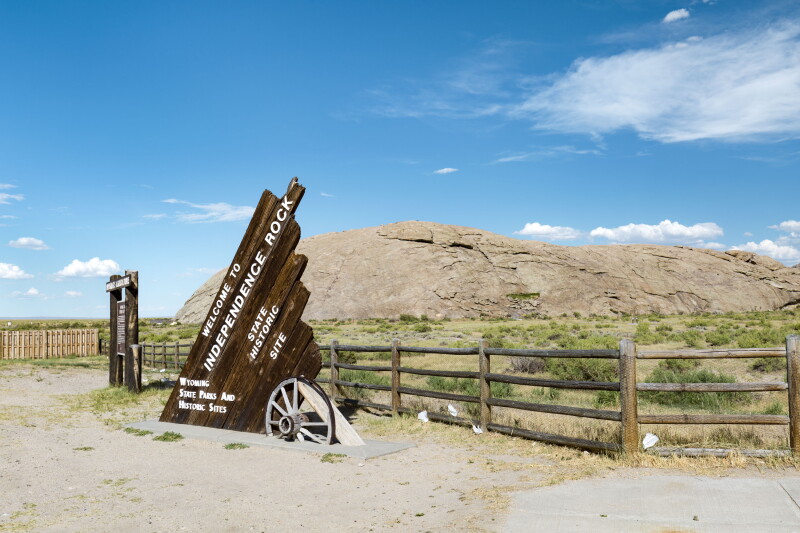
Independence Rock was an important milestone for pioneers to know if they had time to continue onward before winter or turn back.
Photo by BorisVetshev/Shutterstock
Research reveals the numbers behind the trend. A study published in Tourism Management in February 2026 suggests that video games are increasingly encouraging travel, as seen when the release of the popular video game Black Myth: Wukong caused tourism to China’s Shanxi Province to surge 156 percent. The action role-playing game, steeped in Chinese mythology and based on the historical novel Journey to the West, caused players to seek the real-world places and cultural landmarks they had encountered on-screen.
Weren’t we doing the same thing on Wyoming’s North Platte River?
Going beyond the pixelated prairie
Independence Rock earned its name because pioneers needed to reach the landmark by July 4 to have enough time to cross the mountains before winter storms set in. When we visited, wagon ruts appeared in the caked soil along a raised boardwalk entrance to Independence Rock, preserved like fossils. On the rock itself, hundreds of carved names formed a stone guestbook of pioneer vandalism.
From our vantage point, we could see Devil’s Gate, a 300-foot cleft in the earth, six miles away. But as a storm rolled in and the roads turned into sloppy pools of water, we decided not to let our rental car become its own Oregon Trail cautionary tale. In better weather, Devil’s Gate is an essential stop: a dramatic gorge carved by the v that migrant Charles E. Boyle called “one of the wonders of the world” in 1849. It also was a makeshift trading post with saloons, disorder, and even hangings.
That grim reality was part of the point of our trip: My husband and I wanted our son to understand that frontier-bound families couldn’t simply hit restart when the going got rough. And while modern-day travelers to Casper can bunk down at the delightfully cowboy-chic Alma Away, a former brothel turned boutique Airbnb, the original travelers had no such luxuries.
Best Oregon Trail activities to do in Wyoming
Before we dove into the tougher history lessons, we needed provisions: biscuits and gravy at Johnny J’s, followed by a shopping spree at Lou Taubert Ranch Outfitters. My husband and son emerged in Stetsons, I scored a pair of Wranglers, and we strutted into the Fort Caspar Museum looking like we’d taken the assignment a little too seriously.
Afterward, we went to the North Platte riverbank to ponder a familiar choice from the game: Pay for the Mormon Ferry or risk the ford? Noting the high water level, we agreed we’d have shelled out the $3 per wagon.
That afternoon, we mounted up with C Bracket Horse Barn for an hourlong horseback journey. As we rode through Wyoming’s dusty, wide-open landscape, the scale of the Oregon Trail suddenly felt less abstract and very overwhelming.
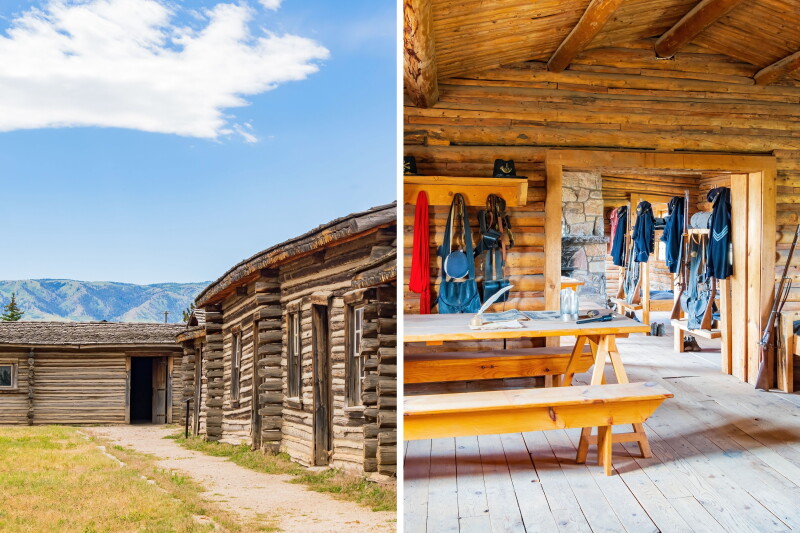
Visit the Fort Caspar Museum and find out how a spelling error forever changed the name of the city to Casper.
Photos by Kit Leong/Shutterstock
We had a prairie wagon ride and chuckwagon lunch planned with Historic Trails West the next day, but once again the stormy skies taught us a trailblazing lesson about the power of nature. Pioneers also faced bad weather, of course, only they couldn’t retreat to an SUV and drive 40 minutes away from the rain to Plan B: the ominously named Hell’s Half Acre. A kind of baby Grand Canyon, this jumble of ravines and jagged badlands left us in awe.
When the video game became real
We felt grateful to admire nature without as much fear as the real pioneers had.
“There was just a lot of death along the trail,” says Jason Vlcan, a visitor information specialist at the newly reopened National Historic Trails Interpretive Center. Roughly 1 in 10 migrants never reached the Willamette Valley, Salt Lake City, or the goldfields on which they’d gambled everything.
It’s one thing when an avatar gets bitten by a snake and the screen flashes Game over; it’s quite another to go looking for real-life casualties. But I knew we had to do it.
Plugging some coordinates into the GPS, we drove 25 miles east of Casper toward Glenrock. At the intersection with a sun-bleached dirt road, I yelled, “Turn left!” We parked on some crunchy grass, then walked to a small headstone, the grave of Ada Magill.
At age 3 in 1864, Ada, the youngest of six, was traveling with her family when she came down with dysentery in Fort Laramie, Wyoming. A few days later, she appeared to improve, encouraging her family’s wagon to continue another 100 miles. But then, near Glenrock, she took another turn, and the next night Ada passed. Her family dressed her in her “Sunday-best calico dress,” then piled stones on her grave in hopes of keeping predators at bay. They still had hundreds of miles to go, and somehow, after burying her, they kept walking.
“This makes the game so much more real,” Wells said.
For once, the kid with the Nintendo had no interest in a screen.


