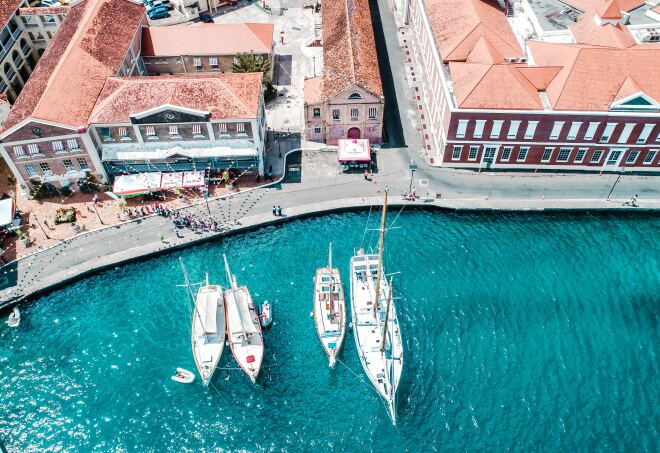
When’s the best time to go to Barbados?
Barbados has annual “wet” and “dry” seasons, with the higher rainfall that characterizes the former coming from June to November; December to May has less rain. But in general Barbados weather is remarkably consistent and temperate, and the island is located outside the principal Caribbean hurricane zone. Visitors can also plan their travel around the island’s many cultural events. The Barbados Independent Film Festival in March, for example, showcases films from a variety of genres, while the annual Holetown Festival in February uses music, dancing, and parades to commemorate the 1627 landing of European settlers and enslaved African who established Barbados as a British colony. The most colorful time to visit, however, is during the raucous summer Crop Over festival, which is like a Bajan version of Brazilian Carnival.
How to get around Barbados
Airline service from North America into Barbados’ Grantley Adams International Airport (BGI) has ramped up sharply in recent years. Jet Blue currently offers flights that include Mint premium-class service to Barbados from Boston and New York American Airlines flies to Barbados from Miami, and Delta Air Lines flies from Atlanta. Barbados is only 21 miles across at its widest point and locations around the island are easily reached by taxi, which can be hired near attractions or at hotels. Fares should be negotiated in advance (Barbados taxis do not use meters) and tend to be reasonable, in part because distances between resorts and attractions are relatively short. Some hotels offer shuttles that transport guests to points of interest across the island. The Zed-R vans that operate in and around Bridgetown offer an at-times crowded but economical option. Barbados’s public bus system operates daily.
Can’t-miss things to do in Barbados
Bajans don’t need much prompting to launch a celebration. Crop Over, the island’s premier festival, began in the 1780s to mark the end of the sugar cane harvesting season. Held between July and August, Crop Over is also akin to a Bajan version of carnival celebrations in Brazil and Trinidad. Full of passionate, island-wide revelry, dancing, colorful costumes, and raucous partying, Crop Over ends with the Grand Kadooment, a jaunty parade with bands and dancers in elaborate outfits. For a fun year-round alternative, residents and visitors alike fill the streets of Oistins each Friday night for the traditional fish fry. A virtual outdoor party, the fish fry takes place along dozens of street stalls and open-air restaurants in this seaside town on Barbados’s southern coast. Pulsating dancehall, calypso, soca, and reggae beats thunder from the restaurants and crafts shops featuring works by Bajan artisans.
Food and drink to try in Barbados
Barbados offers a well-rounded gastronomy that includes fine dining at Zagat-rated restaurants and high-quality but casual West Indian street food. As well as peas and rice, oxtail stew, and other Caribbean staples, local fare includes pudding and souse (pickled pork with spiced sweet potatoes) and flying fish. The latter is traditionally eaten on Fridays with spicy gravy and cou-cou (cornmeal grits cooked with okra); it is the country’s national dish. One of Barbados’s best known food purveyors is Cuz, whose tiny, eponymous sandwich shack near Pebbles Beach on Carlisle Bay has served savory flying fish “cutter” sandwiches for more than 20 years.
Barbados is traditionally celebrated as the birthplace of rum—a distinction generally considered likely, but impossible to prove. It’s believed enslaved people invented rum in the 17th century by fermenting molasses left over from sugarcane production. By the 19th century, Barbados was an international rum-producing center and the drink was an essential element of the island’s social life. Today’s visitors can explore the island’s rum legacy at one of several distilleries, via an hour-long tour at the Mount Gay Visitor Centre outside of Bridgetown, or simply at one of the country’s estimated 1,500 neighborhood rum shops.
Culture in Barbados
Barbados’s colonial history remains part of its present character. Originally inhabited by native Arawak and Carib peoples, the island was colonized by Great Britain; its development via a plantation-based slave economy resulted in the blend of West African, European, and Caribbean cultures that locals proudly acknowledge today. Bajans’ distinctively accented English is influenced by and draws from West African languages. The country’s 17th- and 18th-century Jewish settlers were of Dutch origin and introduced the windmill to the island, and Bridgetown’s ancient mikvah and synagogue incorporate a museum and a major archaeological site that is still being excavated. The Garrison Savannah, near Bridgetown, is a UNESCO World Heritage site and features a historic horse racing track and 18th- and 19th-century military buildings.
Music is an integral element of Barbados culture and each year the island hosts several popular music festivals and numerous concerts. Calypso, Barbados’s first popular music, was developed in the 1930s and retained its popularity even as ska, jazz, and other forms took hold between the 1960s and 1980s. Modern Bajan music remains focused around calypso, reggae, ragga, and soca styles. Global pop superstar Rihanna is the island’s most famous musician and native.
For families
Safe, serene, and filled with beautiful beaches and natural attractions, Barbados is perfect for families, whether they want a week of water sports and adventure or just somewhere special to enjoy together. All beaches are public and the west coast, which faces the Caribbean Sea, is lined with white-sand beaches lapped by calm waters. The most popular beaches feature food shacks and water sports operators offering catamaran, snorkeling, kayak, paddleboard, and dive excursions. Marked by a series of small inlets, Hastings Rock Beach in Christ Church is ideal for families with small children. Batts Rock Beach in Saint Michael parish is close to Bridgetown and very popular with snorkelers. Families can also explore Barbados’s undersea environment via an Atlantis submarine dive. The submersible craft takes passengers up to 150 feet beneath the sea to view colorful coral formations and marine life. Located in a mahogany tree grove near Farley Hill National Park, the Barbados Wildlife Preserve is designed so travelers can observe agoutis, armadillos, brocket deer, pelicans, and caimans in their natural environment. Harrison’s Cave is an underground cavern featuring intricate stalactites and stalagmites. Visitors tour the massive caves by tram, where they will find exhibits and interactive displays.
Local travel tips for Barbados
Casual food options abound in Barbados. Pink Star on Baxter’s Road serves famous liver cutters (sautéed liver in a salt bread roll). Kermit’s Bar in Thornbury Hill is the spot for such local fare as macaroni pie, fried chicken, or fish, but locals most love the bar’s pickled “sea cat”—the Bajan term for octopus. The Souse Factory in St. John parish is known among locals for hot, mild, and no-pepper pork souse, chicken, sea cat, chicken feet, and fried pork.
Local Resources
Guide Editor
Brian Major is a veteran travel writer, public relations professional, and media consultant. He is currently Executive Editor – Caribbean and Latin America at TravAlliance Media. His background includes past positions as director of public relations for the Cruise Lines International Association and senior editor posts at Travel Agent and Travel Weekly magazines. He resides in Brooklyn, N.Y.