

My fingers fumbled with the gear control, flicking back and forth, as I pedaled hard uphill. When the land finally levels into a tree-lined clearing, I dismounted, panting, and looked back toward the village of Les Vans in the valley below. The switchback road I just climbed is now a chalk line threading through the tree breaks, and below me, the land rolls in a verdant expanse to the horizon.
In a patch of shade to my right, two locals sat in camping chairs with a bottle of rosé. Glasses in hand, they waved, and we exchanged some pleasantries. They’re enjoying the same view. All I wanted to do is toss my bike aside and ask if they have a third glass.
When I heard about the Traversée Cévenole, a new biking-and-train route in the under-explored Cévennes region of southern France, I was intrigued. This picturesque loop pairs 62 miles of cycling trails with a 21-mile train ride —a combination that seemed the perfect opportunity to explore a new part of the country in an active, eco-friendly way. Yet here I was, 20 minutes into day one of the three-day trip, ready to scrap the adventure for a glass of cold rosé. Reluctantly, I bid the duo “bonne journée” and continued onward.
What is the Traversée Cévenole?

This southern region of France is known for its farmland views, food, and accommodations.
Photo by Damien Sanchez/Pexels
Cutting through an unruly medley of green peaks, dense forests, granite cliffs, gorges, and ravines, the Traversée Cévenole is a clockwise loop that takes two to three days to complete. It can be broken into three sections: La Bastide-Puylaurent to Montselgues (16 miles); Montselgues to Les Vans (20 miles); and Les Vans to Génolhac (26 miles), where a train north to La Bastide completes the circuit.
Much of the route traverses the 1,203-square-mile Cévennes National Park, a UNESCO Biosphere Reserve and World Heritage site that’s also home to Europe’s largest International Dark Sky Reserve.
High-speed trains (TER) from Nîmes and Clermont-Ferrand stop at La Bastide-Puylaurent and Génolhac, the route’s main entry points, and visitors arriving by train should book tickets with a bike-on-board fee in advance.
While La Bastide-Puylaurent is the official starting point, you can join the loop anywhere. My husband Emmanuel, our nine-year-old son Marius, and I had driven from our home in Lyon to Les Vans.
Using technology to help the ride
We rented e-bikes—and a tandem attachment for Marius—from Hop on Bar, an affordable company that delivers them (for a fee) to you. Ours arrived at the Castanhada camping site in Les Vans, where we also left our car. Luggage transfer is available through local cab services like Taxi du Sauze, but we opted for bungee cords, strapping all the bags to our bikes.
Heading out of Les Vans, we sailed along residential roads lined with squat stone walls and chestnut and olive trees. Signage is sparse, but the tourism office’s Rando Ardèche app can help. A wrong turn sends me into a ditch, but I quickly forget my tumble as the view opens up: emerald-green vineyards and distant steeple-topped medieval villages.
Gaining elevation, we crossed stone bridges stretching over rock-strewn streams, pass through pine forest where sunlight stencils the ground, and wheel around steep, green valleys. The route is graded from medium to difficult, and e-bikes are strongly recommended. While not crucial, I found the assistance helped immensely with the steep inclines.
Farm meals and farm stays along the way

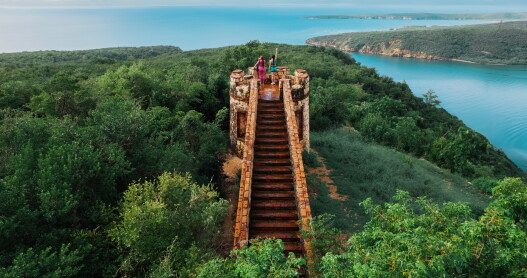
From the Chamborigaud viaduct to the town of Les Vans, the views in Cévennes are worth the laborious climbs uphill.
Photo by fafo/Shutterstock (L); photo by RudiErnst/Shutterstock (R)
Our first stop, Le Bistrot de Malbosc, had already stopped serving lunch when we arrived. Rural France being what it is, many restaurants close between lunch and dinner. Luckily, the bistro doubles as a post office, bakery, and épicerie (grocery store), so we assembled a meal from pâté, spelt salad, and a baguette, and ate overlooking a panorama of mountains.
France’s abundant system of gîtes (rural cottages and farmhouses converted into lodging), campgrounds, and auberges (small inns) means accommodation options are plentiful, but you’ll need to book ahead. That night, we stayed in a tiny, enchanting house at Camping Le Pont du Mas in Génolhac. It was basic, but beautiful.
Then, it was time to for the train segment of our journey, after which, we would bike back to where we started. We loaded our bikes onto the train toward La Bastide Puy-Laurent. This small town is steeped in the legacy of author Robert Louis Stevenson, who documented his 1879 trek through the region with his donkey, Modestine. There is a mural of the author in the town square, the grocery store sells baseball caps with his silhouette on them, and a poster for a play called Adieu, Modestine! hangs in Chez Louky, where I threw back an espresso.
Back on the bikes, cycling from La Bastide Puy-Laurent toward Montselgues, I appreciated that the route started delightfully downhill, gliding through forest past houses of stacked stone with cornflower blue shutters.
We pushed past the silent, heat-stilled town of Montselgues, our sights set on Ferme Auberge de la Bombine, a working farm. Phillippe and Faty Vincent have run this local institution for 25 years, and their fixed menu du jour is famous. When it arrived, we assumed the first course of tourte aux cèpes (mushroom tart), salad, and a one-liter jug of red wine was our entire meal, but then Faty returned carrying roasted beef, ratatouille, potatoes au gratin, and a heavenly omelet. “It’s simple. But it’s efficient!” she said, adding a plate of seven different cheeses to the table.
After a night at the farm, we returned to Les Vans, stopping to admire a church roof that has crisscrossed slate stones jutting from its pitch like interlaced fingers. The mountains in the distance ripple like waves. I can hardly believe the richness of the landscapes. Thank goodness I didn’t give it up for a glass of rosé.


