

It’s fair to say I’ve been obsessed with Ancient Greece for as long as I can remember—as a kid, drawing characters from Disney’s Hercules; as a seventh grader, when my English teacher had us clip modern-day mythology references (Nike, Hermès) out of magazines; in college, reading The Iliad and The Odyssey and scores of tragedies and comedies as part of a great books seminar; and today, when I’ve been known to travel to London for a contemporary Euripides or Sophocles adaptation.
But despite my interest, I’ve always found the idea of an actual trip to Greece daunting: The country seemed so scattered, so dense with millennia of archaeological sites, that any itinerary I could plan on my own would inevitably leave me feeling dissatisfied at all the history I couldn’t squeeze in as I lazed on a beach chair.
Two things finally made me take the leap: the impending release of Christopher Nolan’s Odyssey adaptation, which reignited my interest in a 3,000-year-old story that I hadn’t read in two decades; and the launch of a new tour company that foregrounds rigorous academics.
The Great Courses is an online learning platform with 20,000-plus lectures on subjects like Norse mythology, how to play the ukulele, Charles Dickens, and perfecting the flakiest pastries. Last year, the company quietly launched The Great Courses Journeys, which pairs small groups of travelers with experts: You might wander Machu Picchu with an archaeologist, dig into England’s fairy history with a folklorist, or attend Italian operas with a music historian—something like a roving university lecture.
This May, I “enrolled” in the 11-day Ancient Greece: Myths, History, and Archaeology itinerary, and while it’s not specifically Odyssey-themed, its wide-ranging scope would provide a solid basis for untangling a surprisingly complicated literary work.
An epic tour of Ancient Greece
If it’s been a while since you read Homer’s epic, a refresher: After the Trojan War, Odysseus tries to return home to Ithaca to his wife Penelope and their son Telemachus, and over the course of 10 grueling years, he faces sea monsters, giant cannibals, amorous nymphs, and a sorceress who turns men into pigs.
Those showing up at the multiplex expecting pure escapist spectacle will find a much more complex story—a meditation on grief, guilt, free will, and the psychological effects of war. The epic poem has always been a Rosetta stone to decode the deep Greek past, from its warfare and ethics to its religious practices and politics.
My tour would be led by Dr. Monica S. Cyrino, a classics professor at the University of New Mexico whose research focuses on Greek and Roman poetry and especially Aphrodite. During my Odyssey Summer, I was excited to hear that one of her true passions is a sub-field called “classical reception”—the intersection of the ancient world and pop culture. She’s published articles on Gladiator and 300, written books about HBO’s Rome, consulted on TVs and films, and even taught Latin to Colin Farrell. (If you want to experience her lectures for yourself, check out her Audible series Sex Scandals of Ancient Greece and Rome.)
Another thing that excited me about the itinerary is that it would stick to the Greek mainland instead of venturing out to the more popular islands, with a brief day trip to Aegina, just offshore. As Cyrino would later tell me, if you want important ruins, it’s all about the Peloponnese (where we would be venturing) or Crete. Days would be spent traipsing through dusty archaeological sites and their attached museums. Tours would be led (as Greek law dictates) by local licensed tour guides, with Cyrino on hand to offer color commentary and then provide in-depth evening lectures to give more context.
Her partner in crime was Erin Nedelisky, an American-born travel director who moved to Greece in 1999 and splits her time between Athens and a small town on the Gulf of Corinth. She’s a true wiz at Greek travel logistics and trivia—the kind of person you want on the minibus microphone whether you’re asking about restaurant etiquette, the defunct Greek monarchy, or juicy Onassis family gossip.
Our 10-strong group was made up mostly of retirees—some couples, a bunch of solo travelers—many of whom were Great Courses superfans. They had, in the parlance of academia, done the reading, and they came prepared with questions about Homer translations and the specific archaeologists who discovered certain artifacts. In other words, I had found my people.
A classical start with Trojan war trinkets in Athens
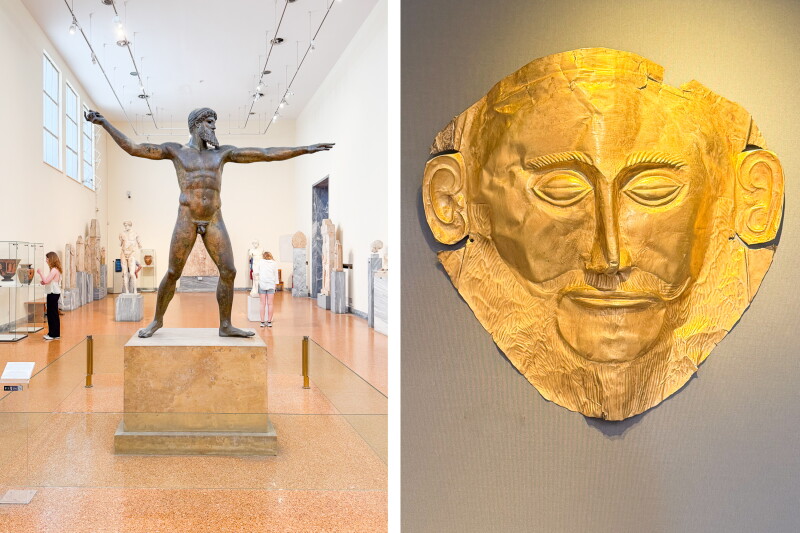
The National Archaeological Museum Athens contains a mask long thought to have been used during the funeral of Agamemnon, a king in the Trojan War.
Photos by Nicholas DeRenzo
Our tour began, as you might expect, in Athens, the dense, energetic capital city. Despite its fast-paced modern culture, it doesn’t take much to conjure mental images of what life was like here 500 or 2,500 years ago. The Parthenon still rises elegantly atop the craggy Acropolis; carved columns jut skyward next to souvenir shops and apartment blocks, remnants of some long-gone temple; and pocket-size Byzantine chapels sit in the shadow of fast food restaurants and department stores.
During our time in the capital, we made our pilgrimage up to the Acropolis, almost overwhelming in its grandeur: If I’m still awed by the perfection of its architecture today, I can’t imagine how it must have moved people back when it was built in the 5th century B.C.E.
Before our ascent, Cyrino said, “As we walk up the very steep approach to the gate of the Acropolis, I want you to think about something that our friends over in the religious studies department and the anthropology department call verticality—the transcultural human urge, to look upwards for divinity, for God.” The Parthenon and Mount Olympus, she told us, fit into a tradition that extends to places like Machu Picchu, Chichen Itza, and Gothic cathedrals.
If the Acropolis is all about outsized splendor, the National Archaeological Museum—which we visited the next morning—is decidedly more human scaled. It’s inarguably one of the world’s great antiquities collections (set to close in 2027 for a multi-year refresh), but for every imposing statue of a god or goddess, there’s also a cabinet of simple drinking cups or animal-shaped baby rattles, vessels for olive oil, and even terra-cotta puppets and yo-yos. Every one is a window into daily life.
I was especially awed by the Mycenaean gallery, dedicated to the Late Bronze Age civilization that flourished from about 1600 to 1100 B.C.E.—the time of the Trojan War, depicted a few centuries later by Homer. Of course, classicists can’t agree if Homer was, in fact, a blind bard or just a collection of oral storytellers, but scholars date the epics credited to him to around 750 to 650 B.C.E.
Among the treasures on display is the Mask of Agamemnon, a gold death mask (which would have been placed over the face of the deceased) discovered in 1876 by amateur archaeologist Heinrich Schliemann. At the time he reportedly telegraphed King George of Greece to tell him that he had “gazed upon the face of Agamemnon,” the legendary king who had led the Achaeans (Greeks) against the Trojans, played by Benny Safdie in this summer’s adaptation. Later research suggested that the mask probably predated the Trojan War by a few centuries, but the moniker stuck.
Out to an ancient city of sin and spa town in the Peloponnese
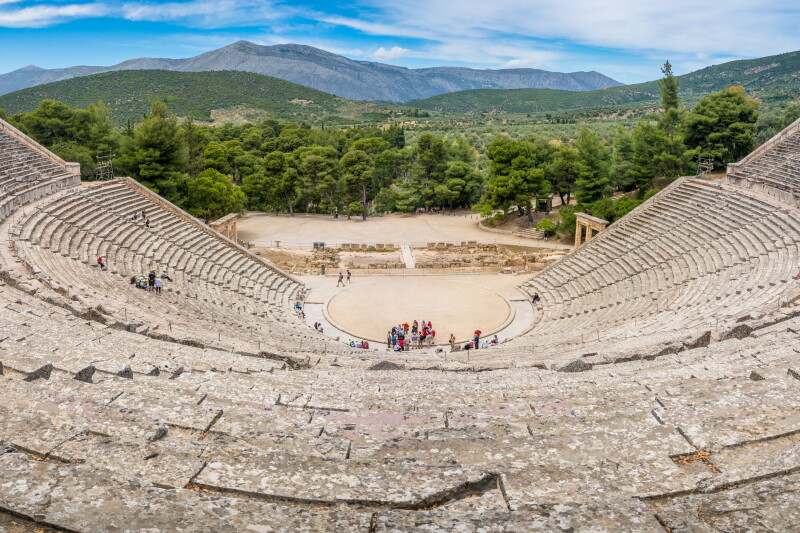
The theater at the Sanctuary of Asklepios at Epidaurus has incredible acoustics.
Photo by Steve Heap/Shutterstock
The next morning, we left behind the bustle of Athens to explore the Peloponesse, a jagged and mountainous peninsula that’s the beating heart of ancient Greece—home to Sparta, the Olympics, and five UNESCO World Heritage sites in an area smaller than New Jersey. As a reminder that we were headed somewhere wilder, we passed a boar-crossing sign on the highway, and my mind immediately thought of the “tameless” Erymanthian boar that Hercules caught as one of his 12 legendary labors.
About an hour’s drive west of the capital, we pulled up to the Corinth Canal, a four-mile-long slice cut into the rocky landscape in 1893 that connects the Ionian and Aegean Seas; cruise ships can sail through it today. Around the seventh century B.C.E., Corinthians built the Diolkos here, a paved track over which men dragged ships between the two seas. As sailors waited, they’d head to the city of Corinth, a debaucherous way station for sex, drugs, and the ancient equivalent of rock ‘n’ roll that earned it the nickname “Las Vegas of the Ancient World.”
We stopped into the archaeological site of Ancient Corinth, marked by the imposing Temple of Apollo and the remnants of a Roman-era agora (marketplace), baths, and cemeteries. The compact on-site museum contains decorative jars that once held prized garum (a fermented fish sauce) and anatomical votives (terra-cotta body parts) offered up to the god of medicine and healing, Asklepios.
For lunch, our group ate pastitsio (a baked pasta dish) at the rooftop Gemelos Tavern, which looks out over the archaeological site. Cyrino pointed up to the Acrocorinth, the city’s imposing acropolis, which towers above the ruins on a craggy monolith. She urged us to remember its contours: The Odyssey cast spent time filming up there, and it would later appear as the exterior of Agamemnon’s palace during his postwar homecoming scene in the movie.
After lunch, we drove another hour to the UNESCO-designated Sanctuary of Asklepios at Epidaurus. Surrounded by pine-covered hills, the site instantly makes you feel calm—which might explain why it emerged in the 6th century B.C.E. as something of a health spa resort, dedicated to the god of medicine. “There would have been a whole team of attendants and priests that would help diagnose you,” Cyrino explained. “You have a meal, you drink a certain little potion, and then you would bunk down for the night and Asklepios would visit you in a dream and tell you what you need to do to fix your gallstones or whatever.”
One of the coolest parts of the sanctuary is that it’s home to the best-preserved ancient theater in Greece, which seats up to 14,000 audience members and is still in use today. (Maria Callas performed there in the 1960s.) Ancient healers believed the arts were a vital part of holistic healing, so “patients” might be prescribed some Sophocles, Aeschylus, or Euripides to watch.
The theater is also renowned for its perfect acoustics. If you stand on a small disk at center stage and whisper or drop a coin, the sound reaches perfectly to the back row. Cyrino sent me clambering up the roughly 110 steps to the top. “Ready?” she called up. I gave her a thumbs-up, and she started reciting a Sappho poem at a normal speaking volume, with the syllables written more than 25 centuries ago crisply ringing out against the limestone.
Hercules lore, cyclops myths, and bloody “Southern Gothic”
If our first days were centered roughly around the “Classical period” (the 5th and 4th centuries B.C.E.), the next would be dedicated to the much older Bronze Age Mycenaean period. We had stayed the previous night in the seaside town of Nafplio, the first capital of modern Greece, known for its pastel-hued architecture, much of which can be traced to its years of Venetian rule.
“We’re going to the way back,” Cyrino told us as we piled into our minibus. “We’ll talk about the family of Hercules, and then the House of Atreus that took over the imagination of tragedians and epic poets for such a long time. There’s a lot of hero stuff, a lot of legends, a lot of ‘Southern Gothic,’ as I call it, because we’re down in the south—a lot of blood and betrayal.”
Minutes from our hotel sits the hulking hill fort of Tiryns, which dates back to the Bronze Age—and was totally free of tourists. Cyrino mentioned that Homer referred to this imposing citadel as “mighty-walled Tyrins,” and in parts, their thickness can exceed 50 feet. These walls are often referred to as “Cyclopean,” because later Greeks assumed that only the giant, one-eyed race could have had the strength to construct them. At the top of the citadel, we stood in the ruins of a palace complex where Hercules was said to have lived during the completion of his 12 labors; it probably would have looked much like the palace Anne Hathaway’s Penelope presides over in the film.
Nearby in Argos, we stopped into a dramatic ancient theater—cut directly into the rocky hillside in 320 B.C.E.—just as a theater troupe was setting up to perform Aristophanes’ Birds for a crowd of local school children. (I didn’t understand a word, but I liked the costumes.) And then we continued on to the vineyards of Nemea, where Hercules was said to have killed a ferocious lion that had been terrorizing the countryside. Cyrino pointed out the Temple of Zeus, where she had worked very briefly on an excavation as a college student, before quickly ditching the “stones and bones” side of the classics. “I decided to become a literary historian instead of an archaeologist,” she said, “because it was just too darn dirty for the princess I am.”
After a winetasting at Semeli Estate, overlooking the Tuscany-like rolling hills, we headed to the Treasury of Atreus (or Tomb of Agamemnon), a Mycenaean beehive-tomb, or tholos, that dates back to 1300 B.C.E. In the 2nd century C.E., Greek travel writer Pausanius first began associating the place with the House of Atreus, the mythical clan that included the likes of Clytemnestra, Helen of Troy, and Orestes and inspired everything from the Homeric epics to the bloodiest of Greek tragedies.
Down the road, we continued our exploration at the Mycenaean citadel, once a major center of world civilization; up a steep incline, the entrance to the old fortress is marked by a grand stone gate decorated with a pair of lions. It was built in about 1250 B.C.E. and is considered the oldest monumental sculpture still standing in Europe.
“You guys might notice that all the movies about the Trojan War use the Mycenaean citadel as a sort of design inspiration,” Dr. Cyrino told us. “This is the best-preserved [citadel from that period]. This is where set decorators will come and get [ideas]—the way it’s so high up, the main palace in the middle. We’ll be able to see some of that this summer with the new movie.”
Steps away, we looked down into the grave circles where archaeologists found the Mask of Agamemnon and other gleaming gold artifacts. I was immediately drawn in by the mystery of the place—how the family of Atreus and Agamemnon exists at some intersection of fact and fiction, Bronze Age history, and myth, like a copy of a copy of a copy of a photograph, faded but forever evocative.
Olympia, a wonder of the world, and a trip to the sea
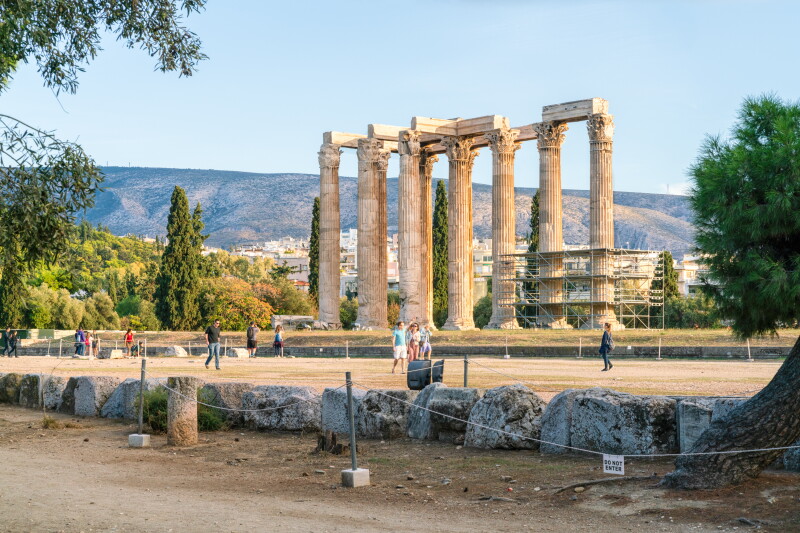
The Temple of Zeus is the location of one of the Seven Wonders of the Ancient World.
Photo by Andrius Kaziliunas/Shutterstock
Over the next few days, we hopscotched across the Greek mainland, taking in a dizzying assortment of historic sites. At each, the major monuments were tempered with the subtle nods to the quotidian, hints at the everyday people behind the legends.
In Olympia, for example, we stopped at the site where the Olympic Games kicked off in 776 B.C.E. We walked among the fallen columns of the Temple of Zeus, which once held one of the Seven Wonders of the Ancient World, a roughly 40-foot-tall chryselephantine (gold and ivory) statue. (Nobody knows exactly when it was destroyed, but a Byzantine historian wrote that it was carted off to Constantinople where it burned in a fire in the 5th century C.E.) The thing that moved me most, however, was a side gallery at the on-site museum, displaying the terra-cotta molds that the sculptor Phidias used to shape gold sheets into Zeus’s draped robes.
We walked through the foundations of the locker rooms, where athletes would scrape olive oil and sand off their bodies with curved strigils; past the pedestals that once held the Zanes, bronze Zeus statues funded with fines paid by cheaters; and into the stadium, where you can still put your toes on the starting line where runners stood millennia ago.
Next, we headed up to the northern coast of the Peloponesse and crossed over to the Greek mainland. We hugged the shoreline, past hidden coves along the Gulf of Corinth, until we eventually reached the foothills of Mount Parnassus, a peak sacred to Dionysus and Apollo and home to the Muses. I thought about Dr. Cyrino’s comments on verticality as we drove up steep switchbacks to Delphi, where the Pythia (a high priestess) used to dole out prophecies to travelers at the “navel of the world.” She would enter a divine trance and deliver her predictions in an ecstatic gibberish that needed to be interpreted by priests. (Some scholars believe she entered that state because of intoxicating gases emitted from geological faults beneath the temple.)
On our last day of the tour, we broke our stick-to-the-mainland rule and headed out to Aegina in the Saronic Gulf. Known for its pistachio groves and a charming neoclassical town, it’s about 17 miles from Athens’s seaport and can be reached via high-speed hydrofoil boats in about 40 minutes.
At one of the island’s high points stands the hilltop Temple of Aphaia, a Doric jewel box that predates the Parthenon by a few decades. I looked out over the gulf from beneath its soaring columns, watching ferries zip along the horizon, and my brain naturally wandered to Odysseus. I thought of his arduous passage over the “wine-dark sea,” as Homer famously wrote. The Odyssey is such a profoundly old text that scholars have squabbled for decades over whether “wine-dark” indicates that the poem predated a word for blue or the concept of blueness—or if the ancients could even see or perceive the color at all.
I was awed by the delicious ambiguity of Greece and the mystery inherent in every square mile here. Each ruin and historical figure raises new questions, and every fact you learn seems to unravel a new line of questioning until you’re left with a knotty ball of yarn.
Was Odysseus real? A composite of historic figures? A literary creation? Does it matter when the landscape is so timeless and evocative that you can practically squint and imagine his boat skittering across the horizon as he tried desperately to get home?


