
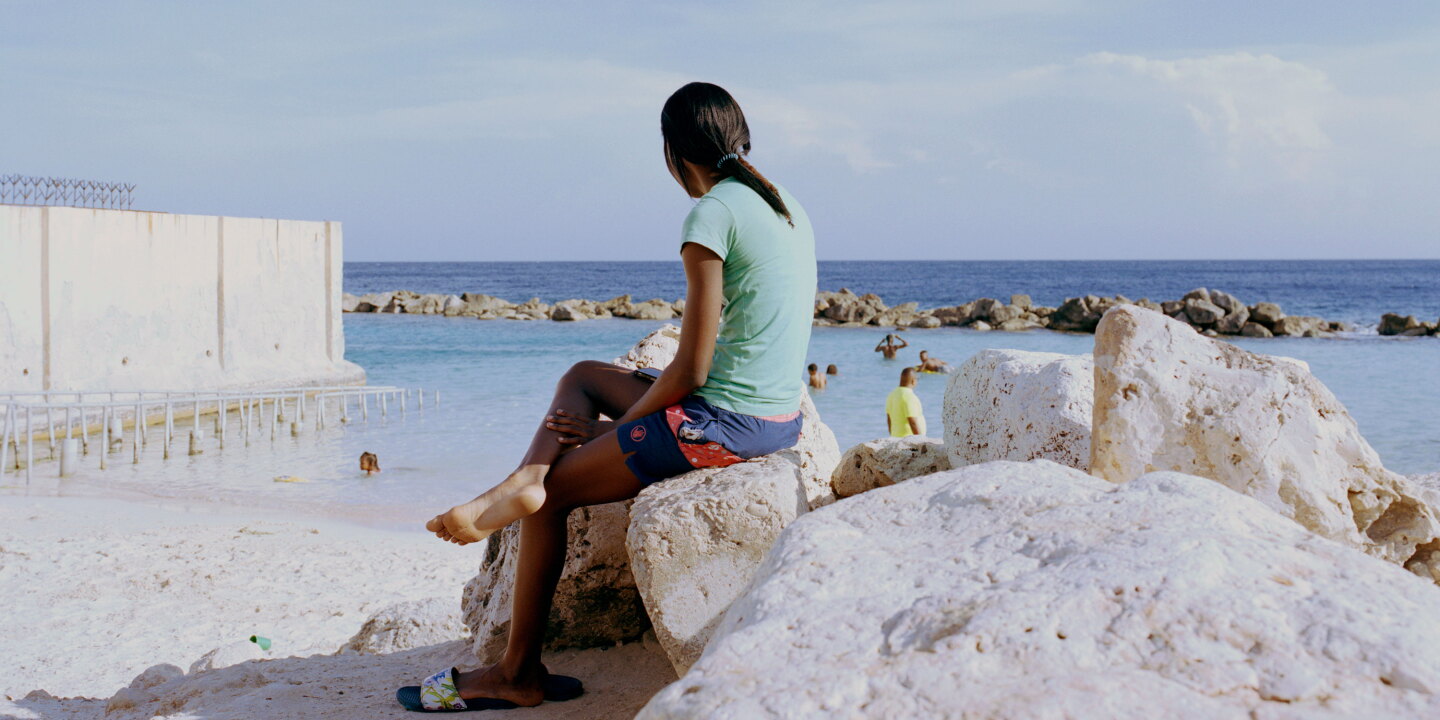
“Google ‘Caribbean island’ and you’ll find a Windows XP background—blue water, palm trees, and white beaches,” says photographer Gilleam Trapenberg. “But I don’t feel that that’s all Curaçao is.”
At the southern edge of the Caribbean Sea, roughly 40 miles north of Venezuela, Curaçao sits outside the so-called hurricane belt and sees less rainfall than its island cousins further east and north. To Trapenberg, what helps set the destination apart is its topography: more cacti than palm trees, and volcanic rock formations juxtaposed with lush vegetation.
Trapenberg grew up in Curaçao’s capital, Willemstad, a UNESCO World Heritage site with a well-preserved historic district of Dutch-style buildings painted buttercup yellow and robin’s-egg blue. The first Europeans to land on Curaçao were 15th-century Spanish colonizers, who enslaved the Indigenous Arawak people and deported them to other Spanish territories in the region. Since 1634, the island has almost continuously been a colony or constituent country of the Netherlands. Enslaved people brought by the Dutch from the west coast of Africa and their descendants make up roughly 85 percent of the population today.
Trapenberg started taking pictures of the island as a teenager and has been photographing Curaçao professionally since 2016. Its residents are often the focus of his work. “The Caribbean has been depicted in a certain way, which is oftentimes very exoticized,” he says. “I try to show a more authentic version of what island life is. It’s important to share stories that offer a counternarrative to this idea that people have of Curaçao and the Caribbean.”
Experiencing a more intimate perspective, for the photographer, includes eating funchi (cornmeal mush) and fried fish at locally owned restaurants. Trapenberg goes to hear live music in Willemstad, and frequents snèks—mini markets on the side of the road, usually with an open-air bar—for pastechi (stuffed fried pastries). “[Visitors should] take their time and talk to people,” he says. “And ask the tour guide for his favorite lunch spot.”

Less than 1,000 miles north of the equator, Curaçao averages more than eight hours of daily sunshine. “At noon, it’s almost as if there’s no shadow, because the light bounces from everywhere,” says photographer Gilleam Trapenberg.
Photos by Gilleam Trapenberg

The language spoken in Curaçao is Papiamento, a blend of Portuguese, Spanish, and Dutch, with some French and English. (It is also spoken on the nearby islands of Aruba and Bonaire.) Some estimate that the island counts more than 55 nationalities among its population, which comes together for festivals such as Seú (pictured), held annually in March or April around Easter Monday. “There’s this huge influence from Latin America, as well as Haiti and Jamaica,” Trapenberg says. “In Curaçao, this melting pot of cultures is very on the surface.”
Photos by Gilleam Trapenberg

Curaçao is one of the Caribbean’s top dive destinations—with more than 70 stand-alone sites—and is known for hiking trails in locations such as Seru Bientu (pictured). The island’s temperature is around 82 degrees year-round and it has nearly three dozen beaches along its 79-mile coastline. Located on the northern end of Curaçao, Shete Boka National Park is a turtle breeding ground from May to December.
Photo by Gilleam Trapenberg

“Conscious travel is something that really fits Curaçao,” Trapenberg says. “It’s not the kind of place where you come to and you spend your whole week inside a resort. You will get to know the people [here].”
Photos by Gilleam Trapenberg

The travel and tourism sector employs more than 20,000 people in Curaçao and makes up 48 percent of the island’s GDP. Several new hotels are slated to open in 2026, including the Pyrmont Curaçao, a 300-room all-inclusive resort that’s part of Marriott’s Autograph Collection.
Photos by Gilleam Trapenberg


