
We’ll be the first to extoll the joy of traveling across Europe by train. Not only is it among the most eco-friendly ways to travel, but many train stations across the continent are downright gorgeous. Some, such as the Victorian Gothic red-brick St. Pancras International in London or the Gothic/Renaissance Revival Amsterdam Centraal, are late 19th-century masterpieces. Others, like the vaulted glass-and-steel station in Liége, Belgium, are strikingly modern.
While this list is not exhaustive, these are 12 of the most beautiful train stations in Europe, from a wee charmer in Scotland all the way to an art nouveau stunner in Prague.
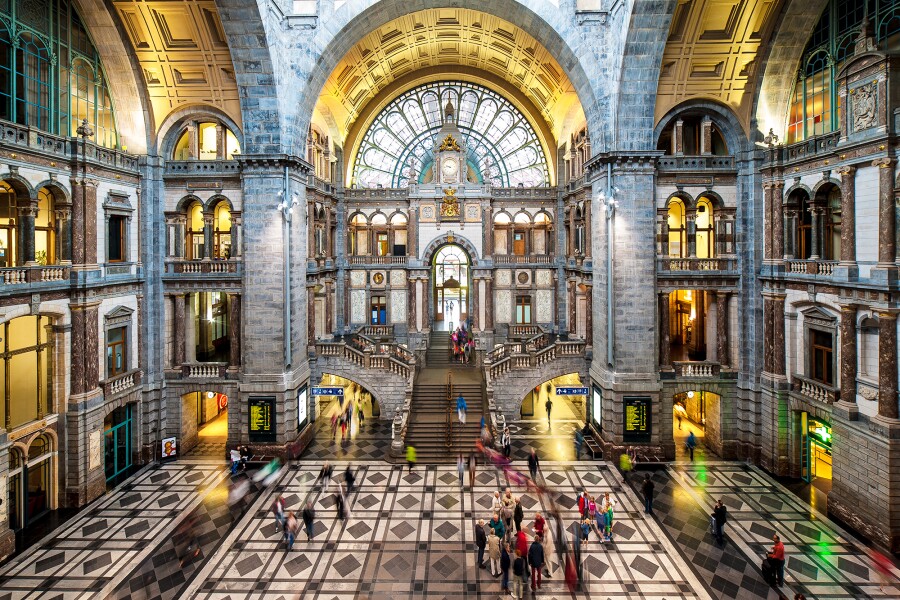
Antwerpen-Centraal
How to get there: Arrive from all over Belgium, the Netherlands (Rotterdam, the Hague, and Amsterdam), Lille (France), and Essen (Germany), and Prague (European Sleeper’s night train).
Where to wait nearby: Two minutes from the station, in the lobby of Belgian media group DPG Media’s offices, is the bright and spacious Mediacafé. This is an ideal perch for eating or caffeinating before a morning and afternoon trains (it closes at 4 p.m.).
Despite the stream of busy commuters, Antwerpen-Centraal’s main hall feels like a sacred space with its grand staircase, lacy iron-and-glass windows, shining marble floors, and a dome inspired by the Pantheon in Rome. It’s no wonder that the station’s local nickname, Spoorwegkathedraal, translates to “railroad cathedral.” First opened in 1905, and updated and expanded between 2000 and 2009 to accommodate high-speed trains, the station has 14 platforms on three levels. Enter from the Koningin Astridplein side for the best view of this truly majestic train station.
Milano Centrale

You’d be forgiven for mistaking Milano Centrale for an opera house.
Photo by iryna1/Shutterstock
How to get there: You can go almost anywhere in Italy from Milan with Trenitalia. There are direct trains between Milan and Paris and Lyon, Zurich, and a night train from Amsterdam and Brussels.
Where to wait nearby: Florentine sandwich shop All’Antico Vinaio is right outside. On the other side of the station is casual, old-school Lambretta Cafe’, where you can munch on a cornetto and slug an espresso.
Milano Centrale is massive, with 24 platforms that serve approximately 330,000 passengers daily (about 43 percent of the city’s population). With its bombastic sculptures and an eclectic architectural mix that pairs liberty (an Italian spin on art nouveau) and art deco, the exterior looks more like a royal opera house or palace. The station was built between 1912 and 1931, and its original simple design was heavily ornamented at Mussolini’s behest to glorify the fascist regime. Deep within the station, at platform 21, is a Holocaust memorial that pays respect to those deported from that platform during WWII.
Related: 4 Days in Milan: A Wes Anderson–Designed Art Café, Risotto Alla Milanese, and a Must-See da Vinci
Strasbourg-Ville

The historic Strasbourg-Ville station is surrounded by a glass pod, which protects the 19th-century structure from the elements.
Photo by Maria Sbytova/Shutterstock
How to get there: There are direct trains to Strasbourg from Paris (and CDG directly), Marseille, Lyon, Montpellier, Brussels, Berlin, Frankfurt, Munich, and Basel.
Where to wait nearby: There aren’t tons of cafés near Strasbourg station, but boulangerie/pâtisserie La Gare’mandise, just across the street, will do the trick.
The stately 19th-century Strasbourg-Ville station was built in neo-Renaissance style when the city, known today for its Christmas markets, was part of Germany. Twenty years ago, the station, which includes an early 20th-century addition, was encased in a 400-foot-long shiny glass pod; this time-capsule design leaves the historical building unmodified but protected from the elements. It also allowed for a sizeable expansion at a station that serves 20 million passengers annually.
St. Pancras International

From the street, St. Pancras International is pure old-fashioned elegance, but inside, it’s exciting and modern.
Photo by Uwe Aranas/shutterstock
How to get there: You can travel all over the U.K. from St. Pancras, and the Eurostar goes to Paris, Rotterdam, Amsterdam, Lille, and Brussels.
Where to wait nearby: There are 35 or so cafes, restaurants, and bars in St. Pancras, where you can find everything from sushi to a sausage roll.
The epic red-brick facade of St. Pancras International is eye-catching, even in the hubbub of central London. In true Victorian Gothic fashion, an imposing clock tower competes for attention with rows of arched windows at this restored 19th-century station. St. Pancras houses 15 train platforms, some 35 restaurants, bars, and cafes the same number of shops, a five-star hotel, and public pianos on which the likes of Alicia Keys and Lang Lang have played.
St. Pancras was expanded in 2007 and can can currently accommodate around 2,000 international passengers per hour, and the station hopes to expand in the coming years.
Related: The U.K.'s Most Beautiful Train Rides Glide Through Glens, Over Viaducts, and Along Cliffs
Helsinki Central Station

The entrance to Helsinki’s main rail station is flanked by a quartet of tall art nouveau “lantern bearers.”
Photo by George Trumpeter/Shutterstock
How to get there: This is Finland’s main station, so from here you can go nearly anywhere in the country, including Lapland.
Where to wait nearby: There are a couple of comfortable places in the station; Pronto serves pastries, coffee, and Roman-style pizza by the slice and Cafe Eliel has soup, sandwiches, desserts, and coffee.
This 1919 art nouveau train station is Finland’s most-visited building, used by approximately 200,000 passengers daily; it’s estimated that roughly 400, 000 people check the time when passing the the station’s 159-foot-high clock.
Helsinki Central is the brainchild of architect Eliel Saarinen, father of Eero, designer of the Gateway Arch in St. Louis. While the red-brown Finnish granite–clad structure is striking, what really steals the show are the two pairs of massive, lantern-carrying statues flanking the main entrance, known as the Lyhdynkantajat, or “lantern bearers.” A glass and steel roof designed by Esa Piiroinen to protect travelers from the elements was added over the central platforms in 2001.
Madrid Atocha

In the 1980s, Atocha train station’s original building was transformed into a large atrium.
Courtesy of ADIF Railways
How to get there: From Spain’s capital, you can zoom all over the country, to Barcelona, Valencia, Malaga, Seville, and Bilbao. There’s one direct international connection, to Marseille in France.
Where to wait nearby: Try Martín Tostador Café, right across from the Calle de Méndez Álvaro entrance.
The Spanish capital’s eclectic Atocha station opened in 1892 after an earlier station was destroyed by a fire, and the train shed’s arched steel-and-glass roof may hint at architect Alberto Palacio’s frequent collaborations with Gustave Eiffel. When traffic at the station outgrew the original building in the 1980s, an annex with 25 platforms was added (15 for high speed trains, 10 for slower suburban lines), and the old platform area was converted into an atrium with several thousand tropical plants from around the world.
São Bento Station, Porto

The tile murals at São Bento station tell stories of Portuguese history.
Photo by Kartinkin77/Shutterstock
How to get there: São Bento is admittedly not that practical for most visitors to Porto, but it’s right in the UNESCO-listed historic city center and is a must visit for its tiles alone.
Where to wait nearby: Time Out Market Porto is part of the station and has 2 bars and 12 restaurants, including Tábua Rasa, which has cheese and charcuterie boards.
Built on the site of a former Benedictine monastery and opened in 1916, this rail station is one of Porto’s most popular attractions, thanks to the floor-to-ceiling tile friezes in the main hall. Painter Jorge Colaço used nearly 20,000 blue-and-white painted azulejo tiles (6,000 square feet worth) to bring to life pastoral scenes, the history of transport in Portugal, a royal wedding, and the Portuguese conquest of Ceuta (now an autonomous Spanish city) on the North African coast.
Amsterdam Centraal Station

The red-brick Amsterdam Centraal Station looks more like a palace than a train station.
Courtesy of Roel Baeckaert-Rechtenvrij/Amsterdam Marketing
How to get there: There are trains all over the Netherlands and Belgium, to London and Paris (Eurostar), Vienna and Prague (night trains), Frankfurt, Basel, and several destinations in France.
Where to wait nearby: Sango Specialty Coffee Roasters has a cozy interior while an outpost of the country-wide chain Loetji sits canalside right outside the station.
From the great mind of Pierre Cuypers, the man behind the Rijksmuseum, comes this palatial train station, through which some 250,000 people pass every day. Opened in 1889, Amsterdam Centraal mixes English, Flemish, French, and Dutch influences into a unique style that includes Gothic and Renaissance revival elements, complete with turrets and a roof spanning 131 feet. But the building’s support system is perhaps more impressive: 8,687 wooden piles pounded into three artificial islands loft it over the IJ River.
Related: 8 Exciting New Sleeper Train Routes Launching Across Europe
Wemyss Bay

In 2009, a group of locals restored Wemyss Bay rail station to its former floral glory.
Photo by Blue Kiwi Camera Club for FoWBS
How to get there: This is a tiny station with trains to Glasgow.
Where to wait nearby: Vegetarians aren’t left out at the Butcher’s Café by McCaskie’s, right across from the station, where you can go for a full Scottish breakfast before hopping on the train.
While not as grand as some of the other entries on this list, this 1903 Queen Anne–style station an hour west of Glasgow is oozing with charm. Somehow cottage-like despite its 60-foot clock tower, it’s the last remaining station built by the former Caledonian Railway Company. The station was once renowned for displays of hanging baskets and potted plants in its glass-canopied waiting areas, but it fell into disrepair during the 1970s and ’80s. A group of locals adopted the station from ScotRail in 2009 and opened a charity bookshop on site to raise funds to decorate the station inside and out with floral displays.
Gare de Lyon

Train station restaurants don’t come much grander than Le Train Bleu at Gare de Lyon.
Photo by Boris-B/Shutterstock
How to get there: There are trains from Gare de Lyon to other cities in France such as Marseille, Lyon, and Grenoble and to international destinations like Barcelona, Zurich, Geneva, and Milan.
Where to wait nearby: Across the road a tiny sandwich shop/wine bar Olga, its sturdy sandwiches ideal for a train picnic. Within the station is Le Train Bleu, open for a full meal or just a drink.
One of the six major railway stations in Paris, the current iteration of the Gare de Lyon was built in 1900 in time to impress the world for the Paris Exposition. The 12th arrondissement terminus is a Belle Époque showstopper, with a clock tower that immediately calls to mind Big Ben and grand frescoes by Jean-Baptiste Olive depicting Mediterranean cities and sites you can visit from the station. The interior of the station, at least in Halls 1 and 2, is big and bright (Hall 3 is underground).
The glitziest part of Gare de Lyon is its opulent restaurant Le Train Bleu, which opened in 1900 and looks exactly as it did more than 125 years ago—dripping with gilt and chandeliers. It’s known for dishes like roast leg of lamb carved at a tableside trolley, but you can stop in for dessert and a drink (alcoholic or non).
Liège-Guillemins

Santiago Calatrava brings his trademark architectural style to the Liège-Guillemins station in Belgium.
Photo by Fortgens Photography/Shutterstock
How to get there: There are direct trains from Paris, Brussels, Frankfurt, and Luxembourg, among others; from London, you can get to Liège on the Eurostar by changing in Brussels.
Where to wait nearby: Cafés Ubuntu is across from the station and has a sunny interior and a few sidewalk tables. Pick up a cinnamon roll or a slide of banana bread for the train.
Few contemporary architects have as immediately recognizable a style as Spain’s Santiago Calatrava, who’s become known for his stark-white, skeletal constructions, such as the Oculus in New York City. He’s responsible for many train stations across Europe, but perhaps his finest is this Belgian beauty that debuted in 2009. Calatrava’s design connects two parts of the city that had previously been separated by railroad tracks, and the layout is all about lightness and openness: There are no side walls, with just a vaulted glass and steel canopy sheltering the space.
Prague Main Railway Station

Prague Main Railway Station (Praha hlavní nádraží) is Czechia’s largest art nouveay monument.
Photo by Správa Železnic
How to get there: You can take domestic trains all over Czechia and international lines to Bratislava, Budapest, Vienna, Warsaw, Berlin, Dresden and, by night train, Brussels.
Where to wait nearby: For a fairly small terminus, Prague main railway station has two nice cafés with beautiful decor—Fantova Kavarna right when you walk in and Foyer Cafe down a pretty little hallway.
The entry hall of Prague Main Railway Station is simply stunning—a honey-colored dome with a row of windows and art nouveau motifs. Indeed this station is the largest art nouveau monument in Czechia (one of the best-known art nouveau artists, Alfons Maria Mucha, was Czech). Both cafes in the small station have are lovely places to linger.
Related: 33 European Countries With One Single Train Pass—Here’s How to Use Eurail
This article was originally published in 2019 and most recently updated on February 13, 2026, with current information. Nicholas DeRenzo and Sophie Friedman contributed to the reporting of this story.


