

Afar’s editorial team has been quite busy this year, traveling around the globe to write stories, report on trends, attend conferences, photograph some of the world’s most beautiful places—and, of course, relax on a vacation or two. By our count, we collectively took 346 flights (podcast director Aislyn Greene clocked 99,128 miles on her own), checked into 262 hotels and Airbnbs, and headed to 32 different countries, with Canada topping the list of our most-visited places.
As 2025 draws to a close, we’re excitedly planning our next adventures; our list of where to go in 2026 is a great place to start if you need inspiration. But we’re also taking a moment to look back at the past year and reminisce about some of our favorite travel memories.
We cycled through Transylvania, car-camped outside glow worm caves in New Zealand, reconnected with old friends in Athens, ate moose in Newfoundland, trekked around the Scottish Highlands, and sailed the Baltic Sea, and we hope you’re inspired to follow our leads and get out there in the new year.

The Hospital de Sant Pau is a UNESCO-designated complex renowned for its colorful art nouveau architecture.
Photos by Nicholas DeRenzo
Barcelona, Spain
Nicholas DeRenzo, editorial director of newsletters
I’ve always been a big fan of Madrid, and I’ve perhaps unfairly turned up my nose at its brasher, bolder, beachfront sister, Barcelona. I’d only visited the Catalan capital once, about 15 years ago, sticking to the well-trodden, Gaudí-lined tourist path, and in the years that followed, articles on local protests against overtourism made me hesitant to return. In January, I didn’t have much of a choice: My sister invited my whole family to join her in the city so she could propose to her now-fiancée at the Sagrada Familia.
And I was thrilled that the city proved me wrong at every turn. Even just getting a few minutes outside of Barri Gòtic (the Gothic Quarter) and El Born, I felt like I could take a deep breath and stretch my legs. The bohemian Vila de Gràcia neighborhood reminded me of quieter residential areas back home in Brooklyn: lots of strollers, vintage stores (filled, inexplicably, with ‘90s parachute pants), organic markets where people shopped for olives and cheese and citrus. The city is also known for its cocktail scene—numbers 3 and 4 on the 2025 World’s 50 Best Bars list—and Gràcia has its own collection of sophisticated, low-key spots, including 14 de la Rosa and FOCO, which is inspired by Foreign Correspondents’ Clubs around the world. Pair FOCO with Sartoria Panatieri, just across the street, which Italian judges recently awarded the best pizzeria in Europe (outside Italy).
Another way to avoid the crowds? Expand your architectural pilgrimages beyond just Gaudí buildings. Just up the street from the Sagrada Familia is the Hospital de Sant Pau, a gorgeous, UNESCO-designated site constructed between 1902 and 1930 by Lluís Domènech i Montaner, Gaudí’s teacher. It ranks as the world’s largest art nouveau complex, exuberantly decorated with Moorish-inspired flourishes, striking mosaics, and colorful glazed tiles, and remained in service as a functioning hospital until 2009. It’s a sprawling campus, which means you rarely battle crowds—and despite its world-famous status, I still felt as if I had discovered some hidden architectural treasure.

Landlocked Saskatchewan is home to a lighthouse overlooking Jackfish Lake.
Courtesy of Tourism Saskatchewan/Norm Beaver
Saskatchewan, Canada
Billie Cohen, editorial director
My long weekend in Saskatchewan this past August was spent embracing the joys of local produce, local art, local history, and local quirkiness. Produce in the form of the Saskatoon berry, which makes a delicious pie and jam. Art in the form of the Allen Sapp Gallery, dedicated to the Saskatchewan-born and nationally celebrated Cree painter. (The gallery is in a former public library built in 1916, so it ticked two of my favorite travel boxes!) History in the form of the Fred Light Museum, a fascinating collection of ephemera compiled from area residents’ own lives, including a poster of 1915 rules for schoolteachers that prohibits them from loitering downtown at ice cream stores and mandates that they wear at least two petticoats. And quirkiness in the form of a lighthouse built in a landlocked province (looking out over Jackfish Lake), a “Canada’s biggest bat” sculpture outside the Saskatchewan Baseball Hall of Fame and Museum (ask for Jane when you visit; her husband started the museum and she’s full of stories), and serendipitously, the First Annual North Battleford Renaissance Faire, which drew cosplayers from all over the country.
I was staying with a friend on a lake in the summer-vacation area of Cochin, but you can base yourself in the city of Saskatoon, where there are many hotels, including the modern Alt or the slightly dated but historic Delta Hotels Bessborough (built in 1935 as a grand railway hotel and now a Marriott property), and grab breakfast at Darkside Donuts (the honey cruller was a hit with my friends). Chappell Roan has promised to make a trip to the province now that she’s sung about it, but regardless, I’ll be going back again myself: Saskatoon is unveiling a beautiful new library in 2027.
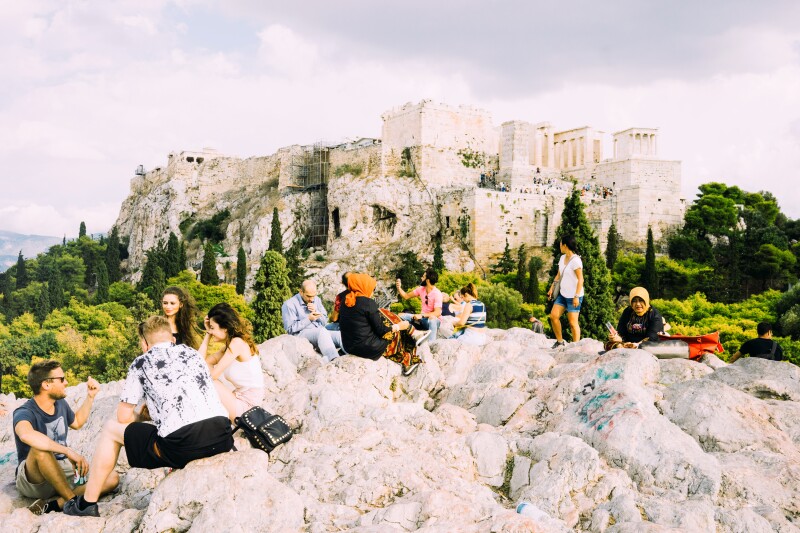
Ancient icons like the Acropolis make for a scenic backdrop to daily life in Athens.
Photo by Marco Arguello
Athens, Greece
Katherine LaGrave, executive editor
I return to Athens once a year to visit friends and family, and my latest trip—at the end of September—was marked by precious time with both. Like any good Greek gathering, it was also filled with food and drink: bright kakavia and orange wine at Linou Soumpasis k Sia; cloud-like tirokafteri with Cretan green pepper (and some of my favorite dishware) at Manári Taverna; a rusk salad with this season’s samphire and tomatoes outside, in the garden, at Ama Lachei; the requisite mastic-flavored ice cream at Kokkion; and red ale from Athineo at Barrett.
Even though Athens has an excellent metro system, I worked up an appetite walking my way around the city. I was dazzled by the paintings at the Alekos Fassianos Museum. I bought pounds of olives from my favorite vendor at Athens Central Market, and visited the Ancient Agora so early it was mostly me and the cats. I went to shop for shirts at Christina Christodoulou’s quietly elegant atelier, It’s A Shirt. Then I went again, new friends made, with promises to be back soon.

California’s Santa Ynez Valley pairs wine-tasting with charming small towns and unique nature to explore.
Photo by L Paul Mann/Shutterstock
Santa Ynez Valley, California
Jessie Beck, associate director of video & SEO
I’ve lived in California for over 12 years, but there are still so many parts of the state I’ve yet to explore. So this year, my husband and I set out on a road trip to discover some of its lesser-visited corners. One of the most memorable was the Santa Ynez Valley. Like most people, I’d only ever stopped in quirky, Danish-inspired Solvang—but this time branched out to check out the rest of the region’s small towns.
It’s such a perfect area for a mini road trip because each of the valley’s small towns are super close together and each one has its own distinct vibe. Santa Ynez has a cowgirl cool vibe—and is also home to Highway Tacos, which has some of the best tacos I’ve found in California. I also loved the western-style shops and our stay at The Genevieve.
Los Olivos, with more than 40 tasting rooms scattered on just a couple of blocks, was the posh, wine-centric one of the bunch. But this town’s highlight was a late, seafood-filled lunch at Bar Le Côte. It’s buzzy, the food is delicious, and I’d go back just for the BLC “snack pack,” a pudding dessert inspired by the childhood fave of the same name.
Then, there’s the up-and-coming Los Alamos. From our stay at retro, recently remodeled motel, Skyview Los Alamos to Cali-style barbeque at Priedite and tastings at women-owned Clementine Carter Wines, this one-street town packed in more creativity and character than we expected.

Lori McCarthy leads culinary workshops through her company Food Culture Place; guests dine on fresh-steamed lobster during an iceberg-watching tour.
Photos by Nicholas DeRenzo
Newfoundland, Canada
Nicholas DeRenzo, editorial director of newsletters
As a fan of the Newfoundland-set Broadway musical Come from Away, I arrived on “The Rock” primed to love it. The Canadian island is known for its outsize hospitality, and that spirit especially comes through in the way its residents relate to food. On the evening I pulled into the tiny town of Fortune, I was greeted by a tour company owner whom I was actually scheduled to meet the next day: He came bearing a Tupperware of scallops his aunt had cooked for me so I didn’t get stuck eating fast food (the only restaurant open at that time of the evening)—and he later sent me on my way with a jar of moose meat he had hunted. This kind of behavior defined my trip.
Up in Triton, I joined a family of lobster fishermen as we bobbed through iceberg-filled waters before boiling up lobsters on their private island. Then, in the capital city, St. John’s, I found a restaurant scene brimming with creativity, where chatty servers answered my questions about local ingredients with rhapsodic odes on the province’s bounty. At Terre, I sampled briny oysters and snow crab on an epic seafood tower; at Rabble, I tried crispy-fried “cod tongues,” a fleshy part of the fish’s throat beloved in these parts; and at Portage, I learned about asparagus-like hosta shoots and dined on moose bolognese with a spruce tip cocktail and a partridgeberry sundae for dessert.
But my favorite food experiences happened south of the capital on the Irish Loop, where accents are practically Celtic. At the Bread and Cheese Country Inn, I shared a table with a group of elderly through-hikers who were tackling the 200-mile East Coast Trail (one of many great inn-to-inn hikes in Canada). The innkeepers—one from Canada, one from Spain—served us a multi-course feast that combined Canadian ingredients and Galician inspirations. (A long history of codfishing connects both sides of the Atlantic.)
And nearby, I met with cultural ambassador Lori McCarthy, whose company Food Culture Place offers workshops and longer residencies on topics like foraging, hunting, fermentation, and basket weaving. We strolled the forests surrounding her yurt, searching for edible plants, and then returned to a campfire where she cooked up Inuit-harvested arctic char with pickled wild garlic, and snow crabs with aioli made from foraged beach greens. We sat on logs, boots in the dirt, my clothes becoming perfumed with the scent of crackling fire, and it was probably the most thrilling—if simple—meal I ate all year.

Mandai Rainforest Resort by Banyan Tree is a susprising tropical escape minutes from the high-energy bustle of downtown Singapore.
Courtesy of Mandai Rainforest Resort by Banyan Tree
Singapore
Elizabeth See, associate art director
I moved to Los Angeles from Singapore in 2024, and whenever someone asks me what I miss most about the Lion City, my answer is always the same: food and family. A recent trip back allowed me to revel in both.
The timing couldn’t have been better: Singapore marked its 60th year of independence on August 9, 2025, and when I arrived later that month, the city was still filled with decorations. I was there to celebrate my cousin’s wedding, my parents’ birthdays, and my wedding anniversary. How did we commemorate these events? By eating, of course.
We kicked off the weekend with my parents’ birthday dinner at the Japanese restaurant Kazu Sumiyaki, our go-to spot for special occasions for more than 15 years. Six of us feasted on grilled chicken skin, ankimo (monkfish liver), wagyu steak, and warabi mochi.
The next morning we headed to the Church of Saints Peter & Paul, a 19th-century Gothic beauty, for my cousin’s wedding. The bride and groom’s declaration of love even came with a side of sugar: elegantly wrapped kueh, colorful bite-size rice cakes. The nuptials were followed by a traditional tea ceremony and a four-course dinner at Botanico at the Summerhouse. Then, as is customary for any good Singaporean party, the tables were moved to make room for dancing—and more food.
With so many family members in town for the wedding, it was the first time in 16 years that my father and his siblings had gathered in one place, so the next day, my parents hosted a reunion at their home. My family is Peranakan—people of mixed heritage, in our case Chinese and Malay—and we dug into classic dishes of our culture such as kueh pie tee (a pastry shell filled with vegetables) and chap chye, a braised vegetable stew that my late great-aunt always made for Lunar New Year events.
After a weekend of nonstop festivities, my husband and I checked into the Mandai Rainforest Resort by Banyan Tree to quietly mark our second wedding anniversary. In our room, we were surprised to discover a chocolate cake from the hotel congratulating us on our milestone. I didn’t know if we’d finish it, but we gradually ate the cake, bite by bite, in between visits to the nearby Night Safari and Singapore Zoo, where we watched proboscis monkeys clamor for fresh leaves put out by the zookeepers. When it was time to finally fly back to L.A., only crumbs remained—a sweet finish to a delicious trip.

Transylvania’s pastoral scenery makes for a lovely backdrop on a cycling adventure.
Photos by Lucy Kehoe
Transylvania, Romania
Lucy Kehoe, senior editor
Cycling through the sepia-hued hills of Transylvania felt like slipping into a diorama of Europe’s pastoral past. In this region of Eastern Europe (about the same size as South Carolina), hay is stacked in old-fashioned bushels, cows walk themselves home from pasture each evening, and on hikes, you stumble across the occasional shepherd snoring across the trail.
I was travelling with Slow Cyclist, a tour operator celebrating its tenth anniversary. The decade of relationship-building showed: I was welcomed into people’s homes and guesthouses—like Giovanna’s traditionally furnished collection of renovated Saxon houses in Copșa Mare—fed heartily, and supplied with ample Romanian red wine and Ciuc lager at every pedal stop. Some nights I slept beneath wooden eaves as village dogs sang outside; others, amid colorful, hand-painted furnishings in painstakingly restored aristocratic homes like Apafi Manor. I even poked around King Charles III’s former home in Viscri (the village of the homing cows). The British monarch fell for the region after visiting decades ago; today, he’s transformed a former vacation home into the King’s House, a center promoting traditional Transylvanian housebuilding crafts. Another of his former properties is now a guesthouse.
Pedaling through the undulating hills, signs warned “beware of bears after sunset”—Romania is home to Europe’s largest brown bear population. Aside from ogling vast muddy pawprints, I joined truffle-snuffling hounds to hunt down fragrant fungi, toured fresco-filled fortified churches with Along the Enchanted Way author William Blacker, and danced with abandon to heart-stirring folk music around an evening campfire. My travelling group made a ritual of throwing back a few shots of pálinka—a strong plum brandy—to loosen sore legs after the day’s cycling. There’s a rule when assessing the strength of the local firewater: If it arrives in an old soda bottle, it’s probably very potent.

Seoul is beloved for its traditional-meets-ultramodern aesthetic; the JW Marriott Jeju Resort & Spa sits on a clifftop overlooking the sea.
Photo by Michelle Baran
Seoul and Jeju, South Korea
Michelle Baran, deputy editor, news
Usually when I travel with my family (husband and two kids, ages 6 and 9), it takes about a week or so on the road before I start to feel the gentle tug back home to some semblance of routine and order. I cannot remember the last time we visited a place and I was overwhelmed with the feeling of not being ready to leave.
But this past fall, after five days staying in the most charming hanok Airbnb (a traditional house) and exploring the epic food markets, tasting heavenly Korean barbecue, reviewing 5,000 different instant noodle varieties, roaming ornate ancient palaces, trying our luck on dozens of gachapon machines (located in the same space as an over-the-top high-end coffee shop), ordering pour-overs and innovative pastries at the city’s endless coffee houses and bakeries, riding floating Poké balls at Lotte World, buying new shoes and surprise boxes in Gangnam shopping malls, getting all the fluffy cuddles at a cat cafe, and playing with local kids at the plentiful parks of Seoul, I truly was not even remotely prepared to say goodbye to the South Korean capital.
And neither was my family. We dragged ourselves begrudgingly onto our one-hour flight to Jeju Island, only to then accept that if any place would be able to cure us of our severe Seoul withdrawals, the volcanic island paradise and the spa resort luxury of JW Marriott Jeju was the one place that might be able to do so. We soaked away our Seoul sorrows in bubbling natural springs, and forgot about our former city life over high tea with ocean views and semi-tropical treks to nearby waterfalls. On our way back home, we arrived late in the evening for one last night at the chic brutalist hotel Nest just outside Seoul Incheon Airport before our morning flight back to San Francisco. I’m not sure my kids will ever forgive me for bringing them so close to their new favorite city again without a proper extended (re)visit.

Aldourie Castle sits on the shores of Loch Ness, and cottages on the grounds make for a cozy stay.
Courtesy of Aldourie
Scottish Highlands
Jennifer Flowers, senior deputy editor
I had followed WildLand for years before seeing it in person. And in 2025, walking and driving through the more than 200,000 acres of its landscapes in the Scottish Highlands, I began to understand conservation as a long game. WildLand is a land stewardship initiative guided by a 200-year vision to restore native habitats while supporting local communities through land management and sustainable tourism. Its long-term stewardship philosophy is reflected in how visitors travel between the various estates, with accommodations designed as sustainable, high-design bases for exploration.
My partner and I began with a road trip from Edinburgh to Cairngorms National Park. There, we checked into Killiehuntly, a four-room farmhouse-turned-inn whose Scandinavian-influenced design—gray and earthy tones, sheepskin throws—reflects the heritage of WildLand’s founders. We spent our days walking through tree-shaded forests, exploring restored centuries-old farm shelters called bothies, and enjoying a picnic lunch on a river, ending one long day with a session at the inn’s sauna.
From there we drove north on one-lane roads to Sutherland and checked into Kyle House, an elegant two-story self-catered retreat stocked with premade meals, designed by Edinburgh-based GRAS architecture studio. We bopped around the shoreline with our car, taking delight in the coconut-scented yellow gorse along the road while visiting adorable area businesses like Cereal Bakery and Bookshop and exploring the restored peatlands. We also caught a glimpse of the construction of WildLand’s forthcoming Hope, an 1870s shooting lodge that will be reborn as a hybrid hotel and exclusive-use retreat in May 2026.
We ended the trip with one final night on the grounds of Aldourie Castle on the banks of Loch Ness. The 300-year-old castle itself is a massive exclusive-use estate—too big for a duo—so instead we stayed in one of the cozy cottages on property where a premade dinner was left for us in our home. We later took a meandering walk to the shores of Loch Ness where we visited the historic Dores Inn pub, which WildLand bought and restored in 2024.

The Iditarod kicks off with a ceremonial start in Anchorage.
Courtesy of The Wildbirch Hotel
Anchorage, Alaska
Jennifer Flowers, senior deputy editor
When I want to be reminded how truly wild the American landscape can still feel, I go to Anchorage. Few U.S. cities sit so close to vast wilderness—glaciers, mountain ranges, and boreal forests that stretch for hundreds of miles almost immediately beyond city limits. My partner has roots there, so I return most years, either in summer when trails are covered in native wildflowers (try Reed Lakes for a challenging eight-mile day hike), or late February during the Iditarod dog sledding race. By then, daylight has returned, while snow and ice still hold, making it prime season for cross-country skiing in Kincaid Park, or near the abandoned gold mine at Hatcher Pass.
For gear, I stop at locally run AMH (Alaska Mountaineering & Hiking). When it’s time to refuel, Moose’s Tooth Pub and Pizzeria remains a local institution for stone-baked pies (their mandarin orange honey ginger salad is unexpectedly good). To avoid long waits, go at off hours or order take out.
On our most recent visit, we stayed at the new Wildbirch Hotel, a new JdV by Hyatt property with 252 guest rooms. Wooden headboards are etched with topographical maps of Denali, and L-shaped seating areas made the rooms especially good for longer stays. The hotel overlooks the Iditarod’s ceremonial starting line, and in March 2026, will act as the commencement headquarters for the race’s 54th running.

Angama Amboseli is a luxurious camp where you can spot some of Africa’s last remaining “super tusker” elephants.
Photo by Tanveer Badal
Kenya
Jennifer Flowers, senior deputy editor
Much of what I know about wildlife conservation I learned in Kenya, through time spent at conservancies and national parks; conversations with guides, ecologists, and tourism ministers; and long days observing the flora and fauna in wilderness areas. When Afar granted me a sabbatical after 10 years at the company, I wanted to return to deepen my knowledge on the ground, and asked Nairobi-based Micato Safaris to help me create a once-in-a-lifetime trip.
I began in Nairobi, spending a few nights at Hemingways Nairobi, where generously sized rooms, a spa and pool, and a restaurant turning out fresh salads and curries made for an easy landing. I visited Micato’s nonprofit arm, AmericaShare, based in the informal settlement of Mukuru, where I met children and young artists supported by its programs. Meals in the city were equally memorable: farm-driven, South American-inspired cooking at Cultiva in the Karen neighborhood, founded by Ecuador-born chef Ariel Moscardi, and a standout lunch at Ankole Grill in Kitisuru—I still think about the West African chicken jollof rice with fried plantains.
From there, I headed into the wilderness, starting in Laikipia at Segera Retreat, where I saw endangered black rhinos from a translocation earlier in 2025 and discovered the work of South African artist Nandipha Mntambo through the lodge’s impressive contemporary art collection. In the Serengeti-Mara ecosystem, I visited the Masai-run Olderkesi Conservancy and stayed at Cottar’s 1920s Camp, which—despite its colonial roots—has become a leading advocate of community-led tourism in the Mara. Next was Wild Hill, an exclusive-use lodge on the edge of the Masai-owned Enonkishu Conservancy and the highest property region, with sweeping savanna views. Days began with elephant and leopard sightings, evenings with spa time and once, a candlelit dinner by the main lounge fireplace. I ended my trip at Angama Amboseli, a striking lodge with a beautiful compelling conservation mission in a landscape home to the world’s last remaining super tusker elephants.

La Paz, Mexico, is a natural wonderland that feels worlds away from the cookie-cutter resorts elsewhere in Baja California.
Photos by Michelle Heimerman
La Paz, Mexico
Michelle Heimerman, director of photography
Before us was possibly the largest tower of nachos on Mexico’s Baja California peninsula. The sun was setting behind sailboats in the marina, and we toasted with Negra Modelo beers, my uncle’s go-to order. These were his favorite nachos, and this was the first time my aunt was ordering them since he died a year and a half ago. My husband and I had flown down to join her, as well as to enjoy the gorgeous desert-meets-sea city of La Paz, where my aunt and uncle had spent months every winter.
To get there, we drove three hours north from Cabo’s international airport, winding through cactus-dotted hills and catching glimpses of the Pacific Ocean. Our first evening in La Paz, we walked with my aunt along the malecón, a waterfront promenade that stretches for more than three miles in the city center. Families gathered to watch the sunset, in-line skaters sped by, local bands sang for people ready to dance, and pelicans repeatedly dove into the water.
My aunt and uncle loved the timeless, laid-back vibe here, but La Paz is also becoming known for its new crop of restaurants. One evening, we ate at Tiger Club, a Southeast Asian–inspired eatery with an impressive natural wine selection. Another night we tried the tasting menu at Nemi, opened in 2019 by Alejandro Villagómez, a former chef at the two-Michelin-star restaurant Pujol in Mexico City.
La Paz is known for its stretch of the Gulf of California, so we hired a guide and boat with On Board Baja. Bouncing in sync with the waves, we followed a family of humpback whales, glided among sea lions, and passed blue-footed boobies sunbathing on a rock. For lunch, we anchored in a cove near Balandra Beach. While our guide prepared fresh ceviche, we paddleboarded on the turquoise water.
Between it all, I shared quieter moments with my aunt, including a three-hour beach walk with nobody around for miles. We talked about whether she’ll return to La Paz next winter. Is it worth it to travel back to a place that brought such joy with a partner if he is no longer around to share it? It certainly wasn’t easy, but remembering some of my uncle’s happiest moments at his favorite spots kept his spirit alive. It felt like we were exactly where he would want us to be, eating nachos together, just as he would like.

New Zealand’s famed glow worm caves sparkle like a planetarium.
Photo by Mikko Wang
New Zealand
Charis Morgan, Photo Editor
This January, as I steeped in 2024’s lingering chill, I decided to take matters into my own hands and grant myself an unabashed Summer: Part Two. So I flew 6,500 miles down to the Southern Hemisphere to frolic in the land of kiwis and hobbits. There are more incredible memories from my time in Middle-earth than I can recount, but one experience that was particularly sublime, was the night I spent car camping outside of the Waipū glow worm caves, in the Northland region.
If you approach from the Waipū Caves Scenic Reserves parking lot, you might, like me, find the cave’s entrance to be misleadingly modest. Let this be a lesson to never judge a cave by its cover. I continued on, and as I waddled down mud-slicked boulders in my nearly spent rubber sandals, I braced myself for an abundance of firsts. My first time caving, my first time wading through pitch-black, grotto waters, and my first time ever seeing a glow worm in the bioluminescent flesh.
Once I had made it a few yards past the cave’s opening, a facsimile cosmos of glimmering stars opened up overhead. A collective hush washed over the smattering of awe-struck adults around me, each of us tilting our heads back in utter child-like wonder at the glow worm display. Luckily for me, one such captive audience member was also a photographer who captured the moment on camera. Thanks, Mikko.

The Latvian capital offers a centuries-spanning primer on European architectural styles.
Photo by corn-flower/Shutterstock
Riga, Latvia
Pat Tompkins, copy editor
From my Baltic Sea cruise in April, candidates for return trips include Gdansk, Poland, and Helsinki—but Riga, Latvia stands out. Two places I explored on my own (free to visit and easy walks from ship) were the huge Central Market, housed in several repurposed zeppelin hangars and the dramatic new national library, a serendipitous surprise, with intriguing exhibits. There are lots of handsome art nouveau buildings to admire around the city, and upcoming Easter meant extra color around the Old Town. But the holiday also brought a drawback: busloads of rowdy tourists from the U.K.

The Isle of Arran looms in the distance behind Turnberry Lighthouse; the island is magical any time of year, but especially when crisper weather brings smaller crowds.
Photo by Dale Kelly/Shutterstock (L); photo by Ashley Revness (R)
Isle of Arran, Scotland
Ashley Revness, associate social media editor
When someone says they’re visiting an island in peak fall or early winter, the instinctive reaction is usually: Why bother if you can’t swim, tan, or flop on a beach? But after a decade living in NYC, the idea of fleeing to a remote Scottish island in the off-season—with zero tourists, zero chaos, and nothing but crisp air, fall colors, empty trails, and local shops all to ourselves—felt like a fantasy I didn’t know I needed.
The trip to the Isle of Arran started on a ferry that was… bizarrely luxe? Leather seats, a full bar, the whole thing felt more business class than public transport. As we pulled into Brodick harbour, two porpoises popped up like our personal welcome committee. Arran is wildly walkable, so we strolled straight from the boat to our hotel overlooking its rocky shoreline. From there, we squeezed a lot into three days: We hiked to a 19th-century castle and gardens, wandered past farms, watched a border collie herd sheep like it was choreographed, and took crisp beach walks where we spotted pheasants, swans, and birds so colorful they didn’t feel real. Every turn looked like a painting.
And the food? Shockingly good—fresh, local, and not in a pretentious way. Think fish and chips made with the day’s catch at a tiny pub where we were clearly the only outsiders, haggis nachos, and the island’s famous Arran ice cream? It tastes like someone whipped heavy cream into a cloud.
Even without a car, getting around was a breeze thanks to how walkable the island is and the super easy bus system. Everywhere we went, locals were warm, curious, and eager to share tips. It was the perfect reset—exactly the kind of quiet your brain begs for after living in the city that never sleeps.


