

The tower of Gaudí’s El Capricho in Comillas is covered in ceramic tiles embossed wtih sunflowers and green foliage.
Photo by saiko3p/Shutterstock
Any serious list of history’s most influential architects includes Antoni Gaudí, the Spanish master of form and function. This year, on the 100th anniversary of his death, the pilgrimage most travelers will make is to Barcelona, home to the greatest concentration of his works—although they will be sharing the city with millions of other visitors. Fortunately, there are other ways to honor Gaudí’s legacy.
Scattered across the north of Spain are three of the architect’s most underrated works, all close enough to one another to visit in a single road trip. They offer something Barcelona increasingly cannot: the chance to stop, linger, and quietly appreciate Gaudí’s lesser-known works, revealing a developing genius.
Comillas: El Capricho
Opening hours: Daily, 10 a.m.–5:30 p.m. (Jan, Feb, Nov, Dec); 10 a.m.–8 p.m. (Mar–Jun, Sep, Oct); 10 a.m.–9 p.m. (Jul–Aug)
Tickets: Self-guided tour from $8; guided tour from $12
]Although Casa Vicens is often mistaken for Gaudí’s first residential work, he completed El Capricho (“the whim”) in Comillas three years before the Barcelona mansion. The property is a playful experiment in color, form, and Arabic influences located on a wooded hilltop not far from Spain’s rainy, wildflower-strewn northern coast.
Just as a sunflower tracks the arc of the sun, Gaudí designed the home so that rooms are ordered from east to west, with rooms used in the morning catching first light and those used in the evening facing the setting sun. A central glass greenhouse captures that solar warmth and disperses it throughout the house.
The team working to preserve El Capricho revels in its free-spirited character. They’re even planning a party (with cake) for the anniversary on June 10. “We want to make culture fun,” says director Carlos Mirapeix.
Other things to do in Comillas
Comillas is home to several historic homes originally built for Indianos—19th-century Spaniards who made their fortunes overseas in the Americas. Sobrellano Palace, built by Gaudí’s mentor Joan Martorell and completed in 1888, is the grandest. Book a tour so you can see inside its chapel, which features benches and carved chairs designed by Gaudí.
Astorga: Palacio de Gaudí

The Episcopal Palace of Astorga houses the Museo de los Caminos, a small museum housing artifacts relating to the Camino de Santiago pilgrimage route.
Photo by Fernando Valero Lopez/Shutterstock (L); photo by tichr/Shutterstock (R)
Opening hours: Daily, 10 a.m.–2 p.m. and 4–8 p.m. (May–Oct); 10:30 a.m.–2 p.m. and 4 p.m.–6:30 p.m. (Nov–Apr)
Tickets: Entry from $10; guided tours from $14
Outsized ecclesiastical residence? Disney castle? Forerunner of the Sagrada Família? The Palacio de Gaudí, also often referred to as the Episcopal Palace of Astorga, is a bit of all three.
Gaudí worked on the palace project in Astorga between 1889 and 1893, building a replacement of the original, fire-damaged residence of Bishop Juan Bautista Grau.
“Astorga marked a turning point in [Gaudí’s] life,” says Victor Murias, director of the modern-day museum. “The friendship he formed with Bishop Grau, along with the bishop’s thoughts and ideas, left a deep impression on the architect, inspiring in Gaudí a renewed faith in Christianity.”
Highlights of the four-story palace include private rooms and offices with majestic arches, as well as panoramic views of the city from the building’s towers. The chapel features frescoes, kaleidoscopic stained glass, and examples of sgraffito, a decorating technique in which the artist carves through an outer layer of color to reveal a contrasting-color layer beneath.
Spectacular as it is, Gaudí considered the Episcopal Palace a professional failure. After disagreements with the diocese and building council, he abandoned the project in 1893, asserting that he would never again cross Astorga, not even in a hot-air balloon.
Other things to do in Astorga
A onetime powerhouse of chocolate manufacturing, Astorga still has a number of landmarks dedicated to the sweet treat. Visit the Chocolate Museum, then pick up snacks to take home at Peñín Chocolatier, Chocolatería La Cepedana, and Confitería Flor y Nata, among others.
León: Casa Botines
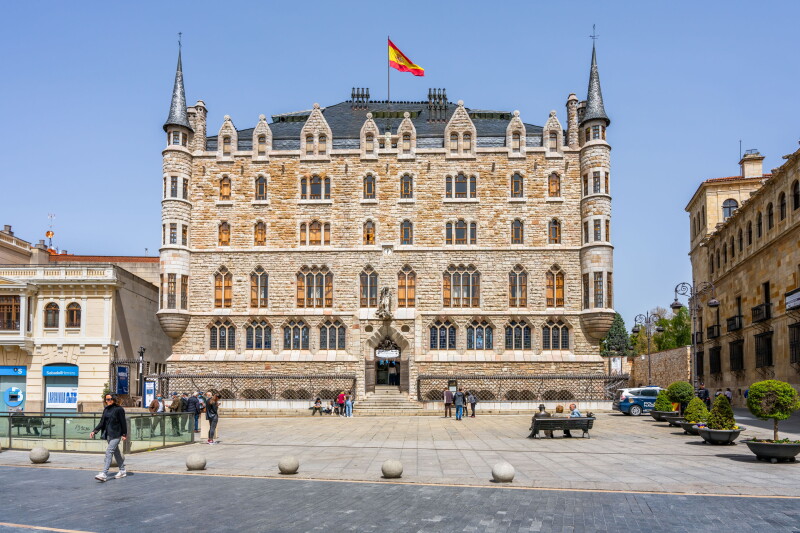
The team behind Casa Botines also run city tours connecting León’s wider architectural history to Gaudí’s work.
Photo by Ivo Antonie de Rooij/Shutterstock
Opening hours: Wed, 3–7 p.m.; Thu, Mon, and Sun, 10 a.m.–7 p.m.; Fri–Sat, 10 a.m.–8 p.m.; Tue, closed
Tickets: Entry from $9; guided tours from $12
Thirty miles northwest of Astorga, León was the capital of an independent kingdom during the Middle Ages. The city’s longstanding importance left behind a trove of Romanesque, Renaissance, and Gothic buildings. These inspired one of Gaudí’s few commercial projects, Casa Botines, a residential building within a former textile factory.
The neo-Gothic building’s design is more restrained than is typical of the architect but still includes many of his signatures: corner towers, lobulated arches over the windows and doors, stone carvings, religious imagery, and skylights that distribute light throughout the space.
“He changed architecture forever because of his use of natural forms, and building using a new kind of geometry,” says Carlos Varela, director of Casa Botines.
Other things to do in León
For a dose of modern creativity, head to the Museum of Contemporary Art of Castile and León to browse 20th- and 21st-century art.
Along the Bernesga River, which flows through the Spanish city, a 12th-century convent has been reborn as one of Spain’s superb paradores—state-run luxury hotels housed in historic buildings.
The sprawling structure is considered one of the most representative in Spain of the plateresque style–a highly ornate architectural style. (The name means “silversmith-like.”) The hotel restaurant serves modernized Castilian cuisine.
Gaudí beyond Spain
Gaudí’s influence has always traveled well beyond Barcelona. The Gaudí Foundation’s new traveling exhibition, Back to the Origins—timed to mark the centenary of his death—brings together immersive art and AI technology inspired by his visionary principles. It’s currently in Osaka until June 28, with more cities to follow (but not yet confirmed) throughout 2026.


