
Dallas

As the third largest city in Texas, Dallas lives up to the expectation that everything really is bigger in the Lone Star State. Situated in North Texas, roughly 70 miles from the Oklahoma border, Dallas is one of the largest cities in the region. The best way to explore it is to divide your time between Dallas’s unique districts and neighborhoods, so you can get a sense of the distinct sub-cultures represented in each. The locals tend to give a warm welcome to visitors and are happy to share their personal favorites in the city.

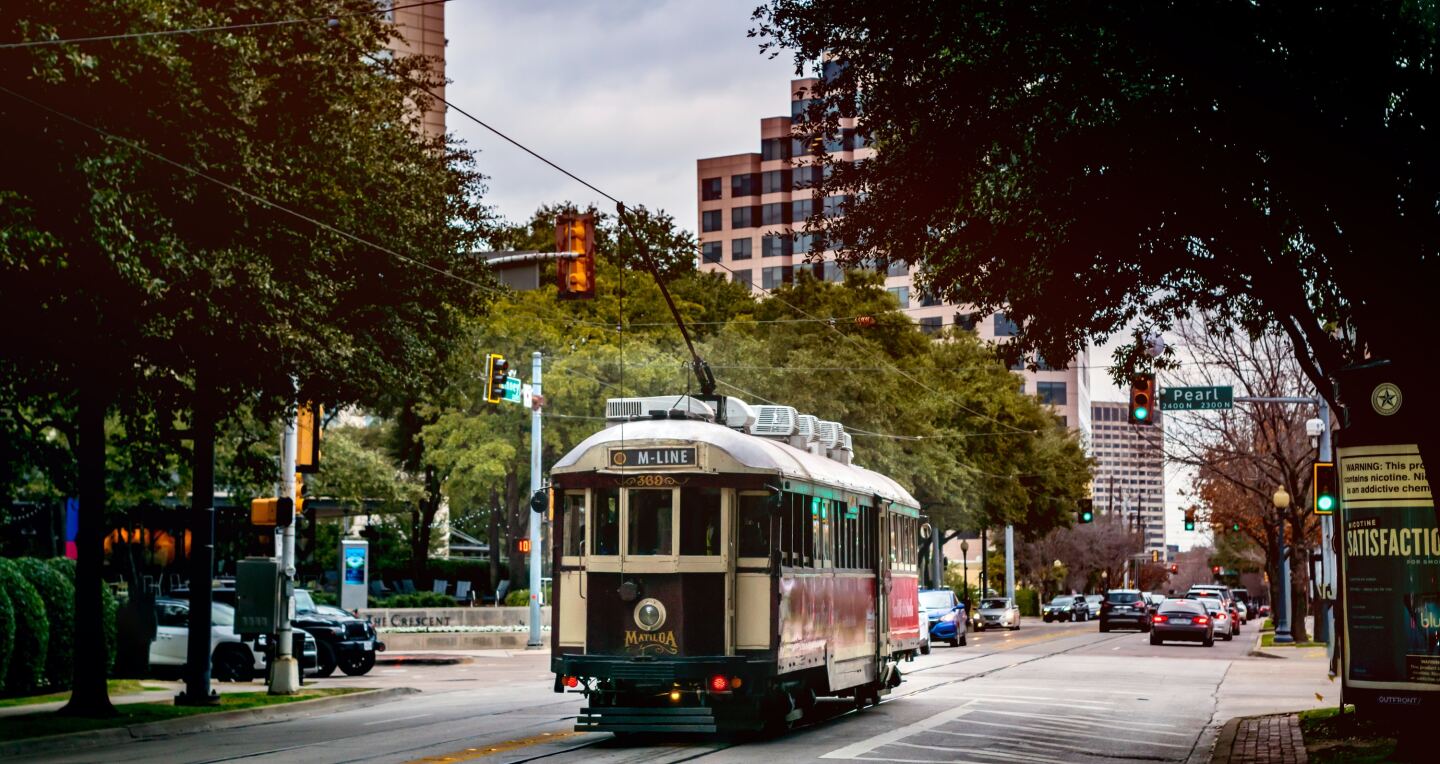
An M-Line trolly moving down the middle of a tree-lined road in Dallas, Texas

Gabriel Tovar / Unsplash

Overview

Can’t miss things to do in Dallas

The Arts District links together Downtown and Uptown Dallas and is a must-see if you want to understand the city better. The depth and range of the museums and venues in this area makes for a perfect day of educating yourself on the cultural epicenter of the city. Experience a vast array of artwork at the Dallas Museum of Art, Nasher Sculpture Center, and the Crow Collection of Asian Art. Watch a performance by the Dallas Symphony Orchestra at the Meyerson Symphony Center, or a theater production at the AT&T Performing Arts Center, which was added to the district in 2009. Klyde Warren Park and The Perot Museum of Nature and Science (named after the family of the politician) opened in 2012, signifying the completion of this district.

Food and drink to try in Dallas

The dining culture in Dallas is ever-evolving, energetic, and comprehensive. As expected in Texas, one of the highlights on every menu is an excellent steak, and Dallas has the top-tier steakhouses to prove it. Tillman’s Roadhouse, Nick & Sam’s in Uptown, and Al Biernat’s in Highland Park all fit the bill for a proper steakhouse experience. Dallas is also known for its Tex-Mex, Mexican food, and barbecue, among other Southern-inspired cuisines. Food trucks are becoming more popular (largely thanks to their prevalence in Austin), and don’t even think about leaving Dallas without trying one of the margaritas.

Culture in Dallas

As a visitor, it’s important to understand just how seriously Dallas natives take their state culture. As the second largest U.S. state, Texan pride runs deep, and visitors may notice the local infatuation with the state flag, the bluebonnet flower, and the longhorn bull. Dallas is also home to the State Fair of Texas, where another state symbol is located: Standing 55 feet tall, the Big Tex cowboy is a cultural icon of Dallas that welcomes everyone to the fairgrounds every autumn.

Shopping

One of Dallas’s biggest draws for visitors and locals alike is its shopping scene, with major designer brands and boutique labels. If you’re looking for large malls and shopping centers to peruse some of the biggest names in fashion, NorthPark Center and Galleria Dallas have you covered with every store imaginable. If you seek a more boutique shopping experience to pick up custom home decor or art, roam neighborhoods like the Bishop Arts District, Knox-Henderson, and West Village, or explore Highland Park Village plaza for shops and finds that are unique to Dallas.

Practical Information

The easiest way to get to Dallas is by flying to the Dallas/Fort Worth International Airport, which is a 30-minute car ride from the city center. Flights are available to Dallas from almost all major domestic and international cities. The weather in Dallas can be quite temperamental. Although the summer months are consistently very hot, the rest of the year varies greatly, so be prepared for an array of weather conditions if you are visiting in the non-summer months. Although Dallas does have the DART transportation system, the city is best explored via car, so be prepared to rent one.

Guide Editor

READ BEFORE YOU GO
Festivals of flowers, film, dance, Pride, and more pack the Texas city’s event calendar in spring and summer.
RESOURCES TO HELP PLAN YOUR TRIP
A trailblazer of the boutique hotel scene, Hotel ZaZa has become a Texas-grown mini-chain over the last decade, with two properties in Houston and one in Austin. But this Uptown outpost remains a true original. The Mediterranean-inspired main building houses the bulk of the 168 accommodations, which include well-sized rooms with generous seating areas, plush king beds and, in some, private balconies. The real ZaZa flair, however, is reflected in the higher categories: 19 Concept Suites are done up in styles like “Bohemia,” “West Indies,” “Opium,” and “Shag-a-Delic;” upgrade further to a super-sized Magnificent Seven Suite (in themes like “Leonardo,” “Crouching Tiger,” and “Rock Star”), or one of the 12 one- and two-bedroom Bungalows, which are set in a 1930s-era former home away from the main hotel and feature individual touches like a vintage 1960s VW Bug tailgate, a 1940s TV fitted into a wooden cabinet, and furniture and artwork handpicked from around Texas. Guests of all rooms have access to free champagne and snacks in the lobby, the ZaSpa wellness retreat and gym, the lively Dragonfly restaurant, and the cabana-ringed pool, which turns into a party scene with DJs spinning after 10 p.m. Another ZaZa signature is the “Magic Carpet Ride,” the hotel’s version of a complimentary house car, which ferries you within five miles of the property in a decommissioned highway patrol car or a Cadillac hearse.
As the patriarch of one of the most prominent real estate empires in the country, Trammell Crow’s work took him all over the globe—including on frequent trips to Asia, during which he and his wife, Margaret, developed a passion for Asian art. Over three decades beginning in the 1960’s, the Crows amassed a deep and diverse collection of important works from all over the region, from a six-foot Ming Dynasty-era seated Buddha and stellar examples of 18th-century jade sculptures to intricately-carved panels from Indian temples. For many years, these pieces were scattered between family properties and commercial buildings, until they all came together under one roof in 1998, with the opening of this Arts District museum. Featuring open galleries framed by natural light and greenery, the jewel box museum is a serene space in which to contemplate pieces from the ever-growing permanent collection, which now includes over 1,000 works from a dozen countries, as well as a library of over 12,000 books and journals; along with all the treasures inside, don’t miss the 15 sculptures in the garden, which span from the ancient to the 20th century. Temporary exhibits might highlight specific techniques (like lacquer work or miniature painting), genres (like the art of the Japanese samurai), or the works of contemporary Asian artists and sculptors. Entrance to the collection is always free; additional fees may apply for tours, talks, or events like yoga and meditations sessions. In 2019, the entire museum was donated to The University of Texas at Dallas, which will continue operating this original location, as well as a future outpost slated for the UTD campus.
For a modern Texas steakhouse experience done right, look no further than this perennial upscale favorite, opened in 1999 by noted restaurateur Phil Romano. The main attractions are the meats, including top-of-the-line prime steaks, chops, and Japanese Wagyu, but there’s also quality seafood, exceptional sides and appetizers, handcrafted sushi, and a wine list packed with 500 well-selected labels. Go big with caviar, oysters Rockefeller, Spanish octopus, or a foie gras–topped deviled egg for a starter, and a prime-aged porterhouse or surf-and-turf main course—accented by shareables like mac-and-cheese, duck confit potatoes, and chili-dusted broccolini. There’s also a seafood selection with classics like lobster and scallops, and a full sushi menu of platters and rolls; one of the latter—crafted with shrimp tempura, avocado, cream cheese, and eel sauce—is named for the local Park Cities area. Desserts are equally creative, so save room for the S’mores Baked Alaska or the Captain Doughnut, made with Cap’n Crunch, bourbon maple syrup, and “cereal milk” ice cream. In addition to its elevated cuisine and wine list, Nick & Sam’s is known for its sleek, art-lined setting, sophisticated bar scene, and friendly service—though the types of cars filling the valet lot are a quick reminder that this is also the kind of place where high rollers and pro athletes come to easily drop thousands on dinner.
It took a 1920s cotton magnate and a 1980s oil heiress to create the city’s most iconic stay, the former incorporating hallmarks of European design into a 10,000-square-foot house the likes of which had never been seen in Dallas—think Italian marble columns, 19th-century Spanish cathedral doors, and a ceiling inlaid with 2,400 separate pieces of wood. The latter transformed it into the Mansion Restaurant, which remains an award-winning favorite, adding a new wing with 143 guest rooms and suites and establishing the first property in the now-global Rosewood chain. Past the signature peach facade, the since renovated accommodations mix modern technologies with gracious amenities, historic touches, and residential-style décor—a combination that’s proved a hit with visiting dignitaries, international business travelers, and privacy-seeking celebs. A small pool, fitness center, and massage treatment rooms round out the facilities in the new wing, while meeting rooms and event spaces are located in the mansion’s gorgeous former living quarters. Young professionals flock to the leather-walled Mansion Bar for after-work craft cocktails and live music on weekends, while the brunch crowd heads to the Terrace restaurant to dine around outdoor fireplaces and oak trees hung with lanterns. Just don’t pass up ordering the legendary tortilla soup at The Mansion.
With artist Mark di Suvero’s 48-foot-tall Ad Astra installation—the only indoor public display of the artist’s work in the world—rising from the central atrium, it’s clear that this is no ordinary shopping mall. And that’s just how the founders planned it: Opened in 1965 by the Nasher family—who also founded the world-class Nasher Sculpture Center in the Arts District—NorthPark Center helped define retail shopping in the Southwest with its modern architecture, state-of-the-art facilities (at one point, it was the largest climate-controlled mall in the world), private art collection, and upscale shops. Over the years, it has remained a popular retail option for locals—and one of the city’s top tourist destinations, welcoming more that 26 million visitors a year. Following a $250 million, 1.2-million-square-foot expansion in 2006, it now features an upgraded cineplex, more drinking and dining options, a central garden, and hundreds of stores from both mass-market international brands and luxury labels; there’s also been a Neiman Marcus outpost here since the beginning. When you get tired of shopping for pretty things, there are pretty things to look at, too, including works by Andy Warhol, Frank Stella, James Rosenquist, and more.
With a great atmosphere and a packed room of locals, if you’re in the mood for Vietnamese food, you won’t go wrong here. Some swear by the pho and others by the gloriously crusty banh mi sub sandwiches, which come heaped high with grilled pork, herbs, salad, and a few slices of chili to add heat. And if you’re feeling greedy, I say do both.
It seems wrong to call this Renzo Piano–designed complex a museum—it’s more like a “sculpture safari,” on which you get to experience the pieces in their intended habitat. Opened in 2003, the Nasher Sculpture Center is a two-acre homage to modern and contemporary sculpture that was founded upon the private collection of the late Raymond and Patsy Nasher, then grew to include new acquisitions and special exhibits on loan from other institutions. Wander the peaceful indoor and outdoor galleries and gardens to spot works by artists like Giacometti, Moore, Serra, Rodin, Picasso, Calder, and de Kooning; many of the larger pieces invite interaction. The lush setting and bold pieces create an idyllic backdrop for the center’s year-round calendar of events (which include movie nights and family-friendly fun)—and make it a top pick for weddings, too.
You’d be hard pressed to find a more stylish stay downtown than The Joule. The independently owned hotel is spread out over three interconnected buildings—a classic revival-style from 1913, a former Salvation Army built in 1911, and a neo-Gothic onetime bank—which have been integrated under the direction of renowned interior designer Adam D. Tihany. His touch can also be seen in the 161 rooms and suites, each decorated with serene jewel or earth tones, contemporary furniture, hand-picked art and photography, and plenty of natural light from oversized windows. Frette bedding, glass-enclosed showers and soaking tubs, and 47-inch flat-screens equipped with Apple TV round out the comfortable digs. You’ll spy pieces from the hotel’s extensive art collection in the public spaces, as well as the outdoor sculpture garden across the street. The block-deep lobby buzzes with an outpost of Weekend Coffee (using Victrola beans flown in weekly from Seattle), a library curated by TASCHEN, and chic boutiques like TenOverSix and Traffic LA, while the popular CBD Provisions draws a local crowd with its modern Texas fare and regional drinks list. The 8,000-square-foot subterranean spa features a vitality pool, crystal steam room, and glass-walled sauna to enjoy before or after treatments, and there’s also a fitness center with a cycling studio and group classes. Two things not to miss: the original historic bank vault in the lobby, and the much-Instagrammed rooftop pool, which cantilevers eight feet off the side of the building.
The lines are long (expect to wait at least an hour) at this young barbecue joint tucked inside the Dallas Farmers’ Market—but the tender, perfectly smoked meats are worth the wait says Daniel Vaugh, barbecue editor of Texas Monthly. “They have incredible brisket and giant beef ribs,” he says. Watch for a brick-and-mortar outpost slated to open this spring—menu standbys like bacon-and-chile-flecked mac and the “trough” meat-sampler, pictured here, are sure to make an appearance.
When President John F. Kennedy was shot in Dallas in November 1963, the world was introduced to the Texas School Book Depository building, which became the primary crime scene for the assassination. It was from a sixth-floor window in this brick warehouse that the shots are said to have rung out toward the Grassy Knoll and the motorcade along Dealey Plaza—and it’s that same floor that now houses this excellent museum dedicated to the event and its aftermath. The engaging permanent exhibits focus on everything from the political climate of the era and the actual assassination to the immediate chaos, the investigations, and even the conspiracy theories; you’ll also have the chance to watch and analyze the Zapruder film, and stand at the famous window itself. Rotating temporary installations may showcase topics like artwork inspired by the event, while a library and reading room offer opportunities for a deeper dive.