Amsterdam

With its Golden Age canals, 17th-century mansions, world-class museums, and well-established counterculture, Amsterdam is a European capital with an edge. While some come for tulips, cheese, and windmills, others are drawn by the city’s reputation for easy sex, drugs, and rock ’n’ roll. Whatever brings you to this charismatic global village, you’re sure to be charmed by its fairy-tale landscapes, tolerant vibe, and historical legacy that harks back to the small, 13th-century fishing village on the Amstel River that would become an international capital.

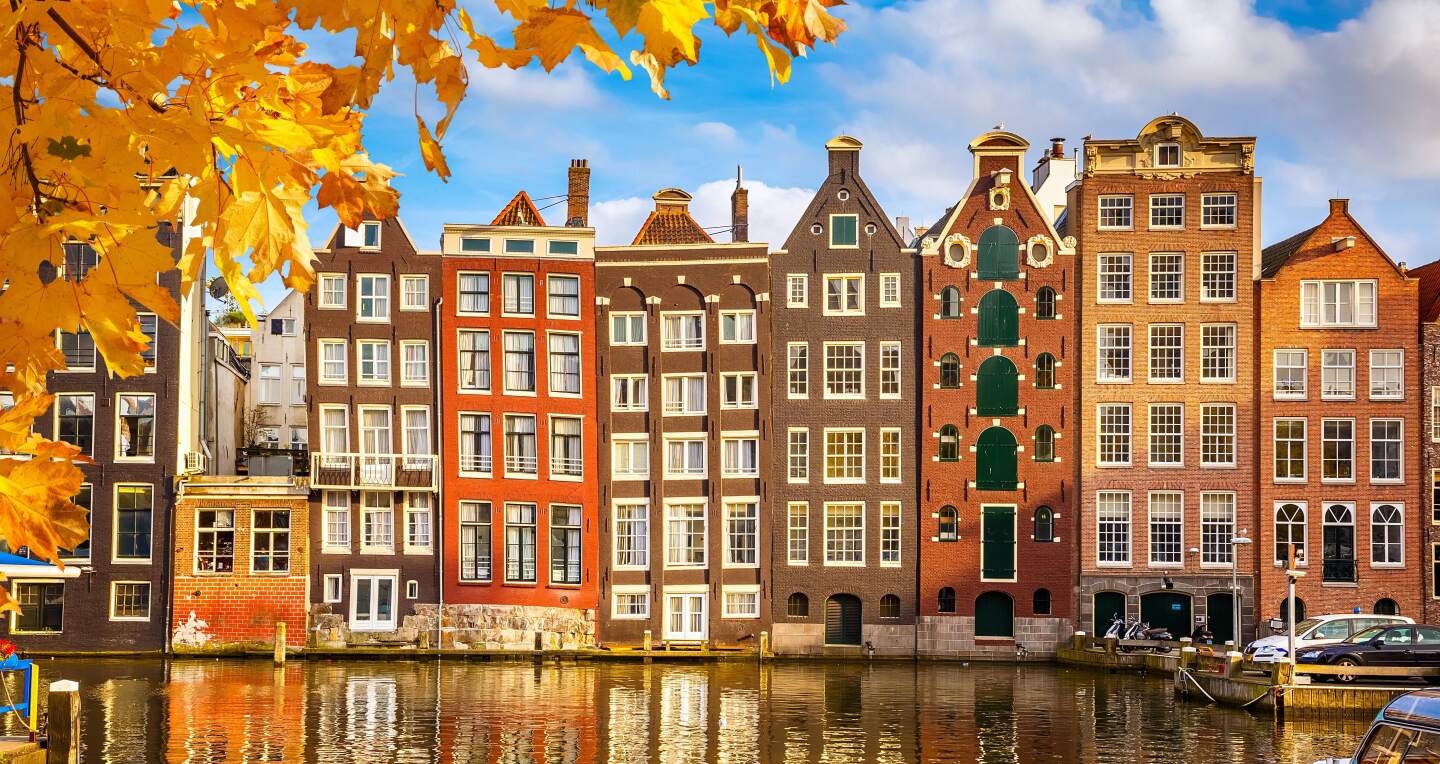
Amsterdam canal at fall, several tall little houses in a row next to the river canal

Sergey Borisov / Alamy/Alamy

Overview

When’s the best time to go to Amsterdam?

Winter may be cold (with January and February the coldest months), but tourists are gone and locals have reclaimed the town. Before the holidays, In Leidseplein and Rembrandtplein, two of the city’s open squares, skating rinks and oliebollen stands appear (oliebollen are the local doughnuts). Twinkling lights decorate bridges; seasonal trimming transform streets into fairy-tale lanes. Amsterdam Fashion Week sashays through town in January, drawing international style-makers. In the spring, tulips bloom, flowers spill over balconies, tourists jam museums, and locals celebrate the lengthening days. Millions arrive to viist Lisse’s Keukenhof, a stunning flower garden. Summer means picnics in Vondelpark, Museumplein, Amsterdam Bos, and all the city’s green spaces. During Open Garden Days in June, many canal houses open private courtyards for viewing. Outdoor concerts and festivals abound, restaurant patios overflow with diners, and locals head to urban beaches. In the fall, as the leaves change color, Amsterdam ushers in the cultural season. New exhibits open at galleries and museums and opera season kicks off.

January: Amsterdam International Fashion Week February: Chinese New Year Festival March: Amsterdam Restaurant Week April: Koningsdag (King’s Day, formerly Koninginnedag or Queen’s Day) May: Art Amsterdam (previously Kunst RAI) June: Holland Festival, Vondelpark Open Air Theater, Taste of Amsterdam, Nuit Blanche, Open Garden Days July: Amsterdam Roots Festival, Kwakoe Zomer Festival August: Robeco Summer Nights, Gay Pride, Grachtenfestival; Pluk De Nacht, Sail Amsterdam, Uitmarkt September: Open Monument Days, Jordaan Festival, Amsterdam Restaurant Week October: Amsterdam Dance Event, Amsterdam Marathon November: Museum Night, Amsterdam Antique Fair, High Times Cannabis Cup, International Documentary Film Festival, Sinterklaas arrives

How to get around Amsterdam

Amsterdam is an international hub for many airlines. Flights arrive at Schiphol, which is about half an hour from the city center by public transportation. Trains arrive at Central Station, where countless connections to the rest of the Netherlands and all of Europe are available. Eurostar buses terminate at Amstel Station. Boat travel is an option for U.K. and Scandinavian travelers, via P &O North Sea Ferries, Stenaline, and Scandinavian Seaways. City parking is rare and expensive. If you must arrive by car, take the A10 Ring into town from any major freeway.

Amsterdam is among the most compact of the world’s major cities, making it easy to get around by foot or bike. An excellent system of GVB trams and buses facilitates travel throughout the city and beyond. A metro line connects Centrum with the suburbs.

Can’t miss things to do in Amsterdam

There’s no sign, no agenda, and no boundaries at Supperclub, where it’s always a memorable evening. From the Salon Neige, where you’ll dine like a sultan to the gay urinal that doubles as a smoking room, this is experimental fun unfettered by convention. Expect eclectic cuisine and entertainment from the seductive to the bizarre, encompassing vaudeville, burlesque, and cabaret.

Food and drink to try in Amsterdam

Holland is known for hearty comfort food, not haute cuisine. Yet its capital competes with the best of Europe on the dining front with nearly 1,500 options, from Michelin-starred restaurants and historic watering holes to gay cafés and Irish pubs. Amsterdam’s culinary melting pot includes diverse fare encompassing Indonesian rijstaffel, Spanish tapas, and Dutch favorites such as stamppot, bitterballen, and pannekoeken. Sample Asian flavors in Chinatown, near Nieuwmarkt, or cruise Haarlemmerstraat, Utrechtsestraat, or Reguliersdwarsstraat for dining options. Avoid touristy Leidseplein. On the street, try Vlaames frites—twice-fried potatoes smothered in mayo—or raw herring served with pickles and onions. Turkish pizza is popular, as are gyros, reflecting Middle Eastern influences. In the wee hours, buy a kroquet or burger from coin-operated windows at FEBO (the Dutch fast-food automat chain), where you’ll see locals trying to be inconspicuous as they grab a late-night snack. Heineken and Amstel are the local beers. For a stiffer drink, try Dutch jenever, which is juniper-flavored gin.

Culture in Amsterdam

With classical music at Concertgebouw, theater at Stadsschouwburg, jazz at Bimhuis, contemporary music at Muziekgebouw, and cabaret at Royal Theater Carré, Amsterdam’s cultural scene offers plenty of variety. Renowned pop and electronic music venues include Air, Melkweg, Paradiso, Sugar Factory, and Escape.

AFAR’s travel partner, Context, offers visitors a private tour, led by a local historian, artist, or architect, of the city’s streets and canals called The Dutch Golden Age, with a focus on how a relatively small Amsterdam came to hold a global position of power in the 1600s.

Local travel tips for Amsterdam

  • Never buy drugs from street dealers.
  • Urinating on the street will cost you €60.
  • Taxi drivers may rip you off unless you know exactly where you’re going.
  • Don’t overtip for inferior service at Dutch bars and restaurants.
  • Establishments along Damrak and in Leidseplein are touristy, overpriced, and often mediocre.

Guide Editor

READ BEFORE YOU GO
HOTELS
Once an orphanage and Palace of Justice, Rosewood Amsterdam is the Dutch capital’s most anticipated new hotel—and one of the city’s last debuts for a while.
A Boeing 737-800 is the main draw of the 1,200-square-foot suite at the Corendon Amsterdam New-West, and the whole room has been recently refurbished to be even cooler.
A recent announcement included numerous measures aimed at controlling what has become an irrepressible flood of visitors.
Who needs a hotel lobby when the city—and its canals—are right on your doorstep?
RESOURCES TO HELP PLAN YOUR TRIP
Once Amsterdam’s main public library, the Andaz Amsterdam Prinsengracht looks like a 1970s block on the outside. But inside, renowned Dutch designer Marcel Wanders has transformed the space into a whimsical and grown-up homage to Alice in Wonderland. Decorated with oversized furnishings (including Wanders’ signature Tulip chairs and modern twists on chandeliers), Delft blue tilework and brocade upholstery (references to historic Dutch style), and avant-garde artwork, the design hotel hardly feels like part of a chain, even one as hip as the Andaz. Instead, with its serene herb garden full of quirky topiaries, a checkerboard mural, and chess-piece statues, the canalside hotel channels a fresh take on Amsterdam. But don’t worry, authentic Amsterdam is still out there—take the free bicycles for a spin along the waterways, and know that free snacks await you back in your room.
Strolling down Marnixstraat you wouldn’t suspect it’s there, unless you notice a small sign near a stairwell adjacent to the Q-Park. From Nassaukade, there’s no access, but you can see the buzzing venue across Singlegracht canal: Waterkant, a tropical-themed bar and restaurant serving casual fare on the waterfront behind the twin towers of the parking garage. The brainchild of the catering team that brought popular Bukowski Bar, Café Kuijper and Maxwell to Amsterdam, Waterkant debuted to instant success in August 2014. Seemingly overnight, the trio transformed the dilapidated night shelter behind the Q-Park into a canal-side bar and restaurant perfect for a romantic date or evening out with friends. At colorful tables on an expansive terrace, you can watch boats passing by and the Nassaukade street scene over beer, snacks, lunch or dinner. Looking to Amsterdam’s colonial past, the new hotspot features a Suriname-inspired menu with specialties like peanut soup, curried duck spring rolls, fried dumplings and roti roll. If you’re starving, order the Jamaican Jerk ribs—a whopping 16 barbecued bones served with coleslaw and fries. Or blow the budget on a whole Canadian lobster for €25. Wash it all down with traditional Parbo beer or a local craft brew.
It may not look like much and there’s certainly no need to dress up. But despite its humble appearance on the posh Brouwersgracht, Swieti Sranang serves up some of the best—and most affordable—Indonesian and Surinamese food in town. Owned by Henk van de Weerd and Juliet Chang, the tiny hole-in-the-wall reflects Amsterdam‘s immigrant influences with Indonesian and Surinamese-inspired sandwiches, snacks, rice, roti and bami/nasi specialties. Swieti Sranang is the perfect source for casual lunch or dinner fixings. Pick up a few Indonesian sandwiches, a bag of banana or cassava chips, a few loempia and kip sate sticks, and you have the perfect ingredients for a canal-side picnic. All dishes are lovingly prepared by Chef Juliet, who was born in Indonesia and raised in Suriname. Most sandwiches and snacks are priced under €3, while main meals are €9 or less, making it easy for two to fill up for about €20. You can sample a few selections from the menu on the new Jordaan Food Tour, (http://www.eatingamsterdamtours.com/jordaan-food-tour/), offered Tuesday through Saturday, beginning at 11am.
It was the fifth of seven food stops on our Jordaan Food Tour (http://www.eatingamsterdamtours.com/jordaan-food-tour/), a four-hour gastronomic adventure through one of Amsterdam‘s most scenic and historic neighborhoods. We’d already devoured apple pie, Indonesian sandwiches, ossenworst, raw herring and lightly fried kibbeling. But could we find room for something sweet? Enter Mariska Schaefer, owner of Het Oud-Hollandsch Snoepwinkeltje, an old-fashioned candy boutique that harks back to a simpler time, when kids saved pennies for a trip to the local candy store. As we might have expected, a child about ten was using his birthday money to buy a bag filled with his favorite sweets on the day we visited. “No pictures of children,” ordered Mariska, then turned her attention to the kid’s selections. “I opened the candy shop because I really like Dutch old-fashioned shops; they have so much more atmosphere than the big chain stores,” she reflects. Inspired by her grandmother, she stocks drop, the national sweet, in dozens of flavors in her small shop—some sweet, others salty, still others downright inedible for some.
Escape the bustle of the city by ducking into the quiet courtyard garden of Begijnhof. Located just a few minutes on foot from the Koningsplein and the Singel canal, this tranquil oasis dates back at least as far as the 14th century. Look among the row houses around the perimeter to find the city’s oldest home, the Houten Huys, built in 1420. And within the courtyard is the Engelse Kerk, or English Church, first constructed in 1390 and refurbished after a fire 100 years later.
With its chill vibe, funky decor, warehouse-like interior and spacious terrace, Pacific Parc is a rock ‘n’ roll bistro with an edge. Situated in a former treatment plant at Westergasfabriek, the café-nightclub on Amsterdam‘s west side clearly represents its mantra, “Do not beg for the right to live, take it.” Life is good over international favorites like satay with coconut-peanut sauce, Indian lentil curry, Black Angus burgers and Dutch pannenkoeken, all priced under €20 on lunch and dinner menus. For kids, chicken drumsticks, chips, cucumber and ice cream are on a children’s menu for €8. While little ones romp on the spiral staircase, you can dine at the bar or at wooden tables in the open-zoned dining area, under a whimsical chandelier hanging from the sunroof. If you’re attending a Westergasfabriek event, Pacific Parc is a great place to meet up with friends. But there’s more to this place than relaxed ambiance, good drinks, reasonably priced fare and a menu based on seasonal ingredients. Thursday through Saturday, DJs mix hip-hop with disco and swing tunes. By 23:00, dinner seats are pushed aside and anyone who sticks around may be in for a wild night. A special “Dinner and a Movie” deal entitles you to a flick at Ketelhuis, Westergasfabriek’s cinema, plus a starter and main course (excluding drinks) at Pacific Parc for €25. While the restaurant may lack for romance, it’s a fine place to get your weekend date off to a savory start.
What do you get when you combine a design gallery/store with a café, beauty salon, fashion boutique and rental apartment? Add it all up and it equates to Droog, a multifunctional space that melds a 160-square meter exhibition space with an airy dining room, a tearoom overlooking an outdoor garden and a single bedroom for overnight guests. “The concept of a hotel has been reversed,” says Renny Ramakers, co-founder and director of Droog. “Whereas a hotel is...mostly about sleeping, here we have enlarged and emphasized all the aspects that many hotels also offer and made them central to the experience—and it even has a room to sleep in.” Housed in a 17th century building in central Amsterdam, Droog showcases product design in exhibitions and lectures, and invites people to plug in as they choose. In the gallery, view the latest in international furniture design, art and fashion. Shop at the Droog Store, then refuel at RoomService by Droog, open for late breakfast, lunch, high tea and early dinner, or just drinks and snacks. Head to Cosmania to up your beauty game, shop for hip fashion at Kabinet and stock up on wellness products at Weltevree. On top floor, Hôtel Droog offers overnight guests a brightly-lit bedroom, bathroom with separate bath and shower, living area and kitchen. Perched in the aery enclave, enjoy a splendid view of Amsterdam rooftops and the city below.
On a hopping night, Noorderlicht (Northern Lights) blazes with colorful lights visible clear across the IJ River—hence its name. For those drinking and jamming to live music on a waterfront terrace warmed by a roaring bonfire, the setting is more intimate. We’ve reached Noorderlicht, a “cultural café” in Noord-Amsterdam, via free ferry from Central Station. Destination: NDSM yard, a revitalized shipyard that belies its maritime/industrial heritage with warehouses and shipping containers transformed into nightclubs, hotels and student housing. Dotted with fishing villages, condos and restaurants, the eclectic neighborhood calls itself “Art City.” With its airplane hangar shape and greenhouse-like architecture, Noorderlicht enhances the funky landscape. The popular café draws creative types who come for waterfront dining, drinking and dancing. Inside, warm-hued wall hangings, wooden flooring, tables ornamented with polished driftwood and a disco ball contribute to an inviting ambiance. Seasonal lunch and dinner menus feature organic and regional dishes, plus casual fare like frites and burgers. Noorderlicht’s grassy terrace offers a spectacular view of Amsterdam city center from the other side of the Ij River. Dine on wicker chairs, cushioned couches and picnic tables as musicians perform overlooking the waterfront. A roster of events ranges from campfires and poetry readings to DJ nights that usually inspire some pumping and grinding in a young, energetic crowd.
With its flamboyant facade, art deco foyer, and main hall outfitted with love seats and private boxes, the Pathé Tuschinski Cinema makes going to the movies a romantic affair. Framed by ornate twin towers, the historic building between the Munttoren (mint tower) and Rembrandtplein was constructed by Polish immigrant Abraham Tuschinski, a Jewish tailor who capitalized on a new craze. The imposing 1,200-seat theater mixes art deco elements with Dutch Amsterdam School style, art nouveau, and Tuschinski’s own taste. Today, Hollywood blockbusters are screened in the theater, now operated by Pathé. In the main hall, snuggle up in love seats or order wine and a meal from a private box. On red-carpet-premiere nights, watch celebs arrive in stretch limos and preen for the paparazzi to the delight of local filmgoers.
This sprawling 19th-century former gasworks complex west of the Canal Ring was a polluted site for decades after its closing in the mid-1960s. It was cleaned up and reopened in 2003 as a park, and its architecturally significant red-brick buildings were turned into cultural venues, restaurants, bars, nightclubs, and shops. The Gashouder, a massive circular structure measuring more than 27,000 square feet, hosts mainly techno parties, while the nearby North Sea Jazz Club is an intimate space for live jazz performances. You’ll also find TonTon Club, a restaurant and arcade with video games, air hockey, and table tennis; Pacific Parc, a café with live rock music and DJs; and a three-screen art-house cinema.