Philippines

With more than 7,000 islands sprawled along the Pacific Ring of Fire, it’s virtually impossible to visit all of the Philippines. Fortunately, the country’s finest qualities—including stunning landscapes and hospitable locals—can be found all across the archipelago. Those seeking white sand beaches should visit Boracay (which is, admittedly, also a serious party island) or Palawan (which is less developed).” Culture-lovers are better off on the largest island, Luzon, home to the UNESCO-recognized town of Vigan, the Ifugao rice terraces, and baroque churches.

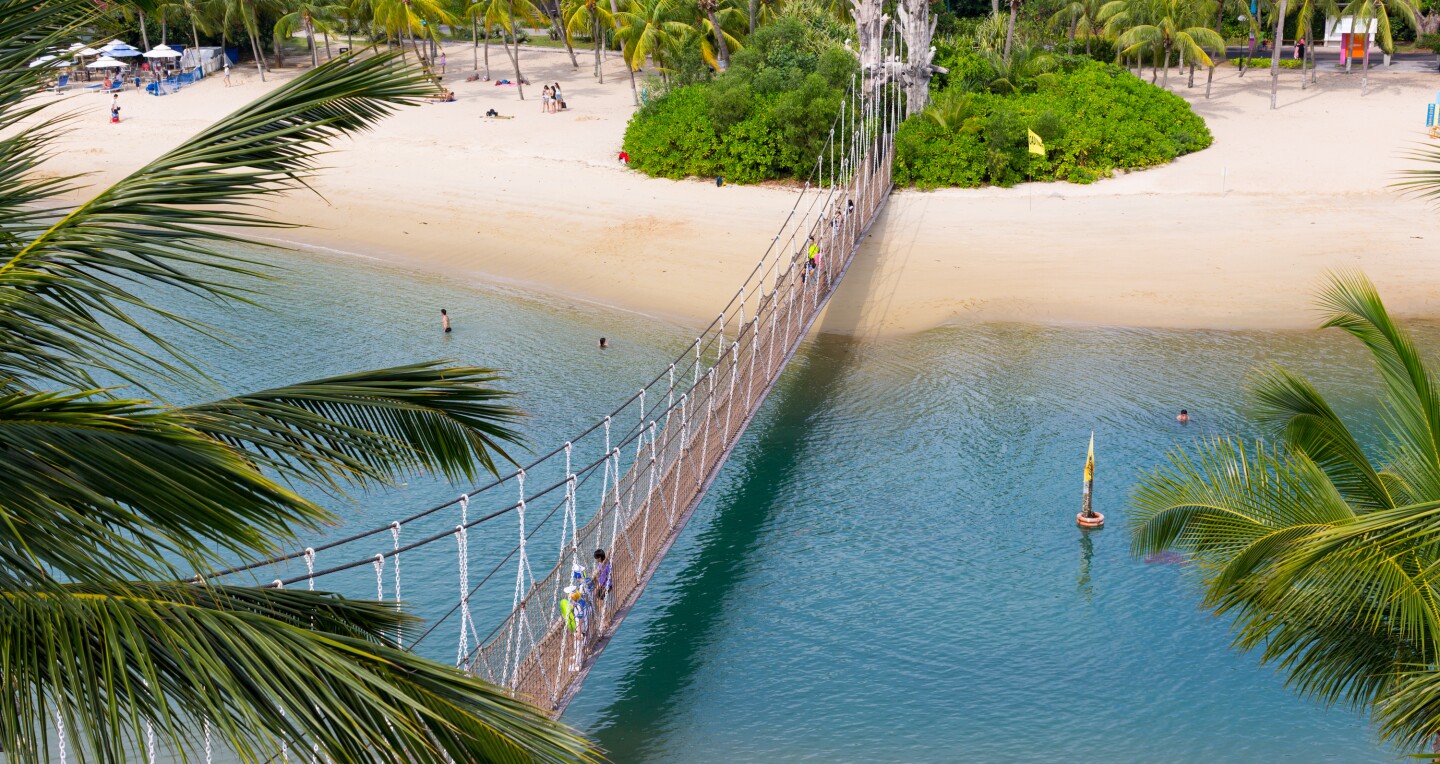
Hanging bridge to Palawan island, Sentosa, Singapore

Photo By Roman Rudiak/Shutterstock

Overview

Can’t miss things to do in Philippines

The Philippines’ charm stems largely from three characteristics: ancient cultures, natural beauty, and overwhelmingly friendly people. A visit to the beach is a must. Swimming with whale sharks is highly recommended (and completely safe). Island-hopping trips among the thousands of uninhabited islands are surprisingly affordable. A visit to a village where life has remained essentially the same for millennia—such as to Batad, set among rice terraces inscribed on the UNESCO World Heritage List—is a unique and humbling experience. Hospitality is an important part of Filipino culture, and if you socialize with locals you’re likely to be invited to a home-cooked family dinner.

Food and drink to try in Philippines

Filipino cuisine—like the culture—varies from island to island. It consists of a hodgepodge of Austronesian dishes influenced by neighbors (such as Malaysia) and former rulers (Spain and the United States). The result is a variety of paellas, pork, noodle-based dishes (known as pancit), and liberal use of soy sauce, vinegar, and fish sauce. Outside of large cities, few Filipinos frequent restaurants, and the best food is most often found on dinner tables in local homes. Fortunately, locals are wonderfully outgoing and quick to invite a new friend to dine with the family. Where possible and appropriate, accepting such invitations is recommended.

Culture in Philippines

The Philippines lacks many of the characteristics shared by other Southeast Asian countries. While others in the region have strong Buddhist and East Asian traits, Filipinos are a primarily Austronesian people (the same who later migrated to Tahiti and Hawaii), strongly influenced by three centuries of Spanish rule and a long American military presence. The culture is best described as Asian–Latin American. American fashion and rock-and-roll culture are popular, Catholicism is widespread, and colorful Filipino Jeepneys are practically identical to Latin American “chicken buses.” Music completely ingrained in the culture and ancing is an unofficial national pastime.

Shopping

Low prices and affordable alterations make shopping any place in Asia a treat. This is especially true in the Philippines, said by some to be Asia’s shopping capital. Western styles are common, and malls are so popular that many of the world’s largest reside in the country. For high-end shopping in Manila, Greenbelt in the Makati district is the obvious choice. The SM Megamall in the Ortigas district is the biggest shopping center in the country and is an impressive sight. Bargain hunters should head for Greenhills in the San Juan district, where pearls are plentiful, designer goods suspect, and shopkeepers ready to bargain. The best times to shop are after Christmas and Valentine’s Day, when sales are ubiquitous.

Practical Information

March through May are the hottest months in the Philippines, followed by a rainy season that lasts until October. November to February are the most temperate months to visit. Most nationalities don’t need a visa for trips of up to 30 days, though an ongoing ticket and a passport that’s valid for at least six months are required. Air conditioning on buses can be frigid, so be sure to take warm clothing. The currency is the peso; English is widely spoken. Electricity is 220 volts.

How to get around Philippines

The majority of international flights land in Manila, though there are other options if you want to avoid the chaotic capital. For a nonstop flight from the United States, book on Philippine Airlines. As of October 30, 2018, the airline launches nonstop service from JFK to Manila five times per week. Domestic travel in the Philippines is affordable. Islands are easily reached on airlines including Cebu Pacific Air, Philippine Airlines, PAL Express, and AirAsia Philippines. You can also island hop by ferry. Book through 2Go Travel.

Guide Editor

READ BEFORE YOU GO
HOTELS
These hotels know how to make an entrance.
RESOURCES TO HELP PLAN YOUR TRIP
Most visitors to the Philippines will learn something about the country’s Spanish and American colonial history; fewer will learn about the people who were here before. The mountains of Luzon are still inhabited by distinct indigenous ethnic groups known collectively as the Igorot, or “people of the mountains” (though today some prefer to use alternative terms). Despite hundreds of years of colonial rule, some indigenous peoples managed to maintain—and still continue—their traditional way of life. Sagada, a town in the Mountain Province, is a good place to witness this aspect of the Philippines. Many travelers check out the hanging coffins in Echo Valley, which are nailed to a cliffside and intended to bring the dead closer to heaven. But the real value of visiting Sagada is to interact with the Igorots and listen to their stories.
The municipality of El Nido, on the northern tip of Palawan, is known for the jagged limestone cliffs that spike up from the turquoise waters and that are home to the island’s endemic swiftlets. Known locally as balinsasayaw, these birds use threads of their saliva instead of twigs to build their nests in crevices on the cliffs (El Nido means “nests” in Spanish). Climbers called busyador scale the cliffs each day to collect the edible birds’ nests, which are mostly sold to China, where the nests are believed to contain a high level of natural minerals that provide health benefits. But the recent decline of the swiftlet population has caused the deterioration of the industry, and many busyador have shifted to tourism instead. El Nido attracts millions of visitors each year to its beautiful white-sand beaches and unspoiled natural landscapes, which include caves and hidden lagoons as well as the legendary cliffs. Activities here include hiking, sea kayaking, snorkeling, and diving, and everything is a lot more low-key than at busier destinations like Boracay.
The popular island in the Philippines is welcoming visitors once again, but with a new set of rules to protect it from the effects of overtourism that nearly ruined it.
The province of Bohol seems to encourage the bizarre. It contains one of the world’s strangest landscapes, a collection of some 1,700 hills in a 20-square-mile area called the Chocolate Hills. It is also home to a peculiar creature called the Philippine tarsier (locally referred to as the mawmag or mamag), one of the smallest known primates, no larger than an adult man’s hand, with giant round eyes and a tail that is longer than its body. These adorable beasts are spread across various islands in the southeast of the Philippines, surviving in rain forests with thick vegetation. They are nocturnal, can leap as far as 10 feet from tree to tree, and (like owls) are able to turn their heads 180 degrees. Unfortunately, habitat destruction via logging and mining threatens the Philippine tarsier with extinction. The best place in Bohol to see them and support their conservation at the same time is at the Philippine Tarsier and Wildlife Sanctuary in Corella. Run by the Philippine Tarsier Foundation, a nonprofit dedicated to tarsier conservation and education, this small but successful sanctuary provides the best possible environment to allow these tiny creatures to survive and thrive.
Two of Manila’s most famous churches can be found in close proximity to each other within the historic walled city of Intramuros. The 16th-century San Agustin Church, a UNESCO World Heritage Site, is the oldest church in the Philippines and was the only building in Intramuros to survive heavy bombing in World War II. It boasts an impressive interior with trompe l’oeil effects, a Baroque pulpit and a majestic pipe organ, and the museum houses treasures of Old Manila. A few blocks away, the Manila Cathedral, restored many times since the original version was built 450 years ago, hosts religious artworks and sacred relics and was visited by Pope Francis in 2015.

Halo-halo is a popular everyday dessert whose name is a Tagalog word meaning “mix.” It’s composed of many ingredients, including various beans, fruits, and jelly-like coconut-based sweets. These toppings are put over a big bowl of shaved ice with milk; finally, the mixture is topped with a slice of leche flan (cream custard) and ube (purple yam). Some versions also incorporate gelatin, cheese, or pinipig (crispy rice), though nothing beats adding a scoop of ube ice cream on top. The proper way to eat halo-halo is to stir it up first so that each spoonful includes many ingredients and gives you a taste and texture explosion. Halo-halo is available everywhere, from public markets and local food chains to ice cream bars and the most luxurious hotel restaurants. But serious connoisseurs go for the classic one at the Milky Way Café. The eatery has been serving halo-halo for more than 40 years, and their iteration boasts 20 premium house-made ingredients and ice that is finely shaved using a hand crank.
Fans of the movie Apocalypse Now probably know it was shot in Baler, some 150 miles northeast of Manila. At the time, locals were already well aware of the area’s killer waves, which caused trouble for the fishermen. But attitudes toward the waves slowly changed, thanks to the film: Residents used the surfboards left behind by the crew to learn to ride them. Surfing culture in the Philippines was born, and the big waves were no longer considered a threat, but rather an opportunity to bring in surfing tourism and events each year from October to February. But Baler has a lot to offer for the non-surfer, too, even if you just sit on the beach and watch the ocean. Couples love the long stretch of sand at Sabang, which is perfect for romantic beach walks, and the sunrise here is a must-see. From a historical perspective, Baler is significant because it was the last stand of Spanish forces in the Philippines; the yearlong siege that began in July 1898 is one of the longest in the country’s recorded history. The undermanned Spanish troops, not knowing the war was over, held onto their fortress in the only stone building in the area, the San Luis Obispo de Tolosa church, for 337 days.
The Caramoan area, on the eastern tip of the Caramoan Peninsula in Bicol, is a rugged and remote landscape of white-sand beaches, rich woods, swampland, lakes, and caves. Numerous seasons of the reality TV show Survivor have filmed around this region, including at Gota Beach. Most travelers explore the pristine Caramoan Islands by small outrigger boat. There are too many to scope out in one trip, but don’t miss famous Matukad Island with its pure white sands, exotic rain forest, limestone rock formations, and even a hidden lagoon. Another must-visit is Manlawe Island, a one-kilometer-wide sandbar surrounded by ankle-deep water. Other highlights include Cotivas Island, Gota Island, and Sabitang-Laya, a triangular landmass with powdery sand, caves, and superb snorkeling. Accommodations in Caramoan include family-run inns that are equipped with modern amenities but rustic enough to accentuate the region’s remote and unspoiled ambience.
Donsol, in southeast Luzon, is the perfect place to snorkel with whale sharks, otherwise known as butanding. Each year from November to May, possibly the largest school of whale sharks in the world migrates here to feed on the dense concentration of plankton and krill in the area. Donsol’s whale shark interaction is strictly regulated to protect the creatures and their natural habitat. They are not captive and are not fed by the local fishermen, so whether they appear or not is pure chance. A small boat takes you out to the bay and spotters cue you to jump in and swim alongside the whale sharks as they begin to near the surface. It’s an incredible experience to be so close to these huge beasts, which are typically four to 12 meters long in Donsol (though residents claim, of course, to have seen larger). They look like spotted submarines, but luckily have a gentle disposition and are surprisingly graceful.
Hop on a lightweight bicycle and learn about the history of the Philippines on a guided bike tour around Manila’s old walled city of Intramuros. The bikes are handmade in the Philippines from bamboo, a natural vibration dampener, and fibers from the abaca plant (similar to a banana); Bambike Revolution Cycles won a Manila FAME Katha Award for Eco-Design in 2015. This is a unique alternative to a walking or bus tour, and takes you inside a walled city that is not normally accessible to bigger groups. Intramuros almost doesn’t feel like Manila: The Spanish influence is evident in the architecture, which includes some of the oldest baroque churches in the Philippines. Fort Santiago still houses underground dungeons as well as a tiny underground chapel, hidden at the end of a tunnel. At the Rizal Shrine you will learn about the life of José Rizal, the country’s national hero who played an instrumental role in the Philippine rebellion against Spanish colonial rule, and follow in the footsteps he made as he took his last walk in the fort from his cell to his execution.