

This story was originally published in 2022 and was updated with new information August 6, 2026.
The first thing visitors see when they enter the YMI Cultural Center is a painting by local artist Jenny Pickens. Its bold colors and cheerful depiction of everyday life in Asheville set the tone for the building that holds artifacts and photographs of Asheville’s Black history. “This picture is living in Asheville,” says the YMI’s director of cultural programming, alexandria Ravenel. “And when the locals come in, they remember this lady here. She really did walk around with a Coke bottle on her head.” The YMI (which stood for “Young Men’s Institute” in the early days) has anchored the Block, Asheville’s historically Black business district, since its 18,000-square-foot building opened in 1893. Today, the neighborhood is experiencing a resurgence that has put it back on travelers’ radars.
The Block thrived through the early 1900s and the Great Depression. By the 1950s, its juke joints attracted headliners including Louis Armstrong, but beginning later that decade and continuing through the 1980s, urban renewal and suburbanization forced many businesses to relocate or close. Thanks to preservation and revitalization efforts, the Block is once again becoming a destination for visitors interested in Asheville’s Black history and culture.
Inside the YMI Cultural Center
Founded in 1892, the YMI quickly became the center of Black social and civic life in Asheville when the building opened a year later. “People would come if you’re Black in Asheville, and you were looking for music or you’re having a bridal shower or a baby shower or a wedding,” says Ravenel. “Everything happened in these buildings.”
At one point, there was a swimming pool in the basement (it’s now a conference room), and the present-day auditorium was once a gym where members played basketball. Original wood beams, stone accents, and other architectural details remain throughout the building.
Today, the lovingly preserved space still hosts events like hip-hop dance and poetry workshops, and visitors can also arrange tours. A sunlit gallery showcases artwork by local and regional Black artists, including Jordan Smith and Jerrie Settles. (For tours or gallery visit information; call 828-617-9001, email [email protected], or fill out the Contact section of the YMI website.)
The Block is also part of Asheville’s new Black Cultural Heritage Trail, which includes stops in downtown, the River Arts District, and the Southside. While you’re in the area, stop by Triangle Park to catch some shade and peek at the murals before continuing your exploration.
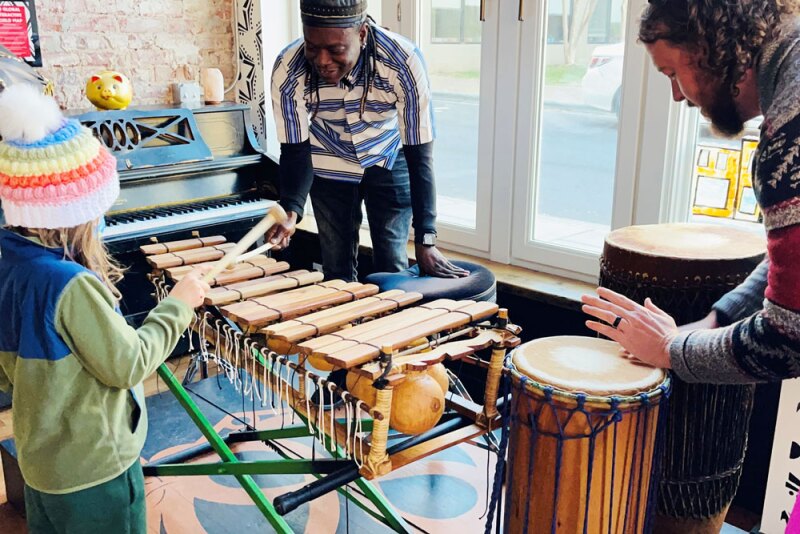
LEAF Global uses music and art to immerse visitors in different cultures.
Courtesy of LEAF Global Arts
Where to stay, eat, and play on the Block
Steps away from the YMI is the Foundry Hotel. The 87-room hotel occupies a former steel factory, pairing exposed brick and industrial details with cozy guest rooms that make a comfortable landing pad after exploring the Blue Ridge Mountains.
The on-site restaurant, the Refinery, serves breakfast favorites like mini waffles with whipped mascarpone and berries and seasonal quiche. The Workshop Lounge, the hotel’s lobby bar, sets an evening off right with cocktails and light bites. The lounge also features a large-scale mixed-media piece by Elizabeth Ivey, installed in partnership with the YMI. (Hint: look closely at the sun’s rays to spot the hidden messages.)
Nearby is Noir Collective, which was cofounded by Ravenel and her child, Ajax Ravenel, in 2020. Ajax had always wanted to open a shop with their mother, who once owned a bookstore and art gallery. “Art and books have always been prominent in our lives,” says Ajax. “Since I was very little, we’ve always had an insane amount of art on the walls. And the books are falling off the shelves in our household.”
Ajax, a photographer, was working at the YMI when the storefront became available and convinced Ravenel to open Noir Collective with them. When the boutique first opened, Ajax hung their photographs on the walls, sold a few T-shirts, and invited six other artists to display their work, too.
As the store gained its footing, other makers and artists showed interest. “We started slowly getting more things. It wasn’t just the shirts and the art anymore. It was the shirts, the art, and some jewelry,” says Ajax. “Some this and some that.”
Today, the vibrant boutique sells all of these items and has an expansive selection of books by Black authors. There’s also a comfy seating area to hang out and enjoy the vibes.
Other neighborhood destinations for visitors to take note of include Pennycup Coffee, a small-batch roaster that leases its space from the YMI, and Limones, a Mexican Californian restaurant that opened more than 20 years ago.
Longtime businesses like Smooth’s Do Drop In, a salon and barbershop, have also remained part of the neighborhood’s fabric. “That’s important to locals, but also for people like me who travel, because when I go somewhere I like to get my hair cut,” says Ravenel.
There’s also LEAF Global Arts, a music education nonprofit that resides in the former Club Del Cardo (a historic jazz club) and offers visitors the chance to catch live performances and take classes, as well as get their own hands on a variety of musical instruments in what it playfully calls an instrument “petting zoo.” Set up a tour ahead of your visit.
As the Block continues its growth, Ravenel hopes visitors will explore the neighborhood’s nooks and crannies. “You might find a gem, like the YMI Cultural Center,” she says. “You might find beautiful art that you didn’t know was here in Asheville.”


