
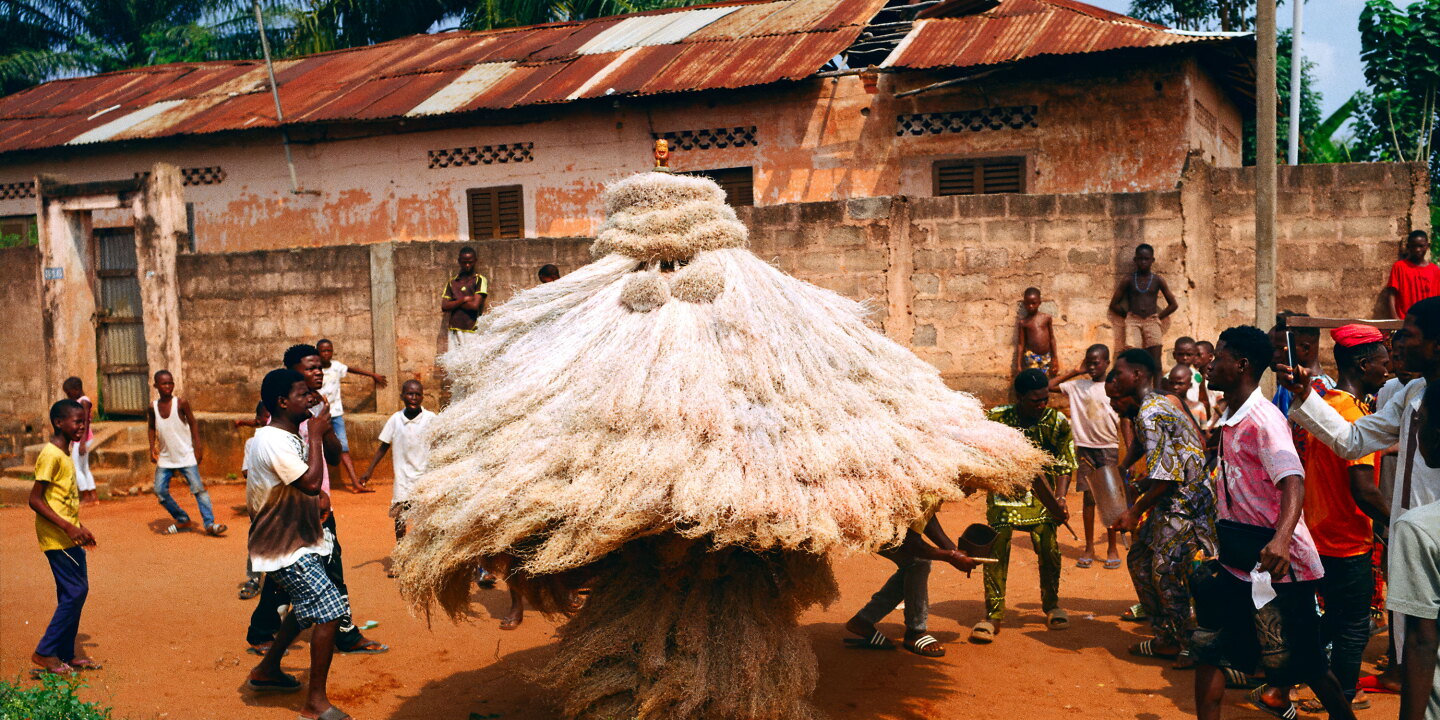
For three days in January, scenes unfurl across Benin’s port city of Ouidah: A goat is slaughtered to honor deities, and guardian spirits called zangbeto (people of the night) patrol in masquerade, their long garments of vibrantly dyed raffia kicking up clouds of dust with each spin. A procession commences, led by a high priest dressed in white, followed by a singing crowd. The group passes temples and a sacred forest before reaching the ocean, where offerings are made to the sea.
These are glimpses of Vodun Days, the world’s largest public celebration of Vodun—an ancient religion of spirit worship that originated in Benin thousands of years ago. An estimated 741,000 participants gathered this year to attend music and dance performances, sports competitions, and ceremonies in Ouidah, the festival’s epicenter, as well as in villages across the country. Led by both his professional and personal curiosity, photographer Brad Ogbonna has traveled to Benin twice since 2025 to capture Vodun traditions.

Ogbonna first came across Vodun in New York City 15 years ago, when he befriended a Nigerian shopkeeper who introduced him to the practice. Ogbonna was intrigued. “I’m Nigerian American and grew up Christian, so I wasn’t exposed to Indigenous religions,” he says. “I saw a new side of my culture. I wanted to learn more.”
The word vodun means “spirit” or “deity” in Fon, one of the primary languages spoken in Benin. To the Aja, Ewe, and Fon peoples of Benin, Togo, Ghana, and Nigeria, Vodun is more than a religion—it’s a way of life. Also known as Vodu, the West African traditional belief system is a parent to many other syncretic faiths that merge religious doctrines, such as Louisiana Voodoo, Afro-Brazilian Candomblé, and Haitian Vodou. Ogbonna has explored these connections within the African diaspora for more than a decade, throughout his frequent travels to Senegal, Nigeria, Côte d’Ivoire, and eventually Benin, which he visited for the first time in 2015.
It wasn’t until 2025 that he began documenting Vodun festivities. “I found myself in villages outside of Ouidah, and that’s where I got to see what felt more authentic,” he says. In the fishing town of Grand Popo, in the capital Porto-Novo, or in the city of Cotonou, people let him take photographs, answered his questions, and invited him to celebrate with them.
On each visit, Ogbonna finds himself among other Black travelers from all over the world. “I think it’s interesting to see the way religion—the way culture—is practiced and still held on to, and what gets passed down,” he says. “People from the diaspora who come to the festival want to dig deeper . . . to know their history. It is a surreal experience, to be around so many other Black people, all in Benin for the same reason.”

Zangbeto (left) are “people of the night,” considered Vodun’s faceless spiritual vessels or manifestations who protect communities from crime and uphold moral order. Members’ identities are known only to the initiated. Grand Popo (right) is one of several villages Ogbonna visited to observe Vodun practices.
Photos by Brad Ogbonna

Porto-Novo’s tropical lagoon provides a vital ecosystem for the capital city’s communities. The municipality recently completed an 11-year redevelopment program to support the local economy and infrastructure along its shores.
Photo by Brad Ogbonna

Festival vendors, such as the papaya seller Ogbonna met in Cotonou (left), offer items to worshipers and spectators gathered along the procession route. Egungun spirits (right) don bright cloaks made of textiles such as cotton, velvet, brocade, and damask. An onlooker can determine a family’s wealth based on the richness of the material and the exquisiteness of the embroidery.
Photos by Brad Ogbonna

Vodun traditions are particularly electric in Grand Popo, where locals fill the streets to dance and honor deities. Situated between the Atlantic Ocean and the Mono River that forms much of the Togolese border, the fishing community stretches along nine miles of beaches.
Photo by Brad Ogbonna

In 1996, the government of Benin enshrined Vodun as a state religion, designating the second Friday in January as a national holiday, which also marks the culmination of the annual festival. Celebrations include communing with egungun (right), ancestor spirits who impart advice.
Photos by Brad Ogbonna

The procession in Grand Popo typically makes its way to the Atlantic seafront (left), where Vodun priests host important ceremonies. At Ouidah’s Temple of Pythons (right), believers revere the namesake snakes, which embody Dangbé—a venerated serpent deity representing protection and wisdom.
Photos by Brad Ogbonna
The Afar Guide to Benin
At 43,483 square miles—about the size of Ohio—Benin is the birthplace of Vodun and home to multiple sites that illuminate the country’s spiritual and cultural legacies.
When to Go
Travelers should aim for a trip in January during the dry season (November to February), when weather is cooler and one of the country’s most anticipated events takes place: Vodun Days, a spirit worship celebration centered in
the port city of Ouidah. In 2027, programming will be extended to eight days, from January 2 to 9.
English is spoken in touristed areas, but French is Benin’s official language. Book a trip with a local travel company such as Wademba Travel. Guests enjoy chef-prepared meals, oceanfront lodging, and the knowledge of expert guides who interpret oral history and cultural context during the eight-day itinerary. “All of this translates into a richer, deeper, and more meaningful experience for the visitor,” says Wademba founder Neil Olympio.
What to See and Do
Benin was one of the most significant sites of the transatlantic slave trade. Several experiences in Ouidah explore this past from the Beninese perspective. In the city center, the Slave Route is a 2.4-mile commemorative path that begins at Place Chacha, a former auction square. The trail is marked with 23 sculptures and concludes on the beach, at the Door of No Return—an arch memorializing the departure point for more than 1 million enslaved people forcibly sent to the Americas.
The International Museum of Memory and Slavery is scheduled to open in 2027 within the Portuguese Fort São João Baptista de Ajudá. The space is expected to include a reconstructed slave ship and will delve into Benin’s history with exhibits on the Kingdom of Dahomey (a former regional power), the global influence of Vodun, and the African diaspora communities shaped by the Middle Passage.
Where to Stay
Native Hotels Ouidah comprises three villas in the historic heart of the city. The buildings retain their original Afro-Brazilian colonial architectural style, with details such as terra-cotta tiled roofs and louvered shutters. Meanwhile, the 37 rooms and suites are sleek, modern, and spacious. A spa, two swimming pools, the O’Manguier restaurant, and complimentary tuk-tuk service are among the amenities.
La Maison de Canelya is in Cotonou’s seaside neighborhood of Fidjrossè. The six-room, women-owned boutique hotel highlights decorative works made across the continent, including Baoulé and batik textiles as well as furniture locally crafted from recycled materials.
The five-star Sofitel Cotonou Marina Hotel & Spa, designed by the renowned architecture firm Sundukovy Sisters, blends the brand’s French aesthetic with Beninese contemporary works of art. Each of the 198 rooms and suites features a private balcony and city or sea views. Among the four dining options is bistro L’Ami, overseen by Benin-born chef Georgiana Viou, whose restaurant Rouge, in the French city of Nîmes, earned a Michelin star.


