
My husband and I once contemplated adopting a child from Kazakhstan. International adoption from this Central Asian nation spiked during the chaotic first decades after the collapse of the Soviet Union, and we were intrigued by the possibility of a child who would bridge our Asian and European heritages. Before delving any further into the logistics or ethics, though, I became unexpectedly pregnant.
I didn’t think about the country again for years, not until an acquaintance posted photos of cobalt-tiled mosques from a trip to the region. They seemed like the color of awe: the precise shade of night sky that evokes cosmic insignificance. Scrolling through the images, I suddenly recalled the place that had briefly offered me hope. I still knew next to nothing about Kazakhstan—I was even a little vague as to where it was—but that only further piqued my curiosity.
My ignorance was understandable. Until its 1991 independence, Kazakhstan had been isolated for more than 150 years from the West, first by Tsarist Russia, then, ultimately, Soviet rule, its people enduring staggering levels of brutality: mass starvation, environmental devastation, and the erasure of their traditional nomadic way of life. But a little digging made it clear that the country was so much more than its tragedies. Tourism, especially in recent years, has exploded; thanks in part to increased air access, eased entry requirements, and better infrastructure, international visitor numbers have risen from 4.7 million in 2022 to 15.7 million in 2025. The majority of them, though, are still from the surrounding regions—fewer than 50,000 Americans made the trip in 2024.

Almaty, home to 2.3 million people, is Kazakhstan’s largest city; one-third of the country’s population lives in rural villages like Basshi.
Photos by Nathalie Mohadjer
I suspect, like me, most are clueless about Kazakhstan, only knowing what they learned—falsely—from the 2006 mockumentary Borat. For the record, the place is enormous, the size of Western Europe (though with a tenth of the population). Russia is to its north, China to the east, the Caspian Sea to the west, and the rest of the “Stans” to the south. Now the strongest economy in Central Asia, it was once a hub on the ancient Silk Road, attracting a confluence of cultures (Turkic, Chinese, and Persian among them) and the ideas, histories, and fabulous food options they brought. It also lays claim to being the birthplace of both apples and tulips—take that, Netherlands!—and is astoundingly ecologically diverse, with more than a dozen national parks that are a hiker’s dream. I wanted to experience it all: the ancient and the modern, the dark and the light, the cities and the wild nature, the scope of the nation’s history and the depth of its resilience.

I landed in Almaty, Kazakhstan’s largest city and former capital, at 3:30 on an early May morning, disoriented after a 20-hour trip from California. London-based tour outfitter Wild Frontiers, a specialist in Central Asian travel, had helped me craft a 12-night itinerary focusing on the southeast—an area about the size of my home state that offered the most breadth with the least time spent in transit, though I would still log plenty of miles on the road.
After a few hours of sleep and a ton of caffeine, I headed to the hotel lobby to meet my guide, Marat Malikov (ethnic Kazakhs typically have Russified last names, imposed during earlier eras). I don’t know what I expected as we stepped out into Almaty’s historic center, but what I found were leafy streets and well-manicured parks, the snowy peaks of the Tian Shan mountains gleaming in the distance. The vibe was cosmopolitan—a new contemporary art museum, charming cafés, restaurants filled with stylish diners—punctuated with the architectural legacy of Tsarist and Soviet Russia. The onion-domed, brightly painted Ascension Cathedral, the tallest wooden Russian Orthodox church in the world, anchors the district, standing in the heart of the central Panfilov Park.

Typical foods of Kazakhstan include a variety of fermented dairy products, on display at Almaty’s Green Bazaar, and meat dishes such as shashlik—which chef Ruslan Zakirov of the acclaimed Almaty restaurant Auyl interprets with a contemporary eye.
Photos by Nathalie Mohadjer
Strolling a few minutes toward the mountains, we passed the lavish 1930s-era opera house and, on the same street, the space-age Hotel Almaty, its facade sporting a 1965 mosaic-tile mural that applies Soviet techniques to Enlik-Kebek, a Romeo and Juliet-esque folk tale. Another 10 minutes took us to the Arasan Baths, a looming concrete structure built in the 1980s with hammam-inspired details. Out front, elderly women sold veniki—bundles of leafy branches, which promise all manner of health benefits, that you smack your naked self with in the sauna-like banya. I’d return later for a shvitz and a massage, the perfect remedy for jet lag.
We continued on to the Green Bazaar, a covered public market built in 1975 on the site of a former caravan stop and currently undergoing an upgrade. Along one wall, Koryo-saram (ethnic Korean) women sold glistening pre-made salads. These vendors are among the descendants of the ethnic group forcibly deported from the Russian Far East, in 1937, by Soviet leader Joseph Stalin, a collective punishment under the pretext of feared disloyalty—part of a political purge now known as the Great Terror. Down another aisle, I nibbled qurt, hardened balls of salty, sour fermented cheese once carried by nomads on the country’s vast steppe; they puckered my mouth yet were as addictive as potato chips. Then, a Tajik vendor dropped a few freshly shelled walnuts into my palm. They tasted ambrosial, as if they’d been dipped in chocolate.

At Auyl, diners can opt for traditional floor seating.
Photo by Nathalie Mohadjer
Kazakhs joke that they are the world’s second-largest consumers of meat. The first—rim shot!—are wolves. Over the past few years, though, Almaty has also become a gastronomic destination. Malikov and I stopped in for lunch at Auyl, a pioneer of a burgeoning “neo-nomad” trend, which the Prix Versailles architecture awards named one of the world’s most beautiful restaurants in 2024. Once a site for entertaining Soviet dignitaries, its redesigned, yurt-inspired interior immerses diners in a nomadic past: rough-hewn earthen walls, lush textiles, hammered copper, hand-carved wood, a grouping of traditional musical instruments. Over the speakers, a custom-designed soundscape thrummed, blending hypnotic techno beats with Turkic throat singing. Across from the live fire and cauldrons of the open kitchen, a wall of windows offered a panoramic view of the mountains.
I started with horse tartare: mild, bright, and a little sweet. Horses were integral to nomadic life, incorporated into rituals and folklore. Kazakhs may well have been the first to ride them. Horses were also a sustainable source of milk and meat on the steppe. I had more trouble with the concentrated mare’s broth—a squeamishness that felt hypocritical, since I happily snarfed a plate of beef bone marrow. The broth came alongside Auyl’s take on beshbarmak, Kazakhstan’s national dish: a mix of smoky kazy (horse sausage) and a variety of other meats served over house-made noodles, all topped with a rich, oniony sauce.
The next day, I sipped kumis—sour-salty, mildly alcoholic fermented mare’s milk—at the dedicated tasting bar at Yurta, another sumptuously designed neo-nomad spot. (Yurta even sells kumis ice cream, definitely an acquired taste.) The restaurant made the best plov of my trip, too: a Central Asian staple, similar to pilaf, of rice, beef, carrots, and other tidbits—though saying so is a bit like claiming I’ve had the best pizza in New York. Regardless, Almaty was quickly ticking all the boxes of a new favorite destination.

Completed in 1907, Almaty’s Ascension Cathedral was built from Tian Shan spruce. The golden eagle, long used for hunting, appears on the national flag of Kazakhstan.
Photos by Nathalie Mohadjer
Kazakhstan summers can hit triple digits; winters plunge below zero. In spring or fall, though, one can explore its more pleasant extremes. From balmy Almaty, Malikov and I drove about 40 minutes up slopes dotted with blossoming wild apple trees and sleek, grazing horses to the base of Shymbulak Mountain Resort. Three gondola rides later, we reached the thin, scenic air of 10,500 feet. I wandered onto the snowpack to watch a raptor glide silently across the sky.
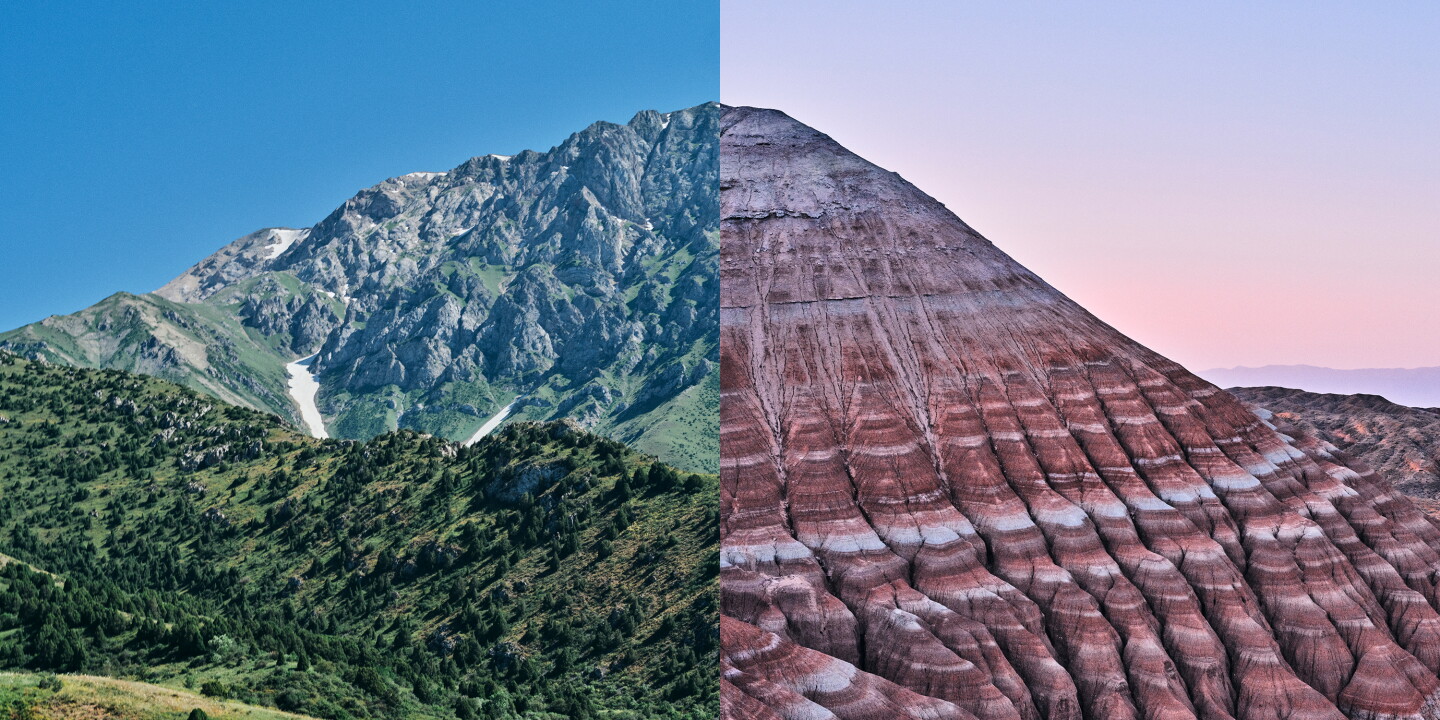
The next afternoon, we drove three hours east to hike in the desert heat of Charyn Canyon, one of the country’s top tourist draws. Roughly 96 miles long and nearly 1,000 feet deep at points, it’s been nicknamed “the Grand Canyon’s little brother” by locals. Its soaring sandstone towers, striated crimson, orange, pink, and tan, are majestic, carved over 12 million years by the Charyn River. We walked about two miles through the spires of the “Valley of Castles” trail out to the river, which didn’t look so powerful now, wading in to cool off before heading back. I made a “next time” vow to visit during sunset, when the dazzling colors of the canyon deepen and glow.
Just before dinner, we pulled into a modest guesthouse in Basshi, an agricultural village of tin-roofed homes, the occasional yurt, and a mosque. Basshi is also the gateway to Altyn-Emel National Park, a reserve about the size of Delaware. We rose early to drive into its Mars-red landscape, occasionally spotting a camel or gazelle. At a parched canyon trail, we set out on a much more solitary hike through rust- and ochre-hued sandstone, scooching sideways past narrow passages and scrambling over fallen boulders that blocked our way. Malikov pointed to fist-size pieces of quartz scattered across the cracked clay ground, and traced the white veins of it threading through the young canyon’s walls.

Conventional agriculture, rare in pre-20th century Kazakhstan, surged under Soviet premier Nikita Khrushchev, who converted vast amounts of steppe into farmland. Back in the city, the angular Almaty Museum of Arts opened in fall 2025.
Photos by Nathalie Mohadjer
I ran my hand over muddy-red bits of raw carnelian also embedded in the rocks. I thought back to Almaty, where I’d stumbled across Aimaq, a private museum and jewelry store. A consultant named Leyla, who happened to have a degree in journalism, led me through displays of 19th- and early 20th-century baubles. There were rings to indicate a girl had started menstruating, to promote fertility, to announce a fresh start after divorce. A pendant designed to hang in reverse protected its wearer against those who talked behind her back. There were ornate shashbau—ornaments for braids—and the medallion-trimmed chains that adorn wedding headdresses. A small case in the front held a few antique items for sale as well as contemporary reinterpretations by the store’s owner.
Each piece telegraphed part of a woman’s identity: her age, her lineage, her social status, her spirituality. “This jewelry is not just about jewelry,” Leyla explained. “It’s about history. It’s about culture.” For thousands of years Kazakh women had bedecked themselves in such intricate silver and semiprecious stones, some gathered in riverbeds like the one I now stood in.
Sometimes you have to do the hard thing. In the mid-afternoon, on the way back to Almaty, we stopped at the Singing Dune, an arcing mountain of fine sand that is another popular site. When the wind is right, as it was for a moment that day, the dune emits a hum likened to that of an airplane engine. Today’s scientists attribute the sound to a singular combination of wind vibrations and rubbing grains of sand. Blah blah blah. Give me the older, more romantic interpretations. Genghis Khan and his invading Mongol army might be buried here, and the sound is their spirits bragging about their exploits. Or maybe it’s the groaning of an evil demon who, exhausted, lay down here to sleep. The 500-foot ascent sounded easy enough, but by then it was an unseasonable 90 degrees. No shade. Every fiber of my being said no, except one: that tiny filament reminding me I would likely pass this way but once. I crested sweaty and grinning, taking in the miles of sand and white chalk mountains against an achingly blue sky.

Shymbulak, just outside Almaty, is Central Asia’s largest ski resort and has some of the best views of the city year-round. Despite the decline of nomadism, horses are still important to Kazakh culture and lifestyle; the country’s horse population is among the world’s highest.
Photos by Nathalie Mohadjer
The next morning, after an overnight train ride south from Almaty to the city of Taraz, the weather had swung again—cool and wet, the clouds low. I was supposed to go from there by 4x4 into Aksu-Zhabagly, Central Asia’s oldest nature reserve, for a hike through a forested canyon, but rain had made the trail treacherous. Instead, Wild Frontiers organized a last-minute horseback tour, for a taste of how people once traveled these dramatic landscapes. I loped into the park with my new guides, Yerzhan Orynbassarov and Daniyar Rashitov: the first an encyclopedia of Kazakh culture and history, the second a nature expert. We rode through tendrils of fog, the horses’ hooves sliding a bit in the mud, past the last of the tulips that blanket this region each spring. At the lip of the canyon, Rashitov described what I would have been able to see without the cloud cover—the rushing river, thick trees, the mountains beyond. Sounded lovely.
I turned my horse to go just as Orynbassarov joined us. He dismounted and strode to the cliff’s edge. When I glanced over my shoulder, the view, as if he’d cued it, had suddenly and spectacularly cleared, and a pair of golden eagles, a symbol of Kazakhstan, were banking overhead. Ten minutes later, the curtain dropped and it began to pour. Still, if this was the consolation prize for my rained-out hike, call me blissfully consoled.

Though arid, Charyn Canyon National Park sustains a rare grove of Sogdian ash trees—a species that survived the Ice Age.
Photo by Nathalie Mohadjer
I’d hoped to see the mystical blues of the mosques that had inspired my trip—Kazakhs are majority Muslim, though typically not devout—but nomads weren’t big on religious monuments, and the Soviets, who enforced atheism, knocked down most that did exist. One of the few religious sites they spared was the 14th-century Mausoleum of Khoja Ahmed Yasawi, a Sufi mystic and poet, in the city of Turkistan, about three hours from Aksu-Zhabagly. Orynbassarov said the site was too enormous, too important, and too sacred to destroy; the U.S.S.R. classified it as an anti-religious architectural museum instead. The shimmering turquoise of its domes, the multihued spectrum of the glazed tiles were all my blue dreams incarnate. Even the unfinished pishtaq—the great entrance, whose construction was abandoned when the ruler who’d commissioned the complex died—fascinated, its protruding beams a glimpse into ancient construction methods.
I was even more taken, unexpectedly so, by the earth-toned ruins of Sauran, a Silk Road city about 45 minutes northwest of Turkistan that dates back to at least the 10th century. Sauran was a major trading center and producer of ceramics; piles of broken clay vessels still littered the ground, along with shards of colorfully glazed pottery (some of it cobalt!) and animal bones. Little steppe tortoises burrowed everywhere. Rashitov scooped up a sheep’s knuckle—from when? I wondered—to demonstrate a game that seemed similar to marbles. I liked knowing that, across the centuries, kids have always loved to play.

Where caravans once stopped for supplies in Silk Road cities such as Sauran, souvenir stands now flourish.
Photos by Nathalie Mohadjer
I spent my last morning at the small but devastating Museum of Victims of Political Repression in Shymkent, Kazakhstan’s third largest city. Starting in 1929, Stalin’s regime forced ethnic Kazakhs into ill-fated, ill-equipped agricultural collectives, confiscating their livestock and sparking the Asharshylyk, a famine that would kill at least 1 in 3 of them in just three years. Hundreds of thousands more died during World War II or were murdered during the Great Terror. The museum’s walls held rows of photographs of some of the latter: political prisoners, artists, intellectuals, community leaders, children.
Today, there are over 14.6 million ethnic Kazakhs in the country—by 1999 they were once again the majority—but Orynbassarov said there should be closer to 40 million. For a final, more uplifting reminder of how vital, how resilient Kazakh culture was and is, we headed to Shymkent’s central bazaar, where a woman selling tea and spices chatted with Orynbassarov in Kazakh, affirmed by the 1993 constitution as the nation’s official language, while I snagged another handful of qurt.

The world’s largest landlocked country by area, Kazakhstan is notably biodiverse; the Mausoleum of Khoja Ahmed Yasawi, in the city of Turkistan, was the nation’s first UNESCO World Heritage site.
Photos by Nathalie Mohadjer
After a quick flight back to Almaty to begin my journey home, I had time for one last wander through the city’s center. The cathedral in Panfilov Park was lit up for evening like a fairy tale; teenagers hung out, laughing and flirting; parents bought their children ice cream or treated them to rides on blinking, battery-powered toy cars. I sat on a bench watching it all, feeling grateful for the quirks of fate that had brought me here. I may have arrived in Kazakhstan with no expectations (and a few misperceptions), but what I’d found was a wondrous reminder: There is always somewhere new and unexpected to explore and learn from, something richer to experience, to connect with—a place for which you have no image, and that no picture or post will ever truly capture.


