
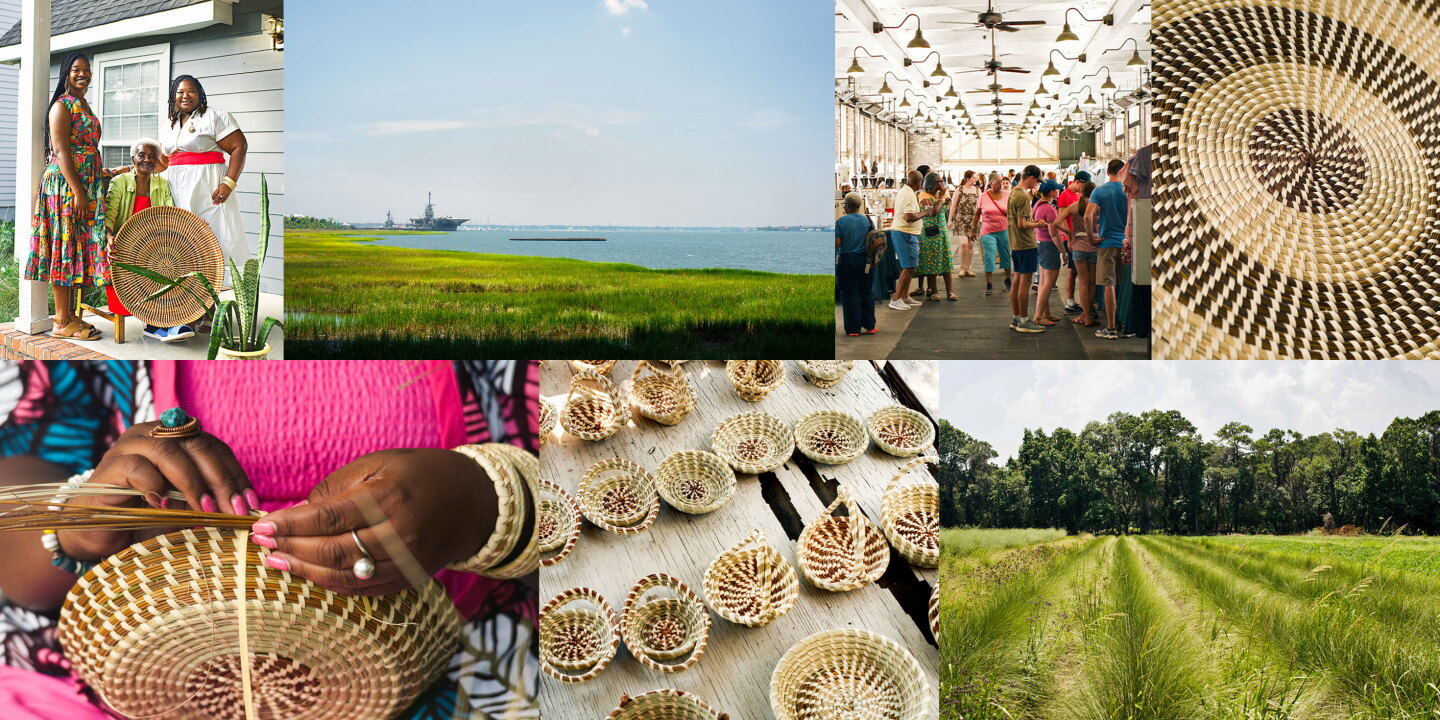
It is very early morning—“dey clean,” as the local Gullah Geechee people call it—when artist Andrea Cayetano-Jefferson sets off on foot into the coastal forest near Mount Pleasant, just outside Charleston, South Carolina. As she walks, the navy sky gives way to the cool cobalt of daybreak. Cayetano-Jefferson is here to gather sweetgrass, a type of marsh grass native to the Lowcountry, which she uses to shape the intricate baskets her family has created for hundreds of years. The collecting process is delicate and deliberate: She removes the stalks strand by strand, aerating the roots so that the sweetgrass can regrow. “I’ve been pulling grass since I was six years old,” she says.
After harvesting, Cayetano-Jefferson dries, cleans, and cures the grass before coiling it into the baskets the region is known for. Most sweetgrass baskets begin with a knot of longleaf pine needles or palmetto leaves. From there, artists use it as an anchor for binding bundles of sweetgrass, which coil to form a circular base. They create patterns through a kind of stitchwork, using traditional nailbones (a tool made from bone or a flattened spoon handle) to thread palm fronds through the sweetgrass, “sewing” the baskets together. (This is why many artisans say they are “sewing baskets.”) Now 40 years into the craft, Cayetano-Jefferson has had her work documented in the international Homo Faber database for master crafters.

Andrea Cayetano-Jefferson pauses in the deeper marsh before continuing to harvest sweetgrass.
Photo by Donaven Doughty
If you’re going to spend that much money, use my basket. Pass me around your table every single day. Tell my story.

Left: Andrea harvests sweetgrass and palm in the marsh. Right: Freshly cut palm, gathered by Andrea.
Photos by Donaven Doughty
Cayetano-Jefferson is Gullah Geechee, a name used by the community of roughly 200,000 living descendants of formerly enslaved West and Central Africans brought to South Carolina for their specialized knowledge of rice cultivation and processing; their engineering skill and agricultural expertise helped make South Carolina one of the wealthiest colonies in the Americas. Often housed on coastal plantations, the ancestors of the Gullah Geechee were able to sustain many Indigenous African traditions—storytelling and weaving among them—while adapting to the swampy wetlands of the Lowcountry. Shallow, wide fanner baskets were commonly made from bulrush, another type of marsh grass, and played an essential role in winnowing rice. Laborers used the vessels to toss rice into the air so the windcould carry away the chaff, leaving the grain behind. Around emancipation, as rice production declined, many basket makers switched over to sweetgrass, and the more pliable material became a source for further creative expression.
But sweetgrass baskets aren’t just about style and beauty, Cayetano-Jefferson says. In 1929, a bridge from Charleston to Mount Pleasant was constructed, and visitors began to frequent the area. This was the era of Cayetano-Jefferson’s grandmother, who had a third-grade education, and the family, like many others in the community, began to sell their goods for income. Sweetgrass baskets have become so beloved—and so central to South Carolina’s story—that they were officially named the state craft in 2006.

Left: Andrea works on a sweetgrass basket on her porch, sharing stories with her daughter, Chelsea Jefferson. Right: Chelsea trims the excess sweetgrass from the basket.
Photos by Donaven Doughty
Even today, creating sweetgrass baskets is often a multigenerational practice. Harvesting materials, then transforming them into tactile art, takes many hands. Sometimes, family members will perfect a specialty. “Aunt Tina made baskets with lids. Martha made tall vases. Aunt Vermell made tall ones with those lids,” Cayetano-Jefferson says. She herself prefers making breadbaskets. “I’m practical,” she says. “If you’re going to spend that much money, use my basket. Pass me around your table every single day. Tell my story.”

Near the Mount Pleasant Visitor Center, Lynette Youson sits in the shade, wrapping sweetgrass around a frame as she chats with passersby. “My great-grandmother, Maggie Jefferson Williams, taught me this art when I was four,” she says. “When Mama and them used to sit under the tree to weave their baskets, I used to wait until they dropped little scraps on the ground and imitate what they were doing.”
Like Cayetano-Jefferson, Youson learned the craft as afamily tradition, with elders passing down designs, techniques, and styles to younger generations. “One day, Mama took time to teach me how to create a full basket from scratch,” Youson says. “And I’ve been doing it ever since.”

A view of the Arthur Ravenel Jr. Bridge from the Mount Pleasant Visitor Center.
Photo by Donaven Doughty
Youson is a fifth-generation weaver whose artwork has been acquired by the Smithsonian, and she now teaches the tradition to her grandchildren, the seventh generation. She also visits local schools to share the skills and stories behind the baskets with young people.
For many artists, sharing the history and techniques behind Gullah Geechee basketmaking and sweetgrass sewing through hands-on experiences is an important step in ensuring the art form persists. Youson, for her part, leads adult workshops through specialized art programs outside of South Carolina, including the Arrowmont School of Arts and Crafts in Gatlinburg, Tennessee, and the Textile Center in Minneapolis. And in the Lowcountry, instructors such as Gail Wright can be found leading short workshops around South Carolina, for anyone wanting to learn.
On a May morning in Hilton Head, 90 minutes north of Charleston, I sit for a class with Wright, who explains to participants the evolution of sweetgrass baskets. In strands on the table in front of me, the grass smells of vanilla and sun-warmed hay. I pick it up, and it feels light in my hands. I realize how many thousands of bundles of grass it must take to make the heavy, sturdy baskets I’m familiar with as a South Carolinian.

Left: A view across the marsh from the welcome center. Right: Martha Cayetano on her porch with the sweetgrass baskets she has made.
Photos by Donaven Doughty
Even as an expert artist skilled at teaching others, Wright says she is still learning. Her work has taken her across the Atlantic to participate in collaborative projects such as Hands to Heritage, in which sweetgrass basket weavers from South Carolina and Rwanda exchanged stories and techniques. Some of the baskets created through the collaboration are now permanently on view at Charleston International Airport.
While Wright tells our group about her time in Rwanda, the fronds slip through my fingers. I try to maneuver the nailbone between the coils in a feeble attempt to complete a stitch, but within minutes, more grass has landed on the floor than has been attached to my sweetgrass spiral.
After almost two hours, I have produced a coaster-size creation. My hands are sore, but I’m glad for this time and for a deeper understanding of all that goes into the finished product. As I leave the studio, I think of what Cayetano-Jefferson told me days earlier: “I am my ancestors’ wildest dreams. We are not history. We are living and thriving.”
Where to Find Handmade Sweetgrass Baskets in Charleston, South Carolina

Left: Monique Palmer learns her mother Janie Mae Palmer’s basket-weaving technique at Charleston City Market. Right: Janie demonstrates her technique.
Photo by Donaven Doughty
Some Charleston shops sell machine-made baskets for half the price of handmade ones. Authentic baskets are woven from sweetgrass (not raffia), have no hole in the center of the base, feel sturdy, and are often signed by the artist. Buy directly from weavers at the historic Charleston City Market, the Sweetgrass Festival in July, or the family-run roadside stands along U.S. 17, known as the Sweetgrass Basket Makers Highway.
Visit the Gullah Geechee Gallery inside Charleston’s International African American Museum, where some of the earliest known basket fragments, dating to the 1780s, are on display. The Gibbes Museum of Art, in the city’s French Quarter, also features sweetgrass sculptures in its Mary Jackson Gallery—named for the celebrated Lowcountry fiber artist.


