
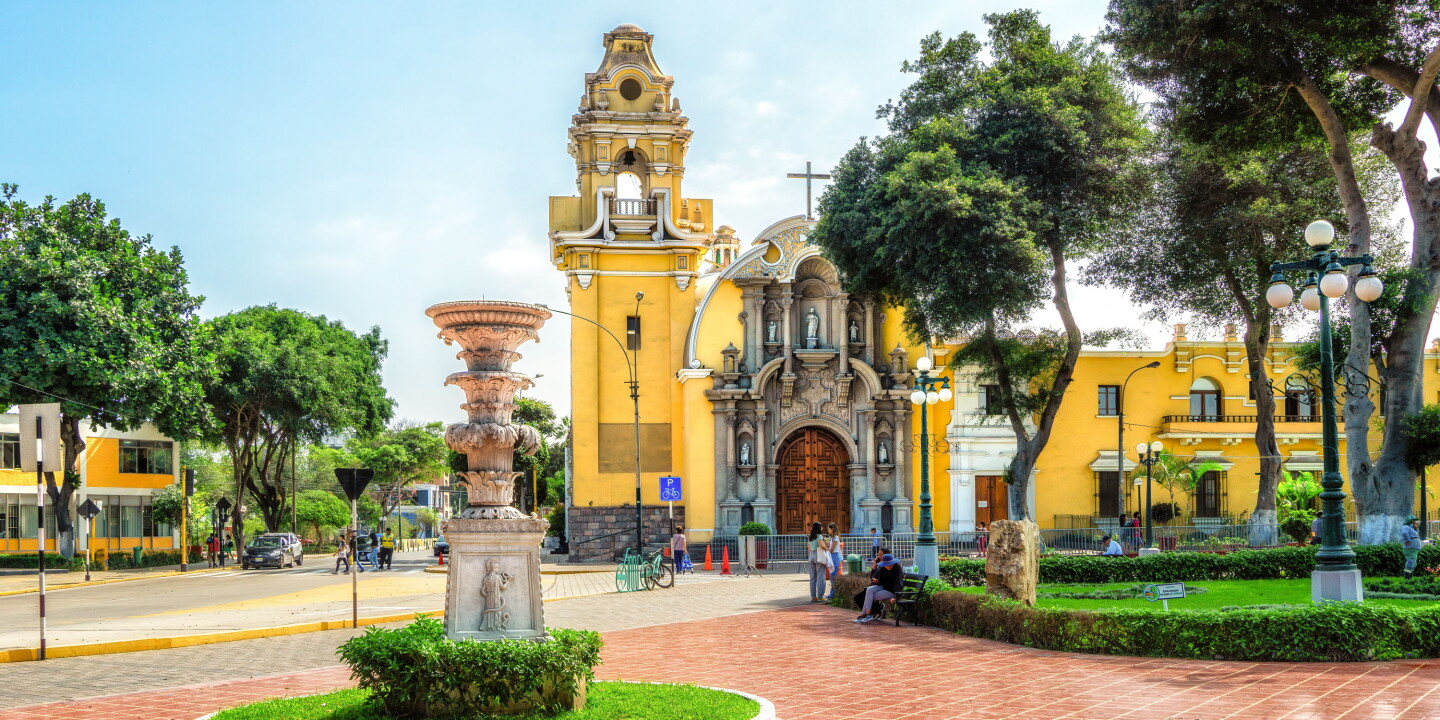
A seaside resort for the city’s wealthy in the late 19th century, Barranco today is considered one of Lima’s most creative (and walkable) neighborhoods. The area stretches from the cliffs above the Pacific to an atmospheric historic core, where the Puente de los Suspiros connects the streets around the main plaza.
Barranco’s old mansions, colorful facades, and leafy streets now house a diverse mix of contemporary galleries, coffee and chocolate shops, award-winning restaurants—Central, from star chef Virgilio Martínez, among them—and boutiques selling Peruvian handicrafts. Here’s what not to miss.
Barranco Municipal Park
Between Av. Almirante Miguel Grau and Av. Pedro de Osma
Inaugurated in 1898, the neighborhood park is still the place to see and be seen. Look for the heritage-listed coral-pink library, completed in 1922, on the southern edge, and Parroquia La Santísima Cruz to the north—legend has it that the historic yellow church stands on the site where Barranco, once a tiny fishing village, was founded.
Cordial

At Cordial, both vinyl tunes and natural wine are on the menu.
Photos by Alonso Mujica
Casual, charming Cordial serves natural wine in a dimly lit basement lined with shelves of bottles and vinyl records. DJs spin after sunset from Friday to Sunday, and events are announced on Instagram: @cordial_barranco.
Demo
Though Demo’s interior design is the stuff of minimalist dreams, dishes here are best enjoyed outside on the terrace. Food at this all-day café (from chef Juan Luis Martínez, who runs a fine-dining spot, Mérito, nearby) blends Peruvian and Venezuelan influences. We’re partial to the cold brew–topped orange juice and the arepa benedictina, a reimagined eggs Benedict.
Dédalo Arte y Artesanía

Dédalo stocks handmade pieces by artists and designers who use traditional techniques, such as colorful throw pillows from Mozhdeh Matin.
Photo by Sofía Lores/Dédalo Arte y Artesanía (L); Courtesy of Dédalo Arte y Artesanía (R)
Modern Peruvian wares are on display at Dédalo, an arts and crafts store inside an old colonial home. The rooms are filled with ceramics, jewelry, glassware, handmade silver pieces, toys, and textiles from more than 700 artisans, all selected by founder María Elena Fernández.
Ciclos Café and El Cacaotal

Amanda Jo Wildey, cofounder of Ciclos and El Cacaotal, trained as an anthropologist before entering the coffee and chocolate industry.
Photo by Ken Motohasi
Occupying a bi-level space, Ciclos and El Cacaotal are devoted to Peruvian specialty coffee and craft chocolate, respectively. Founders Amanda Jo Wildey and Felipe Aliaga offer English or Spanish tastings that highlight the important role of both ingredients in Peru. Email to book ahead.
Pedro de Osma Museum
Pedro de Osma Gildemeister was a 20th-century philanthropist and collector whose French-style mansion now displays art from Peru’s period of Spanish colonial rule. The museum collection includes everything from Jesuit religious paintings to llama figurines made by Inca metalsmiths.
Kjolle

At Kjolle, chef Pía León serves dishes like ceviche-style corvina (Peruvian sea bass) and clams in a sauce made with lulo, an Andean fruit.
Photos by Camina Novoa
Chef Pía León founded Kjolle in 2018 and was named Best Female Chef in Latin America by the World’s 50 Best guide that same year. Her restaurant showcases the cultural and biological diversity of Peru through a nine-course tasting menu. A standout dish, “Many Tubers,” features yuca, sachapapa, and ullucu—native root vegetables cultivated by Indigenous peoples in the Andes and Amazon for millennia.


