

Visitors to Italy tend to dream of lunch and dinner: the three-hour meal on the piazza, the ensuing sublime feeling of fullness known as abbiocco. Breakfast, on the other hand, often goes overlooked. However, on my recent trips to Italy, I’ve developed a new appreciation for the day’s first bites.
“I don’t think breakfast in Italy is the richest meal, but it is the most fundamental meal,” says Gianluca Colucci, who grew up around his grandfather’s pastry shop in Martina Franca, Puglia, and is now the executive pastry chef at Therasia Resort Sea & Spa on Vulcano, an island just north of mainland Sicily. According to Colucci, “Breakfast was born in the bars. The most beautiful thing is those five minutes at the counter where all these relationships are formed, where you have this interaction with colleagues, friends, people you see exclusively at that moment of the day.”
“In Italy, breakfast is truly an awakening of the senses,” says Angel Valdivia, head chef at Villa Lena, an agriturismo estate in Tuscany where guests begin the morning with a spread of cakes, cookies, and cantucci (the original Tuscan biscotti). “It is a small, daily indulgence that sets the pace, energy, and mood for the entire day.”
Why, then, is breakfast overlooked here? Valdivia chalks it up to the simplicity of the meal and “the fast pace of modern life,” but if you slow down and look, there’s so much happening. This is especially true when it comes to pastries, which, along with coffee, make up the backbone of the Italian breakfast and which vary greatly by region.
“The extraordinary thing about Italian pastry is that changing cities changes every single signature sweet,” Colucci says. “I go to Sicily and eat brioche; I go to Puglia and eat pasticciotto; I go to Rome for a maritozzo, Naples for a sfogliatella. There are a thousand different breakfasts wherever you go.”
Start your enjoyment with these six classic Italian breakfast pastries.
Maritozzo (Rome)
The Eternal City is famed for rich pasta and offal dishes, so the maritozzo is a surprisingly light treat. Its beauty lies in its simplicity: At the bancone (the counter), the barista slaps snowy whipped cream into a split brioche bun, sweeping a spatula to scrape away the excess. Bite in, and the spongy bun caves as cold cream spills onto your top lip. It’s a masterclass in air. You may see the occasional riff, like a version Colucci serves at Therasia Resort that replaces the whipped cream with tiramisu.
Crostata (across Italy)
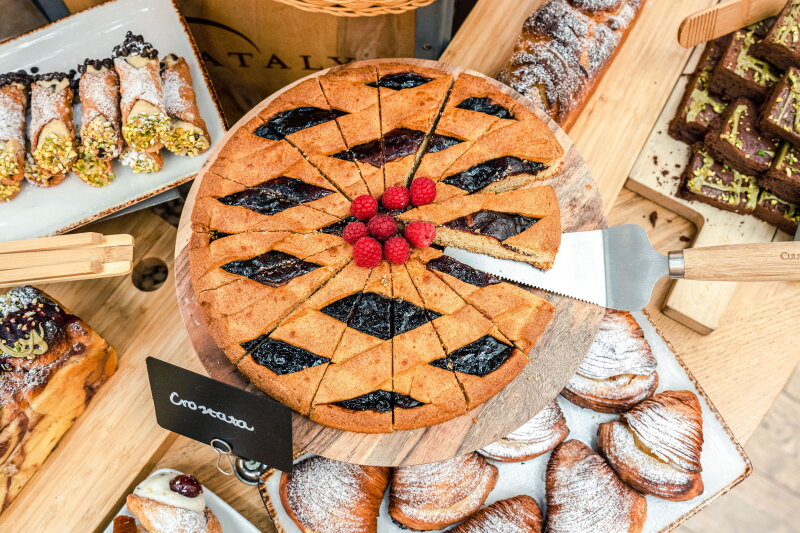
Cherry, apricot, and berry jams are common fillings for crostata.
Photo by Jacques Dillies/Unsplash
According to Valdivia, the crostata is “the mother of all Italian breakfasts.” A buttery shortcrust is filled with jam, jam and ricotta, or even Nutella, and then baked until its lattice top lightly browns. You see these rustic tarts under glass domes on kitchen counters across the country; spend enough time in Italy, and each slice tastes like home.
Iris (Sicily)
Dredged in breadcrumbs and fried like a chicken cutlet, this ball-shaped Sicilian doughnut offers three distinct tiers of texture with each bite. First, the savory coating shatters; next, the teeth sink into a dense, pillowy yeast dough; last comes the silky-smooth core of sweet, sheep’s-milk ricotta studded with chocolate chips (or, sometimes, chocolate pastry cream without the cheese). Using leftover bread to elevate pastry is Sicilian resourcefulness at its finest.
Sfogliatella (Naples)
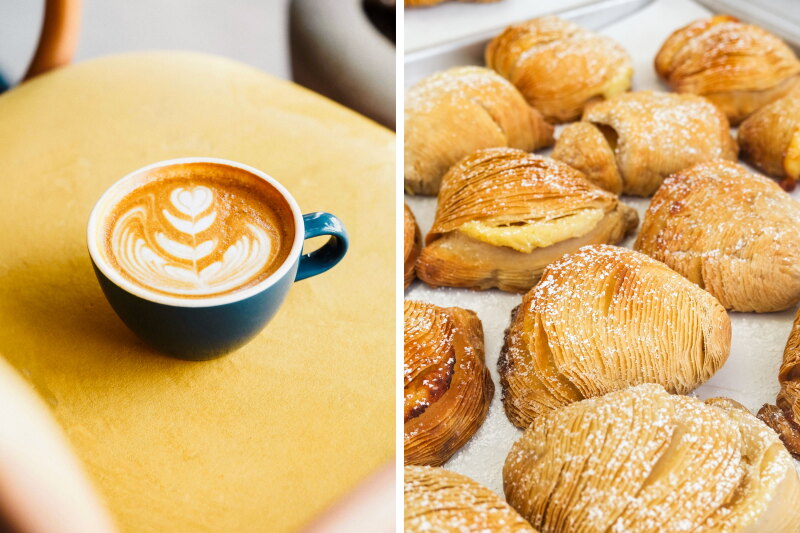
Legend has it that sfogliatella was invented in a monastery 400 years ago and inspired by the shape of a monk’s hood. The pastry still has a charitable tradition: When you order one, leave some extra money on the counter to pay for the next person’s coffee.
Photo by Jhunelle Francis Sardido/Unsplash (L); photo by Elena Katkova/Shutterstock (R)
The Neapolitan sfogliatella’s shell-like shape conceals a compact filling of ricotta, semolina, candied orange peel, and orange blossom water. Every morning brings a choice: Order riccia, and that filling will be bound in razor-thin, croissant-like ridges that shatter like dry leaves; order the more homespun frolla, and the shell will be soft, crumbly, and cookie-like. Either way, be sure to leave an extra euro behind to take part in the local tradition of caffè sospeso, paying a coffee forward for a stranger in need.
Pasticciotto (Puglia)
The thick, golden crust of the pasticciotto is made from a heavy shortcrust called pasta frolla (like the simpler version of sfogliatella), and the most common filling is an egg-rich pastry cream perfumed with lemon. Nibbling into that cool, creamy interior, you might find a single, syrupy cherry buried in the yellow. Whether enjoyed at an Autogrill (a rest stop chain on highways throughout the country) or under the fig trees of a masseria (the historic walled farmhouses of Puglia), this treat echoes its homeland region: a rustic exterior with pure charm underneath.
Brioche con Granita (Sicily)
This Sicilian morning ritual is Italian summer eating at its most electric. As the heat starts to muster, get a just-baked brioche and a glass of dense, slow-churned ice flavored with almond, pistachio, coffee, or fruit (with an optional topper of fresh cream). No utensils necessary—simply tear off chunks of the pillowy brioche and dunk them in the granita. Shaved ice for breakfast? Absolute glory.


