

In a dusty square in the village of El Llanito, I study a tortilla stamped with curious purple animals: an anteater with an oversized snout, a hound with a corkscrew tail, and a bird with a fox’s face. “Perhaps those animals existed at the time the great mothers started the tradition,” suggests Gloria Vazquez Sánchez.
Sánchez leads a group of 15 cooks from the Indigenous Otomí community who are working to preserve their ancestors’ culinary heritage through cooking demonstrations at fairs and festivals across the central Mexican state of Guanajuato. The mesquite-wood presses used to make the tortillas are passed down through the female line of Otomí families. The purple dye comes from the Mexican honeysuckle plant.
Although frequently overlooked by travelers in favor of Mexico City and Oaxaca, Guanajuato’s cuisine is known among Mexicans for preserving centuries-old cooking traditions, such as using a molcajete (mortar and pestle) made from volcanic stone. The region’s wild ingredients are put to use in dishes such as quelites (wild greens) cooked with garlic and pleasingly piquant sopa capón, which is a soup made with prickly pear and pork rind.
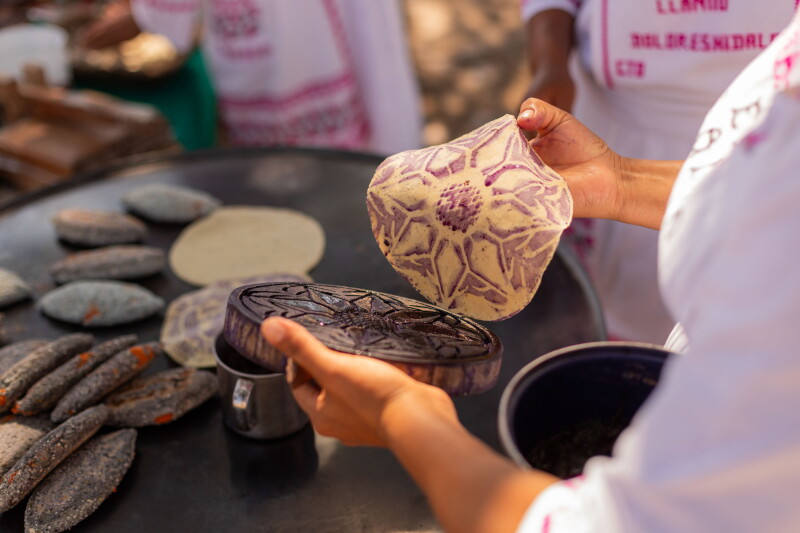
Muicle, or Mexican honeysuckle, can be boiled to create a dye which Otomí cooks use to stamp designs onto tortillas.
Photo by Leandro Bulzzano
The cuisine is a blend of Indigenous and Spanish influences, shaped in large part by the Otomí people, who predate Spanish settlement and continue to live in the region today, and the ancestral legacy of the Chichimeca, the various nomadic Indigenous groups who traveled the area in the pre-Hispanic era.
With disrupted weather patterns making farming less predictable and local industries, such as mining, in decline, many young people are leaving the state for work and opportunities in larger cities and abroad. Traditionally, mothers would teach daughters to grind nixtamal (dried maize steeped in limewater) on the metate millstone, or to dry chilies on the roof rather than in the kitchen for a more nuanced flavor. But this passage of generational knowledge has begun to dwindle.
“Guanajuato’s cuisine is still very much alive in private homes, almost like a family secret preserved by women, but it has historically been difficult for visitors to access,” says Dr. José Eduardo Vidaurri Aréchiga, the capital city’s official historian. “Now some of [these women] are doing a very important job by choosing to share those recipes with outsiders.”

The historic center of Guanajuato city was designated a UNESCO World Heritage site in 1988.
Photo by Gerardo Martin Fernandez Vallejo/Unsplash
Across the state, but particularly in the 16th-century municipalities of San Miguel de Allende and capital Guanajuato city, communities are now working to preserve this culinary heritage. Women are leading most of these efforts by recreating dishes traditionally cooked in small restaurants and at cookery demonstrations.
Back in El Llanito, Sánchez shows me how to fold my tortilla into a spoon sturdy enough to scoop up a velvety peanut mole.
“We are the proud descendants of the Indigenous people of Mexico and guardians of our living culture,” she says. “Our roots are preserved in our food and we don’t want to lose them.”
Here are four places across the state where visitors can experience their cooking firsthand.
Enchiladas Doña Lupe
- Location: Antigua Plaza de Gallos 28, 36000 Guanajuato | View on Google Maps
On a quiet backstreet in Guanajuato city, Doña Lupe stands over her stove, flipping chicken with fingers toughened by nearly 60 years of work. Her eponymous restaurant has just five tables and serves a single dish found only in Guanajuato: enchiladas mineras, tortillas dipped in guajillo chilies and stuffed with potatoes, carrots, chicken, and cheese. “In 58 years, I’ve never had a day’s holiday,” she says. “They’ll have to carry me out of here in a box.”
Restaurante Casa Mercedes

Luz María González oversees the kitchen at Restaurante Casa Mercedes, where her daughter Mayela Cárdenas serves family interpretations of traditional dishes.
Photos by Leandro Bulzzano
- Location: Calle, De Arriba 6, San Javier, 36020 Guanajuato | View on Google Maps
In the folk art–filled dining room at Restaurante Casa Mercedes, chef Mayela Cárdenas serves deconstructed versions of the traditional plates she learned from her mother, Luz Maria, who still oversees the kitchen. Local foods like xoconostle (sour cactus fruit) and amaranth grain are reimagined in bold dishes such as a sweet custard infused with the earthy beans of endemic mesquite trees. “Using these ingredients is a way of keeping our history alive,” Luz Maria says.
Rancho Xotolar
- Location: Xotolar, 37790 San Miguel de Allende | View on Google Maps
Located 18 miles southwest from San Miguel de Allende, Rancho Xotolar’s 400 acres have been passed down through four generations of the Morin Ruiz family and are now co-owned by nine siblings. Travelers can sign up for cooking classes or visit for horseback tours and hiking excursions through the ranch’s high plateau. All experiences include a meal cooked by co-owner Maria Luisa, served in an airy building with a wood-fired comal. Menus are based around whatever is harvested on the farm that day: gorditas stuffed with tender nopales (cactus), heritage black-corn tortillas, and smooth, saline pozole. “These recipes come from my grandmother and I love to share them,” Luisa says.
Vía Orgánica

Rosana Álvarez has also founded a weekly farmer’s market in San Miguel de Allende, providing opportunities for more than 200 local growers.
Photo by Leandro Bulzzano
- Location: 12 Arboles St., El Membrillo, 37886 San Miguel Allende | View on Google Maps
Rosana Álvarez’s Vía Orgánica is a regenerative ranch that provides vital employment for residents of Membrillo, an Indigenous village 25 minutes by car from San Miguel de Allende. The city seems very far away as you wander between towering agave plants on a tour or while feasting on bruschetta and pulque (alcohol made from fermented agave sap) at the farm-to-table restaurant. “You want to experience Mexico? The essence of our culture is in the land,” Álvarez says.
More female-led food experiences in greater Guanajuato
Cacomixtle’s walking tours
Susana Ojeda’s historical and gastronomic tour of her home city, Guanajuato, includes tastings of tlacoyos (stuffed masa patties) and atole (a hot, spiced drink), both made from nutty black corn, as well as visits to family bakeries tucked away in the city’s oldest districts.
Luna de Queso
Mariana Peraza first founded this specialist deli in San Miguel de Allende to sell cheeses made by her parents. She now stocks more than 100 varieties of queso, all sourced from small regional producers.
Related: 14 Essential Mexican Foods to Try on Your Next Trip


