
Zurich

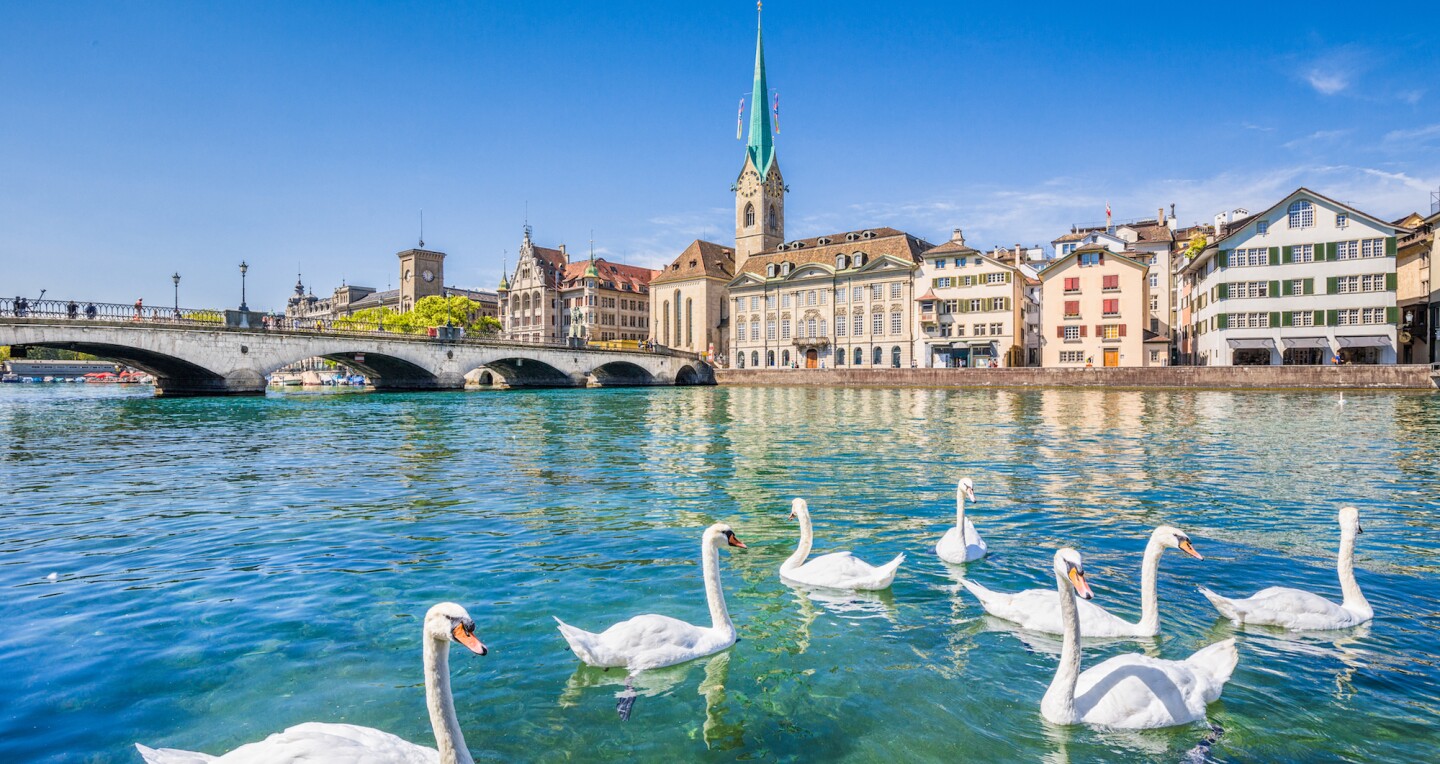
This international finance capital is blessed with one of the highest qualities of life in the world, making for an exceptionally safe and highly enjoyable visit. While the city is smaller than you might think, there’s plenty to keep you busy, whether you’re wandering the gilded cocoon of the Altstadt (Old Town), lined with glittery watch and jewelry boutiques, private banks, and storied chocolate houses, or taking in the dynamic, edgy scene that awaits in Zurich West with its art galleries, design boutiques, and trendy eating and drinking establishments. Capping it all is an unparalleled natural beauty, with the serene Limmat River cutting through the city’s heart before opening into vast, shimmering Lake Zurich.

zurich-switzerland.jpg
Overview

When’s the best time to go to Zurich?

The image of Switzerland might be of snow-capped mountains, but you’ll be hard-pressed to find much snow in Zurich. The country is full of microclimates, and Zurich’s is a moderate one. Winter is a glorious time to visit, thanks to temperatures that barely ever dip below freezing, Europe’s biggest indoor Christmas market, and Bahnhofstrasse shopping—even on Sundays throughout December. Spring weather can be cool and sunny, but it’s often wet, especially in the later months. (One consolation is the numerous pockets of gorgeous cherry blossoms that dot the city.) Surely the best season to visit is summer and early fall, when it’s warm enough to swim in the lake.

How to get around Zurich

The concrete, steel, and glass–clad Flughafen Zürich, also known as Zurich Kloten Airport, offers a microcosm of what to expect in the city you’re about to enter: Everything is pristine, with advertisements for watches everywhere. Zurich’s main train station, Hauptbahnhof, is just eight miles south, and a number of trains will take you there in as little as 12 minutes. The number 10 tram takes 35 minutes but might be more convenient if your destination is on the northern edges of town. Taxis are insanely expensive—about 50 Swiss francs or $55 to the heart of the city—and should be avoided unless you have lots of baggage.

It’s no exaggeration to say Zurich’s public transportation system is the most punctual and reliable in the world. Like practically everything else in this city, it doesn’t come cheap: a one-hour ticket costs 4.20 Swiss francs. But a day pass, at 8.60 Swiss francs, is a relative bargain considering it allows for travel on any of the city’s various modes of public transportation, be it train, bus, tram, funicular, cable car, or boat, during any given 24-hour period. The most popular, and efficient, is the city’s iconic blue tram. A fun alternative is to tour the city on two wheels with Züri rollt, the city’s popular—and free—bike-share program. Also, considering Zurich’s relatively small size and pedestrian-friendly Altstadt, it’s possible to reach many of the city’s most interesting sights entirely on foot.

Can’t miss things to do in Zurich

Even born-and-bred locals can’t get enough of strolling along the lake, with loyalties divided between the right and left bank. The former may seem the obvious stunner, with its gorgeous tree-lined promenade, but the latter certainly has its lures. Keep wandering south until you reach Saffa Island, perhaps the most charming spot on the lake, reachable by an arched pedestrian bridge, and offering a straight-shot view of the Alps.

Food and drink to try in Zurich

Swiss food is hearty—and deliciously indulgent. It is certainly possible to dine on fondue and bratwurst for all your meals here, but it would be wise to seek out some of the lesser-known traditional dishes, like raclette, rösti, and Zürcher Geschnetzeltes, the classic Zurich specialty of pan-fried veal with a creamy white-wine sauce. But the Zurich food scene is much more than just meat, cheese, and potatoes: there’s visionary fine dining, internationally inflected vegetarian, and fresh fish dishes prepared with Lake Zurich catch. There’s also a seemingly limitless choice of chocolate, whether your vice is richly dense cake, Champagne-filled truffles, or single-origin bars. Zurich is a beer-loving city—try a local TurbinenBraü brew—but while you’re here, make sure to sample some of the wines produced from grapes grown in and around the city, many of which you’ll be hard-pressed to find outside of Zurich, much less out of the country.

Culture in Zurich

Where there’s wealth, there’s art. This is a city brimming with cultural institutions. The venerable Kunsthaus, which holds Zurich’s most important collection of modern art, should be on every art lover’s itinerary, as should the lesser-known “Löwenbräu brewery-turned-arts complex, home to Kunsthalle Zürich and Migros Museum für Gegenwartskunst, two of the most important museums for contemporary art in the city. If you never step foot inside a museum, you can still get your fill of great art: Fraumünster church has stained-glass windows by Marc Chagall and Augusto Giacometti, several hotels have sizable art collections (the Widder even commissioned a Rauschenberg), and for high-rolling diners, Kronenhalle serves veal steak and wiener schnitzel amid pieces by Picasso, Matisse, and Mirò.

For a small city, Zurich has a packed celebratory calendar. With time-honored, tradition-bound festivals such as the Sechlauten in the spring, raucous blowouts like Street Parade in the summer, and numerous cultural events like the Zurich Film Festival in the fall, there is no shortage of events around which to plan your vacation.

Local travel tips for Zurich

The Swiss tend to be proud and reserved, but they can be exceedingly polite and helpful if encountered on their terms. Always greet shop owners and restaurant staff with “Greüzi” (hello) when entering, and “entschuldigen” (pardon) before asking a question or making a request. Use polite tram etiquette. On older trams, avoid the second car, which is reserved for strollers and wheelchairs, unless necessary. If you want to cross ahead of an idle tram, make eye contact with the driver and proceed only if he waves you through. The Swiss are very rule abiding: You’ll find them standing at a red light even if there’s no traffic in sight. Follow their lead.

Guide Editor

READ BEFORE YOU GO
Yes, you read that right. Locals in this Swiss financial hub may be buttoned-up during the day, but they know how to let their hair down after dark.
RESOURCES TO HELP PLAN YOUR TRIP
Built on the site of Roman and Celtic ruins, the unassuming 5-star Widder Hotel comprises nine medieval townhouses that were painstakingly renovated over a 10-year period by Swiss architect Tilla Theus. The results are jaw-dropping, from the unusual structures such as circular rooms and passages that refer architecturally to a Roman well uncovered during construction, to the mix of antiques and modern designer furnishings (Eames, Frank Lloyd Wright) in the rooms.

Alongside the 35 standard rooms, 14 suites also mix the old with the new, featuring works of art by the likes of Robert Rauschenberg and Andy Warhol, contemporary design classics by Le Corbusier and Mies van der Rohe, and original medieval frescoes, exposed-beam ceilings, and brick or stone walls. All rooms are equipped with a TV, Quadriga communication system, and two telephones.

Widder Hotel also features three great restaurants, a bar with more than 1,000 spirits, and a cozy garden restaurant and lounge open in the warmer months.
The tallest international 4-star business hotel in Zurich is also surprisingly appealing for non-business types. The 347 rooms are contemporary and elegant, stacked with modern conveniences like flat screen TVs, Wi-Fi, Nespresso coffee and tea makers, and, of course, large work desks for business travelers. Upper-level rooms come with panoramic views of Zurich and the Swiss Alps.

There’s an expansive spa area on the 32nd floor, which also has killer views, and restaurant Le Muh is a bright, refined space for breakfast, lunch, and dinner. Add a hairdresser, café, and shoe shop—all located in the lobby—plus a convention center that holds up to 800, and the result is a business and leisure superstar.
This esteemed, five-star hotel, set in its own park overlooking Lake Zurich and the Alps, has a remarkable history. Opened in 1844 by Johannes Baur, the property hosted the world premiere of Wagner’s Die Walküre (Wagner himself performed), and Alfred Nobel’s former secretary, Bertha von Suttner, came up with the idea for the Nobel Peace Prize in one of the hotel’s salons.

The 119 rooms are individually decorated with styles ranging from Art Deco to French Louis XVI and English regency, but all feature exclusive fabrics and furnishings from Europe, plus marble bathrooms with heated floors. The amenities are many, from valet parking and on-demand, chauffeured limousines to a round-the-clock concierge and even car-repair and flower-purchasing services.

There are two renowned restaurants on-site, along with an inviting bar and an idyllic garden.
The 25hours brand is known for its playful take on the hotel experience, and this Zurich establishment follows suit. With an interior concocted by local designer Alfredo Häberli, the space features the usual mix of colorful, offbeat furnishings, slick design, and casual friendliness, as well as the cute touch of Häberli’s personal city tips scrawled on various surfaces.

The rooms and suites are separated into categories of silver, gold, and platinum to reflect the city’s banking-capital status. That’s as corporate as it gets, however, since the interiors are decidedly funky, with bold colors, quirky carpets and artwork, and angular work desks. The hotel also offers a restaurant, living room and business lounge (with iMac workstation and free Wi-Fi), plus an in-house kiosk that stocks everything from necessities (shampoo and toothpaste) to accessories (Freitag bags).
There are 14 outposts of the famed chocolate shop in and around town, but the one to go to is its flagship, which occupies a prime corner perch on Paradeplatz. There are gorgeous displays of Sprungli’s signature sweet, the Luxemburgerli, Lilliputian takes on the macaron; its exquisite line of truffles; and its dense, rich, uniquely shaped Truffe cake—quite possibly the best chocolate cake ever. Don’t miss its gorgeous second-floor café.
This “boutique coffee house” offers various pastries, macarons and croissants with wide selection of teas and coffees. It is a romantic place for coffee!
Most of Zurich’s department stores have restaurants, but by far and away the most sprawling—and value-oriented—is this spot, atop Manor near Hauptbahnhof. The city’s unofficial canteen has a tantalizing salad bar (that’s priced not by the pound, but by the plate, which you can pile as high as you would like for about 12 Swiss francs or $13), grill (for burgers topped with herbed butter, steaks and local fish prepared as you wait), and sections for pastas, stir-fries, desserts, and fresh-squeezed juices.
“Dini Mueter” translates to “your mother,” so it’s no surprise this is the most inviting restaurant on bustling, seedy Langstrasse, with a chalkboard wall, and the kitchen windows that overlook the long wooden communal table and the green-and-white gingham curtains. There are two daily changing specials—often incorporating seasonal, organic ingredients—plus a terrific brunch menu with eggs Benedict and fluffy pancakes topped with vanilla yogurt. Photo © Katja Granzin.
The owners of this bi-level bar in the Prime Tower took great pains to create its visually stunning speakeasy-style décor: the impressive 80-year-old wooden bar and six tons of subway tiles were shipped from New York City. On a recent evening, patrons sipped whiskeys from Japan and ginger wines from Scotland to a soundtrack that ranged from Bob Dylan’s “Mississippi” to Fink’s “Blueberry Pancakes.”
After the hip and edgy kids of Zurich West cool off at the graffitied Flussbad Oberer Letten on the banks of the Limmat River, they head to this buzzing spot nearby for excellent burgers from the grill and an impressive range of local beers. Photo © Caroline Minjolle/Zürich Tourism.