
Cambodia

Cambodia is smaller than Oklahoma, with a landmass of less than 70,000 square miles, yet it contains some big lures for visitors. At Angkor, one of the world’s most significant archeological sites, 12th-century temples stretch for 150 miles. The Tonlé Sap, a lake within the Mekong River basin, represents one of the most varied freshwater ecosystems on the planet.

More than two million people a year visit Cambodia, heading to the central and northern regions, as well as to the heartlands for temple tours and river experiences. The charming coast also wows, from the colonial architecture of Kampot to the lively seafood markets in Kep, and the natural splendor of Ream National Park.

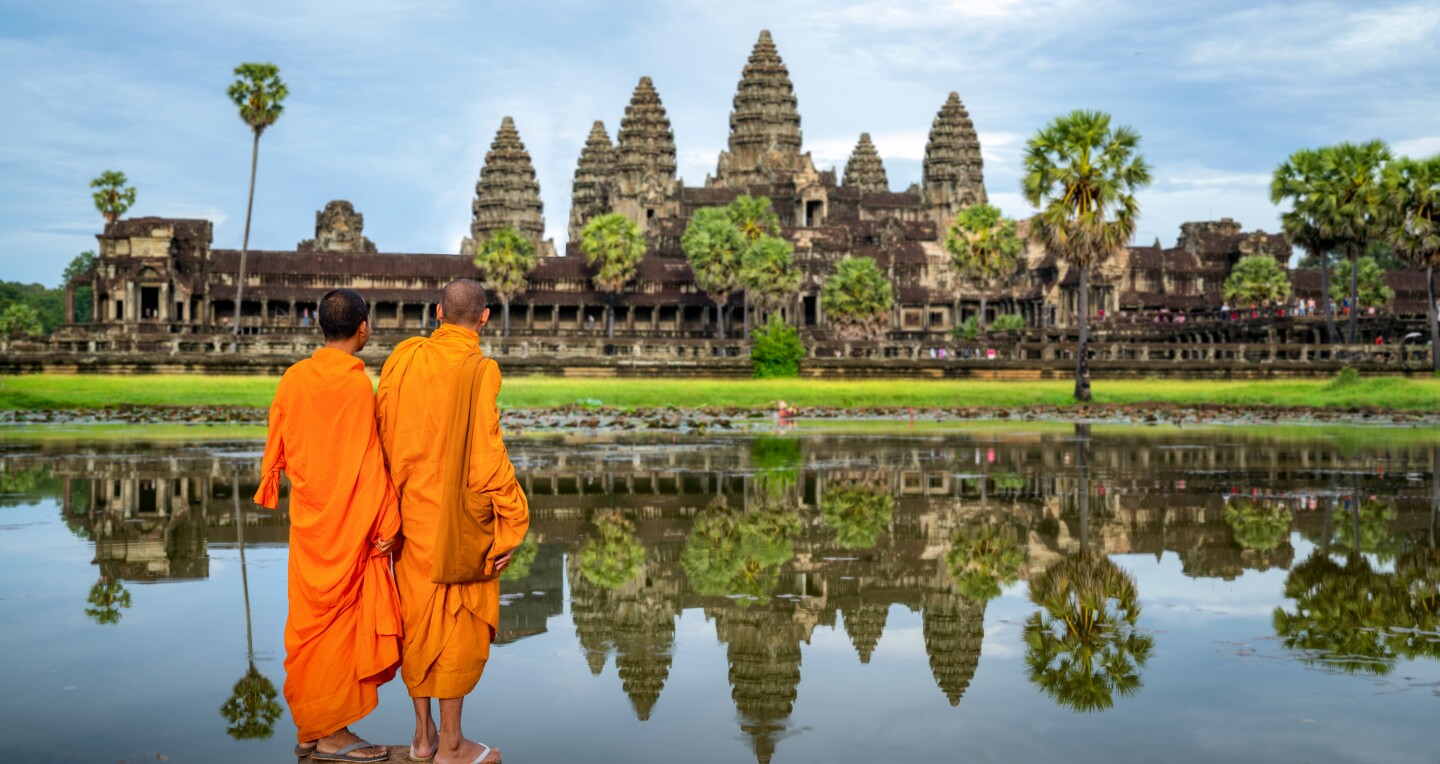
Asian monks stand and look to Angkor wat in siem reap, Cambodia, this image can use for travel and landmark in Asia

Phot By anek.soowannaphoom/Shutterstock

Overview

When’s the best time to go to Cambodia?

Cambodia has two seasons—wet (May to October) and dry (November to April)—and both hold charms abundant.

In November, temperatures at night dip to the low 70s, and while you won’t need a raincoat, you may want an umbrella to shield you from the sun and to put some distance between you and the seasonal crowds at Angkor Wat.

April usually means 100 degrees during the day, but that month’s New Year’s festivities are beautiful, with games and dancing and celebratory dishes like the kralan, a delicious roasted coconut rice cake. It’s easy to fall in love with the romance of the monsoon months, when jungles are at their most vibrant, wildlife is abundant, and crowds are blissfully absent.

How to get around Cambodia

A flexible itinerary and easy-going attitude are optimal, as the few existing highways only began seeing extensive asphalt in 2008.

Flights land daily at Phnom Penh International Airport from major Asian cities, via several carriers. Cambodia Angkor Air flies Phnom Penh to Siem Reap and down to the beaches of Sihanoukville for a few hundred dollars, but charter buses are the cheapest and most common option. Private car with drivers are also popular and can shave an hour off of bus time. A private car from the capital to the coast costs around $60 each way.

Cambodia’s Royal Railway––defunct for decades––is running again, and is a romantic-yet-thrifty option ($7+) for travel to Phnom Penh, Sihanoukville, Takeo, and Kampot. The restored cars offer air-conditioning and bathrooms.

In cities or villages or beach towns, tuk tuks can take you where you want to go. And in Battambang, ride the famous Norry trains, bamboo platforms that ramble along tracks to nowhere and back again, reaffirming that “it’s about the journey, not the destination.”

Can’t miss things to do in Cambodia

Millions of people tour Cambodia’s UNESCO-recognized temples, spending the night in lovely boutique hotels in neighboring Siem Reap. Battambang’s mesmerizing local circus gets press for good reason, and a plate of pepper crab in Kampot is an unforgettable indulgence. The sunsets over the emerald waters and white sand of Koh Rong Islands are Instagram gold, and Phnom Penh’s culinary scene is the latest talk of Southeast Asia.

Food and drink to try in Cambodia

Expect ingredients familiar from Thai food, like lemongrass, lime, coconut, soy, sugar, ginger, and vinegar, but without the intense spice. The most common pepper you’ll find is a peppercorn variety native to Kampot. Amok is the national dish: a slightly sweet coconut fish curry, with turmeric, lime, palm sugar, and fish sauce. Bai Sach Chrouk is breakfast—sliced pork over rice with pickled cucumbers—and never skip dessert. In this former French colony, skilled bakers are plentiful.

Culture in Cambodia

This was a powerful kingdom from the 4th to the 14th century, comprising vast sections of Thailand, Laos, and Vietnam. Cambodia has worked its influence on many Asian arts, from carving to dance, ceremonies to architecture. Family is extremely important to the fabric of life, and traditional marriage remains sacred. In rural areas, unmarried women and men avoid physical contact, as sex before marriage is strongly held social taboo. Children begin school around the age of seven and while the father figure in the family usually holds the authority, Cambodians show great respect to the matriarch as well. In the late 1970s and early ‘80s, the Khmer Rouge regime enslaved and murdered millions. A visit to the Killing Fields of Choeung Ek and the Tuol Sleng Genocide Museum in the capital is an important step to understanding the culture’s troubled past and fervent desire for a bright future. The Phnom Penh City Center project––a real estate venture bringing new housing, entertainment, retail, and restaurants––can provide a happy counterpoint in focus. The project is predicted to draw 200,000 people per day by 2025.

Events

One of the most popular annual events is November’s Water Festival, with colorful boat races and fireworks stretching over three days.

In summer, monsoons flood the Mekong River, temporarily forcing its waters back upstream into the lake of Tonlé Sap and bringing rich nutrients to the lake as well as thousands of fish. This is a bountiful time for eating, drinking, and celebrating.

Most events follow the Cambodian Lunar Calendar—the Chhankitek—but that’s not to say all are religious or agricultural. The Johnnie Walker Golf Tournament at the Phokeethra Country Club in Siem Reap is held in autumn. Marathons are popular, too, including the International Half Marathon in December and the Ultra Trail d’Angkor in January.

For Families

At the Battambang Phare Ponleu Selpak Circus, performers of all ages mix comedy and satire with breathtaking acts under a ‘big top’ tent. This city’s Norry trains are also popular families. Passengers whizz through the jungle on bamboo platforms propelled by small motors. (The rigs were originally used to transport agriculture between villages.) The Russian Market and weekend night market in Phnom Penh offer a million entertaining sights, sounds, and toys for sale, and the koi fish pond at the National Museum is a kid favorite.

Local travel tips for Cambodia

Theft is common in the capital. Avoid wearing jewelry or using your cell phone on the street. Cambodians traditionally cover their knees and shoulders, and this practice is enforced at holy sites and temples. Unmarried women and men avoid touching. Putting your arm around a stranger for a photo or touching a child may be misunderstood.

Guide Editor

Jenny Adams is a full-time freelance writer and photographer, who over the last decade has spent six months a year living in Southeast Asia. She formerly worked for an NGO in Sihanoukville, Cambodia. Jenny catalogs her triumphs and mishaps on her blog, www.BuddhaDrinksFanta.com. She covers food, cocktails, and off-the-beaten-track travel stories for a number of publications.

READ BEFORE YOU GO
RESOURCES TO HELP PLAN YOUR TRIP
The most quintessential Cambodian souvenir must be the checked cotton krama that you will see around the necks, heads or waists of every Cambodian you meet. Cambodians like to boast that the krama has a dozen different uses -- some clever, some cute, some cringe-worthy. The most popular way to wear the krama is as a handsome scarf and a symbol of national and cultural pride, hung loosely around the neck over a pressed dress shirt. However, head out to the villages and you’ll see local farmers wearing them wrapped around their forehead to soak up the sweat, while village women will wear them as a head-dress. I’ve used mine as a belt. They’re handy for wiping the perspiration from your brow while scrambling temples in the sticky humidity. You’ll see kramas sold everywhere and in the Old Market they start from as little as US$1, however, these are generally made from a polyester-cotton mix and don’t do the trick. I love the authentic, quality cotton kramas sold at boutiques like Wa Gallery, which is where the ones above are from.
Siem Reap’s emergence as a somewhat unlikely destination for fashion lovers is largely due to the efforts of one individual: Madagascar-born Eric Raisina. Inspired by the Khmer artisanal silk weaving he witnessed on a trip to Cambodia back in 1996, Raisina decided to base himself in the country and hasn’t looked back since. He opened his original haute couture outlet in 2005, and his daring designs, colorful and often inspired by ancient Cambodian culture, have earned acclaim worldwide. Admirers of his work can find it for sale at two locations in Siem Reap: at his couture house on Charles de Gaulle Avenue and at the FCC Angkor hotel.
A collaboration between two of Siem Reap‘s most stylish women, French-Cambodians Nathalie Saphon-Ridel and Sirivan Chak, Galerie Cambodge specializes in beautiful fair trade clothes and accessories made in Cambodia to the highest quality of workmanship. The women work closely with designers and artisans to source, design and produce natural, eco-friendly garments, accessories and gifts. Collections change regularly, however, you can expect to find anything from the lightest of cotton shirts and scarves that are ideal for Siem Reap’s sultry weather to sturdy handmade leather sandals that will survive years of temple scrambling. Not everything is made in Cambodia—the women have made a few exceptions, such as authentic Panama hats, direct from the source. Also handy for long days in Siem Reap’s blazing heat.
Skip the night markets if you’re after authentic handwoven textiles (most of what’s there comes from Thailand and Vietnam) and instead make a beeline for Weaves of Cambodia. Located in a sleek contemporary store attached to the Angkor Hospital for Children, the proceeds from your purchases go directly to the hospital, which provides free medical care to Cambodian kids an the disabled weavers of Preah Vihear who make these beautiful handwoven textiles, garments, accessories, and woven products, like cushions. I love the large vibrant textiles which make wonderful wall hangings and sideboard runners, however, there are also small inexpensive embroidered purses and wallets, like those above, that make great gifts that give back.
The 10th century temple of Banteay Srei, known as the ‘Citadel of Women’, is one of the prettiest temples with intricately detailed carvings and decorative features painstakingly carved into the pink sandstone. It’s also one of the most compact and can easily be explored in an hour or two. You can make a day trip of the journey out there (25km from Siem Reap) by combining it with visits to the nearby Landmine Museum and Banteay Srei Butterfly Centre.
The coffee may not be the best in Siem Reap and the food can be hit and miss. But there are few more relaxed places to hang out than the wooden tables and benches at the front of this sunny cafe opposite the riverside. Owned by two Melbourne sisters who do a lot of charitable work, it’s a good spot to meet expats and there’s a noticeboard promoting volunteer opportunities and other ways to give back.
To many gastronomes, the subtle flavors and spicing of Khmer cuisine makes it one of Southeast Asia’s great food secrets. That’s certainly the view of French chef Joannes Riviera, who has taken inspiration from Cambodia’s unsung culinary traditions to create one of the region’s biggest restaurant success stories. Cuisine Wat Damnak has received numerous accolades since opening for business in 2011. Using only the freshest local produce (think juicy tropical fruit, bamboo shoots, and fish from nearby Tonle Sap), Riviera devises regularly changing tasting menus that burst with creativity. Recent hits include a fish sour soup with green banana and rice paddy herb, and a duck confit curry with fresh rice noodles. Dinner is a steal at just $27 for five courses or $31 for six.
It sounds “too good to be true”, right? No big resorts... miles of remote beaches... turquoise water... no crowds. The coastline of Cambodia is truly a tropical paradise! There are signs that things are changing, but today Otres Beach, just outside the Cambodian town of Sihanoukville, is untouched by commercial tourism. The beaches are empty and clean. Decent marijuana can be purchased legally (although the law is grey in this area as it is only legal to consume and NOT smoke!) at a number of hip bungalow bars set up along the beach. Drinks are cheap and very easy to come by, and your toes never have to leave the sand. Everything is rustic here, but there is a lot of charm in the dozen establishments along this remote stretch of beach on the Gulf of Thailand. The roads are still dirt. It’s off the beaten path. Air-conditioning is pretty much nonexistent here, and even electricity is hit or miss. Some describe the vibe here like Thailand 20 years ago before tourism was that country’s biggest industry. It’s what all of us beachcombers are looking for, and I found it at Otres Beach, Sihanoukville, Cambodia!
A room at S-21 where prisoners were systematically tortured for weeks on end by Khmer Rouge soldiers in order to ferret out false confessions that the victims had committed acts of treason against Pol Pot and the regime. When I look at these images I really do find myself at a loss for words--this is one of those pictures that really do convey more emotions that spoken vocabulary ever could. It reminds of the video game Silent Hill, except it’s real--the evils of man are deeper than the pits of his imagination.
Launched in 1929 with a glamorous opening party attended by royalty, this grande dame has long been the most elegant hotel in the Cambodian capital, hosting everyone from Charlie Chaplin to foreign journalists covering the civil war. Part of the Raffles group since 1997, the meticulously restored building—a mix of Art Deco, French Colonial, and Khmer styles—is replete with artisan-crafted decorative touches. Outside, tropical gardens, courtyards, and striking sculptures surround two swimming pools. Hand-woven carpets, polished wood floors, claw-foot tubs, and silk accents—from the throws to the robes—set the scene in the 175 rooms, suites, and apartments.

Khmer culture comes alive at fine-dining restaurant Le Royal (serving Royal Khmer cuisine) and the Apsara dinner-dance show (offered weekly from November–March in the gardens), while international dishes are on the menu at the indoor-outdoor Café Monivong and poolside terrace. The retro-chic Elephant Bar—a city institution, like its counterpart at the Raffles in Siem Reap—is a favorite for afternoon tea and evening cocktails; don’t miss the “Femme Fatale,” created in honor of Jackie O’s visit in 1967. Signature massages using local herbs and traditional healing techniques can be enjoyed at the boutique spa.