At United Club Fly in Denver International Airport, there’s little reason to settle in. The 1,500-square-foot space has a handful of seats, no bar, and no restroom. Instead, refrigerators are stocked with cans of sodas and premade sandwiches, salads, and wraps; shelves are lined with bags of both sweet and salty snacks; and travelers can order a to-go coffee from a barista before heading back out into the terminal with a meal in hand a few minutes later.
When United opened Club Fly in 2022, the concept was unusual enough to require some explanation. It was a lounge for people who didn’t have time to lounge—particularly useful in Denver, where a large share of United passengers are connecting between flights. Four years later, the idea no longer looks quite so experimental.
Last year, American Airlines opened its own compact, takeaway-focused Provisions by Admirals Club at Charlotte Douglas International (CLT) and is already expanding the concept. That followed the 2023 launch of Delta’s Grab and Go, which is available in the lobby of select Sky Clubs, including in Hartsfield-Jackson Atlanta International Airport (ATL) and New York’s John F. Kennedy International Airport (JFK). And this summer, Airport Dimensions debuted Poppin, a new express lounge concept in ATL available to Priority Pass members.
Chase is getting in on the trend, too. At its new Sapphire Lounge at Dallas Fort Worth International Airport, the financial firm is testing a grab-and-go refrigerator for travelers who don’t have time for the lounge’s full-service restaurant, whiskey room, facials, or nap pods.
After years in which the airport-lounge arms race largely meant bigger spaces and more elaborate amenities, a second kind of competition is taking shape: creating a lounge that’s still worth using when boarding starts in 20 minutes.
The lounge visit is splitting in two
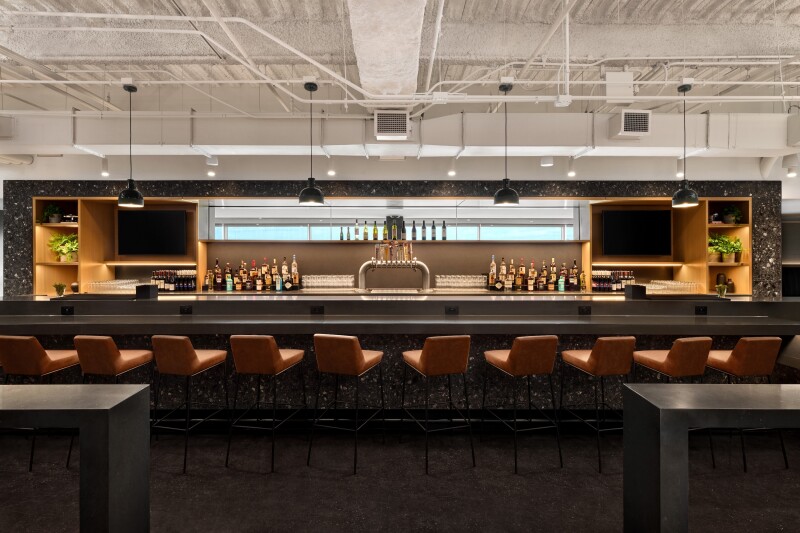
United’s Denver hub is also home to the airline’s largest lounge, a 33,000-square-foot space that reopened in 2025 after a massive overhaul.
Courtesy of United Airlines
United had good reason to think travelers would use Club Fly. When the airline was developing the Denver concept, it had conducted independent research that found that 54 percent of airport lounge visitors liked taking food or drinks with them. Denver was also a natural place to test it: More than two-thirds of United passengers there were connecting to another flight when Club Fly opened.
The airline has since added a second Club Fly at George Bush Intercontinental Airport in Houston, another major connecting hub.
“Not every traveler uses a lounge the same way—some want to relax or enjoy a full meal, while others need a faster, more convenient option on the way to their gate,” a United spokesperson told Afar. “United Club Fly complements our traditional clubs by helping meet that need.”
Anna LaBrie, a travel expert at flight-deal service Going, sees the same divide.
“For years, lounges served every traveler the same way, whether you had three hours to kill or 12 minutes to make your connection,” says LaBrie. She adds, “If you’ve got a long layover, you want a real seat, food, and Wi-Fi. If you’re sprinting between flights, you probably just want good coffee and to not get charged $8 for a water bottle.”
Henry Harteveldt, a travel-industry analyst and president of market-research firm Atmosphere Research Group, says the appeal is also about giving lounge-eligible travelers more choice.
“If a passenger has enough time to spend in a traditional lounge, [they] will inevitably try to do that,” Harteveldt says. “But when the lounge is full or the passenger doesn’t have a lot of time, offering a ‘to go’ lounge provides these passengers with an appealing option. They still get value from the airline.”

United’s Club Fly concept in Denver is meant to serve as a quick-service alternative to its larger lounges there, not as a replacement of the bigger spaces.
Courtesy of United Airlines
That distinction is important: United hasn’t used Club Fly as a replacement for its traditional lounges; it has continued investing in much larger clubs for passengers who do have time to stay awhile. The largest lounge in its network sits in the same concourse as the Club Fly concept does, less than a five-minute walk away.
“Grab-and-go concepts help split those two needs apart,” LaBrie says. “They cut wait times and free up the good seats in the lounge for people who are actually going to sit and use them.”
American has landed on a similar model. Its first Provisions by Admirals Club, which opened in North Carolina’s CLT in August 2025, is about 2,000 square feet. It has high-top tables for quick stops but emphasizes portable options such as meal boxes, snacks, yogurt, fruit, coffee, tea, and canned or bottled drinks.
In Atlanta, Poppin offers a slightly different variation on the idea. Airport Dimensions, the company behind the Club lounge network, recently opened the smaller-format space on the mezzanine in Concourse F, beside the full-service Club ATL.
Airport Dimensions is careful not to call Poppin a grab-and-go lounge. “Poppin was built as a faster, more streamlined lounge experience, not a takeaway counter,” Chris Gwilliam, chief growth officer at Airport Dimensions, told Afar. Travelers can still sit down, eat, and take a short break; those rushing to a flight can take food with them.

Airport Dimensions characterizes its new Poppin outpost in Atlanta as “a faster, more streamlined lounge experience.”
Courtesy of Airport Dimensions
The company says the concept was designed both for travelers with limited time and for airport spaces too small to accommodate a traditional lounge. “Some travelers want a more traditional experience . . . with a broader range of amenities,” Gwilliam says. “But others have a limited window to grab a bite, check email, and make their way to the gate.”
And some companies are experimenting with shorter stays without the “grab-and-go” part at all. Sidecar by the Centurion Lounge, which American Express opened in Las Vegas in March, is reserved for travelers departing within 90 minutes. Rather than stocking a takeaway refrigerator, the smaller space serves travelers quick bites and drinks directly to its limited number of seats. The regular Centurion Lounge remains nearby for eligible travelers who want more time and space to relax.
“This isn’t just about airports adding grab-and-go options,” LaBrie says. “It could be more about different tiers of airport experiences built around how travelers actually use them.”
Crowd control
There’s another reason these concepts are arriving now: The lounge has become considerably less exclusive.
Airport Dimensions’ 2026 traveler study found that 52 percent of the 11,165 global travelers surveyed use airport lounges, an 11 percent increase from the previous year, growth the company attributes partly to broader access through banks and membership programs.
Gary Leff, founder of frequent-flier site View from the Wing, puts the issue simply: “Lounge eligibility has grown faster than lounge capacity, largely thanks to adoption of premium credit cards.”
Those crowds can undermine the very reason travelers seek out a lounge. In J.D. Power’s 2026 lounge study, based on responses collected from 2,991 travelers who visited a U.S. airport lounge in the past year, 46 percent of respondents said the lounge they use most often is usually moderately or severely crowded.
Not surprisingly, satisfaction rates dropped dramatically among travelers who encountered severe crowding. Complimentary food and beverages, meanwhile, were the highest-ranked lounge benefit, and 39 percent of respondents said the high cost of airport food and drinks was one reason they visited a lounge.

The speakeasy-inspired Sidecar by the Centurion Lounge, the recently opened American Express concept in Las Vegas, is reserved for travelers departing within 90 minutes.
Courtesy of American Express
“Lounges have become victims of their own success,” LaBrie says. “Premium cards, status, and premium tickets have let far more people in, which creates more crowds and longer wait times.”
That can be especially frustrating because the people standing in those lines are often exactly the customers airlines most want to keep happy.
“Airlines’ lounge customers are often high-value customers whose business airlines want to retain,” Harteveldt says. “They tend to have higher-tier status in airlines’ loyalty programs, are more likely to buy premium fares, and are more likely to carry an airline’s higher-tier co-brand credit card.”
In Atmosphere Research Group’s first-quarter 2026 study of more than 5,000 airline passengers, 12.7 percent considered themselves loyal to at least one airline or airline alliance, Harteveldt says. That makes lounge access one of the increasingly valuable ways airlines can reward—and retain—the customers who remain devoted.
“When lounges are full and have long wait times, ‘to go’ lounges provide another way for airlines to serve and, they hope, satisfy these high-value customers,” he says.
LaBrie echoes that sentiment, saying, “Giving people an alternative instead of turning them away is a better way to build loyalty.”
LaBrie also notes the matter of space. “The ability to service more passengers in a smaller footprint is hugely important,” she says. “Airport space is some of the hardest real estate to expand, especially after security, so operators can’t just build their way out of crowded lounges.”
Adds Leff, “A traditional lounge where each passenger sits and works needs capacity for more people for a longer period of time. A grab-and-go serves far more people per square foot per hour.”
The smaller format also opens up parts of airports that can’t accommodate a full-scale lounge. A spare storefront near a cluster of gates could be useful for an express operation even if it doesn’t have room for hundreds of armchairs and a commercial kitchen.
For airlines and banks, that can mean extending a premium benefit to more customers without needing a proportionate amount of new lounge space.
The lounge within a lounge

The inaugural Capital One branded lounge at Dallas Fort Worth International Airport has a built-in grab-and-go area for travelers in a rush.
Courtesy of Capital One
And not every lounge operator is carving out a completely separate space for a quick service spinoff.
Capital One built a grab-and-go concept into its first lounge, which opened at Dallas Fort Worth International Airport (DFW) in 2021. The company says it had begun thinking about takeaway food even before that opening, after recognizing that not every traveler had—or wanted to spend—hours in a lounge before a flight.
“We wanted Capital One Lounges to work for those travelers, too, and give them a way to quickly refuel without sacrificing quality,” Callie Kooiker, head of airport lounges and landings at Capital One, tells Afar.
The result was a refrigerated selection of salads, sandwiches, bowls, juices, and other food made daily in the lounge. Internally, the company says it has a “no sad salads” mantra: Being short on time, Kooiker says, shouldn’t mean settling for worse food.
Capital One has continued experimenting with how travelers reach that food. Normally, grab-and-go is part of the full lounge experience, meaning a traveler still has to enter the lounge first—a potential drawback if there’s a waitlist and the traveler has a tight connection. But during a recent test at DFW, eligible Venture X and Venture X Business cardholders could choose a separate grab-and-go option when the lounge reached capacity, allowing them to pick up food without joining the lounge waitlist.
The company has also expanded the idea at New York’s JFK, where its lounge includes a bodega-style counter with takeaway food alongside hand-rolled Ess-a-Bagel bagels, lox, smoked whitefish, pastrami, and barista-made coffee.
Capital One says it sees grab-and-go and sit-down dining not as competing experiences, but as two ways to use the same lounge. “Someone may only have a few minutes to grab something fresh before heading to the gate, while another traveler may have time to sit down for a meal and enjoy the rest of the space,” Kooiker says.
Chase is now experimenting with a similar idea at its new Sapphire Lounge by the Club at DFW, though on a smaller scale. The 18,000-square-foot lounge has full-service dining, a Texas whiskey room, complimentary facials, showers, and nap pods, but near the entrance is a refrigerator stocked with food and drinks that guests can take with them.
Dana Pouwels, Chase’s head of airport lounge benefits, told Afar that the company is “testing” the feature during busy periods, when some guests may want something from the lounge but don’t necessarily have time to stay. For now, it is specific to DFW.
Ultimately, the grab-and-go lounges leave travelers with more than one way to use the same kind of airport perk, depending on how much time they have before a flight, Kooiker says. “Sometimes that means being able to grab a great meal in a few minutes. Other times it means having time to enjoy [the lounge]. For us, it all comes back to creating experiences that fit the pace of travel.”