


This story was originally published in October 2024. It was updated in October 2026 to include current information.
From disembodied voices to apparitions dressed in Victorian-era clothes, some of the most legendary hauntings have occurred in hotels. In historic lodgings across the United States, people have reported unusual smells, like the lingering scent of a live cigar or old-fashioned perfumes in hotel corridors, general feelings of unease accompanied by inexplicable drops in temperature, or phantom apparitions who awaken them in their rooms in the middle of the night. And it’s no wonder—some people who have checked into hotels (cue spooky music) have allegedly never checked out.
Some of the country’s most iconic haunted hotels have been immortalized in horror culture, most notably the Stanley Hotel in Estes Park, Colorado, where Stephen King’s 1974 stay inspired The Shining. Others include the Chateau Marmont in Los Angeles, whose celebrity ghosts live on in pop culture legend. For those seeking spooky thrills, October is one of the best times to visit a haunted hotel for history lessons through the lens of its ghostly residents, especially around Halloween, when it’s said that the veil between the world of the living and the dead is at its thinnest.
Whether it’s a spooky hot springs resort in Missouri or New York’s most infamous bohemian lodgings, Afar’s latest Hotels We Love list presents 12 of the most haunted hotels in the United States to get you in the spirit.
Biltmore Hotel

The Biltmore Hotel in Coral Gables, Florida a National Historic Landmark.
Courtesy of Preferred Hotels & Resorts
Why we love it: A destination resort outside the city with an epic pool and sprawling golf course
Loyalty program: I Prefer (Preferred Hotels & Resorts)
Rates: From $299
Designed by architects Schultze and Weaver, the Biltmore Hotel opened in 1926 and quickly became a glamorous destination for the elite, hosting celebrities, socialites, and even presidents. The hotel has a striking 315-foot tower inspired by the Giralda in Seville, Spain, and its expansive grounds include a swimming pool that was once the largest in the world.
Thanks to its historical significance and architectural beauty, the Biltmore was designated a National Historic Landmark in 1963, which helped spark restoration efforts. By 1987, after years of careful renovation, the Biltmore reopened its doors as a luxury hotel. But no amount of paint could stop the ghost stories that surround it.
During Prohibition, the Biltmore housed a speakeasy and attracted a host of gangsters, including the infamous mobster Thomas “Fatty” Walsh, who was shot and killed on the 13th floor of the hotel in 1929 during a gambling dispute. Rumor has it that Walsh’s spirit never left the hotel, with reports of unexplained noises, flickering lights, and apparitions near the spot where he died.
Additionally, during World War II, the hotel was converted into a military hospital and later a Veterans Administration hospital, and many believe the spirits of former patients still roam its halls—some people have even reported seeing men in military uniform wandering about.
Related: The 16 Best Luxury Hotels and Resorts in Miami
Bourbon Orleans Hotel
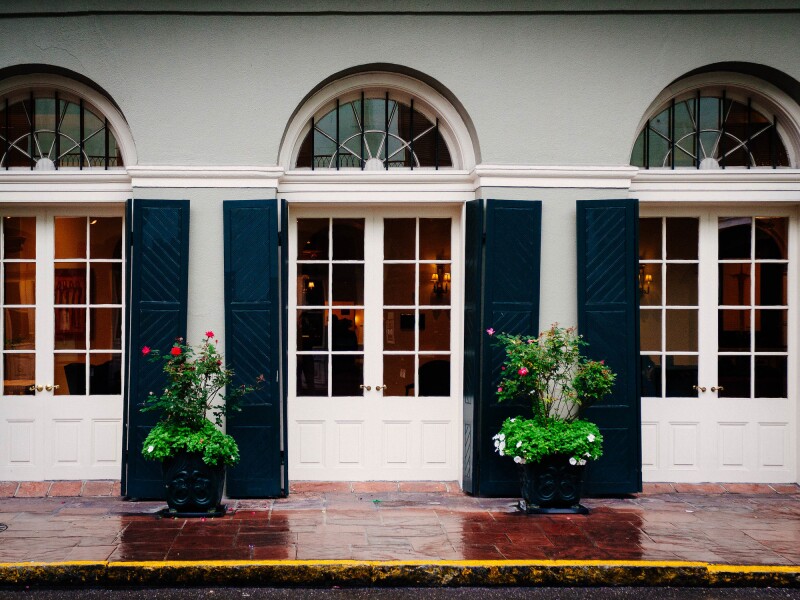
One of New Orleans’s most famous hotels is also one of its most haunted.
Photo by CEBImagery/Flickr
Why we love it: A historic hotel that has hosted countless cultural events
Rates: From $170
New Orleans has long held a reputation as one of the most haunted U.S. cities, so naturally some of the Big Easy’s hotels have supernatural visitors.
The French Quarter property that is now home to the Bourbon Orleans Hotel was originally a theater and ballroom, constructed in the early 1800s and destroyed by a fire in 1816. The remains were purchased by entrepreneur John Davis, who commissioned British-born architect Benjamin Henry Latrobe—who designed the U.S. Capitol—to rebuild both the theater and the ballroom. The newly constructed 1,300-seat theater placed New Orleans on the map as one of the country’s major cultural centers, and it was the setting for hundreds of Creole soirees, plays, and operas.
In 1881, the property was sold to the Sisters of the Holy Family, the first Black American religious order in the country. While it was under the order’s care, the ballroom (the theater burned in another fire in 1886) would serve as a school, orphanage, and makeshift hospital for children sick with yellow fever. The property was sold to Bourbon Kings Hotel Corporation in 1964; after redevelopment and restoration, it reopened as a hotel in 1966 and has been welcoming overnight guests ever since.
Visitors to the Bourbon Orleans Hotel have reported experiencing several types of specters. Some have heard the ghostly laughter of children, seen nuns who disappear into walls, or had their personal items misplaced without explanation. Others have caught sight of a lonely dancer waltzing alone underneath the ballroom’s chandelier. One of the most famous spirits of the Bourbon Orleans is the ghost of a Confederate soldier, who can sometimes be seen marching solemnly in his gray fatigues.
Chateau Marmont
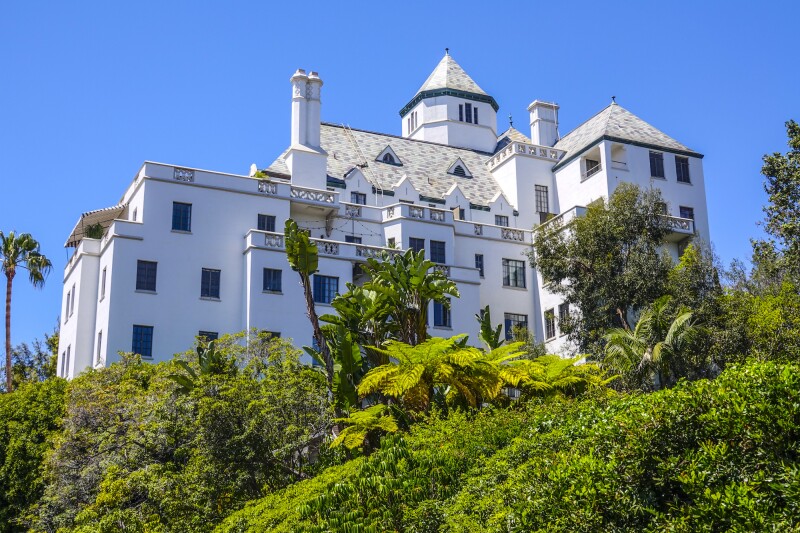
Chateau Marmont has long held a reputation as a place where stars can go to behave badly.
Photo by 4kclips/Shutterstock
Why we love it: An iconic Golden Age retreat filled with stories, both historic and contemporary
Rates: From $760
Chateau Marmont has long held a reputation as the place where stars go in Los Angeles to misbehave. During Hollywood’s Golden Age (1930–1945), cofounder of the film studio Columbia Pictures Harry Cohn famously told two of his most popular leading men at the time, William Holden and Glenn Ford, “If you must get into trouble, do it at the Chateau Marmont.”
In recent history, the Chateau Marmont has seen its fair share of celebrities behaving badly: Led Zeppelin drummer John Bonham rode a Harley Davidson motorcycle through the lobby in the ’60s; Britney Spears was temporarily banned from the hotel for smearing food on her face in a dining area during her (tragically and unfairly) public mental health crisis in 2007; and Lindsay Lohan was permanently banned from the property in 2012 after racking up a delinquent $46,350.04 bill. The hotel has a castle-like appearance, and it’s said that the staff guards its high-profile guests’ secrets as they would a fortress.
However, the hotel has also seen its fair share of tragedy. On February 28, 1982, actor and comedian John Belushi checked into a bungalow on the property and was found unresponsive five days later by his personal trainer, according to The Hollywood Reporter. EMTs who arrived shortly afterward declared him dead at the scene—he had suffered a drug overdose. Then, in 2004, fashion photographer Helmut Newton lost control of his car on Sunset Boulevard and fatally crashed into the Chateau Marmont.
Guests have since reported seeing apparitions around the property; some claim they’ve heard the faint click of a ghostly camera. Most famously, Al Franken claims he saw Belushi’s ghost, which appeared to him in the room he was staying in, a week after the comedian’s death. Others have heard an exuberant party and the tinkling of glasses, only to turn the corner and find an empty room.
Crescent Hotel and Spa

The building that is now the Crescent Hotel once served as a cancer “hospital” run by Norman Baker.
Photo by RaksyBH/Shutterstock
Why we love it: A character-filled retreat tied to the history of Eureka Springs
Rates: From $150
Constructed in 1886 by the Eureka Springs Improvement Company in partnership with the Frisco Railroad, the Crescent Hotel and Spa soon garnered a reputation as a luxurious hotel, with people traveling from all over the country to experience the town’s 60 mineral springs. It earned the nickname of the “Grand Old Lady of the Ozarks” and was advertised as the “the finest hotel west of the Mississippi.” Sadly, the original hotel owners were not able to turn much of a profit, and in 1901, the building became a girls’ school.
In 1937, the building was sold to radio personality and (soon to be revealed) charlatan Norman G. Baker, who claimed he’d found a cure for cancer that didn’t require surgery or radiation. The hotel, which is part of Historic Hotels of America, became the Baker Hospital, and he sent flyers to people across the nation advertising the clinic as a place “where sick folks get well.” His cure? A mixture of chemicals and substances that included carbolic acid, ground watermelon seeds, corn silk, and alcohol, injected into patients up to seven times a day. During the 20 months that the Baker Hospital was in operation, 44 people died there. (After cooking up other frauds and money schemes, Baker would serve time in prison, and eventually, in an act of poetic justice, he died in 1958 of liver cancer.)
Afterward, the building would pass through the hands of various owners who would sink money into renovating the building, lose their steam, and sell it once again. In 1997, preservationists Marty and Elise Roenigk purchased the Crescent and reconstructed it back into a hotel.
Since its reopening, guests have reported strange phenomena. Some say they’ve seen a sad-looking young girl drift through the corridors. She’s believed to be the spirit of a student who once attended school there and died by suicide after she found out she had gotten pregnant out of wedlock. Others have spotted a specter of a nurse pushing a gurney down a hall, only to see her disappear into thin air. One of the most famous ghosts of the hotel is a young woman named Theodora, who resides in Room 419; she introduces herself to guests as a patient of Dr. Baker, then vanishes before their eyes.
The Elms Hotel & Spa

The Elms Hotel and Spa has burnt down twice in its history.
Courtesy of Nicolas Henderson/Flickr
Why we love it: A hotel dating back to the late 1800s with a spooky past
Loyalty program: World of Hyatt
Rates: From $150
The Elms Hotel and Spa, in Excelsior Springs, is about a half-hour drive northeast from Kansas City. The town is known for its ferro-manganese mineral water hot springs, Siloam Spring, the only one of its kind in the country. During the late 1800s, Excelsior Springs became a wellness destination, with people traveling to soak in its therapeutic waters, which were said to have curative properties and even the power to heal tuberculosis.
The original Elms Hotel and Spa was built in 1888, just down the road from its present location, to accommodate travelers and visitors like President Harry S. Truman coming to Excelsior Springs. The original hotel burned down in a fire in 1898 but was rebuilt at its current location in 1909. Ironically, the Elms burned down again in 1910 but was restored three months later with salvaged limestone and building materials from its second incarnation. The third rebuild, which underwent a $20 million renovation in 2012, is what stands today; it is now part of Hyatt’s Destination by Hyatt portfolio.
The hotel hit its stride during the 1920s, when it gained a reputation as an illicit speakeasy during Prohibition and became a playground for the rich and famous. Gangsters Al Capone and Bugsy Moran frequented the resort, as well as bank robber “Pretty Boy” Floyd. They’re said to have held illegal gambling and gin parties on the premises. There’s even a Capone Suite on the second floor; the legendary mob boss liked being able to easily see who was arriving at the property and duck out the back door if he needed to.
Said to be haunted by several different ghosts, the Elms Hotel has such a spooky reputation that it was featured on the Syfy show Ghost Hunters in 2013. All of the spirits on the property, however, are friendly—for the most part. Rumor has it that one ghost started the fires that destroyed the Elms in 1898 and 1910.
Some of the most frequently spotted apparitions include a gambler dressed in Prohibition-era–style clothing (he hangs out near the lap pool) and a housekeeper wearing an old-fashioned uniform. The hotel offers a Paranormal Tour, which includes a stay and two tickets to its nightly ghost tour, for those keen on a deep dive into the hotel’s haunted history; tickets start at $25 per person.
The Emily Morgan Hotel

The Emily Morgan was built on the grounds of the Alamo’s long barracks.
Photo by Philip Lange/Shutterstock
Why we love it: A former Medical Arts Building turned retreat that is supposedly one of the most haunted hotels in the world
Loyalty program: Hilton Honors
Rates: From $130
San Antonio is famous for the Alamo, but Alamo City is also home to one of the most haunted hotels in the world: the Emily Morgan Hotel.
The Gothic Revival–style building is located within shouting distance of the Alamo and was constructed on what was the fort’s long barracks, where Texan defenders battled against Mexican forces over 13 days. Nearly 600 men would die in the fight for the Alamo. The building that the hotel now occupies was constructed in 1924 by architect Ralph Cameron to house the city’s Medical Arts Building, a hospital with more than 100 doctors and dentists.
First-time visitors to the Emily Morgan are often struck by the building’s intricate exterior, with its cast-iron embellishments, a copper roof with wooden ribs, and an assemblage of gargoyles that portray various medical ailments. After functioning as a hospital for more than 50 years, the building became a hotel in 1984.
The most haunted levels of the Emily Morgan are said to be the basement and the 7th and 14th floors. The basement served as the hospital’s morgue and crematorium, and visitors have reported that the elevators will sometimes take them to the bottom level even if they’ve selected a different floor. The 14th floor—which is actually the 13th—was the hospital’s surgical ward, and some people have said they can still smell the faint odor of disinfectant there.
The seventh floor, the hospital’s former psychiatric unit, is rumored to be the hotel’s most haunted, according to multiple theories: One story says it’s haunted by the ghost of a jilted bride. Some hotel guests on the seventh floor have experienced unexplained phenomena, such as ghoulish shrieks in the night, misplaced belongings, and phone calls with no one on the other end. Consider booking a room yourself to find out if the hype is real.
The Hawthorne Hotel

The Hawthorne Hotel acted as the backdrop for several episodes of the TV show Bewitched.
Hawthorne Hotel/Historic Hotels of America
Why we love it: The perfect spot for exploring the supernatural side of Salem
Rates: From $199
Even though the Hawthorne Hotel was built more than 230 years after Salem’s infamous witch trials, the grand hotel, which is part of Historic Hotels of America, wasn’t able to dodge the spooky vibes associated with the town.
The most well-known and frequently discussed space within the hotel for paranormal moments is Room 325. Over the years, some visitors have claimed to have seen apparitions standing at the foot of their bed or in the corners of the room, while others describe objects inexplicably moving or vanishing only to reappear later in a different spot. Cold drafts, sudden temperature drops, and feelings of being watched are commonly noted, even when the windows are closed and the room should be warm and secure. Another haunted area is Room 612, where the spirit of a woman has been reported standing in the corner.
Various pop culture moments have magnified the haunted lore. In the 1960s, the hotel was the filming location of some episodes of Bewitched, a TV series about a witch married to a mortal man. Similarly, in 1990, the hotel held a séance in the Grand Ballroom to try to contact Harry Houdini on the 64th anniversary of his death (they failed to contact the legendary magician). And in 2007, the paranormal show Ghost Hunters visited the hotel in a Salem-focused episode; it claimed one of the women killed in the witch trials owned an apple orchard where the hotel is now (something local historians have denied).
Hotel Alex Johnson, Curio Collection by Hilton

The Hotel Alex Johnson, Curio Collection by Hilton, dates back to 1928.
Photo by Travel South Dakota
Why we love it: A storied hotel—with a founder who reportedly never left
Loyalty program: Hilton Honors
Rates: From $76
Conceived by Alex Carlton Johnson, a Chicago & North Western Railroad executive, the Hotel Alex Johnson opened its doors in 1928. The late Johnson aimed to reflect the unique heritage of the Black Hills, blending the architectural and cultural styles of the region’s local Lakota Sioux and Germanic settlers. This vision shaped the hotel’s distinctive Tudor revival design, with Native American art and symbolism integrated throughout the building, attracting several U.S. presidents, including Franklin D. Roosevelt and Ronald Reagan.
Johnson was dedicated to his work—so much so that many say he never left the hotel, even after his death in 1938. His ghost is said to have stuck around to make sure everything was running smoothly.
It’s just one of the many supernatural stories about the hotel reported by guests and staff members over the year. Another famous legend is about a “Lady in White,” believed to be a bride who tragically died by falling from the window of room 812 in the 1970s. Some claim she jumped; others say she was pushed. If it was the latter, she may be looking for those responsible for her death. There’s also the ghost of a young girl who is said to knock on guest room doors and run giggling down the hallway.
The hotel leans into its haunted reputation with a Ghost Adventure package, which includes a stay in one of the haunted rooms and a handheld electromagnetic field detector for ghost hunting. For those who do see or hear something spooky, the hotel has a form on its website where people can report paranormal activity.
Hotel Chelsea
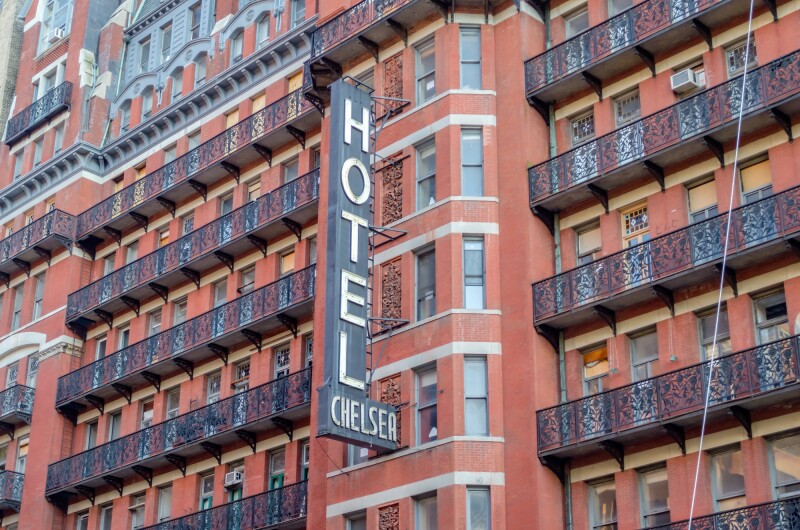
The Hotel Chelsea garnered a reputation as a bohemian hangout during the 1950s and ’60s.
Photo by Marco Rubino/Shutterstock
Why we love it: A reborn New York icon where decades of artistic—and allegedly paranormal—history still haunt the halls
Loyalty program: Leaders Club (Leading Hotels of the World)
Rates: From $516
Manhattan’s Hotel Chelsea is the stuff of American literary and pop culture legend—it also happens to be haunted. The building was constructed in the late 1800s as one of the first private cooperative apartments in the city. It became a hotel in 1905 that also accepted long-term tenants, many of whom were the glamorous, pop culture–icon kind. Arthur Miller moved into the building after his divorce from Marilyn Monroe. Bob Dylan wrote “Sara” from his Desire album there in Room 211.
Jack Kerouac had a one-night stand with Gore Vidal in the hotel, and Janis Joplin and Leonard Cohen hooked up here, too. It was where Arthur C. Clarke wrote 2001: A Space Odyssey. Perhaps most tragically, it was also where groupie Nancy Spungen would die after she was stabbed in the abdomen in her room’s bathroom—her boyfriend, Sex Pistols bassist Sid Vicious, was charged with her murder but died of a heroin overdose before he could be brought to trial.
In addition, several notable figures have died at the hotel by suicide, and their ghosts are said to haunt the hotel’s halls. One of the most commonly seen apparitions is a young woman named Mary, who was a survivor of the Titanic. Mary’s husband perished during the ship’s sinking, and she was later so overcome by grief that she killed herself at the Chelsea. (The Sopranos actor Michael Imperioli reported that he saw Mary at the hotel during a stay in 1996.)
Another ghost, a tortured artist known only as Nadia, also died by suicide at the hotel (and first cut off her hand in creative frustration), and so did Charles R. Jackson, author of The Lost Weekend. In addition to glimpses of apparitions, guests of the Chelsea Hotel have experienced a wide array of phenomena, from hearing ghostly whispers and having chills to feeling uneasy on the premises.
Related: Ghosts, Celebs, and Rock ’n’ Roll: A History of NYC’s Hotel Chelsea
RMS Queen Mary

The Queen Mary is now permanently docked in Long Beach, California.
Courtesy of the Queen Mary
Why we love it: A legendary art deco ocean liner where you can sleep in an original stateroom—and, perhaps, meet a former passenger
Rates: From $129
Long before it became a floating hotel in Long Beach, the RMS Queen Mary carried passengers across the Atlantic, making her maiden voyage from Southampton, England, to New York in 1936 and ushering in a new era of glamorous transatlantic travel. The art deco ocean liner carried renowned passengers, from Hollywood stars to European royalty, before being pressed into service during World War II, when she was painted gray, nicknamed the “Grey Ghost,” and used to transport Allied troops. The Queen Mary returned to passenger service after the war before retiring in 1967, when it sailed to Long Beach and became a permanently docked hotel and attraction.
With that much history packed into one ship, it was perhaps inevitable that ghost stories would follow. One of the Queen Mary’s most notorious spaces is Stateroom B340. A 1949 ship log records that a passenger was found dead in the cabin, and guests staying in the room since have reported knocks at the door, lights and faucets turning on by themselves, and bathroom doors opening and closing without explanation. The former first-class swimming pool has its own resident ghost story: Visitors and paranormal investigators have reported hearing the laughter of a little girl. Elsewhere, guests have reported footsteps in empty corridors, unexplained voices, and strange noises near the engine room and the ship’s watertight Door 13, where a crew member was killed in an accident.
Unlike some historic hotels that would rather their ghosts keep a low profile, the Queen Mary embraces its paranormal reputation. Travelers can explore the ship’s darker history on haunted and paranormal tours, while particularly committed ghost hunters can book B340 itself.
The Stanley Hotel
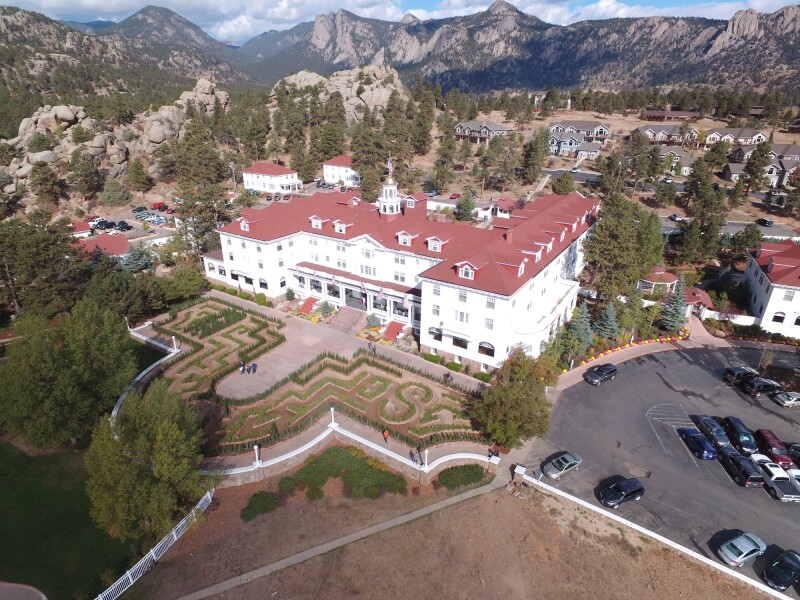
After staying at the Stanley Hotel, author Stephen King was inspired to write The Shining.
Photo by Brian Bloss/Shutterstock
Why we love it: A hotel so haunted Stephen King wrote a novel about it
Rates: From $320
The famously haunted Stanley Hotel in Estes Park, Colorado, opened its doors in 1909 and was owned by inventor Freelan Stanley, who fell in love with the area after he traveled to Colorado in hopes that the dry mountain air would help ease his tuberculosis symptoms. The hotel quickly garnered a reputation as a luxury wilderness retreat, and people like socialite Molly Brown (famous for surviving the sinking of the Titanic), President Theodore Roosevelt, and the Emperor and Empress of Japan would all stay at the Stanley.
The hotel, another Historic Hotel of America, is best known for inspiring what many critics consider one of the greatest American horror classics: The Shining, the best-selling novel by Stephen King. After staying one night at the Stanley, King was so creeped out by his experience that he was inspired to write what would become his third major work, which was adapted for film by director Stanley Kubrick (who famously took a few liberties with the source material).
Several ghosts supposedly haunt the Stanley, including the specters of the original owner, his wife, and the spirit of a mysterious child. One of the most requested rooms in the hotel is number 217, where King stayed. The space is said to be haunted by the spirit of a maid named Mrs. Wilson. While lighting a lantern in it, she was blasted out of the room, which had a gas leak. Though she lived, the powerful explosion sent her tumbling into the MacGregor Dining Room below, and she broke her ankles.
Apparently, Wilson wasn’t a fan of unmarried couples sleeping together, and any unwed lovebirds who try sleeping in Room 217 will sometimes feel a cold presence push them apart at night. Famously, Jim Carrey stayed in Room 217 while filming Dumb and Dumber (1994) and was so unnerved by the hotel that he left the Stanley in the middle of the night. If you’re hoping to check into Room 217 during the Halloween season, prepare to wait; the space is booked solid for spooky season years in advance.
Tarrytown House Estate

Thought you saw a ghost at Tarrytown House Estate? You wouldn’t be the first to think so.
Courtesy of Tarrytown House Estate
Why we love it: A sprawling Hudson Valley estate with Gilded Age history (and a resident ghost)
Rates: From $150
Tarrytown House Estate is ideal for travelers looking to get into the spooky spirit—not only because it’s a few miles from Sleepy Hollow, but also because the 26-acre Hudson Valley property has a supernatural story of its own. Its history dates to 1840, when the white Georgian mansion now known as King Mansion was built.
Over the following decades, the surrounding land was divided into neighboring estates owned by a series of wealthy New York families, including railroad executive Thomas M. King and tobacco executive William R. Harris. The two families eventually became connected when King’s son Frederick married Harris’s daughter, Sybil. The estate changed hands several more times before eventually becoming a full-service hotel in 1994.
It’s Sybil who is said to have stuck around. Guests and staff have reported hearing footsteps pacing the second-floor hallways of King Mansion, and seeing faint shadows, unexplained orbs, and an apparition of a woman dressed in white. Much of the activity supposedly centers around Room 293.
Today, the King Mansion is part of New York State’s Haunted History Trail, and travelers can spend the night in the 10 guest rooms inside the historic house. Those who don’t want to sleep with a possible ghost can still visit the mansion for dinner at Goosefeather, chef Dale Talde’s Cantonese restaurant, where staff have been known to share stories about Sybil with curious diners.


