
It was mid-August on the Swedish island of Gotland when, after dinner, I followed a cobblestone street down to the sea, past houses whose sharp edges had been sanded by wind and time. On a promenade along the town of Visby’s medieval stone walls, an impromptu theater had formed. Young couples dangled their legs in the water. Clutches of middle-aged friends stretched out on wooden loungers, and a family grilled hot dogs in a firepit conveniently at snout level of a very alert chocolate Lab. All of them had turned their gaze to the same spectacle: the setting sun as it tinted sky and sea sherbet orange. In that moment, it felt as if every component—the illuminated faces, the scent of charred sausage, the gleeful cries of teenagers cannonballing off the pier into the lapping water—had coalesced into the very essence of summer.
As someone who has lived in Scandinavia for the last 10 years, I’d long heard of Gotland’s mystique. The province’s proximity to the Swedish mainland, 60 miles into the Baltic Sea, coupled with more days of sunshine than any other spot in the country, holds obvious appeal. Friends often spoke wistfully about summers on the archipelago, mentioning the rustic houses, wild dewberries, midnight swims in the sea.
From my research, I’d read about Gotland adopting Sweden’s most ambitious sustainability initiatives, and that the region was a magnet for artists (famed filmmaker Ingmar Bergman lived on one of its islets). But there was something else—was it the light? The freedom?—that defied description. “It’s hard to explain,” my friend Per stated. “Gotland is just magical.”
So, I hopped on a 30-minute flight from Stockholm to find out for myself. Over the course of a week, I’d circumnavigate the main island’s nearly 500-mile perimeter. Per furnished me with a list of highlights but recommended I experience Gotland and the season like a Swede: by wandering wherever my curiosities led me.

Gotland’s main city, Visby, is often a hub for travelers to explore the island’s wild nature, fishing villages, and dramatic coastlines.
Photos by Petter Backlünd
I began my exploration in Visby, the portal to Gotland for most visitors. As home to 24,000 of the island’s roughly 61,000 permanent residents, it’s as close as the province gets to a big city, although the narrow streets and adorable hollyhock-lined cottages give it the feel of a hobbit village. There are vestiges, however, of a more glorious past. In the Middle Ages, Visby was one of Europe’s most important trading hubs, and the sturdy stone warehouses that are occupied today by coffee roasteries and artist workshops, as well as the remains of Gothic churches rising over red-tiled roofs like dinosaur skeletons, testify to its former power. At Hotel Helgeand, situated in a roughly 800-year-old building, co-owner Tobias Lundgren told me that Visby’s rapid decline after its medieval heyday helped preserve its antique charms. “You feel the history beneath your feet,” he said. “I never get tired of it.”
For lunch that afternoon, I ventured eight miles north of town to Salthamn, an eco-retreat whose outdoor restaurant is imbued with a beachy, boho atmosphere. I struck up a conversation with newlyweds David and Johanna. They’d gotten married a few days earlier in Gothenburg, then packed up their four-month-old baby for a honeymoon on Gotland—a place where their own parents had vacationed in their pre-kid years. Already enamored, they were spending their days doing just what Per had advised. “We love just choosing a direction and driving,” Johanna said. “You see so many things on the side of the road that you want to explore. There’s so many people making things, so much creativity.”
When I started my own driving tour the next morning, I could hardly travel more than a couple miles along the western coast before spying roadside attractions: the candy-colored Villa Villekulla, where the Pippi Longstocking movies were filmed; ceramics studios; and treasure-filled loppis, the informal little flea markets that Swedes adore.
I made my first stop at the organic farm Lilla Bjers, picture-perfect down to the red barn and matching apple orchard. Its shop teemed with vegetables so enticingly ripe I couldn’t help but purchase some, even though I had no kitchen where I could prepare them. I overheard a mom tell her tow-headed daughter, “They grow everything themselves here.” Having spotted one key sign, the girl made a beeline for the freezer. “Do they grow their ice cream too?” she giggled.

Sibbjäns, where Nordic design meets regenerative practices, is located on the southern tip of Gotland.
Photo by Petter Bäcklund
Gotland’s agricultural richness continued as I drove south to Burgsvik, passing more farms and even a vineyard. I arrived midday at Sibbjäns, a boutique inn, restaurant, and farm that opened in April. Sibbjäns is co-owned by four friends, including Pontus and Susanna Rönn, Stockholmers from the film and fashion industries who vacationed on the island for decades before making their stay permanent. “We had a summer house here for 35 years,” Susanna said. “Gotland is our happy place, where we feel most relaxed and free. And we wanted to show it to the rest of the world.”
With their business partners Jonas Nordlander and Kina Zeidler, they transformed a 19th-century farm into the region’s most elevated accommodation, kitting out the property with contemporary art, vintage furniture, and prolific flower gardens that pop with color. Together, they are also trying to make sure that Sibbjäns embodies the sustainability valued throughout Scandinavia, but especially on Gotland, which is aiming to become climate neutral by 2040.

Medieval buildings and meals at sustainable venues such as Salthamn are among Gotland’s many allures.
Photos by Petter Bäcklund
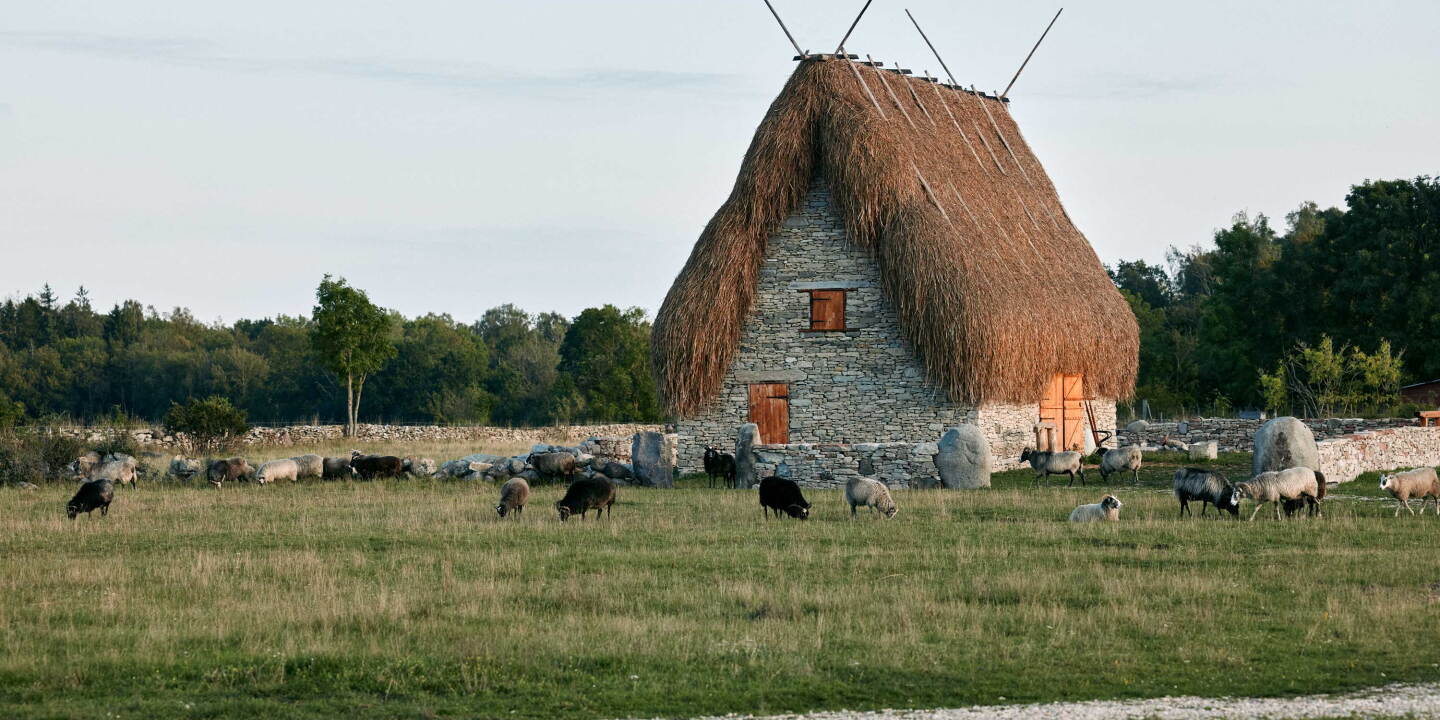
The menu features the farm’s own vegetables, eggs, and meat, which are all produced regeneratively. High-tech showers and low-tech rain collection systems help conserve water, a necessity on an island that has become increasingly vulnerable to drought. Livestock help keep the soil fertile without chemicals, and none do it more fetchingly than the small flock of indigenous sheep that graze behind the swimming pool, flaunting long gray curls reminiscent of those fabulous silver-haired models who convince women to give up their hair dye.
After a night experiencing the thoughtful curation at Sibbjäns, I couldn’t help but notice that Gotland also abounds in its wild opposite. Down the road, I visited the Holmhällar nature reserve on the island’s southeastern tip, where I trekked against the wind up grass-covered cliffs to gaze out at the churning sea. The light was extraordinary, crisper somehow, as if the colors on the spectrum were separated by discrete borders rather than bleeding into each other. And it was volatile, changing from sparkling one moment to brooding the next.

Sibbjäns is located 1.2 miles from the beach.
Photo by Petter Bäcklund
It was early afternoon when I pulled into Katthammarsvik, a bump of a town that juts into the sea. I moseyed by a pier, watched terns and gulls bobbing in the bay, and admired a honey shop that operated on the honor system. Judging by the crowd, Katthammarsvik’s biggest attraction was the old-fashioned smokehouse and restaurant whose front room is lined with cases of mackerel and herring cured into silvery planks. I joined the queue and before I knew it, I was precariously toting a steaming bowl of fish soup, redolent with saffron, to a table. The dining room was unpretentious (guests were expected to clear their own plates) and cozy, with stacks of board games for kids, water bowls for dogs, and candles on the communal tables for adults.
The couple seated next to me was not surprised by the DIY setup. While their two boys raced around the restaurant, Martin and Line explained how cleaning up after themselves, as they did at the bring-your-own-bed-linen summerhouse their family rented each year, wasn’t merely about simplicity.
It was an important piece of the Scandinavian ethos. I’d noted something similar in Denmark; the concept janteloven teaches that no one should put themselves above another. But Martin translated it into the language of vacations: “Swedes like to think of ourselves as all equal. So it’s more relaxing for us not to have people waiting on us,” he said.
I was met with more of that rustic equality after driving about half an hour north. When I checked in to Liste Gård, a former farmhouse dating to the 18th century, the owner Christina Sundkvist handed me a set of sheets and told me to make my own bed. Coupled with the shared bathrooms, the bare-bones room gave me serious youth hostel flashbacks.
Yet whatever discomfort I felt was offset once I stepped into the surrounding flower garden. Riotous with frilly sweet peas and dahlias the size of dinner plates, it offered an opportunity rarer and, for me, far more luxurious than any high–thread count, premade bed—the chance to create my own bouquet. Knowing it would not survive the drives to come, I resisted plucking and instead gave in to a more achievable longing: dinner.
A little over six miles from the hotel, I found Krakas Krog, a tiny restaurant that friends had told me was one of the island’s best. The meal started with a refreshing glass of bird cherry soda beneath an apple tree. After a vivid series of small bites, the other 13 guests and I were ushered indoors, where waitresses in smart black frocks glided through the dining room bearing spectacular dishes, such as the clever “raviolo” made from nettle leaves wrapped around an egg yolk cream. The courses that followed, including a plate of the most flavorful heirloom tomatoes I have ever eaten, didn’t so much showcase local ingredients as shine a spotlight on them and hand them an Oscar.
Owner and sommelier Ulrika Karlsson attributes the quality to the setting. “Gotland is unbelievably productive,” she said. “Restaurants everywhere like to say, ‘Oh, we have a farm right here,’ and I’m always like, ‘No you don’t, you have to go hours outside the city.’ But here, we bike to the farm every morning and pick [what] we serve that night.”

Andrea Guerra and Emma Serner craft organic wine on the island at their vineyard Långmyre Vineri.
Photo by Petter Bäcklund
Karlsson then produced a bottle from Långmyre, the vineyard I’d admired on my first day on the road, and poured me a glass. It proved crisp and surprisingly good, considering we were in Sweden (where wine production is a nascent pursuit at best). After a buttermilk dessert with tart blueberries and pine oil that tasted of the forest, she ushered us back out into the garden. Night had fallen, and blankets and bonfires staved off the chill. As I sat beneath the apple tree again, fairly humming with well-being, I asked the server what they did in case of rain. “Somehow, it’s never a problem,” she said with a smile so sincere it made me believe her. Even if it’s raining during the day, she added, “at dinnertime, poof, it just clears.”
I set out early the next morning, eager to arrive at my final lodging. But once again, I got distracted, this time by tree-lined boulevards around a medieval monastery’s ruins and a striking wooden church with handpainted interiors. (Inside, there was an altarpiece that would give the Monkey Jesus of botched Spanish restoration fame a run for its money.) Once I reached Lärbro on Gotland’s northern tip, a sign for Galleri Grönwall drew me in.
Artist Sebastian Grönwall warmly welcomed me into his studio, where I immediately felt a sense of déjà vu: The rough walls of the barn were lined with captivating paintings of the moody landscapes I had been moving through. Grönwall, a Gotland native, moved to Stockholm for art school, but found the mainland rigid and conformist.
‘There’s just a special energy here, a sense of freedom that makes you more creative,’ Grönwall said. ‘People here dream big.’
With its romantic ruins and unspoiled nature, his island home had lured artists since the 19th century, and it pulled him back as well. His plein air painting practice has made him a fluent interpreter of the famously ineffable quality of Gotland’s light. To understand it, Grönwall suggested I look literally at the ground beneath our feet. “Limestone reflects—it makes the light bounce,” he said. “And we’re far enough north that the light comes in from the side, which is what creates those long shadows.” Yet not everything, he admitted, could be defined so scientifically. “There’s just a special energy here, a sense of freedom that makes you more creative,” Grönwall said. “People here dream big.”
I too had dreamed big. When I’d booked my final accommodation, I’d hoped it would fulfill the Swedish ideal: simple, but comfortable enough to at least have indoor plumbing (less a Swedish requirement than a personal one), and surrounded by forest and sea. And of course, it had to be painted a classic countryside red.

Open since 2012, the restaurant at Lilla Bjers serves produce harvested from its 47-acre farm south of Visby.
Photos by Petter Bäcklund
The cabin met all my hopes. Over the next two days, I woke to birdsong from the bed I made myself, then went for swims in the sea along a deserted sandy beach. I tromped through pine forests collecting berries and watched sheep graze from my window. I visited the haunting limestone stacks on the neighboring island of Fårö that had inspired so many artists, and I cooked dinner from the still-luscious tomatoes and zucchini I’d bought at Lilla Bjers. I even fulfilled what I couldn’t at Liste Gård, by picking wildflowers from the meadows.
As I sat drinking wine on the back porch of my little summerhouse, I realized that my own fulfillment of the Swedish ideal was echoed by the island as a whole. Gotland, I now saw, was the perfect recipe. It started with the things Swedes love, like flea markets, moody coastlines, and handpainted churches. It added things that they admire about themselves, like their respect for nature and belief in equality. And to this mix, it stirred in all that they longed for, like better food, the freedom to create, and long, sunny days. Gotland was Sweden with a glow-up, a vision of what Sweden could be.
But it was only when I returned to Visby the next day that the final piece fell into place. Again, I walked down to the sea. Although it had been only a week since that first sunset, the page had turned. The town was quieter, the evening now blustery and cold, and the sherbet sun a thin line on a horizon heavy with clouds. I recalled something that Hotel Helgeand owner Tobias had told me back at the beginning: High season lasts just six weeks. Maybe it’s that fleeting quality that makes summer in Gotland—that most idealized time of year in that most idealized of places—so sweet.
As I turned to leave, I heard a gleeful yelp. In the distance, I could make out the silhouetted shapes of three boys cannonballing into the sea, one final burst of joy before season’s end.

Gotland, Sweden’s sunniest region, offers ample opportunities for dining outdoors.
Photo by Petter Bäcklund
How to visit Gotland
With its wildflower meadows, tranquil fishing villages, and staggering sea stacks, Gotland embodies the ideal Scandinavian summer escape. Hop on a leisurely ferry or quick flight from mainland Sweden, crossing the Baltic Sea to the town of Visby, a UNESCO World Heritage site. From there, traverse the island in the local spirit: meander wherever the mood strikes you to go, with overnights at revamped farm stays along the way.
The best time to visit
High season lasts from the end of June until mid-August. To avoid crowds, consider arriving in late September, when the sea is still warm and the beaches are quieter.
How to get there
Visitors typically opt to travel via passenger ferry, boarding from Sweden’s eastern coastal cities Nynäshamn or Oskarshamn for the three-hour trip. Boats dock in Visby, renowned for a 13th-century wall encircling the town’s cobblestone interior. For a shorter journey, direct flights departing from Stockholm and Gothenburg land at Visby Airport in under an hour.


