
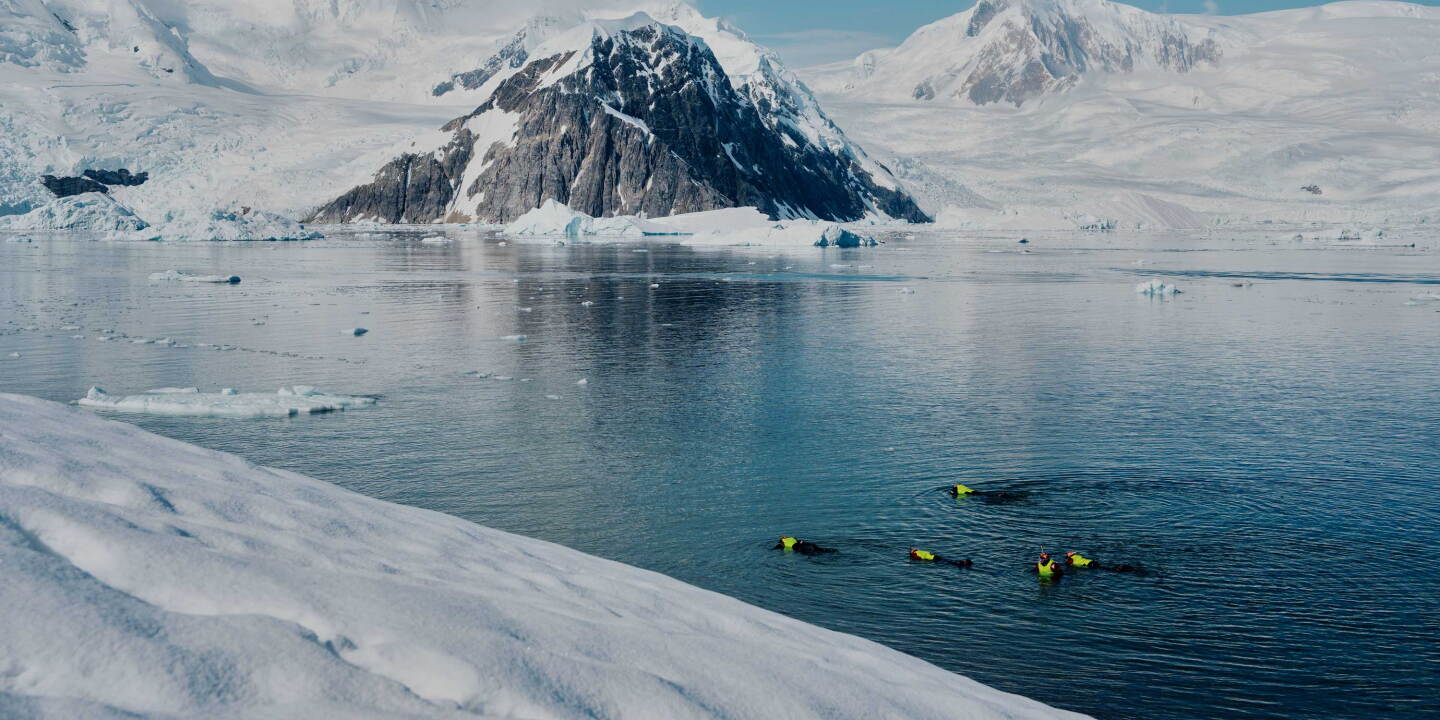
I place my regulator in my mouth and inhale sharply—an involuntary reflex to both the frigid cold and my own nervous anticipation—before rolling myself backward into the Southern Ocean. Despite the protection of my dry suit, hood, and gloves, my face and hands begin to tingle almost immediately. Once submerged, I notice around me a wall of turquoise light, refracted by the surrounding ice like sun streaming through stained-glass windows in a cathedral.
Most travelers who explore Antarctica do so from the deck of a ship or the edge of a Zodiac, craning their necks to see sprawling penguin colonies and calving glaciers. But Aurora Expeditions—a Certified B Corporation that in 1998 became the first cruise operator to offer scuba diving as an excursion—makes it possible for passengers to go deeper. At Barrientos Island, Recess Cove, and other stops on a 12-day March sailing aboard the Sylvia Earle, named after the renowned marine biologist, I followed my fellow divers down past the bobbing ice and into one of the least visited ecosystems on earth. Thanks to a diver-to-guide ratio of roughly three to one and a route that can be adapted constantly based on changing weather and ice, every one of our nine total descents felt impromptu and immersive.
Antarctic diving is tightly regulated due to extreme conditions: Water temperatures vary from around 28 to 35 degrees Fahrenheit. Every plunge is an exercise in strength and pain tolerance, and we never last more than 30 minutes before the cold begins to feel as if it’s burning our skin. To participate, you must have Advanced Open Water and Dry Suit Diver certifications, demonstrate completion of at least 30 dry-suit dives, and bring your own freeze-protected regulator and other gear. In practice, more experience is recommended: With 300-plus dives under my belt, I was the least-savvy member of our seven-person group, though I’d honed my dry-suit buoyancy in Wisconsin’s frozen lakes in preparation. (Many of Aurora’s Antarctica sailings also offer snorkeling excursions—sometimes daily, if the weather allows—for guests who don’t meet the necessary dive qualifications.)

Speedy gentoos are one of seven penguin species in Antarctica and the subantarctic islands.
Pete Shaw
“In some places you’re diving where few, if any, divers have been before, which makes the experience incredibly powerful,” says Catherine Buckland, an Aurora activity guide specializing in polar scuba diving. But these dives aren’t about thrill-seeking for the sake of it; rather, they’re an opportunity to gain a better understanding of the Frozen Continent, where roughly half the marine life is endemic.
“With the possible exception of a few mosses and associated organisms, the sea provides the sole foundation for Antarctic ecosystems,” says Graham Edgar, a marine ecologist and the president of Reef Life Survey, which works with Aurora to document marine species. “Without seeing what is happening under the sea surface, a visitor will miss the true richness of Antarctic life.”
The Southern Ocean around Antarctica is home to upwards of 9,000 species, including more than 35 types of starfish. I experience this exceptional biodiversity firsthand during each descent, trying (and failing) to keep up with penguins underwater, weaving through kelp forests where Technicolor invertebrates crawl along the seafloor. I dance playfully with a Weddell seal and gawk at sea spiders and isopods (crustaceans resembling roly-polies) that have grown larger than my hand due to polar gigantism, a phenomenon that allows them to thrive in the cold.
On our final afternoon, I swim at a safe distance alongside a curious humpback whale—one of nearly 100 that have gathered to feed. In the sea around the Antarctic Peninsula, they gorge on krill before migrating north to breed; these nutrient- and oxygen-rich waters are some of the most biologically productive in the world. Back on board, the expedition team extends my lesson, showing me krill under a microscope in the Citizen Science Program lab and explaining that declining ice cover is putting the continent’s critical food web at risk. Traveling with Aurora, divers surface not just with awe, but also with a new perspective on fragile polar ecosystems and the unique creatures that, against all probability, call Antarctica home.
Scuba diving is available on select Antarctica sailings with Aurora Expeditions, including 10 that are currently scheduled for the 2027–28 season.


