

Rates: From $1,395
The Afar take
Go on, we dare you: Try to set foot inside the Faena New York without cracking a smile, and not just at the faintly ridiculous all-white, ringmaster-style outfits the door folks gamely wear. This is the long-anticipated West Chelsea outpost of founder Alan Faena’s theatrical hospitality empire, housed in a Bjarke Ingels–designed tower overlooking the High Line. The hotel is unabashedly maximalist and squarely aimed at adults with Main Character Energy who favor style, spectacle, and a lively social scene.
There’s a major opportunity for Faena to become the de facto clubhouse of this corner of Chelsea, thanks to its buzzy vibe and strong bar program. The biggest challenge, though, is timing: With several signature amenities still forthcoming, the property is only partially open and doesn’t yet deliver the fully realized feel of Faena’s Buenos Aires and Miami Beach flagships.
Who’s Faena New York for?
It was Miami-based architect Morris Lapidus who coined the phrase “too much is never enough,” and Faena’s founder has taken it as a mantra to live (and design) by across all three of his hotels. This property is geared toward adults who wouldn’t dream of even going to the grocery store without primping and prepping, and it’s all the better for it.

A two-story high mural by Diego Gravinese enlivens the lobby, while the hotel literally rolls out the red carpet outside its entrance.
Courtesy of Faena New York
Who isn’t it for?
Don’t come here looking for a quiet family getaway. Faena properties are gloriously over the top, color-clashing movie sets; wallflowers may feel out of place even in the NYC hotel’s lobby, dominated by soaring murals by artist Diego Gravinese, with astrological symbols and other psychedelic imagery that recall a 1970s album cover.
The location: West Chelsea
Faena is the final tenant of a much-delayed building on gallery-heavy Chelsea’s western edges, a pair of twisting towers by Danish starchitect Bjarke Ingels (residences fill the rest of this building, as well as its twin). The High Line elevated park is so close you’ll feel like you could clamber onto it from the hotel, but the nearest subway is a 10-minute walk away, so give yourself extra time or plan to use rideshares or taxis for convenience.

Guest rooms at Faena New York occupy the first 10 floors of a Bjarke Ingels–designed tower next to the High Line.
Courtesy of Faena New York
The rooms at Faena
There are 120 guest rooms spread across the first 10 floors of one of the twisting buildings. The only rooms with true river views are on the 9th and 10th floors, so if that matters, opt for one of the 900-square-foot Hudson Signature One-Bedroom Suites. Despite the hotel’s location on a trafficky avenue, street noise isn’t an issue if you’re facing toward the water. Lower-floor rooms facing east over the street, however, sit close to the High Line and may require keeping the curtains closed.
The Faena New York is unabashedly maximalist and squarely aimed at adults with Main Character Energy who favor style, spectacle, and a lively social scene.
My Signature Corner King room, at 500 square feet, felt spacious, and while the common areas lean hard into maximalism, the rooms themselves are more subdued, with blond wood floors and deep blues, and the occasional scarlet sofa or jazzy patterned rug.
Bonus points for flattering Hollywood mirror-style bathroom lighting, comprehensive vanity kits (including nail polish remover and a glass cleaning cloth), a supersize shower, and bedside charging points for both USB and USB-C. That said, the giant shower, complete with frosted door leading onto a narrow terrace, felt slightly over designed, especially given the absence of a single towel hook.
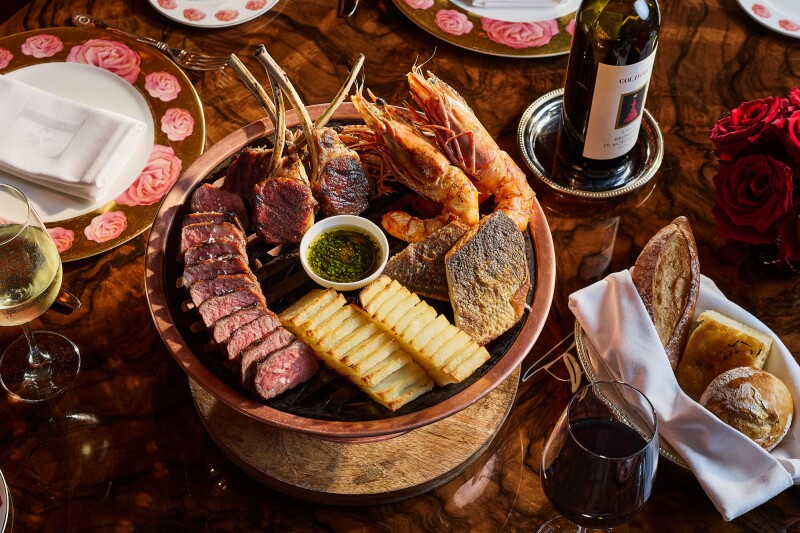
La Boca at Faena New York is led by Argentine chef Francis Mallmann.
Courtesy of Faena New York
The food and drink
Fittingly, given that Faena’s first property opened in Buenos Aires, the New York hotel tapped Argentine chef Francis Mallmann for the fire- and smoke-inspired La Boca restaurant—if only it lived up to his stellar reputation (or the prices, which are best described as ambitious). The $32 bluefin tuna crudo appetizer was passable but overpowered with aioli, while the $95 “thick milanesa” looked and tasted more like a country-fried steak at Cracker Barrel than a dish at a tony dining room. Breakfast fared no better: Gramajo eggs ($22) arrived as an overcooked omelet with chunks of deli ham and scattered with cold shoestring fries.
In fact, the biggest upside to the restaurant had nothing to do with the food. On a Sunday night, the Moulin Rouge-in-Manhattan space was thrumming with dressed-to-the-nines diners, including several women in full-length gowns who brought real energy to the room. Skip dinner and stop in for a drink to soak up the scene—and admire your fellow diners’ glam—or head upstairs to the atmospheric, leopard print-heavy Living Room lounge. Kudos to the bar for offering guests a welcome drink that comes either with or without alcohol.
Staff and service
Staffing is plentiful: Door folks and several team members are ready to assist at the smallish reception desk. (Shout-out to the men’s natty cherry-red suits, which exude panache and make up somewhat for those strange ringmaster uniforms.) Service is brisk, bright, and willing, with a butler ready on command via WhatsApp, whether to bring ice or press a garment for you. Responses were quick and efficient throughout.
Accessibility options
Among the 120 accommodations (40 suites and 80 rooms), 18 are ADA-compliant, including one of the rooms in the three-bedroom, signature Faena Suite. The design is subtly adapted with brushed metal handles for safety and an oversize, wheelchair-friendly wet room.

Faena is known for its statement-making art, including this Keith Haring work in NYC.
Courtesy of Faena New York
Art and spectacle
While wandering the second floor, you may spot a large Keith Haring mural in the corridor, installed behind protective glass—the largest work by the artist not housed in a museum. It’s a flex typical of Alan Faena’s properties; one of his partners is art collector Len Blavatnik, who also supplied the Miami Beach hotel’s gilded mammoth sculpture Gone But Not Forgotten, by Damien Hirst. Elsewhere, a deconstructed disco ball by conceptual artist Sebastian Errazuriz adds to the hotel’s dramatic flair.
Still to come
Faena New York’s rooms opened in September 2025, but several major components of the property are still on the way. A 17,000-square-foot Tierra Santa wellness space and a permanent fitness center with a hammam and five specialized plunge pools are slated to open in the basement in spring 2026, Meanwhile, a theater, overlooking 10th Avenue, is expected to open its doors as early as this winter for live entertainment ranging from cabaret to jazz. The most exciting soon-to-debut amenity is El Secreto, a speakeasy-style drinking den that promises to be one of the hotel’s most seductive late-night draws.
The hotel is already an alluring place to spend an evening, but for the full experience, consider waiting until the performance space and oversize spa are operational—just remember to pack a bikini or two.
Afar was a guest of Faena New York. Our coverage is independent; the hotel did not review or approve this story.


