

My neighbors are professional vaudevillians. I contend daily with horse-drawn-carriage traffic. My house is haunted. You guessed it. I reside in New Orleans.
Specifically, I live in the Bywater. After six years of chaotic French Quarter residency, I moved to this quieter, riverside neighborhood. That’s not to say it’s less colorful. In the Bywater, one can shop at Monsters of the Underworld, a costumery that makes wearable puppets and handsewn fashions. You could peruse opulent European furnishings and decor at Lucullus Antiques. Or get a day pass and a towel for a backyard swim at the Country Club, a yellow mansion offering wild weekend drag brunches and Creole Southern fare.
That’s only one part of the city. The Treme is America’s first African American neighborhood and the birthplace of New Orleans sound. The Marigny is home to an abundance of 1800s cottage architecture, and in the Garden District, there are more than 900 designated historic structures.
New Orleans is like no other American city, and a few words of wisdom will help you enjoy it more.
Our summers are hot, our winters wet. And we have different high seasons than other cities, thanks to our events. Easter, Jazz Fest, Mardi Gras, and Halloween are boisterous times of year and not the best opportunities to delve deep. Visit in sleepier months, like November or directly after Mardi Gras, when hotels and restaurants offer discounts.
New Orleans is very easy to navigate. You’ll need 15 minutes by rideshare to cross the entire town. Want a more leisurely, romantic pace? Take our storied streetcars, a pedicab, or go on foot. Blue Bike stations are common in tourist areas, too, and it’s very flat here. As with many big cities, it’s best to follow big city rules, like walking in groups, taking rideshares or pedicabs late at night—and always being vigilant of your belongings in high-traffic areas, like Bourbon Street. Here’s how to partake in everything appealing about New Orleans without the crowds.

The French Quarter in the morning is less hectic and a good time to check out French Truck Coffee on Chartres Street.
Photo by Caleb George/Unsplash (L); photo by William A. Morgan/Shutterstock (R)
Experience the French Quarter . . . the right way
It’s one of the most striking neighborhoods in the country, with 300-year-old architecture and gas-lantern ambience. The French Quarter remains a worthy first stop—particularly if you approach it correctly. It has a late-bedtime reputation, so use that to your advantage. Explore in the first golden hours, when the streets are wet and shining from the street cleaning trucks, birds swoop merrily over peeling roof dormers, and colorful houses are bathed in that timeless, sepia hue.
Forgo the obvious
Instead of the famous Café du Monde, where lines for a coffee and beignets can stretch an hour, head to French Truck on Chartres Street. The New Orleans Iced is a town cult classic, with coffee, milk, and chicory, shaken and strained over crushed ice. It goes perfectly with the bacon, egg, and cheese biscuits.
Skip the French Quarter’s busy western half, and seek the residential blocks between Ursulines and Esplanade, from North Rampart to Decatur. Here, Creole cottages and striking townhouses are strung like pastel pearls down shady, tree-lined streets, with gas lanterns flickering and side yards neatly maintained.
Heed the advice of full-time residents
Ashley Porter owns Porter Lyons—a Royal Street fine jeweler with inventive designs and ethically sourced stones. She loves the tiny spots, like the cocktail-and-oyster-focused Fives. “It feels like I’m stepping back into Paris, circa 1920,” she says of the petite raw bar and craft cocktail emporium near Jackson Square. Manolito is another she names. The famously cramped space serves “the city’s best Cubano and gorgeous, frozen cocktails.”
It’s rare to grow up in the French Quarter, but Katy Casbarian loved the experience. So much so, she still lives on one of the neighborhood’s busiest corners, at Bourbon and Bienville, right above her family’s restaurant, Arnaud’s. She and her brother are fourth-generation owners of this haute Creole establishment that first opened in 1918. It’s one of the largest restaurants in the country, capable of seating 1,100 guests, via 17 opulent dining rooms. A perennial draw for visitors, Arnaud’s remains a local favorite thanks to its exquisite hospitality and beloved classics.
For Casbarian, the French Quarter’s charms remain ever vibrant. “We walk outside our front door and are embraced by the most beautiful architecture, the sweetest music, and the world’s best restaurants,” she says. “Grocery shopping isn’t so easy, but we have our perks, like strolling over to Cane & Table for bites and cocktails, then ending the evening with drinks at the Carousel Bar.”

The Botanical Garden, which dates back to 1936, houses 2,000 plants across 10 acres.
Photo by Rita Harper
Visit the quieter neighborhoods
The city has dozens of historic neighborhoods, destination streets, and micro-neighborhoods, each bringing exclusive highlights and singular character.
After the French Quarter head to Algiers Point
Directly across the Mississippi River, Algiers Point is a suburb that feels like a small, historic town. Jean-Baptiste Le Moyne de Bienville—the founder of New Orleans—owned the land and it’s now the second-oldest neighborhood in the city.
The ferry from the French Quarter takes 30 minutes. Disembark and admire Jazz Hall of Fame statues of city musicians. Snag a latte at Congregation Coffee and a cold beer at the ramshackle Old Point Bar. Algiers offers numerous global flavor options, such as Plume, an inventive, spicy Indian spot serving Fish Thali done Southern style, using fried catfish. At Nighthawk Napoletana, opened in 2023, the gooey, Naples-worthy pizzas come crust-charred with tart red sauce.
Belly full, bed down at the House of the Rising Sun, a pink bed-and-breakfast in a shotgun-double house, with a white picket fence and double porches.
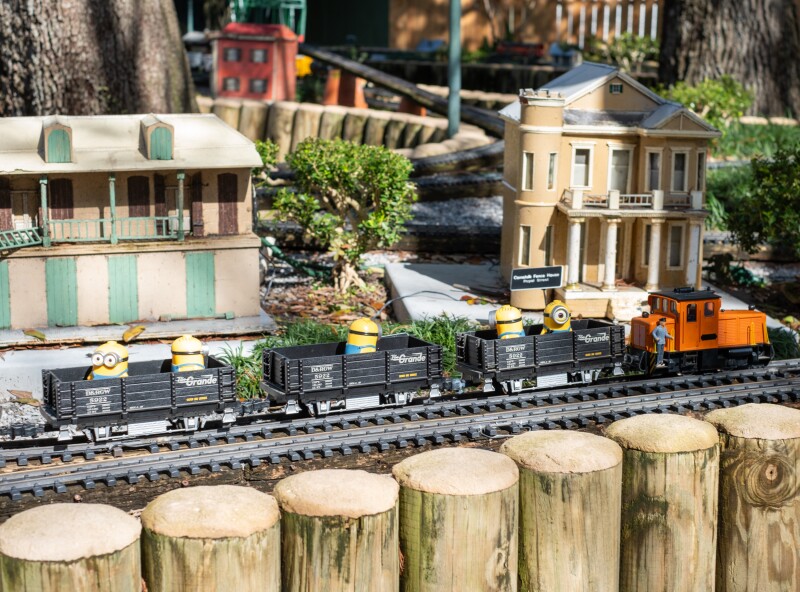
The Train Garden displays replica models of the trains and streetcars that used to run through the city in the late 1800s and early 1900s.
Photo by Rita Harper
Skip the Lower Garden District for Bayou St. John
If New Orleans were The Breakfast Club, the French Quarter would be Judd Nelson, and Bayou St. John would be Emilio Estevez. There’s an athletic, outdoorsy vibe and an actual bayou running though the latter district, which you can tour by kayak, paddling past sites like the Old Spanish Custom House, built in 1784. This micro-neighborhood within Mid-City also offers the three-mile Lafitte Greenway and City Park, which is twice the size of Central Park in New York City. In the back of City Park’s Botanical Garden is my favorite gem: the Train Garden. Along 1,300 feet of track, vintage trains chug past mini replicas of famous city buildings.
Refueling in this ’hood is a delicious endeavor. Bayou Beer Garden is a dog-friendly, indoor-outdoor venue with Old World wine lists and live music. For authentic European gelato, the Angelo Brocato parlor has scooped for over a century, and Lola’s plates excellent Spanish recipes, from Caldereta lamb stew to seafood paella.
Shop the Bywater instead of Magazine Street
Magazine Street is one of the country’s longest stretches of retail, with six miles of shops, cafés, galleries, and hotels. It’s certainly a fabulous corridor to stroll. However, the shopping in the Bywater neighborhood provides more local vibes down winding pathways, river view access, plenty of nourishment, and a slice of everyday life in this town.
Start at the train tracks on Homer Plessy––named for the Black activist––where you can gaze upon towering murals at StudioBE. Created and founded in 2016 by prolific street artist Brandan “BMike” Odums, this art museum, event space, and nonprofit is home to dozens of enormous murals depicting moments in the Black experience.
Walk down Dauphine Street, past colorful cottages and striking Greek revival homes, to the corner of Piety if you want po’boy sandwiches (Frady’s One Stop), a variety of syrup-flavored shaved ice snowcones (Chance in Hell Snoballs), or funky retail options. Here you’ll find the aforementioned Monsters of the Underworld store and also Just Like Heaven. This quirky, brightly painted little shop has a wonderous mix of vintage glassware, handmade fashions, ’80s nostalgia, and bric-a-brac. Other standout shopping options in the Bywater include Lucullus for antiques, Tiger Rag Vintage for secondhand apparel, and Euclid Records for vinyl pressings.

Floor13’s motto is “Keep good furniture in service, not in the trash.”
Photos by Rita Harper
Consider lesser-known alternatives
Instead of the biggest tourist attractions, head to equivalent (but smaller) museums, shops, and points of culture.
Antiques
This city is fabulous for shopping, particularly for antiques and flea-market scores. The suburb of Metairie is excellent for authentic, Old World items. Only 15 minutes from downtown, Renaissance Interiors is a consignment emporium of estate pieces, from midcentury coffee tables to sterling silver. Ten minutes away, in the Jefferson suburb, Dop Antiques is a 20,000-square-foot, open warehouse for European antiques. New containers arrive monthly, and the staff is always happy to haggle. Floor13 is for funkier finds. This colorful Mid-City warehouse has curated, shoppable vignettes and everything you never knew you needed—coonskin caps to old chess boards, tiki barware to Elvis ashtrays.
Museums
Of course, the New Orleans Museum of Art, notably its scuplture garden, and the World War II Museum are invaluable stops, the latter especially, which debuted the Liberation Pavilion in 2023, exploring the postwar years.
Beyond the big stops, the city’s smaller museums offer more curated education. Le Musée de f.p.c., in the Treme neighborhood, showcases the story of the 1,800 free people of color who resided here prior to the Civil War, through architecture, oral histories, and art.
I love the New Canal Lighthouse. It’s a five-minute car ride from City Park. The museum is a rebuilt, 1839 lighthouse, right on the edge of Lake Pontchartrain. Tours blend history with science, and tickets support the nonprofit Pontchartrain Conservancy. Climb the lighthouse stairs to learn about Madge Norvell, the last keeper, who rowed out to save a downed Navy pilot.
About 20 minutes from downtown by car in St. Bernard Parish is the Los Isleños museum, a historic village of preserved houses, formerly home to influential Canary Islanders, who immigrated in the 1700s. It’s a cool opportunity to see early construction styles, including the Estopinal House, from 1790. The walls showcase moss and mud, layered between wooden support posts.

New Orleans’s cemeteries can draw crowds—skip the busy favorites in favor of some quieter alternatives for a more respectful visit.
Photos by Jenny Adams
Cemeteries
The St. Louis Cemetery No. 1 and the Lafayette Cemetery No. 1 are our most famous burial grounds, frequently featured in movies and novels. Heavy crowds can feel almost grotesque in high season. St. Louis No. 1 also now requires a tour guide booked in advance.
St. Louis No. 3 is better. Adjacent to City Park, noteworthy citizens buried here include architect James Gallier, New Orleans chef Leah Chase, and Storyville photographer E.J. Bellocq.
Speaking of photography, I recommend a 7 a.m. visit to St. Vincent de Paul Cemetery for capturing mausoleums in that golden morning light. It’s just north of the Bywater, and purportedly, a dog ghost haunts the rows.
Theaters
Did you know that New Orleans was the first city in America to have a motion picture house? The Vitascope opened in 1896 on Canal Street. Pictures were a dime, seen from church pews. Today, all that’s left of the Vitascope is a plaque, but the century-old Prytania Theatre in Uptown is another historic theater, fantastic for a modern flick.
At the Broad, in Mid-City, arrive early for your movie, because the front bar is prime for cocktails and snacks. The adjacent event-space concept, Broadside, hosts live music, brewery tastings, comedy shows, and fundraisers frequently, in an indoor-outdoor space.

Forget the neon slushies of Bourbon Street and discover some really nice wines at Really Really Nice Wines.
Photo by Madeline Rose
Ask a local for the best food recommendations
Lean over to the next table at the coffee shop, ask a cab driver, or seek out someone in service. Chatting with locals will always lead you to tasty fare and cool dining experiences. These are a few of my favorite places currently:
The best burger
Slap Burger, hidden in the back of a dive bar called Marie’s, is in the Marigny neighborhood. It’s a hangover-annihilating, greasy delight, with American cheese, pickles, chopped onions, and sauce, on a brioche bun. If you’re in town on a Friday, check out the Friday-only pop-up called Burger Church at the Tuff Break Loser’s Lounge. Grab a drink in the bar, then head out back. The yard here has cooks grilling incredible smash burgers with all the toppings, and it has an open policy for dogs off leash.
The best dinner experience
Portuguese food is seeing a moment in New Orleans, and 34 Restaurant & Bar—the newest concept by Emeril “Needs No Introduction” Lagasse—would feel right at home in Lisbon. The celebrity chef celebrates his maternal heritage in dishes like Piri Piri chicken, Pork & Clams, and Shrimp San Miguel, in a space that mixes lounge-style seating, ceramic tiles, and an open-kitchen show.
The best pop-up
At Really Really Nice Wines, a bottle shop and bar that opened in 2023, stop by for a glass of natural wine, but also visit for dinner and art. The owners brought in chef Luci Winsberg, formerly of Zasu, who is plating seasonally driven dishes like anchovies on toast, white beans with grilled artichokes, and oysters from small farms in Grand Isle. The shop also hosts a series of events based around crafting your own creation. From wreath classes to building terrariums, the craft nights allow you to work on pieces guided by professionals, while sipping tasty vintages.
The perfect drink
Jungle Bird—a classic tiki drink from the ’70s, featuring a bold, beautifully bizarre combination of Campari and dark rum—had nearly faded into oblivion. That is, until the late 2000s, when NOLA’s foremost tiki expert, author and historian Jeff “Beachbum” Berry, began slinging it and singing its praises. Berry now owns Latitude 29, in the French Quarter, and it’s widely regarded as one of the best modern tiki bars anywhere.

The Columns Hotel, housed in a historic building, is small enough to feel intimate but uncrowded.
Photo by Yoshihiro Makino
Stay beyond the fray
While the French Quarter is lovely to visit and a wild place to party, stay in quieter zones for a more neighborhood glimpse of everyday New Orleans’s life.
The best modern hotel: Hotel Saint Vincent
Try Hotel Saint Vincent, in the Lower Garden District. Steps away from the home of actor Jennifer Coolidge (yes, she resides here) and around the corner from appealing shops, this hotel is perfectly situated for retail therapy or the ultimate relaxing. You won’t want to leave the property: Perks including a swimming pool, fine-dining Amalfi classics at San Lorenzo, and a Vietnamese café with inventive breakfast pastries.
Old World digs: the Columns
Consider the Columns, a stately, Thomas Sully mansion built in the 1800s. Surrounded by towering live oak trees and set back from the street, with a huge front garden and grand porch, it feels tucked away. While it is fairly well known, the handful of rooms keep it intimate. The hotel welcomes you with a dark, saloon-style lobby bar, art-filled parlors, vintage beds, antique armoires, and balconies overlooking the St. Charles streetcar line in the Milan neighborhood.
This article was originally published in 2024 and most recently updated on January 7, 2026, with current information.


