
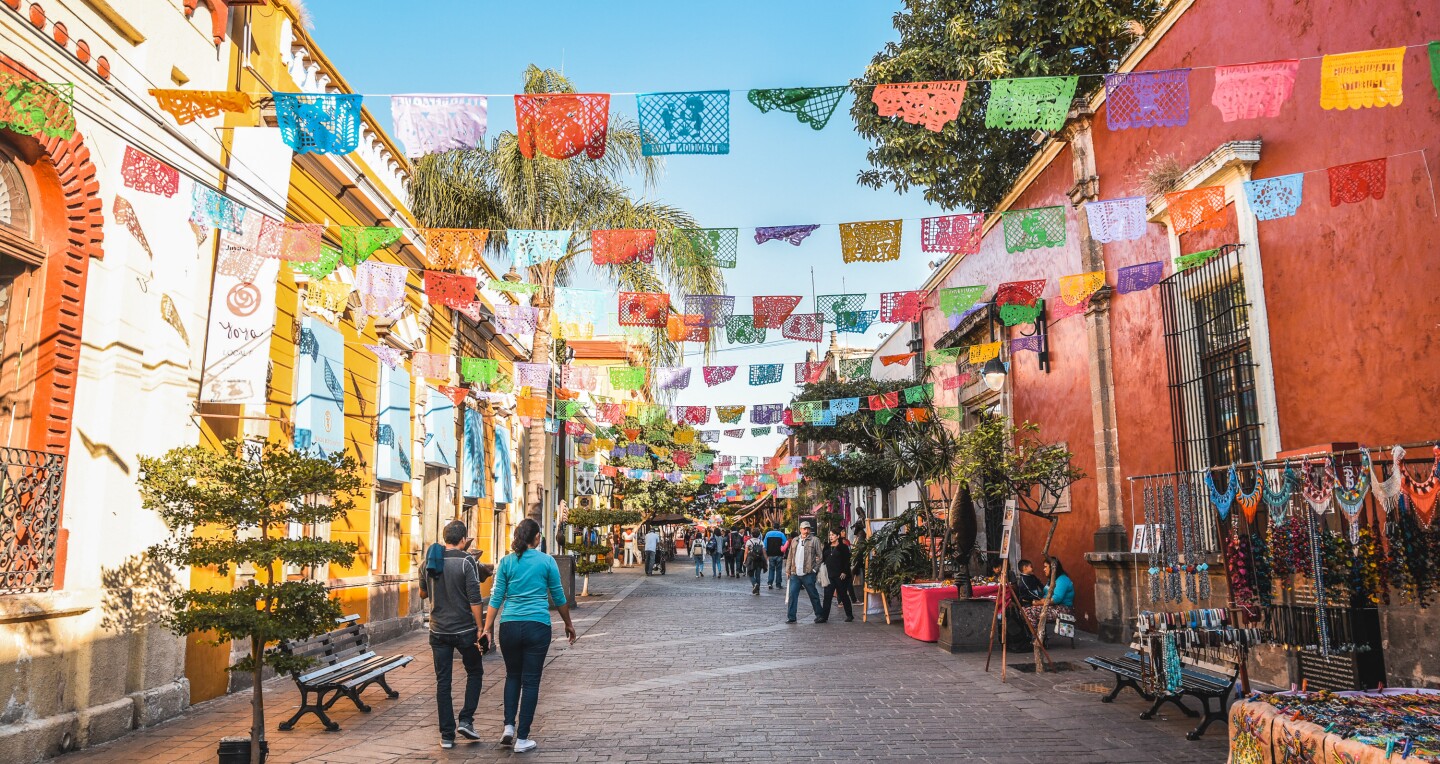
When’s the best time to go to Guadalajara?
While the weather in Guadalajara is more or less temperate year-round, it’s at its best from October through May. The rainy season runs from June through September, which is also the time of year when temperatures are highest. If it’s affordability you’re seeking, visit from January through May, when hotel prices typically decrease. The fall and early winter are high season, boasting dry weather and a full calendar of festivals, like September’s Mariachi Festival and the Guadalajara International Book Fair (the second largest in the world). Come in March for the Guadalajara International Film Festival (the most prestigious in Latin America), or in April for Roxy Festival, an alternative outdoor concert.
How to get around Guadalajara
Fly into Libertador Miguel Hidalgo International Airport, which is served by major airlines like Alaska, American, Copa, Delta, and United as well as Mexico’s main domestic carriers (AeroMexico, Volaris, Interjet, and VivaAerobus). From the airport, you can take a taxi, rent a car, rely on your hotel’s airport shuttle, or take advantage of the bus that stops at the bottom of Terminal 1 and goes to the Central Camionera Vieja near the historic city center.
Once in the city, the Centro (or downtown) is accessible by walking or Mibici, the city’s public bike system that runs until midnight. Taxis or Ubers are another easy option if your legs get tired. For trips farther from the center, public transport is relatively straightforward—the city has just two metro lines that join at the western side of the historic center, one that travels north-south and the other running east. The public bus system is more extensive, with dozens of routes and options ranging from regular buses that cost 6 pesos, to luxury buses for around 10 pesos.
Can’t miss things to do in Guadalajara
No trip to Guadalajara is complete without tequila, mariachi, art, architecture, and delicious food. A day trip to the town of Tequila to visit local distilleries is easy to arrange. You may also want to experience the slightly out-of-the-way Tlaquepaque, an artisan area full of incredible handmade pottery and other souvenirs. When you’re done shopping, stop by El Parían in the main plaza to enjoy live mariachi music and some cazuela, a local citrus-tequila punch served in a handmade clay bowl.
Within the city proper, start at the Centro Historico and walk around the beautiful plazas, where you’ll see buildings dating back to the Mexican Revolution. From there, you can visit the Hospicio Cabañas, an old hospital complex built at the start of the 19th century that features an incredible selection of murals by Jose Clemente Orozco. Art and architecture buffs should also check out Hotel Demetria, a boutique hotel in the charming neighborhood of Colonia Lafayette that’s flanked by two beautifully preserved pieces of Mexican modernist architecture—a 1929 home by Pritzker prizewinner Luis Barragán that now houses modern art gallery Travesía Cuatro, and Casa Quiñones, designed by Barragán’s contemporary and close friend Pedro Castellanos.
Finally, you’ll want to hit Mercado Libertad, one of Latin America’s largest indoor markets. Even if you’re not interested in buying any of the fresh produce, handicrafts, or home items on offer, you’ll be impressed by the market’s sheer scale, colors, and culture.
Food and drink to try in Guadalajara
Foodies who flock to Mexico City would be remiss to not also explore Guadalajara’s rich culinary culture. Here, Aztec roots result in regional stews and a bevy of protein-rich bug snacks, found in both local markets and fine-dining restaurants. Be sure to also try Guadalajara’s signature dish—the torta ahogada, or drowned sandwich, which features a dense, yeasted roll filled with carnitas and dunked in spicy salsa. Other local delicacies include pozole, birria, and cazuela, a citrus punch served in wide-mouthed clay bowls. If you’re thirsting for something stronger, the town of Tequila is just a bus ride away.
Culture in Guadalajara
Jalisco’s capital is a city of contrasts. The birthplace of time-honored customs like mariachi music and the rodeo, Guadalajara and its surrounding towns (like nearby Tequila, where you can tour distilleries for a song) are steeped in tradition. At the same time, the city is home to a cutting-edge cultural scene, with modernist architecture, trendy art galleries, and restaurants like the whitewashed Hueso (decorated entirely with animal bones) continually making waves. Everything comes together at places like the Hospicio Cabañas, a 19th century hospice complex and UNESCO World Heritage site that hosts rotating art exhibitions.
For Families
Guadalajara is a very safe, walkable city. Its manageable size and host of kid-friendly activities make it perfect for a family visit. Local destinations like the Guadalajara Zoo, Globo Museo del Niño, and Trompo Magic Museum are specifically geared toward children. For a beautiful—and free—way to explore nature within the city, visit the Bosque Colomos, a park with lakes, pine forests, and a traditional Mexican garden, where you can hire trained horses to traverse the terrain.
If you want to take a trip out of town, Tlaquepaque offers glassblowing workshops that are suitable for older children. Lake Chapala is home to various water activities, while the circular, grass-covered pyramid of Guachimontones is a great place to learn about ancient Mesoamerican culture.
Local travel tips for Guadalajara
Lula Bistro chef Darren Walsh, who has lived in Guadalajara for nine years, says “One of the best ways to experience a destination is through its food, and Guadalajara is no exception. Everywhere from the markets of Mercado Libertad (a.k.a. Mercado de San Juan de Dios) to the fine-dining restaurants, Guadalajara offers delectable regional cuisine. Typical dishes include tortas ahogadas, birria, carne en su jugo, and pozole Jalisco-style. I live with my wife and two girls in Providencia, which has an amazing restaurant and nightlife scene. The bars and restaurants are all in walking distance of one another. But most Tapatíos will say that the famed Chapultepec Avenue is best.”
Local Resources
Check out the “Expat Living” section of local English-language paper The Guadalajara Reporter for upcoming events.
A bit like a Spanish-language version of Time Out, GuadalajaraMiDestino.com features roundups of food trucks, places to go with kids, and more, as well as an extensive list of local concerts and cultural happenings.
The Jalisco Ministry of Culture’s website has a sidebar events calendar with information on art exhibits, dance performances, and more throughout the state.
Practical Information
The weather in Guadalajara is fairly temperate year-round but temperatures are highest during the rainy season from June through September. Visas are not required for tourist or business visits up to 180 days for citizens of the U.S., E.U., Canada, Australia, and 61 other countries. All flights land at Libertador Miguel Hidalgo International Airport (IATA: GDL). The public bus system is extensive, but Uber and bike sharing are the most convenient ways to get around. The language is Spanish; the currency is the Mexican peso. It’s standard to tip 15 percent in restaurants but you need to add it before you sign your receipt—when you hand your credit card to your waiter, say “con quince” (meaning “with fifteen”) and they’ll add your tip to the bill. Electricity is 127 volts, more or less the same as in the U.S. (120V).
Guide Editor
Allegra Ben-Amotz is a writer, editor, and amateur chef living in Mexico City. Her writing has appeared in The Wall Street Journal, Afar, New York magazine, Cherry Bombe, Roads & Kingdoms, Serious Eats, and more.


