
Limited flights resumed from major airport hubs in the Middle East late Monday following a chaotic weekend that left hundreds of thousands of travelers stranded as airports and airspace were shuttered due to military strikes across the region.
As some service returned, the State Department on Monday urged Americans to “DEPART NOW” from 14 countries in the Middle East, including the UAE, Saudi Arabia, Egypt, Jordan, Israel, Kuwait, Oman, and Qatar “using available commercial transportation, due to serious safety risks,” according to a post on X from the assistant secretary of State for consular affairs Mora Namdar.
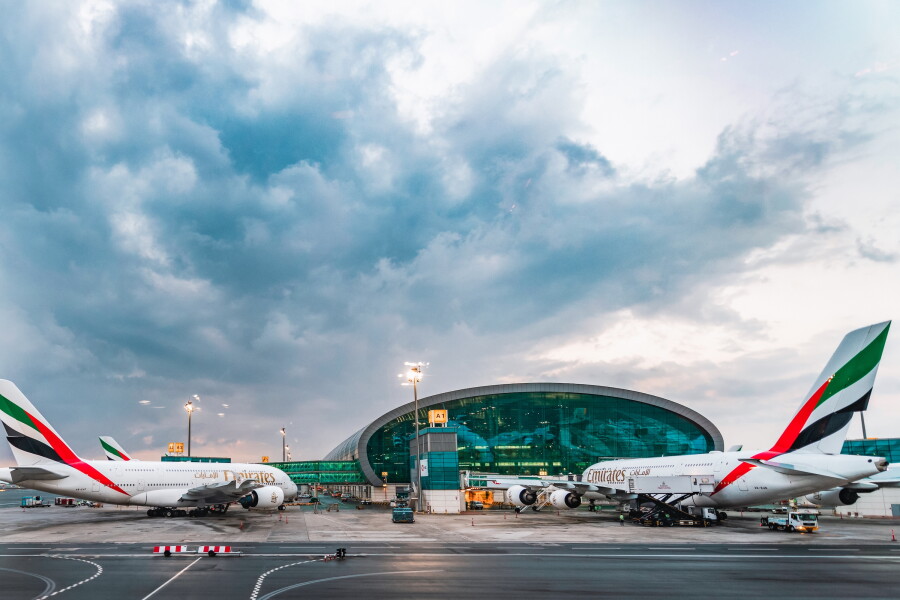
Emirates—one of the largest airlines in the Middle East and a flag carrier of the United Arab Emirates (UAE)—said on its website that it had received permission to resume some flights from Dubai, the world’s busiest airport for international travelers. The budget carrier FlyDubai was also operating a few flights Monday night.
The New York Times reported some flights had also resumed at Zayed International Airport, another major UAE hub in Abu Dhabi, although the airport’s website simply instructed travelers to check with their airlines. In Doha, Qatar, Hamad International Airport said in a statement on Monday that flight operations remained suspended.
According to the flight-tracking service Cirium, more than 12,000 flights to and from destinations throughout the Middle East—including Israel, the UAE, Saudia Arabia, Kuwait, Oman, Bahrain, Iraq and Iran—had been canceled as of Monday. The cancellations occurred as Iran continued retaliatory strikes in the region in response to the United States’ and Israel’s attacks on Saturday, when Iran’s Supreme Leader Ayatollah Ali Khamenei was killed.
As Emirates began flying again, it said it would give priority to passengers with existing reservations. It also said only travelers who had been notified should come to the airport.
The resumption of some flights came after a weekend that saw strikes from Iran spread beyond U.S. and Israeli military installations. Two luxury hotels in Dubai were reportedly hit by retaliatory strikes. According to news reports from the region, a fire broke out at Fairmont The Palm, injuring four people. Additionally, debris from a drone strike hit the iconic hotel Jumeirah Burj Al Arab.
Reports said one person was killed and four injured in a drone strike on Abu Dhabi’s Zayed International Airport, and seven more were injured in a strike on the Dubai International Airport, according to the Associated Press. Kuwait’s airport was also targeted.
Due to the limited number of available commercial flights, the U.S. and other nations in Western Europe and beyond have begun repatriation flights for stranded citizens. According to Reuters, the first repatriation flights to the U.K., France, and New Zealand were slated to depart on Wednesday, while The New York Times reported that the U.S. State Department said it was “facilitating charter flights from the United Arab Emirates, Saudi Arabia, and Jordan for American citizens, and will continue to secure additional capacity as security conditions allow.”
Strife in the Middle East will have ripple effects on global travel
The massive flight disruptions “will be felt across all six populated continents,” said Henry Harteveldt, an airline industry analyst and president of Atmosphere Research Group, told Afar.
“Etihad, Emirates, and Qatar Airways connect their home hub airports with hundreds of destinations around the world,” Harteveldt said. He added, “Emirates, the largest of the three, operates the largest international hub of any airline. The suspension of airline service at Abu Dhabi, Doha, and Dubai will not only disrupt travel to and from those cities, but will make it difficult for people in North America to travel to and from the Indian subcontinent, Africa, and Asia/Pacific. It will also disrupt travel for people living in those regions to Europe and the Americas.”
Flights that cross over the region could also be affected if rerouting to avoid closed airspace adds too much time to the journey, Harteveldt said. Having to reroute could result in the flight going beyond a plane’s maximum range, which could force refueling stops and crew changes that could make a flight impractical and/or too expensive to operate.
According to a report from the Dubai news radio station Dubai Eye, the UAE’s General Civil Aviation Authority was working to provide temporary accommodations and meals to stranded passengers. The report said that more than 20,000 travelers had been helped and that the agency would cover all the expenses. That’s good news for fliers since traditional flight travel insurance—except for Cancel for Any Reason policies—generally excludes acts of war. CFAR policies usually require 48 to 72 hours’ notice of trip cancellation.
The U.S. State Department on Saturday issued a Worldwide Caution security alert, advising “Americans worldwide to exercise increased caution” and noting that U.S citizens “may experience travel disruptions due to periodic airspace closures.” The State Department recommends that U.S. travelers follow the alerts and guidance issued by the U.S. embassies or consulates in the countries in which they are traveling.
Even domestic travelers could see delays and ripple effects due to the upheaval in the Middle East.
“Passengers should be prepared for heightened airport security, even if they have TSA PreCheck, for the next few days,” Harteveldt said. “That’s fairly typical when military attacks occur. TSA screening officers—who, by the way, aren’t being paid right now due to the funding dispute about DHS’s budget—may scrutinize your luggage more thoroughly as it goes through the screening machines. Sensitivity levels on metal detectors may also be elevated.”
He advised travelers to give themselves extra time to go through security, and to help the TSA by packing neatly and avoiding overpacking carry-on and personal items.
Harteveldt also warned that if the bombing continues, “there is also a risk that there could be attacks by groups sympathetic to the Iranian government in cities outside the Middle East, which may cause problems for people traveling to or through those cities.”
“Travelers need to be prepared for nearly everything to go sideways,” he said.
This story was originally published on March 1, 2026, and was updated on March 2, 2026, to include current information.


